

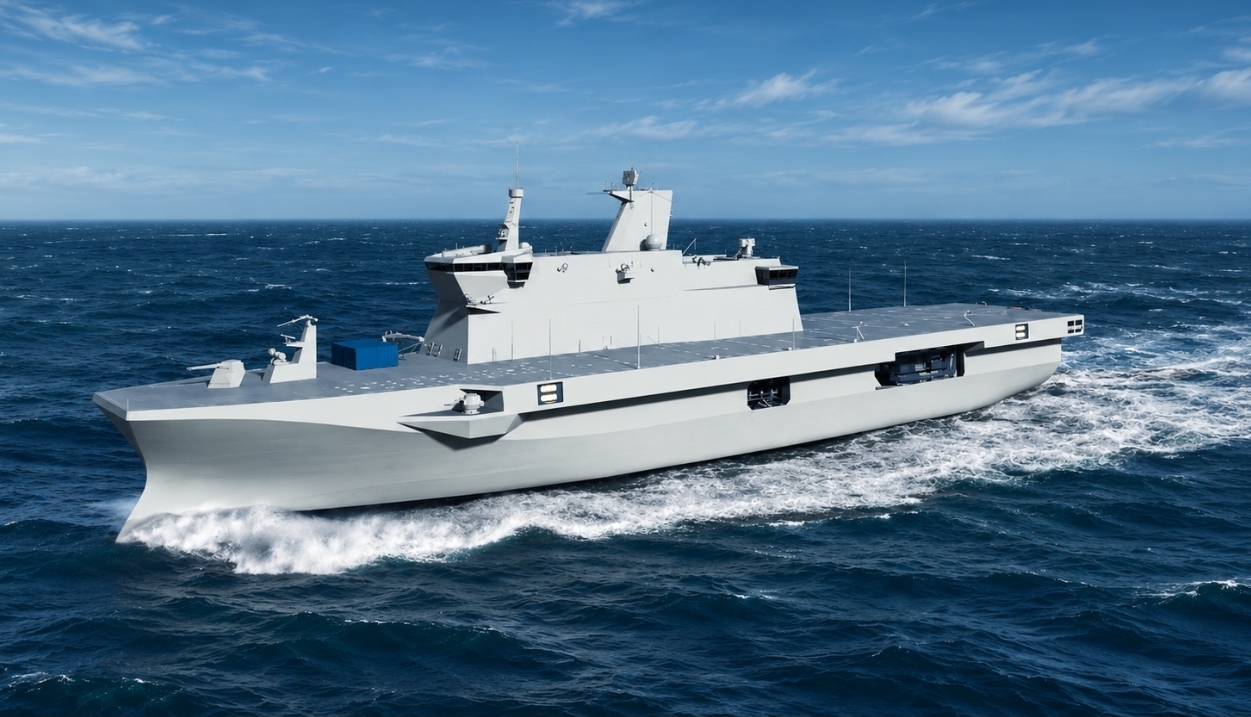
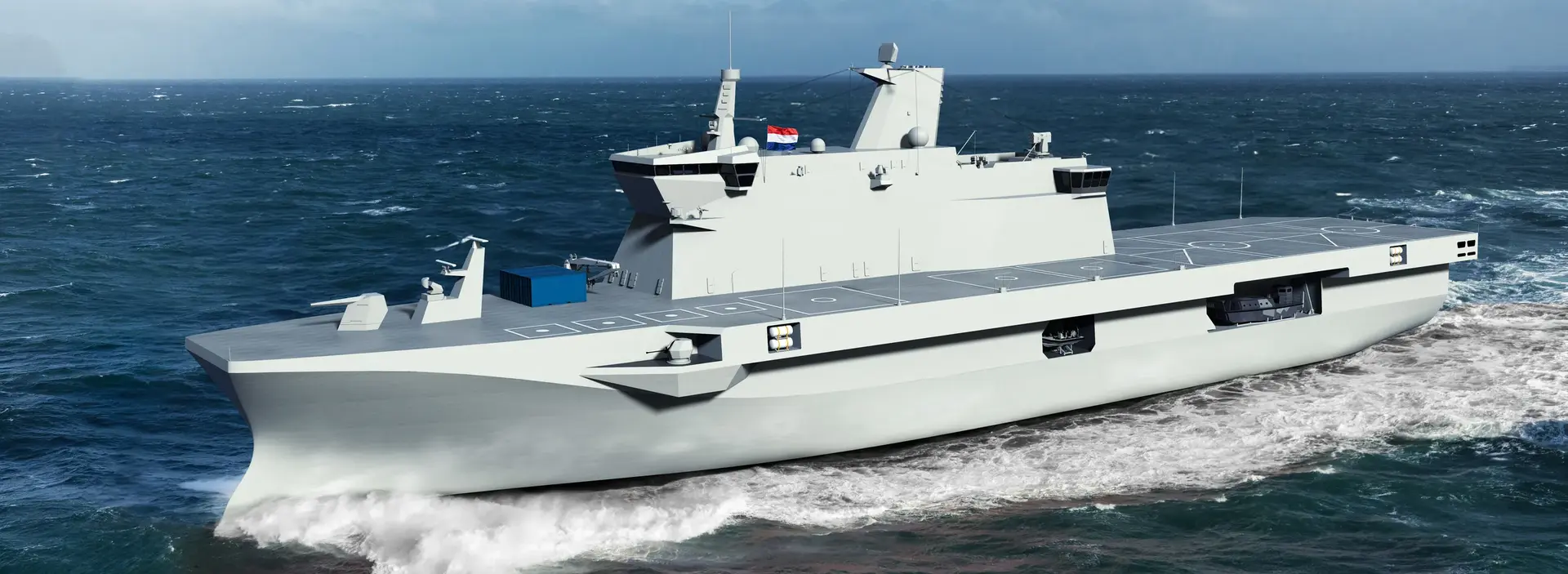
The design of the Royal Netherlands Navy’s new Amphibious Transport Ship has been unveiled at the NEDS 2026 naval exhibition, as Damen Naval and electrical integrator Alewijnse agreed to work more closely on the programme, according to Damen.
The ships will replace the Dutch landing platform docks HNLMS Rotterdam and HNLMS Johan de Witt, and Britain agreed in July to operate four of the same type as part of a joint eight-ship programme. Alewijnse will be responsible for integrating and installing all electrical systems on board, and the two companies formalised plans at the show to work together on future defence projects.
Roland Briene, Managing Director of Damen Naval, said: “In our role as designer, builder and integrator of complex naval vessels, we work closely with the Dutch maritime manufacturing industry. Alewijnse is one of the companies with which we have collaborated for many years and on many vessels. Strengthening our cooperation is an important next step that helps ensure the continuity of naval shipbuilding programmes and enables new vessels to become operational as quickly as possible.”
Gert Bravenboer, CEO of Alewijnse, said: “Our strength lies not only in what we can achieve individually, but especially in what we can accomplish together. We are proud to contribute our expertise, capabilities, and teamwork to the delivery of the best naval vessels, thereby supporting the security and future of the Netherlands.”
Prime Ministers Keir Starmer and Rob Jetten signed the UK-Netherlands agreement at the NATO summit in Ankara on 7 July. The government said the ships, worth £2.4 billion in total, would be based on a Dutch design and built in UK shipyards alongside Dutch industry, with each 160 metres long, displacing 15,000 tonnes and carrying troops, vehicles, equipment and drones from a flight deck designed for long-range drones and autonomous systems. The UK Defence Journal reported at the time that the UK committed to new assault ships in a joint effort with the Dutch.
The ships would replace the amphibious capability lost when HMS Albion and HMS Bulwark were retired, and HMS Bulwark is now being prepared at Devonport for transfer to Brazil. No yard has been announced to build the British ships, and Lord Coaker, Minister of State at the Ministry of Defence, listed the UK-Netherlands programme among future shipbuilding opportunities in a parliamentary answer this week.
Balaena Structures has also pitched its yards for the new ships.






Its tiny, can’t we do better than this or is it another case of Navy on the cheap?
4 good sized flight decks is nothing to be sniffed at, especially in today’s current circumstances.
Would bigger ships be better? Obviously, it would’ve been preferable to get something closer to a Mistral, but 4 hulls with decent capability is better than 2 hulls with more capability and a gap in availability.
If the requirement and number can get nailed down and ordered, this is exactly what the RN should be doing; procuring decent platforms in solid numbers to restore a genuine warfighting capability.
Underwhelmed. May as well concede defeat at this point. Looks like a small hanger on the island for a helo. Presumably this means the helicopters will be deployed above either QE or POW.
Could you even operate a Chinook effectively on that?
From Ocean, Albion, Bulwark plus 4 Bays to this.
Managed decline.