

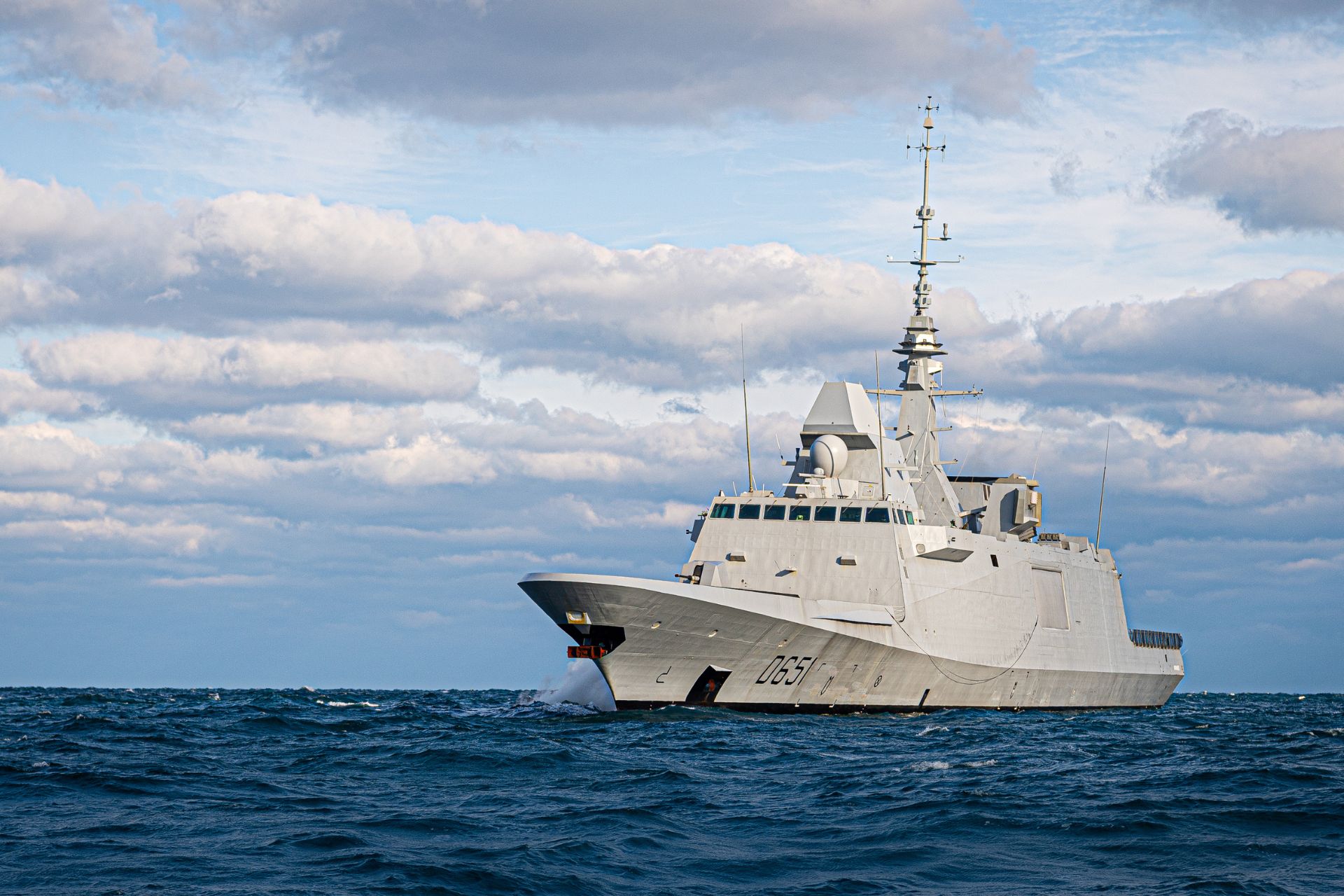
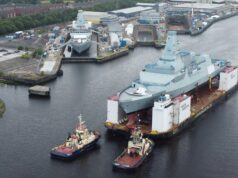
The French Navy frigate Aquitaine is currently inbound to the King George V Dock in Glasgow.
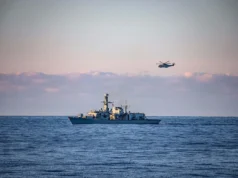
This is a routine visit by one of France’s most modern surface combatants to the west coast of Scotland. The arrival comes as NATO navies continue a steady pattern of port visits and presence operations around the UK, particularly in the North Atlantic and approaches to the GIUK gap. While the visit has attracted attention locally, such movements are not unusual and are typically linked to logistics support, crew rest, liaison activity, or scheduled engagement with British counterparts.
Aquitaine is the lead ship of France’s Aquitaine-class FREMM (Frégate Européenne Multi-Mission) frigates, a class designed for high-end multi-role warfare including anti-submarine operations, air defence, land attack, and surface strike. Commissioned in 2012, the ship displaces around 6,000 tonnes and is widely regarded as one of the most capable anti-submarine frigates in European service.
The FREMM design is optimised for quiet running and long endurance, giving it a significant advantage in submarine-hunting roles. The class operates with advanced sonar systems, embarked helicopters, and modern combat management systems, allowing it to track and prosecute underwater threats in complex maritime environments. France has frequently deployed FREMM frigates on NATO and national operations, including missions in the Mediterranean, Atlantic, and the wider Indo-Pacific.
The vessel is also equipped for wider combat tasks, carrying a modern missile suite and sensors suitable for escorting high-value units such as aircraft carriers or amphibious groups. Aquitaine has previously operated alongside allied navies in major exercises and deployments, including participation in French carrier strike group operations.
King George V Dock, located on the River Clyde near Govan, is a significant commercial maritime facility and has hosted a range of visiting naval vessels over the years. Visiting warships typically berth at such docks due to their deep-water access, secure facilities, and proximity to logistics infrastructure.
The Clyde continues to play an important role in UK naval activity, not only due to its proximity to key naval infrastructure in Scotland, but also because of its strategic position for ships operating into the North Atlantic.
If you’re reporting this elsewhere, please do include a link back to our reporting on this as too often we’ve had instances of content being lifted without attribution.




It’s a real pity the US didn’t just copy one of the ASW FREMM frigates instead of trying to go all gangster and squeeze a destroyers worth of capability onto a 7,000 tonne hull to do AAW and ASW
20 of these would have made all the difference.
The issue is, as we have been discussing on NL, the very different DC standards.
FREMM is nowhere near RN DC standards.
One of the reasons we left HORIZON.
But DC standards can be managed.. just look at the T31 from its original design, very significant increase in damage control standards..but little problem..
The U.S. tried to cram a lot in a 6000 ton frigate hull..
AN/SPY-6(V)3, hardly a light low end radar, full ASW sensor set,
Taking the crew from about 130 to 200
32 MK41 cells vs 32 SYLVER A50 cells.. that’s an extra 8 tons of top weight per cell.. essentially the equivalent of 64 sylver A50 cells
16 deck mounted missiles vs 8
Essentially they doubled the weight of the armaments, but a heavier radar on it, increased to crew by 50% and massively upped the damage control requirements…
Dr Alexander Clarke has a multi hour video on the Constellations; long story short his conclusion is that it’s nothing to do with DC and it’s considerably more complicated. They essentially wanted a River Class Destroyer but native, de-risked, and in service, and couldn’t decide exactly where to draw the line. Despite 2 Constellations being in build, apparently the design is still being changed because the USN is *still* coming up with bright ideas for them.
Sure DC improvements might have been part of the changes, but it’s far from what killed Constellation.
“ 200 32 MK41 cells vs 32 SYLVER A50 cells.. that’s an extra 8 tons of top weight per cell.. essentially the equivalent of 64 sylver A50 cells”
8 tons per cell added top weight cannot be right as a good part of the cell is below the metacentric axis.
I believe they tried to keep the GM low with a light weight superstructure, so you could imagine most of the weight of the MK41 would be above it.
I did read a lovely summary of what killed the design
“Frigates live and die on weight, margins, and metacentric height. The Constellation-Class design has experienced unplanned weight growth, the classic symptom of “just one more” change repeated many times. Extra armor here, cableways there, heavier foundations for a radar face, a thicker bulkhead for shock standards—each justified, all cumulative. Added weight threatens range, speed, seakeeping, and service life (if you burn margins now, you have less left for future upgrades).
The solution isn’t magical; it’s engineering discipline: shave pounds everywhere, re-balance loads, and lock the design so trades don’t creep back in. The good news is that these are solvable problems when a program enforces configuration control. The bad news is they consume time—and time is the one thing this program already spent.”
Well as N-a-B would say on NL and I totally agree that is to do with having a ‘tight group of people who know what they are doing’ who do the bones of the thing and can then Y/N the bright ideas that cause these things.
The tight group who know what they are doing’ will know all the DC standards etc from the off so they can size the hull plus markings appropriately. Really that isn’t that hard to do if you know a few basic equations.
The problem arises once the hull size is set and the ‘realisation’ dawns that various ‘things’ have to be done.
That is hte problem with design by dictat and a whole community rather than a tight steering group.
It does seem as though the USN tried a “bait and switch” trick with the Constellation class, in which they agreed to accept an Americanized FREMM in order to get funding for a new frigate, and then tried to surreptitiously modify it into a new design that was what they actually wanted. As a result, they are now likely to get something less capable, and on a longer timescale.
I feel a bit jealous of the French with these ships, not necessarily the spec but in an alt history and a less useless Blair Brown hatchet job on the UK defences, a similar path would have kept UK hull numbers up now that T23s are starting to fail.
First built 2007, commissioned the first ship in 2012.
No frigates were ordered in the Blair Brown administration. Even if 12 then 8 Type 45s were seen as unaffordable , leaving just 6, there was a gap for a less complex GP version on the same hull, the same way France gap filled the loss of the extra Horizons.
4 or 5 Type X frigates , possible on a cut down Type 45 hull would have filled the Type 22 gap and kept numbers in the low 20s of escorts. (32 was deemed the suitable number previously? )
Instead , Brown gave us carrier delays and an additional wasted £1B.
I mean then we wouldve had to fix 4-5 more ships with PIP though
I’d like to understand what the European battle damage standard isn’t good enough for the US Navy. What are the major differences that caused the Constellation class to be canned?
It wasn’t Damage Control that killed it, that was just part of a massive list of changes that are still ongoing that killed it.