

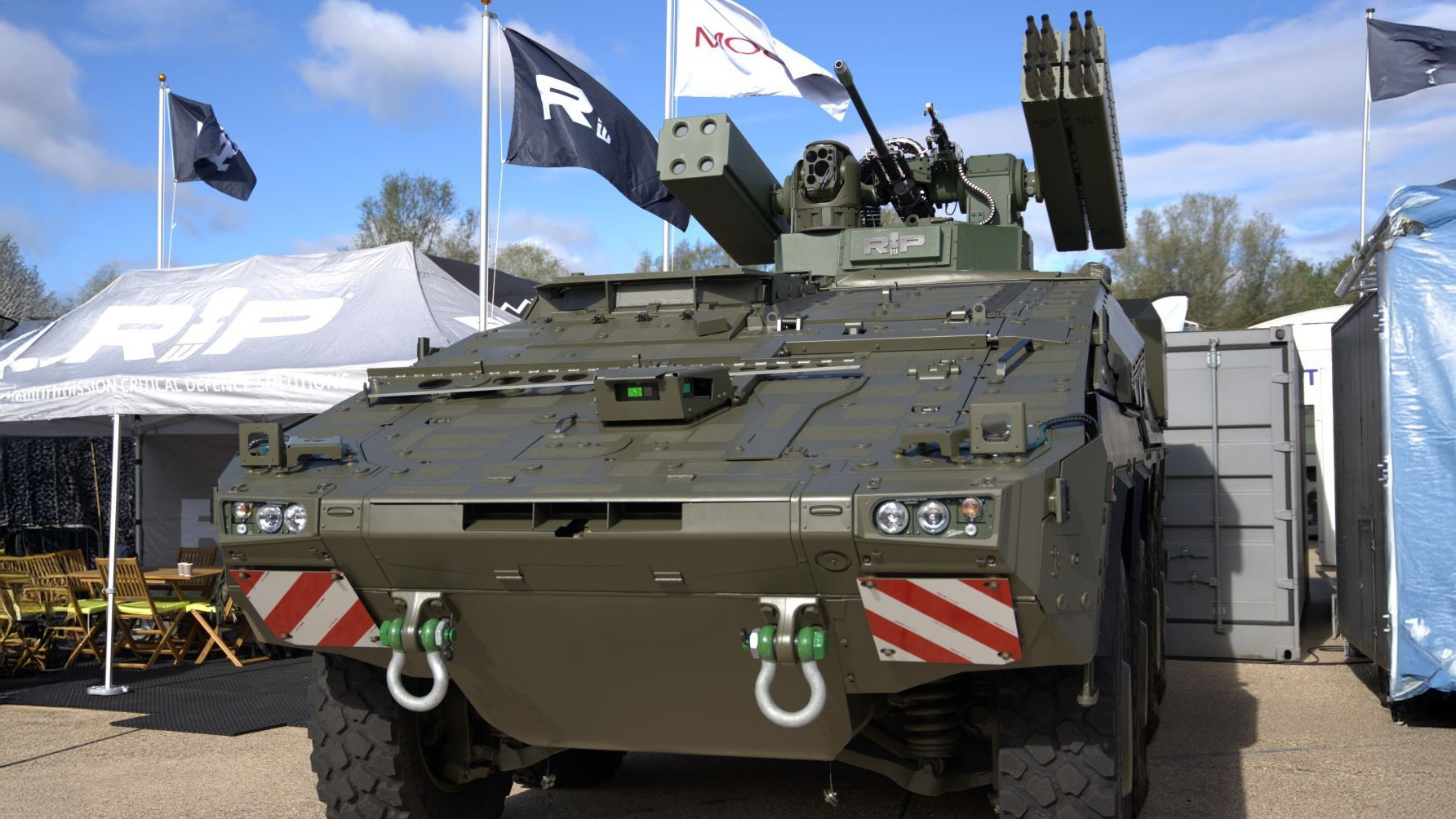
Moog has shown an air defence mission module for the Boxer 8×8 vehicle at Defence Vehicle Dynamics, the first time its Reconfigurable Integrated weapons Platform has been fitted to the wheeled platform, the company stated.
The configuration on display carries the XM914 30x113mm cannon, an M240 7.62mm machine gun, a four-missile canister of Stinger and a sixteen-missile canister of 70mm laser-guided rockets.
According to Moog, the module was brought together in a matter of weeks using British engineers at its own and KNDS’s United Kingdom facilities, and the company has committed to manufacturing the platform in Britain using a local supply chain.
Richard Allen-Miles, International Business Development at Moog, said: “We are delighted to showcase RIwP integrated on Boxer for the first time, giving UK and international delegates at DVD 2026 the opportunity to see the system in this air defence configuration. This collaboration demonstrates the strength of Moog’s relationships across industry and reinforces RIwP’s modularity across multiple mission sets. As operational requirements continue to evolve, RIwP provides the flexibility needed to support the British Army in meeting the challenges of the modern battlespace.”
Nick Drummond, UK Special Adviser for Strategy at KNDS, said: “KNDS and Moog have collaborated for decades and share common values, engineering excellence and complete customer orientation being chief among them. The addition of a RIwP-based mission module to the Boxer family is a compelling new collaboration, bringing customers an outstanding capability that leverages the best of both systems.”
The pairing rests on both products being built around the same idea. Boxer separates a common drive module from interchangeable mission modules, allowing a vehicle to be reconfigured for a different role rather than replaced, and the turret works on comparable lines, with the weapon fit changed to suit the task.
Two design features are highlighted by the company, the first being that the turret does not intrude below the vehicle roof, which preserves internal space for dismounted troops, and it allows reloading under armour for all direct-fire weapons, so a crew does not have to expose itself to replenish.
The Boxer integration is within a wideer series of configurations Moog says demonstrate how the system can be adapted while retaining a common architecture, including versions developed for the British Army’s specialist counter-drone requirement, for short-range air defence, and for force overwatch.
Ground-based air defence has risen sharply up the agenda for European armies since 2022. Tim Roca, the Labour MP for Macclesfield, told the Commons last week that Spain, Germany and France operate Patriot or SAMP/T systems while Britain lacks a ground-based missile interceptor, and asked what progress has been made on procuring the right range of air defences.
Wes Streeting replied that the Defence Investment Plan carries £790 million for new homeland integrated air and missile defence, alongside broader investment including directed energy weapons, Sea Viper upgrades and a new integrated air, space and missile defence operations centre.
On the counter-drone side specifically, Luke Pollard confirmed this month that hard-kill opportunities are being explored but that no decision has been taken to include a hard-kill counter-drone active protection system within the Mechanised Infantry Programme, which is the programme delivering Boxer to the British Army. The Army is receiving more than 600 Boxers, built in Britain by WFEL at Stockport and Rheinmetall BAE Systems Land at Telford, with the whole life cost of that programme having fallen from £7.009 billion to £5.151 billion over the past year following what ministers describe as Army reprioritisation and Defence Investment Plan outcomes.











It’s been proven these systems do not have to go on high end vehicles! Why waste boxer hulls that will be needed elsewhere doing the job they are being bought for.
Because that is what the British Army has and there is no indication they are buying anything else anytime soon, They can sell the turret and dump it on existing vehicles.
Exists, works, has open integration of new missiles. Can go on Boxer, Foxhound or Patria CAVS. Been around in the UK configuration for several years. Just buy some!
Agreed.
But they’ll talk of moving at pace, while having years of assessments of the requirement, then a competition, then find there’s no money till sometime after 2030.
Translation. Nobody will make a decision as they’re terrified without going through the process.
On Boxer, tranche 2 is clearly dead, as has been suspected for some time, as it says “Army reprioritisation and investment plan outcomes” in their smoke and mirrors language.
Which, i agree with, if they spend those billions better, like on the RA, like on GBAD.
Yet last week Pollard admitted there wasn’t the money available at this time. Where’s it going?
It’ll need to be adapted for LMM-Starstreak though. If that 30mm the same as on the Apache that’ll be good ood for sharing inventory. This turret was shown on the back of a Supacat a while back.
Will need radars added.
Can already have those, Moog have been showing an 8-LMM configuration for a while.
A small radar panel can also go where the RWiP logo is on the front.
Indeed, not sure we want to rely on stingers. Surprised they even suggested it, like we were back in the days when the US was actually a reliable (of sorts) ally. Perhaps American companies like Moog haven’t cottoned on yet.
“Wes Streeting replied that the Defence Investment Plan carries £790 million for new homeland integrated air and missile defence”
£790 million buys one anti ballistic missile radar from Lockheed Martin (LRDR) , it’s the same line item that has been kicking around since 2021 without being fulfilled (Project Lewis)
It won’t touch the sides on BMD for the UK and it won’t provide a single missile to intercept enemy ballistic missiles.
It’s beyond me why we are pissing billions up the wall on niche expeditionary capabilities when the single most important capability in modern warfare is defence against SRBM.
Iran has been able to defeat the USA and caused it to now withdraw almost all its bases from across the Middle East using ballistic missiles. The British army is now largely a waste of time and resources because it lacks this one capability.
And all Wes can do is talk about a radar instillation for the UK and how the navy can atleast defend itself against ballistic missiles despite the other two services having nothing in stock and zero plan to do anything about it.
In fairness to Wes and politicans in general this have nothing to do with them and everything to do with the service chiefs who were only too happy to over look this vital capability so they could prop up their respective pet project content that they would never have to do anything other than okay second fiddle to the USA.
For just the cost of Ajax alone the UK could have purchased a comprehensive missile defence capability with SAMP/T NG and we could have been transferring desperately needed missiles to Ukraine.
Its really hard to believe the time wasting over not procuring something more substantial for GBAD. Where’s the common in this? It’s the umbrella to protect everything else including our very own defence assets and personnel. As you say other countries are doing it and why not some SAMP/T Aster and even some Patriot? The former can be shared with the RN and the later shared with Europe and especially Ukraine. And even additional SkySabre with CAMM/ER/MR, Raven or NASAM’s, good for firing off old and new. So much ready choice. Ships, subs, Tempest, drones, others, all important, but so is GBAD. You’d think Ukraine and Gulf would make this need blindingly obvious and urgent.
SAMPT would make most sense cued from existing radar heads.
The will buy quite a bit actually.
Missiles @ £2m
Launchers @ £120m
Problem is the £790m will be spent on studies; integrations and training.
Using Denmark as an example, each SAMP-T NG battery is $1.1 billion. If the UK is developing CAMM-MR for Poland, I cannot see why the UK does not also buy CAMM-MR for itself. Other than the usual lack of national will.
No accountability. When the missiles start falling and vast tracts of our fair land are laid waste ( or at least all the power plants and Amazon warehouses) it will be someone else’s fault. Easy.
The hardware exists. Defence of the nation is the first responsibility of the government…as long as someone else makes that decision.
AA
This is a massive deviation from the posted article but i think it is clear to us all that the political leadership, along with what should be a vocal MOD given the public mood, simply do not believe that we need to be spending significant sums on homeland defense. I do not share this opinion but there is simply no other way of translating the lack of investment and speed in our “rearmarment”.
I sadly recall a period in the early/mid 90’s when my unit was regularly sent on training exercises with the instruction that “due to limited ammunition stocks, we need to improvise”. This resulted in what felt at the time comedic, in hindsight somewhat pathetic, situations were units would be running around training areas yelling “bang” for rifle shots and “bananna, bananna, bananna” for automatic fire. It feels like we are back in these dark days of investment and that truly scares me. Especially since the threat envelope has broadend so significantly with the proliferation of cheap drones and missiles. With measures/kit/principle assets seeming years away from service (if ever).
Back to the relevant. This turret has been around for a while now, in various itterations. Surely it is a must for mobile forces and therefore should be integrated until such time as something better is developed?
Maybe add a few more Rapid Sentry’s to the UKs GBAD/ Shorad list. Relatively simple, affordable, mobile and in service already.
All the 30mm off the T23s, if not being bused by Navy could they be refurbished for Paladin platforms for Shorad?
Correct.
33% of British adults now think defence and the armed forces should be prioritised to receive more public spending, representing a 13-point increase since May 2026.
But (IPSOS) 64% still believe the government’s target for net zero should be at least 2050, if not earlier…YouGov’s latest Net Zero tracker shows support for trying to hit the target running at 63%-29%, with 2024 Labour voters even more in favour: 80%-16%.
While that state of affairs continues, defence will continue to be underfunded in this country despite the manifest multiple threats to national security at home and from overseas.
Net zero and defence spending have nothing to do with each other.
The government doesn’t spend any money on net zero and actually gains tax revenue from items such as leases on offshore wind farms.
2019: Former Chancellor (Spreadsheet) Philip Hammond warned that the total transition cost would cross £1 trillion, translating to roughly £70 billion per year.
2020: The cost of net zero is highly likely to be above the 2020 estimate of roughly £3 trillion from the National Electricity System Operator (NESO)
2026: National Electricity System Operator (NESO) 2026 calculated gross cash costs of £7.6 trillion or over £9 trillion including the carbon costs of emissions.
The Department for Energy Security and Net Zero (DESNZ) warned that grid upgrades will cost £80bn by 2030. National Energy System Operator (Neso) has already published a “Beyond 2030” plan recommending that the UK spend £58bn on new cabling and substations for new offshore wind farms. This would be in addition to the £77bn cited by DESNZ. Net zero by 2050 would require between £100-240bn of investment in the electricity network by 2050.
These costs will escalate. For example, the subsea cable known as Eastern Green Link 1 estimated cost of £2.5bn and its sister project, Eastern Green Link 2, were originally meant to cost a combined £3.4bn, a figure that has since doubled to an estimated £6.8bn. A report quietly published by Ofgem in May revealed that a string of eight projects being built in Scotland by SSE were forecasting total cost increases of 284pc on average. Some grid-improvement schemes have already seen their projected budgets balloon by nearly 500pc.
And that is the tip of the iceberg…
There will be no significant extra money for defence against a net zero by 2050 funding backdrop.
Perhaps learn the difference between government spending and private investment? Besides, net-zero is not even a real cost because the amortization of those investments is set against a much greater reduction in the cost of purchasing fossil fuels. In consumer terms it will simply result in lower energy costs.
As a consequence of government net zero policies, Britain gets 76% of its gas and 15% of its electricity from overseas; insecure. Renewables will always require fossil fuel back up. Battery storage is too expensive and ecologically unsound (Toxic fire risk, difficult to recycle, rare metals from overseas etc.). Nuclear has to be run at 80% capacity, cannot mediate demand from renewables. Renewable generators are produced overseas by countries using coal power.
‘UK electricity prices are among the highest for developed economies.In 2023, the UK had the highest industrial electricity prices among 24 members of the International Energy Agency (IEA), a group of developed economies.
If the UK technology is getting cheaper and the UK is producing more green electricity, why aren’t bills lower? Solar and wind are subject to the vagaries of the weather and are frequently offline. Renewables need backup capacity, storage, transmission and system balancing, the costs of which are added to bills.’
Deputy director of DESNZ: “As we electrify transport, heating, industry and other sectors, electricity demand is expected to more than double by 2050…Meeting this demand would require between £100-240bn of investment in the electricity network by 2050′. None of this spending covers upgrading the local distribution network, which is variously estimated to cost hundreds of billions more.
Higher electricity prices function as indirect taxation because government environmental levies and policy costs are directly embedded into consumer energy bills.
“The government doesn’t spend any money on net zero…”
Are you fucking serious???
You don’t ask F*ckwits for directions. If you’re in government you’re supposed to lead. Heavan knows they ignore the public on other issues when it’s something they really get excited for.
Unfortunately British governments since John Major was ‘in office but not in power’ have imported from the U.S. the political concept of ‘the permanent campaign’:
‘…this conception of the permanent campaign has proven much too limited to capture the growing importance of campaign strategies, tactics, and resources in all aspects of American public life. Candidates for the presidency and Congress now are in a perpetual campaign mode. Political consultants and pollsters occupy prominent staff positions with public officials. Fund-raising trumps all competitors in the struggle for the attention and energy of politicians and their aides. Interest groups launch sophisticated advertising campaigns to shape important public policy debates. Journalists employ campaign metaphors to frame their coverage of governing. The line between campaigning and governing has all but disappeared, with campaigning increasingly dominant.’
Are we going buy any? or are we the MOD going talk about, talk it up, have meetings, have a look at it and put out an long winded statement that says nothing about it and then keep quite?, buy it we have some of the weakest AD in NATO, We never buy AD guns but should,
To be fair to HMG and MOD there is no indication in this article that they have at any time stated that this particular item is a requirement for the Army. Happy to batter them when they deserve it but this article is pretty much a showcase for Moog.
The Army need loads but lets not get in to that, retire kit before a replacement is ready, thats the MOD way, Nimrod, Harrier, CVR T, AS90, Assult ships, AWACs , Harpoon, to name a few,
Given the variety of modules now available for Boxer, and the talk of greater interchangeability between modules and base vehicles, here is a question for the geeks out there.
Will / are the modules given a different Equipment Registration Number (ERM) from the vehicle in the same way that Transportable containers used to have a different ERM (was **TC** during my time), or as I suspect, it wasn’t thought about by DE&S, so they will eventually not know what Module is on each vehicle.
I do seem to recall we discussed this in broad details back in the late 90’s during my last “uniform” posting at ATSA Chertsey.
Turrets on wheeled vehicles can be problematic. Turreted Ferrets, Fox armoured cars could be lethal offroad, challenging terrain.
Boxer (in Australia) appears to be no exception:
‘…sources inside the LAND 400 Phase 2 project warn there are now growing problems with the Lance Block 2 turret which will be integrated with the Spike 2 anti-tank missile and the Iron Fist Active Protection System (APS).
“It is the Lance Block 2 turret that is overweight — it’s unable to integrate the missile and APS without making the vehicle too heavy”, a Defence official, who declined to be identified publicly…’ ABC
All talk and no purchase probably. The First Sea Lord has made a speech which the traitors in Downing Street will ignore about rebuilding the Navy at pace and not just hoping and wishing in the future. I don’t know why he bothers the people in power are not or cannot hear him.
O/T on defence blog the warrior 40mm turret has just turned up on a Redback IFV at DVD 2026! Now who could that be aimed at I wonder🤔
We can look at other ENATO armies with their burgeoning purchases of new air defence systems and wonder why we seem to be so far behind and slow to re-arm. After all, we have the second or third largest defence spend in NATO, where is the money all going?
The reality is that Germany, Italy, Poland etc, don’t have an independent nuclear deterrent to fund out of their defence budgets. While our Defence Nuclear Enterprise (DNE) is now consuming around or maybe more than 50% of our annual procurement budget. The current 4 year commitment for DNE is £63.6bn, so about £16bn a year. The combined procurement budgets for the Army, RAF, RN and weapons was IIRC about £12bn a year prior to the DIP and is unlikely to be much more than the DNE spend.
So basically we have about half the money we need for conventional defence equipment, hence are short of just about everything and cannot afford to buy all the things we all know that UK defence needs.
The independent deterrent is seen as vital in the Whitehall corridors of power, justifying our place as a permanent member of the UNSC (for all the good it does us) and is a comfort-blanket for much of the general public. When the UK embarked on the independent deterrent 70 years ago, in the twilight of empire, we still thought of ourselves as a world power. Today, we are just a small middleweight power, with very limited military resources to project power overseas. In Scotland, pretentious ladies without the financial wherewithal are described as ‘fur coat and nae breeks’ (aka nothing much on underneath).
The FT described our independent deterrent as ‘an expensive luxury in exchange for status as a global power. General Lord Barron said that it was eating out defence from the inside. Lord Robertson said words to the effect that we may need to look for financial assistance for it from NATO allies. Yet the wider defence circles resolutely avoid looking at the issue and that includes many here. We rant at the government for not providing enough money for defence, while resolutely ignoring that we would need to be spending upwards of 5% of GDP on defence right now just to bring our very small forces up to scratch and maintain this nuclear programme.
Which Government, Parliament and public are not going to provide, no matter which political party is in office.
There is accordingly a large degree of cognitive dissonance in many of the comments on here.
Defence Nuclear is
Whilst we’re quite content as a country to incinerate vast sums of money on unproductive luxuries like welfare and the state pension, wastage on the DNE is an afterthought. It’s all quite affordable if one of our venerable politicians grew a backbone and stood up to the welfare lobby
You do know that the cost of defence nuclear will total £128 BILLION through to 2033? We would need to take an axe to not just welfare but to government spending across the board to find that kind of money for defence.
Then the question is: what benefit cuts are you proposing? Pensions is the biggest slice, but pensioners on basic state pensions are living on the breadline. With 4 million unemployed, a shrinking numbet of jobs and AI resulting in many more job losses, doubt we would get much change from trying to impose cuts in unemployment benefits. If you’re thinking of welfare cuts, advocates would need to explain which parts of the NHS, social care and education they intend to cut, without bringing the citizenry out on the streets in protest.
No doubt there are some cuts and some hardships HMG could impose. No guarantee that the savings would all go into the defence budget, we also have a prisons and courts crisis and lots of other claims from transport, housing farming, energy etc., which the government is required to address and resolve.
Most things the government has to fund have already been cut to the bone over the last 14+ years, I doubt more cuts an austerity would achieve that much in terms of savings. It would need significant tax rises to meet what defence requires but good luck getting the British public to buy that one.
I doubt there is any easy answer until we address the unaffordable of defence nuclear head-on and find a way to mitigate the vast costs being incurred.
Even if we purchase enough, it will mean less boxers available for their core taskings.
Not forgetting, that if we start to buy into the swop body concept in a live theatre, we need to be able to ensure, that we have the additional logistics (transporters) to move the modules, when reconfiguration is required, especially in the field.
Swop bodies realistically, would have to be done prior deployment.
On a positive, if switching from war fighting, to peace keeping etc, they would give you excellent reconfiguration options
This Moog air defence system looks interesting.
Mounted on a Boxer, it would be a very heavy combination, too tall a target and mega-expensive.
If we are getting Patria 6 x 6, that would be a practical and less expensive platform. Whether a Foxhound could handle the top weight is another matter, the combination of small wheeled vehicle and tall/heavy armament hasn’t been too successful in the past, thinking of the Fox CVRT, which had to be withdrawn.
All it will be doing is replacing Stormer in the LLAD role and adding a counter-drone capability. The Moog system looks a bit over-specd, the German Sky Ranger has a 30mm cannon to handle low-flying drones and a missile system to down aircraft, missiles and higher altitude drones. I’m sure we will want to add a laser system, if we can make DEW work reliably at a manageable cost, in place of either cannon or Starstreak/LMM.
This LLAD/C-UAV role is vital, as we can no longer send army units into a contested battle space without a very capable defence against drones in particular. Stormer can do the job for now, but lobbing Stsrstreaks at every incoming is not an ideal solution, in terms of missile costs and the vast number that would be needed.
Biggest problem is the RAF view that every penny spent on Army air defence is a penny not spent on their toys.
Something along these lines needed for each military airfields in the UK but can be mounted on simple lorries that are cheap and mobile that would cover the local area air defence needed as there will be some parties in the UK that will use drones to attack such vulnerable locations. Lets get some ordered but with UK Missiles tech built here and then the UK double benefits with the cash spent in the UK economy.
Still those oxygen thief’s in the MOD will waste so much time and money and end up with nothing at all.
RAF Reg are the right ones to defend those vital bases with something available and relatively cheap. A positive deterrent……………..
Isn’t that exactly what rapid sentry is for? By all accounts it’s performed very well against Iranian drones in the middle east, we just need more of them.