

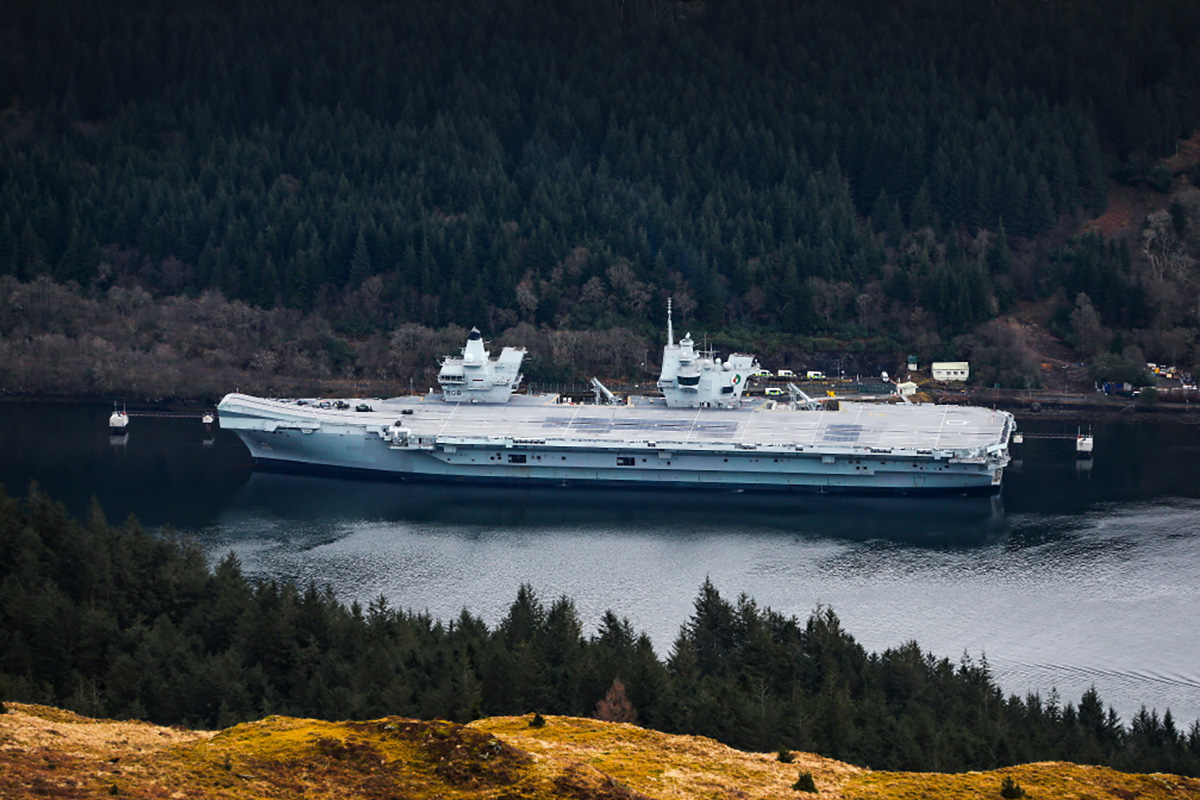
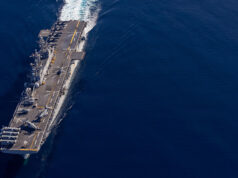
HMS Queen Elizabeth has arrived in Scotland, sailing up the Firth of Clyde and into Loch Long to the jetty at Glenmallan, the Royal Navy has confirmed to the UK Defence Journal.
Commander Adrian Visram, a Royal Navy spokesperson, told us: “HMS Queen Elizabeth is currently in Glenmallan completing a short logistics and engagement stop before continuing on operations.”
The 65,000-tonne carrier sailed from Portsmouth earlier this month for three months of training and operations around the United Kingdom and northern Europe, in her role as NATO’s command ship for the Allied Response Force, a role she assumed in July and one neither Queen Elizabeth-class ship had performed before.
Glenmallan sits on the western shore of Loch Long in Argyll, and its jetty is the only facility on the west coast able to take a ship of the carriers’ size alongside, which is why both Queen Elizabeth-class vessels have called there repeatedly since it was rebuilt.
The jetty itself underwent a £67 million upgrade under a contract awarded to VolkerStevin in 2019, with Jacobs as managing agent and Arch Henderson as designer. It had last been upgraded in the 1970s and had reached the end of its economic life. Around £20 million of that work went to local suppliers and small and medium-sized enterprises in Scotland, and the project extended the jetty’s life by an estimated fifty years while making it accessible to the carriers.
The work involved installing four new navigational aids to allow safe passage through the confined waterway, two modular fender spacer units that move with the tide to keep the flight deck clear of the jetty, and dolphin mooring points to hold a ship of that size securely.
As we reported at the end of April, the last Queen Elizabeth-class carrier to make the trip was HMS Prince of Wales, which called at Glenmallan ahead of Operation Firecrest. That deployment, announced by the Prime Minister at the Munich Security Conference in February, took the carrier strike group across the North Atlantic and the High North, with Prince of Wales leading the force.
Firecrest was designed to deter Russian aggression, protect critical undersea infrastructure and demonstrate the ability to project force at scale within a NATO framework, against a background of a 30 per cent increase in Russian naval vessels threatening British waters over the preceding two years. It included activity under NATO’s Arctic Sentry mission and exercises alongside Standing NATO Maritime Group One, which Britain has led throughout 2026.
Queen Elizabeth’s own programme runs on a different track from her sister’s, and she will undertake advanced training under Flag Officer Sea Training, exercising across the spectrum of modern naval warfare, and will rehearse how an allied naval force would operate together in a crisis. The programme continues into next year with participation in major NATO exercises, preparing her to take over from Prince of Wales as fleet flagship and high readiness strike carrier in late 2027.
The Royal Navy has linked the deployment to the £240 million committed in the Defence Investment Plan towards developing drones for a Hybrid Carrier Air Wing, including jet-powered types intended to operate alongside the F-35B.
The first visit by a Queen Elizabeth-class ship to the upgraded jetty came in March 2021, when Queen Elizabeth called there during final preparations for her maiden operational deployment, the first time she had visited western Scotland after becoming a familiar sight on the Forth during her assembly at Rosyth.
On the way up the Clyde the ship paused over the wreck of HMS Dasher, the escort carrier lost on 27 March 1943 with 379 of her company, and laid a wreath. The ship posted afterwards that “the lessons from the tragedy improved the safety of carrier aviation. We still benefit from those lessons.”
Dasher was a converted merchant hull operating in the Firth of Clyde when an internal explosion sank her within minutes, and the inquiry that followed changed how aviation fuel was stored and handled aboard carriers.





I was expecting PoW to go into refit next year for installation of bot-on CAT for jet drones?
No plan now to fit any CAT’s
The navy seems to be of the opinion they are not required to operate jet powered drones under project vanquish.
Project Vanquish became Project Vanish
RN is pathing the smooth progression pioneered by USN from Constellation Class -> Consternation Class -> Cancellation Class….
Could an engineer explain £67M for the work done or is it Defence add a ZERO?
Believe it or not that’s pretty cheap ! By comparison 1 mile of HS2 is over £1 Billion and it doesn’t have a 65,000 tonne Aircraft carrier tied up to it.
The costs are partly because they had to build it PDQ which meant 24/7 working to get it done so the QE’s could be operational. And the geology involved means very heavy duty civil engineering, Loch Long is deep and has a wide tidal span, even near the shore it’s 120 to 150 feet deep, the structure has to be rigid so over 130 steel and concrete piles had to be driven into the Sea bed which is solid Granite.
Then it gets really expensive as you essentially have to a massively strong and stable floating jetty which goes up and down with the tide so it doesn’t smash into the overhang of the flight deck. It also has to have a very efficient mass volume fire fighting capability, high security and a completely independent off grid electricity generating and distribution system.
The reason for all this safety and heavy civil engineering is because what they are loading / unloading is all the 100’s of tonnes of munitions needed by the ship and its air wing. Which is why both ships tend to dock there before and after deployments and why it’s 100% vital it’s built to last !
Oh and if you think £67 million is a lot for a jetty the ones at Faslane and the Synchrolift cost £1.6 billion back in the 90’s and over £15 Billion is allocated to enlarge, rebuild and modernise them. Then again they have to be Nuclear certified !
Rodders, I will accept and bow to your knowledge. Thank you.
PS, great bird watching in Latvia if you ever get the chance, although Sweden is probably safer.
Need to start moving away from Scotland and start opening massive ship building capacity and bases in England. Scotland will leave the UK at some point. Those jobs must be brought back to England!!
Should I say this..? Suprised she didn’t breakdown?
Don’t feed the trolls.
Indeed moving the shipbuilding to the North East would be Politically Popular allowing some Immigration of Shipbuilders from Scotland..!.
Faslanes move to West Wales or West of England may take Time but is Achiveable….Army and Airforce move should be more straight forward with Airforce operations out of Norway and Greenland a possibility..!
No. Never gonna happen!
Don’t believe the nationalists delusions (& hatred)… They’re just useful idiots for Russia…
Its bonkers not to upgrade the carriers self defences with CAMM and stick on 40mm. ( still not even 30mm. Can someone explain this? ) When they are away from the main bases I imagine they are at greatest risk from all types of drones. Don’t say we readers didn’t warn you.