

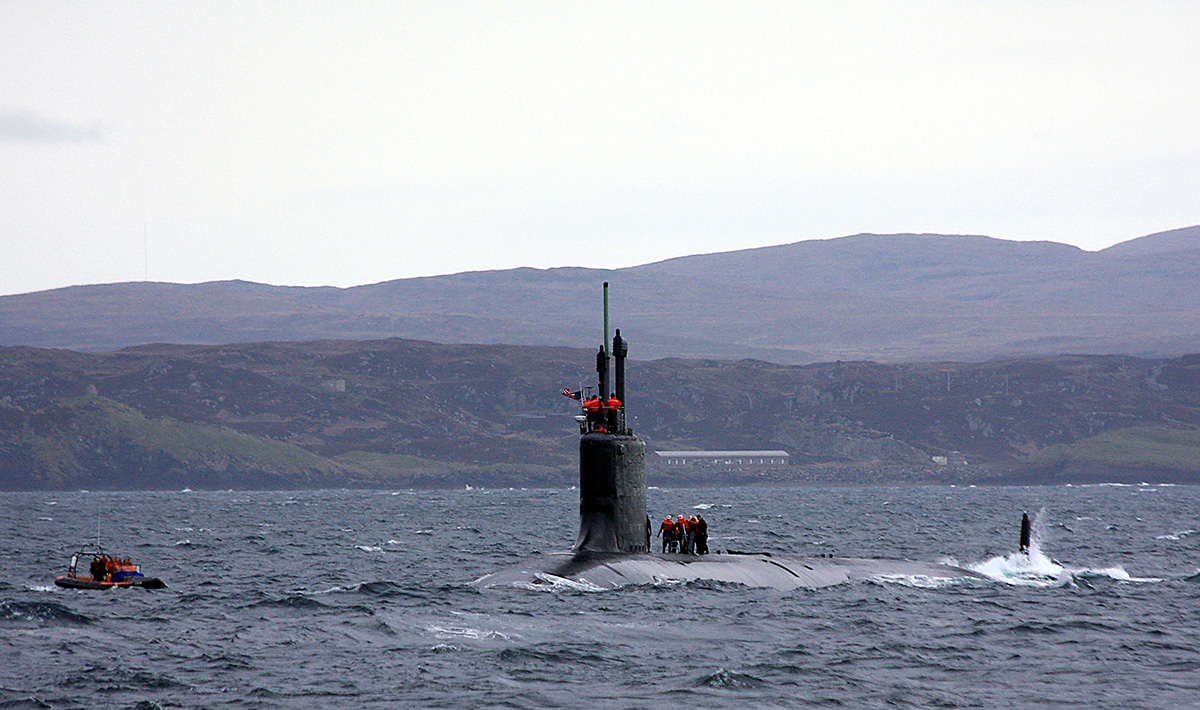
The AUKUS partners have streamlined Australia’s planned acquisition of US-built Virginia-class submarines under Pillar 1, with the country now set to receive three in-service boats rather than a mixture of new and in-service variants, the UK Defence Journal understands.
The change was confirmed in a joint statement issued by Australian Deputy Prime Minister Richard Marles, US Secretary of War Pete Hegseth and UK Defence Secretary John Healey following a meeting at the US Embassy in Singapore on 30 May.
The statement said the ministers “welcomed the proposed approach to streamline Australia’s acquisition of Virginia-class submarines, simplifying supply chain management, operational and maintenance requirements, and maximising cost efficiencies,” adding that “this approach would enable Australia to acquire three in-service VCS in lieu of a mixture of new and in-service VCS variants.”
The original Pillar 1 plan agreed in March 2023 envisaged the United States selling Australia three Virginia-class boats from the early 2030s, with the option of a further two if needed, and with the early transfers expected to comprise a mix of existing US Navy boats and newly produced submarines. The Singapore statement removes that mixed-variant element in favour of a cleaner arrangement using only boats already in US Navy service. The shift is intended to reduce complexity for the Royal Australian Navy as it stands up its sovereign nuclear-powered submarine capability, while easing pressure on US shipyards that have been struggling to meet the existing Virginia-class production rate.
The ministers also confirmed the finalisation of arrangements for establishing Submarine Rotational Force-West at HMAS Stirling in Western Australia in 2027. The United States has authorised the establishment of US Navy support elements for SRF-West and will begin rotating the first US Navy personnel to HMAS Stirling later this year. The United Kingdom reaffirmed its commitment to a rotational presence and noted the successful Submarine Maintenance Period conducted earlier this year by HMS Anson, a Royal Navy Astute-class submarine.
On the longer-term programme, the statement said significant progress has been made in the design and delivery of SSN-AUKUS, the next-generation attack submarine to be operated by both the UK and Australia, with delivery underpinned by investments from both nations including £6 billion committed by the UK in 2025. The first UK-built SSN-AUKUS boats are expected to enter service in the late 2030s, with the first Australian-built boats following in the early 2040s.
The ministers acknowledged Australia’s planned investments of up to A$8 billion at SRF-West for infrastructure and logistics support at HMAS Stirling, alongside initial down payments of A$3.9 billion to deliver a new Submarine Construction Yard in South Australia and A$12 billion for the Henderson Defence Precinct, which will support contingency docking and depot-level maintenance.
On industry, the statement confirmed support for expanding the AUKUS licence-free environment between the three partners by taking expeditious and practical steps to narrow the list of excluded technologies, and reaffirmed the value of the Advanced Capabilities Industry Forum.
The Trump administration completed a review of AUKUS Pillar 1 in late 2025, publicly affirming its support for the programme. The Singapore announcement is the most substantive operational refinement of Pillar 1 since that review concluded.


Lots long words, waffhel anf other catch words in that, must have been writern by some government stating some thing, that might or could happen but then again might change with no real set in stone time line or any numbers of future subs.
“Waffhel” … I always like learning new words.
Is It German ?
no its dyslexic
Oh, Di Selic…. Welsh then 🤔
I’ve gained $17,240 only within four weeks by comfortably working part-time from home. Immediately when I had lost my last business, I was very troubled and thankfully I’ve located this project now in this way I’m in a position to receive thousand USD directly from home. Each individual certainly can do this easy work & make more greenbacks online by visiting
following website—.,.,.,.,.—>>> JobatHome1.Com
It’s a competitively priced pilsner from Aldi 🍺😂
😂😂😂😂
Makes sense for Australia to get older boats from the same class. Virginia block 5 or 6 would probably be too large for their needs.
???
Block 1 through 4 Virginia class SSN are shorter and have fewer VLS than block 5 and 6 Virginia class SSN (377 feet vs 460 ft) although crew numbers remain the same across all blocks
Thing is, they’re never getting anything, new or used they won’t receive it. They got scammed.
AUKUS Are Rported As Up to 130 mtrs in length…! Same as later Virginia Batches..!
Interesting that South Korea, which has no experience of building nuclear subs, reckons it can get it’s first boat in the water in a decade but we’re taking more like 15 years to deliver SSN-AUKUS. Thoughts?
Good point but the obvious reply is will they be as capable as AUKUS boats. They have only just launched the first few home grown diesel boats and they certainly don’t have the 60 year history.
What they do have is a massive industrial base with shipyards aplenty that could be converted.
The SKs have sailed a boat to Canada to pitch for their submarine contract Defence blog reporting,covering 4000 miles of ocean ocean!
The Dosan Ahn Chango was a 10,000 nmi range, with its VLS cells, I think it was always intended as a transition submarine to SSNs
The biggest point for me is in the water is a lot more effective than in the shipyard. It can be the greatest submarine in the world but it doesn’t really matter if it arrives after it’s needed.
KOREAS Reactor Must be Well in Advanced Design Wise and Ready to Go into Production..! Wonder if its based on the French or US/UKs Reactor Designs…??
Difficult as we don’t know the specs of any South Korean boats and early days too to judge how quickly they will actually be produced, but they do have extensive non nuclear experience so they may be adaptations in the first instance. I note the reactors will come out of their civilian programme so may be quite conservative designs too. But yes they are one of the Worlds most advanced ship and submarine builders so I can see why their plan is pretty impressive time wise and of course events from the direction of both Nth Korea and the US are putting great pressure on them creating such a capability while the Australians have much to learn while we already possess such capability, so don’t have quite the same urgency. But one does have to admire South Korean capabilities that the West generally struggles to match.
Firstly, South Korea have been working on this long before it was formally disclosed.
Secondly, we’re delivering in 2038-39 because that’s when the first A-boat leaves service, not due to any particular delay.
agreed UK has no urgency because Astute still have plenty of life but Australia needs those subs yesterday because the Collins are waybpast their sell by date. I imagine first deliveries will be for the RAN not the RN?
Australia has just committed>$A11b to refurbish their Collins class submarines, extending their service life to 2040 and beyond.
Probably about the same time as Astutes go out of service.
Weirdly enough, the first SSN-AUKUS that’s delivered will go to the UK, probably in 2038/39. Australia won’t get their first until the early 2040s.
Whilst the Astute-class will remain in service likely until the 2060s (given a 30-year service life), that’ll only be with HMS Achilles, which has yet to enter service. HMS Astute will reach the end of her three-decade reactor life in 2040, giving room for about a year’s worth of delay on SSN-AUKUS-1.
Australia has to build its own submarine construction yard, as their boats are supposed to be built in Australia (with select British-built components, like the reactor, being delivered to Australia). That’ll take a while, and even if the Australians began building at the same time as the UK, there are very likely to be delays, because this will be Australia’s first SSN (and it’ll be a 10,000t, VLS-equipped, open-ocean thorough-bred, unlike the initial SSNs built by France, the UK or USA).
In the intervening years (the 2030s), the Australians operate six LIFEXed SSKs and three second-hand SSNs from the USA. The UK will operate 7 Astute-class SSNs, before presumably retiring Astute as SSN-AUKUS-1 enters service.
Since the plan is for ‘up to twelve’ SSN-AUKUS, there is sense in delivering before the latter starts to leave service – unless, of course, some planner’s crystal ball says we’ll be absolutely fine with seven SSNs until 2038, when suddenly we’ll need twelve?
12 SSNs plus 4 SSNBs Gives us 16 Boats Which is Theoretically the Number Required to Keep BARROW at a 18mths Turnaround Schedule With a little Extra Time for SSBNs ( Dreadnoughts Replacment!?) Thru to (AUKUS Replacment!?)…And BARROW in Continuous Production well into the 2060/80s..!
Also presumably because our sub building facilities will be quite busy with finishing off the Astutes and building the Dreadnoughts.
Back in the day when we just dropped a nuclear reactor into a modified SSK we could knock them out really quick as well. SSN A is more like a battleship of old. It’s massive with huge armament and the very latest technology.
The other thing is that we already have SSN’s and the new SSN A is a replacement class, it’s designed to be delivered at a certain rate to provide continuous build, rather than a rushed program to fill an existing security gap.
Yes but the UK is building finishing off a legacy SSN build, building a SSBN class and developing the new class all at the same time…..
Actually when you put is like that and fact in the stupid build holiday the governments took during the 90’s and we ain’t doing too badly really. We need to do better given the growing threat obviously, but all said and done not bad. We shouldn’t forget the fire either…
Cheers CR
That is if Astutes are good boats or instead as some are saying worse/problematic than Trafalgars.
They’re certainly more capable in a sensors/quietness/weapons-based comparison than the Trafalgars.
They’re definitely more comfortable for their crew, and easier to operate.
They’re significantly better to maintain. People seems to have forgotten that the Trafalgars similarly struggled at time to deploy more than a single boat to sea during the 2000s, back when the fleet didn’t have the maintenance pressures of aging SSBNs or a drydock shortage.
One of the Problem we’ve Had is No full Production of Nuclear Submarines..
11 Subs has been Insufficient to Keep Barrow Production at Optimum and Workforce Retention in Key Areas Difficult..
does Australia get a discount for second hand vs new?
They get all the kinks worked out for free 👍
So we now know the first 2 sea wolf class are being decommissioned in the early 2030s, all the LAs will be gone by the early 2030s as well and 3 early Virginia class will have gone to Australia… that’s nasty for the USN
They have 26 now by 2035 they may have just about commissioned Atlanta as boat 40… that means the USN SSN fleet will be only 38 strong.. 37 virgins and 1 sea wolf… its meant to be 66… that’s not an aspirational figure that’s the actual number the USN is meant to have.
When you think the PLAN have almost 60 electric boats.. 8 rubbish old SSN, 12 New SSNs that are up to LA flight 2 standards that they will finish building over the next couple of years and by 2029 it’s estimated they will have popped out the First couple of 095s a contemporary SSN, they have 16-20 slips to build the 095 on.. and will be able to crack them out at 4-6 a year moving beyond 2030…
Considering the USN surface fleet has no ASW frigates backing up its 37 ish SSNs against that a PLAN fleet that may be close to 80-100 submarines with 80+ dedicated ASW frigates 60 ASW corvettes and 80-100 dual ASW AAW destroyers.. not sure I would want to be the USN sub surface fleet in 2035.. I don’t think they would have enough torpedos.
I wonder if the American general public are any better informed than ours about the declining state of their navy..?
Just wondering
CR
Nah…. Most are thick as F$%K.
The ones I have had conversations with seem to think the USN will always be the largest and most power navy in existence due to some god given right, just because it’s the USN, and the fact that by 2035 the PLAN will be 2-3 times larger in pretty every areas apart from carriers… just means they will have more targets to sink. Its practically a psychotic delusion… even when you point out it’s the US naval college that’s ringing the alarm bells..or that actual on the ground the PLAN are actually building 10 times more surface combatants and 4 times more subs they just don’t believe you.
The craziest thing about that build rate, China recently built a surface ship and an SSN in civilian yards to see how easily they could convert production. They managed pretty well. That now gives them up to 218 times the US total production capacity
There little Doubt CHINA Wins Quantity Hands Down…!
The Question is Quality…
The Great Unknown With PLAN..
AND Of course Leads to the Question
Does QUANTITY TRUMP QUALITY.??
(Forgive the Pun)
Maybe the reason the Trump admin wants to increase U.S defence budget to $1.5 Trillion per annum?
The problem is, the US has funded plenty of ships.. it’s got a whole backlog of funded ships.. money has been thrown at warship production, but it’s not shifted the dial on output of commissioned warship. The USA seems to have a structural problem.. and the Trump class battleship is probably the epitome of that.
1) a profound focus on capability over practical mass
2) no real guiding principle of what the fleet is for and what ships are really needed and how many.
3) an industrial capacity that seems unable to grow and deliver ( immediate profit over sustainable US security)
CR,
Certain elements of the public are quite concerned about the future of all US forces. The general public–not so much. Assume it is virtually the same throughout E-NATO. Until hostilities commence …
I think there is a difference from what I can see from discussions I have had.
The UK and European populations assume 2 things
1) Russia is a hell if a lot stronger than it is ( people still see the Bear).
2) out armed Forces are weak, but we are going to have to do something
On the US side it’s the exact opposite..
1) China is a third world nation that makes plastic ships and could never out produce or our fight the industrial might of the US.
2) the USA cannot be beaten it’s the most powerful nation to ever and will ever exist and it only losses wars because it wants to…
I think I know which is the more dangerous attitude to have.
Jonathan,
Some E-NATO countries have politically embraced the concept of, and already initiated, rearmament programmes, specifically: the collective Baltic states, Germany, and Poland. There is a significantly larger group of states which may, eventually, embark upon rearmament, based upon future elections and geopolitical developments. And of course, there is a third group of ENATO states, including Portugal and Spain, which will probably never attempt to prepare for the coming storm.
Very difficult to discern the future US defense/political environment at this juncture. Defense expenditures will probably increase at a rate faster than inflation, but the degree of isolationism w/in US foreign policy is almost impossible to predict w/ any certainty.
When most journalists are so culturally limited that they not show any interest in military matters – just the oldest human activity after the other one -you cant expect the public be informed.
Royal Navy is in current state because journalism too.
Hmmm … connecting the relatively close dots, presume SRF-West will become the transfer mechanism and process for conversion of three Virginia class to RAN ownership. Blended USN/RAN crews will eventually become solely RAN. However, RN advocates should not be entirely sanguine about this prospect. Willing to wager that if the SSN-A development schedule is significantly impaired, RN may be compelled to surrender an Astute class boat to the RAN. Admittedly,
a definite incentive to hold nominal schedule.
Not Critical of your Point…But what is the Quality of PLANs Submarines….? Rumours of Accidents And Building mistakes With Substandard Materials…. I Doubt Even PLAN knows…!
As for 3 Second Hand Subs..!..Makes Some Sense..
A Similar Batch Would Simplify Maintenance and Operating Familiarisation..!
If the US is supplying some of their old boats early I assume that the UK has lost the updating contract it had on this deal. Is that the case?
What updating contract. The plan was that they would get a second hand Virginia followed by a couple of new builds and had options on another two if AUKUS ran late. Collins would have to have a life extension whatever. The plan now seems to be that they will get three second hand boats which means they are more likely to keep the AUKUS production line going as the US boats will have less life remaining and will need replacing sooner.
Thanks for your perspective. Interesting.
Indeed it will be interesting to see which boats they get.. the USN will want to ditch its older boats that are likely to head out of commission from around 2039-2042…
Australia pays approx. 5 times more than the deal they had with Naval Group, ends up with second hand submarines in the late 2030s all the whilst having to spend billions to keep their current Collins class sea worthy up until the 2040s. what a procurement clown show
In the end they are a pacific power and they will be facing off against a navy with SSNs.. it gives Australia greater deterrent… in the end electric boats are defensive and essentially static ( from a strategic point of view) that does not make a good deterrent… for some pain now they make themselves far more able to detter in the future.
Its a Very Big step Change between
Collins 》》French Option 》》Second Hand Virginia’s 》》To AUKUS…..!
Both in Size, Capabilites and COST !!!