

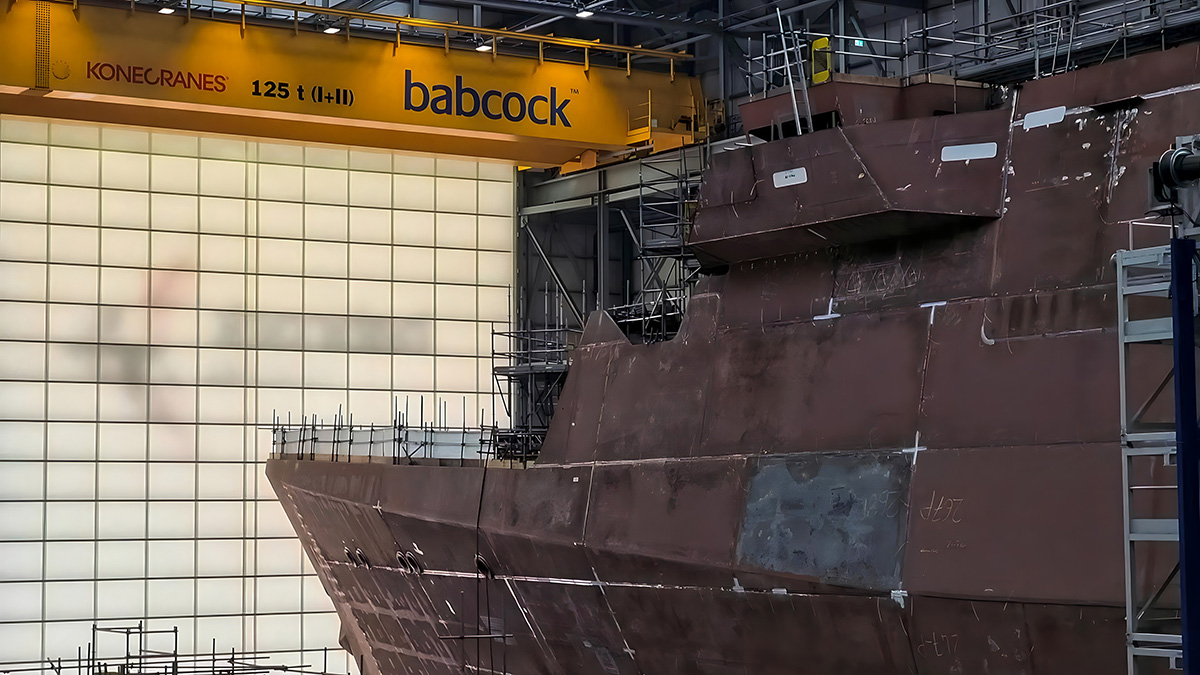
At the latest meeting of the Scottish Parliament’s Cross Party Group on Maritime and Shipbuilding, Babcock signalled that the Danish and Swedish naval programmes it is competing in are approaching decisive phases.
The company kept commercial details tight, but its briefings suggested that Arrowhead 140 may be approaching a moment when export opportunities in northern Europe come into clearer view.
The Danish programme has been in development for roughly five years, which is typical for major naval recapitalisation cycles but lengthy by public expectations. Conversations at the meeting suggested that key decisions may emerge in the first quarter of next year. The structure of the potential Danish package is complex, involving several vessel types, though an Iver Huitfeldt-class successor appears to form part of the mix. Arrowhead 140’s presence in that competition is strategically notable: the design itself evolved from Danish principles, and the UK’s Type 31 has re-exported that lineage back into the global market.
If Denmark selects a variant of the Arrowhead family, it would open two channels of influence. First, it would reinforce the UK’s claim to be re-establishing a viable export model in naval shipbuilding, something successive governments have pledged but rarely delivered at scale. Second, it would deepen Nordic interoperability at a moment when the security agenda across the High North is shifting rapidly. Recent remarks from the First Sea Lord underscored that the UK views the North Atlantic and Norwegian Sea as one continuous strategic zone. Alignment with Denmark on surface combatant design would sit neatly inside that logic.
The Swedish opportunity appears to be moving at a different tempo but remains live. Babcock indicated that Sweden has a competitive process underway, with Arrowhead in the frame. Any outcome there would depend heavily on Stockholm’s industrial policy. Sweden has traditionally integrated foreign designs into national yards rather than outsourcing major warship builds, but it also faces a growing fleet recapitalisation challenge. The return of territorial defence as the organising principle for Swedish security has forced several procurement timelines forward. Where domestic capacity is constrained, hybrid build arrangements become more plausible.
Both Nordic cases test a broader question: can the UK deliver workshare structures and schedule confidence at a level that convinces partner nations to adopt Arrowhead? Early progress on Type 31, including the steady sequence of keel-laying milestones at Rosyth, strengthens the argument that the production system is stabilising.






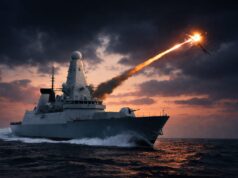


The UK needs to show it’s trust in Babcock and order 5 more type 31s, god knows they are needed desperately.
If the UK gets it’s shipbuilding programmes right I can see the USN requesting Babcock build variants of type 31 for them. They need frigates, their Constellation class programme , like DDX before it, have been hugely costly disasters.
Sadly the US will never buy a foreign manufactured warship because of the build in America policy and the Jones act dictating requirements for ships transporting US goods….
It makes a lot of sense if they did, they have a very poor experience with building smaller vessels so maybe they concentrate on the bigger ships from destroyers up and get others o build the cheaper general purpose vessels without going overboard on the specs. Don’t turn a $500m ship into a $1.5bn overkill.
But they will, they always do, they just can’t stop themselves.
I think the USN will need to outsource, especially if things ever turn hot against China. The USNs Arleigh Burke class of sole surface combatants will be worked hard and suffer significant attrition.
The Chinese can rebuild and have much greater shipbuilding capacity (USNI estimates 40x the USAs shipbuilding capacity) so in any prolonged attritional war the USN will become desperate to get their hands on as many frigates as possible. I’m actually surprised with the collapse of the Constitution programme that they haven’t already contacted Babcock to ask them how many type 31 frigates they could churn out if money and numbers wasn’t an issue. I think at full speed with expansion of workforce and facilities 3-5 ships a year is viable, maybe even more.
It looks as though the replacement for the Cancellation-class will be American-designed and American-built; specifically, the National Security Cutter-based design was reportedly confirmed at a recent private navy event in a speech given by the naval secretary. Here’s the link, fix by adding a ‘dot’ after ‘defense’.
breakingdefensecom/2025/12/navy-wants-new-frigate-in-2028-says-services-acquisition-head/
Looks like there’s a danger our US friends might be coming to their senses 🙏
It’s way way more than 40 times.. china has now over 50% of the world’s shipbuilding capacity..the U.S. has 0.1-0.2% so china builds about 39-40million tons of gross tonnage of ships vs the U.S. 100,000 gross tons. Essentially it’s hundreds of times more infact in June 2023 the US office of naval intelligence suggested it’s was 232 times greater.. but as of 2025 it’s probably increased to close to about 400 times greater.
Rosyth is a tiny shipyard, it could not churn out anything.
Apart from two 70 thousand tonne Carriers and five T31’s !
They did not churn out the carriers, those were built across the country and were still heavily delayed. And its going to take them over a decade to deliver 5 frigates
Hugo – let me tell you about the QEC build as it is something I *know* about.
Most of the delays to QEC were deliberately caused by one George Osborne
– looking at cats’n’traps
– reprofiling the project to suit the much delayed JSF BRAVO
You could argue that the second line has less to do with JSF and rather more to do with pushing costs to the right.
Don’t forget Gordon Brown’s government delayed the project by 2yrs to save cash, adding £1bn to the final bill
The UK needs to return to the building sections across UK shipyards and speed up the construction of the T26, T31, and others. Doing so would boost ship production numbers, helping to fill the gap the MOD has created in our Frigate strength and fulfilling export orders.
Another issue not being spoken of is the replacements for Albion and Balwark. We trained specifically to deploy on those ships during larger-scale operations. There’s no news on replacing these, leaving a significant capability gap that the Royal Marines once filled.
We’re already building sections around the UK
That’s more a more recent reflection. They churned out over 50 OHP frigates for USN service and 20 for allies the last production being 2004 .
Before that the built over 40 simple Knox class into the 70s.
The problem is capacity withered and as you point out the general purpose full spectrum of the Aegis Destroyers became cruiser sized.
The Freedom and Independence debacle is the glaring off track decision.
Looks like the USA will be going for a frigate version of the national security cutter. Very low end, much more like an OPV with missiles than a modern European frigate.
The USN just seems incapable of having a warship that’s not a full fat Arleigh Burke destroyer.
Trump just wants programmes he can boast about with US stickers on them, hiding MAGA caps is a lot easier than frigates even for him. So low end crap it will be but presented as usual as 24carat gold plated mega destroyers that are simply the best and envy of the World. Far easier to sponsor his mates to buy all the news channels and suppress all the social media outlets as Antifa so the only message getting out is his. Comical Ali returns on steroids as Vomital Donny.
T31 is delayed, ordering 5 more now would achieve nothing.
Europe needs to get its own Navies into some kind of shape, the Yanks have made their bed let them sort themselves out. If they get themselves into a shooting war with China that’s their fault and if we can then sell them stuff all the better, after all life and death is all about money according to Agent Orange.
Sadly I think that is the world we live in..l my big issue is that china may well just recapitalise the Russia navy and screw us over at the same time.
Hmmm a nice reverse lend lease opportunity comes to mind, hey we mat even get some of out gold back that’s sitting with uk identity marks on them in Fort Knox. If only 🥳 but one can dream.
You know the west is really f**ked when nations start relying on our naval industrial base. Our current resources can’t match our own needs and I do worry that we get caught up in a short term naval build up with exports only to find communities devastated again once the work drys up.
Fife and the Edinburgh city region is a pretty vibrant and successful place and Rosyth has proven very adaptable over the years so no worries there but places like Glasgow, Belfast and Barrow are not.
The government needs to make sure it can maintain a continuous build program and not get caught up in headline grabbing export orders. There is a reason our warship export industry died off before and with not government support and ultimately subsidy it will happen again. These communities don’t deserve to be out through the ringer again.
An article in Naval news yesterday suggests that Sweden are forming closer tyes with Navantia on their frigate programme
Hardly closer ties, more that the Spaniards had offered a design. Naval News do republish a lot of company press releases.
They did say similar about Norway mind as often repeated on here as signs the Germans were favourites .
Export orders are good, but we are not considering the current build capacity?
Do the Shipyards need more investment?
Will building these ships for foreign navies slow down the RNs procurements?
Would those countries be willing to wait until the RN orders are completed?
There is already speculation that the 3rd or 4th T26 might go to Norway.
Thing is if you have the workflow you can build a whole series of state of the art fabrication sheds that are optimised for the systems and processes inside them.
Productivity will then increase as you build warships as efficiently as possible and not to a stalled cash curve.
It makes a huge difference to both pace of build and cost to UK taxpayer as the capital investment isn’t just MoD but amortised to the foreign buyers as well.
A hit fast production line is to everyone’s advantage.
As long as the Uk actually does what it needs to do and recapitalise the major surface combatant fleet back to 30+ frigates and destroys.. the thing about having live productive lines of warships that are churning out a T26 and T31 derivative a year, if we do end up in a nasty global naval conflict ( which I think is a likely risk in the 2030s) then over five years of conflict we can replace 1/3 losses.
Those yards are day one targets for conventional attack.
If you are going to naval war you need to make sure the building and maintenance as well as any munitions dumps are OOS.
Best way of shortening a war of attrition.
To true but in this case I was thinking more of an indo pacific war so less chance of that..
But that is one reason to get better air defence.
Were not getting 30, its just not on the table anymore
We just don’t know the future and did say that is what we need not what we may get. 👍
@Jonathan
Hugo only knows to constructs
– NO
– CAN’T
to Hugo it is impossible to plan for growth even if more money was delivered as part of DIP as promised by Rachel From Accounts.
24 escorts or even 30 is perfectly achievable with quite modest levels of spend if the Hi-Lo profile is followed.
As many have pointed out something is needed to control all these drones and then prosecute the targets. That sounds a lot like a T32 to me.
A regular frigate with new equipment can control them just fine. Please let me know when any actual significant funding shows up
A regular frigate with new equipment can control them just fine. Please let me know when any actual significant funding shows up.
You think a modest spending increase will double our escort force? You realise the navy doesn’t get all the funds
6 T45, 5 T31, 8 T26, 5 OPVs, 3 MCMV, 3 MRSS = 30 minimum
Creative accounting then
Plus QE class, Points, Tides and FSS, SSN, SSBN is a good broad navy. Additional compatible Frigates / escorts for N.Atlantic, high North responsibilities and will come by working with Norway and Denmark. 5 well armed MCM/OPVs like the Icelandic Thor would be nice.
I think the workflow is currently good, but I don’t think we currently have capacity for larger or non-domestic orders.
We need to engage more shipyards or expand the ones currently involved, i.e. build more fabrication and Frigate sheds, fit-out docks, and employ more skilled workers.
Not really.
Efficiency massively increases with better arranged lines and less choreography. The flow of parts should match the line. The building arrangement is very important.
Also having space for robots to run moving parts around 24/7 to avoid ‘stores’ issues.
Also with automation of some of simpler repetitive fabrication processes and full automation of plate handling, blasting & priming etc – this strips out a lot of man years so the skilled team can focus effort.
its guaranteed the 3rd or 4th goes to norway its part of the contract.
At least T26s will be used in the North by Norway. It’s the delay on the GP T31s that is more of a worry.
Lovely so can the UK now order a total of 20 frigates and 10 destroyers please Thankyou.
Dream on lol
Yep we can always hope..and keeping people real on what we need is important.. we have a saying in healthcare.. the care you walk past is the care you accept..
The Chancellor has already spent an extra 5 gigillion pounds on Defence over the 2060s, and as a result the British military are the best in the world and fully able to undertake all taskings asked of them. The apparent destruction of the Royal Navy this decade never really happened and is a wonderful opportunity to make way for Britain’s new Hybrid Navy. Hybrid because it will partly exist and partly not, giving us a huge advantage over our adversaries, a tripling of delivery capacity and three times the number of platforms than we actually need to pay for. As for your suggested order of escorts, we have set up a working group to assess this seemingly outdated concept and who will put out a RFI if the time is right. These escorts may find a place for themselves in the second part of the Hybrid Fleet as early as 2030.
The sad thing here Jon is that you’re actually saying what might happen. The Tories, for all their faults, did place orders. Starmer and Reeves between them are bankrupting the country so money for defence? Highly unlikely. Sound bites certainly but no orders.
There won’t be any more than 19 RN escorts by 2035. The budget is not there to do more and, as usual, the RN is already going over budget with trying to build 2 frigate classes at once, plus the new FSSS, MROS, Castle MCMVs etc and now this Bastion Atlantic thing.
We will get the 5 x T31s and most of the 8 x T26 by 2035, with the T84s following on post-2035.
If the defence budget ever gets to 3%, there will be more money available, but army and air force are going to need most of it, not least with Tempest getting underway.
If there really is more money in the pot by 2030-35 for additional ships and boats, emphasis really needs to be on ASW and MCMV, where we are very clearly short. 2 more T26s tacked onto the order would be good, a future upgraded T31 design – call it the T32 -with ASW capability – meaning hull-mounted AESA sonar, equipment rafting, TAS etc – would be a lot more suitable for solo overseas patrol than the T31s, which could be recast as Bastion motherships or whatever.
For ‘T84’, read ‘T83’
Ref export sales, we would need to build up.our shipbuilding capacity considerably. Babcock at Rosyth will have capacity.from probably 2032 and could handle export orders for the same.
But the other yards will be at full stretch, Govan/Scotstoun with the T26 .H&W with the FSSS (and then maybe the first 3 MRSS), CL with its current orders for the second Proteus and 3 more Castle MCMVs, and probably some Bastion elements, and the smaller yards like Appledore will be fabricating elements of the above.
Sure, yard capacity could.br increased with prefab sheds etc, if the money was there – which it almost certainly isn’t. The other real constraint is skilled workforce. All the yards are trying to increase the numbers, with trainee schemes, ex-North Sea oil and gas workers etc, I read that Babcock apparently has hired 200 Filipino welders and so on.
But these new recruits are needed just to build what’s already in the order books and there is already competition for skilled workers from Barrow, RR and the rest.
So there is quite a bottleneck in both capacity and workforce for a good 5 years ahead.
Agreed on workforce, not a magic bullet but Babcock firing up additional 850 apprentice/graduate posts due 2026. ( Not all naval based I confess) Problem is finding the dudes who want to be welders and actually be up north in the yards. Anyone with a brain needs to see that it is a viable and lucrative path, and one that will not whither on the vine. Also of note partnership signed up to build modules/kit ( of unknown type for the Virginia class subs. Partnered with HII i believe)
doesn’t help the government for 20 years has told all kids the only future is going to university
There is no second proteus on order or any MCM vessels
The Royal Navy is procuring new MCM vessels along with the Norwegian Navy. The RN has a requirement for at least 3 mother ships to support the transition to uncrewed mine hunting, the vessels are based on the Vanguard design, I think.
Not sure if he Royal Navy also has plans to procure a second MROSS though
It appears that the second MROSS has been merged in to a replacement for HMS Scott, whose service life has been extended to 2033. Given the MODs now universal policy of gaping capabilities to avoid the cost of concurrently funding old and new systems, I don’t see much hope of an order before 2030. But just possibly a second ship will be ordered to replace RFA Proteus. Operating two identical and purpose built ships obviously has many advantages over two very dissimilar ships.
We can always wish for more investment and more orders.
But that shouldn’t detract from the achievement so far. Licence built frigates in Australia, Canada, Poland, Indonesia, UK built vessels for Norway and now strong prospects with Denmark/Sweden (as well as inroads in places like Chile and New Zealand).
Considering what a low base shipbuilding reached for many decades (with only second hand ships and a few OPV’s being built since the Leanders and Yarrow frigate iterations in the 60’s and 70’s) it’s a fantastic revival!
Denmark was expected to make a decision on its new frigates late this year, indeed Danish newspaper papers reported in October that it got within a few days of being announced when pressure to build the ships in a local shipyard caused the government to press pause, and ask for a rethink of the options. Meanwhile, the Sweden procurement was complicated when it was announced a few months ago that the navy was no longer looking for a frigate primarily for use in the Baltic, but instead wanted a larger and more capable destroyer capable of world-wide deployments. Arguably the Type 31 might still meet Sweden’s needs, but if there has been a budget increase then German, French, Spanish and Italian shipyards will all have strong proposals.