

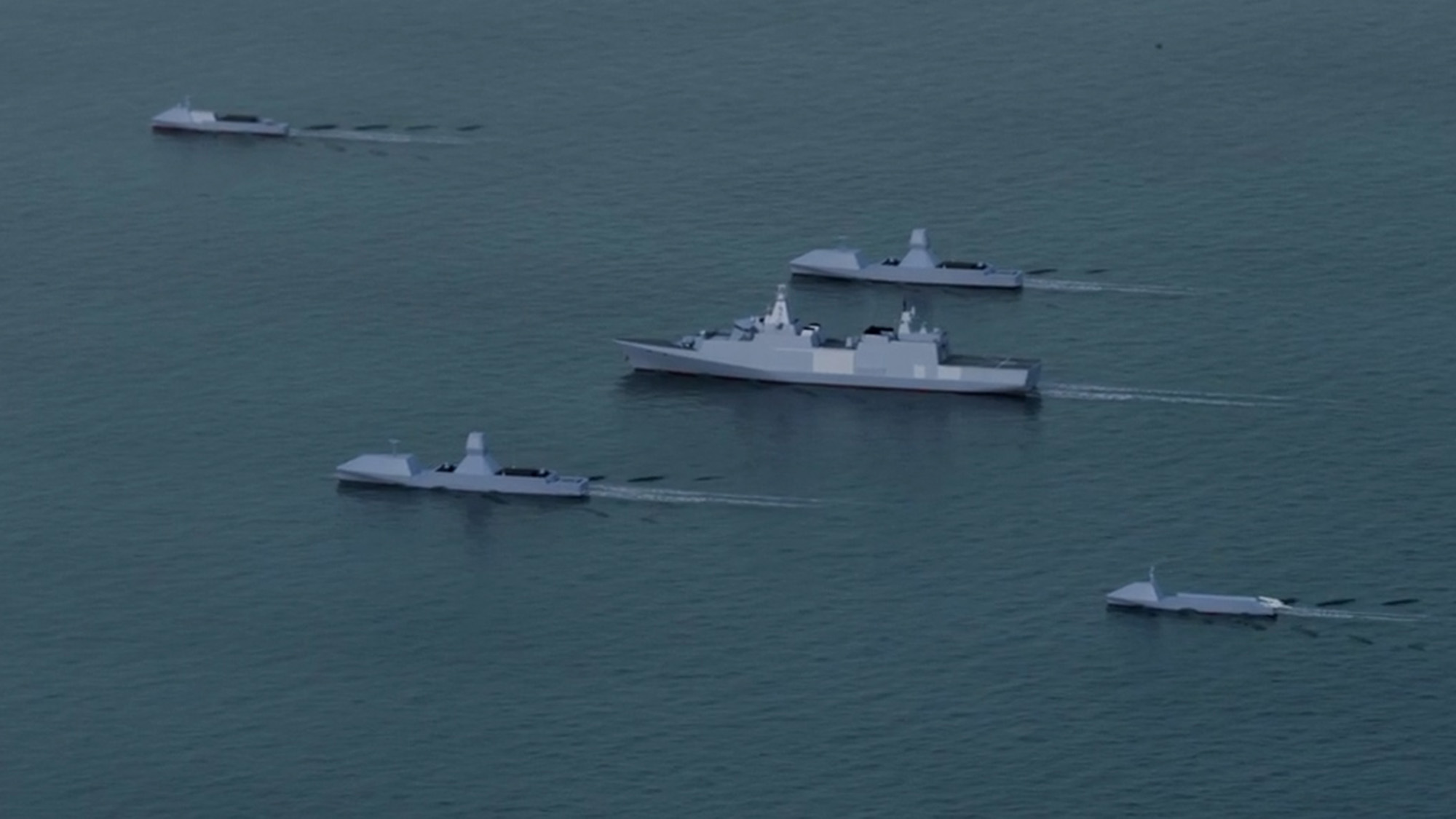
Speaking under the hulls of HMS Active and HMS Formidable at Rosyth, Babcock’s senior leadership told the UK Defence Journal how they intend to meet the First Sea Lord’s call for rapid expansion of autonomous mass at sea, telling me their ARMOR Force concept is built to deliver both speed and scale.
Babcock chief executive David Lockwood said the company’s partnership with HII and Arondite is designed to combine industrial production with fast software-driven adaptation. “It’s a collaboration to take their uncrewed technology together, their platform technology, to offer a thing we’re calling ARMOR Force,” he told me. “You can invent once, used many times… technology going from us to them then to us. I was with their CEO last week, and it’s a really strong, deep relationship. Culturally we’re very similar.”
Asked whether industry can realistically deliver mass at the pace the First Sea Lord demanded, Lockwood argued that the model behind ARMOR Force allows capability to evolve while the ships are still being built. “I think he’s looking for two things. One is pace of build, and the other is pace of innovation,” he said. “We can innovate post-build. We can actually innovate in build as threats emerge. I’d like to believe the great strength of Babcock is we’re big enough to have mass, but small enough to respond like an SME.”
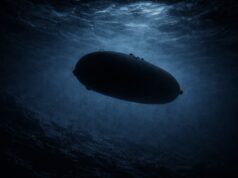
ARMOR Force is built around the Type 31 frigate acting as a Common Command Vessel controlling a dispersed fleet of large unmanned surface vessels drawn from HII’s ROMULUS programme. Backed by PODS modular payloads and an autonomous mission system planned for deployment by the end of 2026, the concept is central to the Royal Navy’s Atlantic Bastion, Atlantic Strike and Atlantic Shield operations.
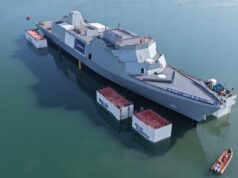
Sir Nick Hine said the Type 31 platform is well suited to leading such a fleet, but he wants further refinements. When I asked how adaptable the frigate is for autonomous command, he said, “Straightforward to make it a command vessel. There’s lots of things I’d like to do. I’d like to give it a stern ramp. I’d like to change some of the internal configuration to make it easier to move things around, to make it more flexible.”
Hine also disclosed that Babcock has offered the Navy an early demonstration package. “My offer to the Royal Navy yesterday was to deliver HMS Venturer and an unmanned surface vessel from HII as an initial operating concept for ARMOR Force in 2027,” he said. “It would only be initial operating capability, it wouldn’t be everything, but it would be a really good start.”
The approach aligns with the Royal Navy’s push for a hybrid fleet in which autonomous systems carry risk, range and persistence while crewed ships act as command hubs. With HII providing repeatable-production USVs designed for long-endurance operations and Arondite supplying the Cobalt autonomy stack, Babcock says the architecture is built for continuous upgrade.
The First Sea Lord had warned that Britain’s traditional advantage in the Atlantic is under strain. Babcock’s pitch at Rosyth was that industry can meet the moment, provided the Navy embraces faster cycles of adoption. Both Lockwood and Hine suggested they are ready to move as fast as the customer demands.




Shouldn’t priority still be given to making sure that all current and planned crewed ships also have their full armaments and systems beforehand? And any costing comparisons done on these hybrid fleet proposals versus crewed? If it all costs more than a fully armed T26 or T31 or multiples of either is it really worth it with the RN fleet in such low numbers? How many drones ships is too many, too little, just right?
You’re being sensible again. You really must stop having these thoughts !!
Sorry…it’s a disease! But I’m not alone! Lol.
Keeo taking the pils…ner.
Yeah lets not bother with force multiplers.
They haven’t even delivered a single working Frigate yet.
Does this mean they’re desperate as no batch 2 T31?
The seemingly increasing build time on the T31 is concerning also. Are Babcock’s putting more into the build before floating off or is there a problem beyond the process? We need movement on both current order and future order(s), either UK or other, to keep Rosyth busy. Come ON MOD/UKGov, get the finger out!
And we all want Babcock to secure the Danish order and if we/they can be greedy, the Swedish order also! There’s got to be some reason for it. Not good to interfere with the good thing happening here. If they got other orders maybe they could fill the gaps.
Is there more here than meets the eye between T31 and Konigsberg. It’s been argued that UK yards are focused on all we can deal with currently. Are we looking at Konigsberg being built against UK policy of home build for all RN War fighting vessels as a trade off and increasing supply lines?
Reading an article in Naval news today, it looks like Sweden will go with Navantia for their frigate program but hopefully the Danish will go for the T31
I think drone warships are sensible force multipliers for our Escorts. They have to innovate. And T31 build is ahead of schedule.
Just to add to the happy mood around defence, has anyone else read how CH3 could be headed down the MRA4 road as the new turrets don’t always fit on the hull rings, as they’re often slightly different?
😳🥺🙄
The engineering answer would be: Now we have the opportunity to rework/standardise those turret rings
Lots of hulls in progress, many design ideas and prototypes, still no new ships ready to enter service.
Are we focusing on the right things?
Autonomous may well be the future but the crisis in the Atlantic is now. The best way to get more ASW capability into the fleet as quickly as possible is to build 5 extra T31s (10 in total), give them all the CAPTAS 2 modular sonar, a Merlin instead of Wildcat, 30+ Sea Cepter and a 8 x NSMs each. Yes I understand they are not silent hunters like the T26 but they would augment that force well and provide some mass to our efforts in the Atlantic. Fairly sure we would get 3 so equipped T31s for every 1 T26. The whole point of T31 was that it was a flexible modular design so why not optimise that?
Please get a grip of how awful this website actually is to use.
The anti-spam function has users taking time out of their day to share views and discussion, only to be blocked for no apparent reason over and over. Totally wasted time and energy.
Oh, and add an edit button.
What year is it?
Merry Christmas.
I work in IT and AI is now undoubtedly part of the nom, but there is still often a need for “remote hands” – i.e. a human physically there. I’m concerned about the practicality and cost of large unmanned drone ships which are going to have to operate at sea for several months with no maintenance and probably no replenishment. I fear that the bean counters have got overly and unrealistically excited about the savings that will result from no longer having to crew many warships.
I suspect the drone ships/USVs will be “optionally crewed”, to ensure safe operation in busy UK waters for example.
My wild idea, maybe a common hull could be used as a future OPV (ideally more heavily armed than current gen, or at least with ability easily add weapon modules). I believe Batch 1 Tiers will need replacement soon.
Hopefully these could be built at pace and being smaller more shipyards could be involved than just the big primes.