

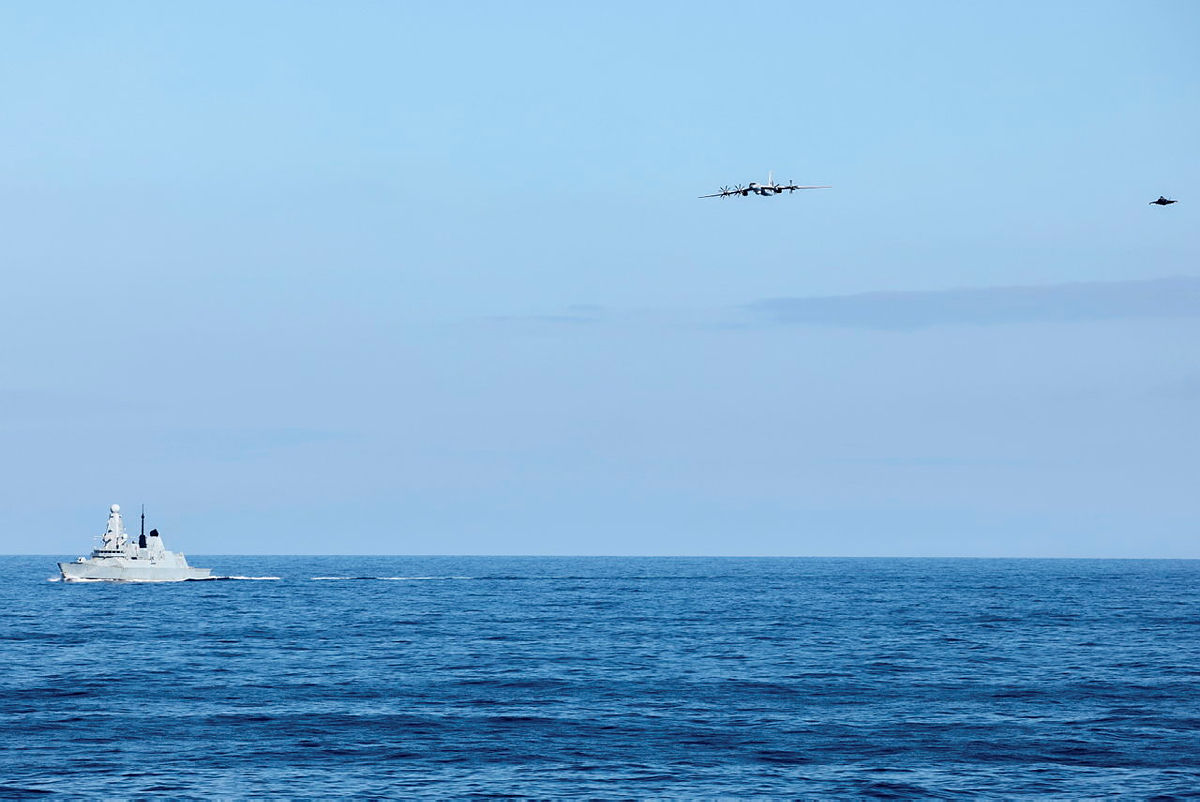
The images that carry the Royal Navy onto front pages, and into the pages of this publication, are taken by a small branch of serving sailors who deploy alongside the ships and units they photograph, and a new film released for World Photography Day gives an account of the work in their own words.
Made by the photographers themselves, it runs from a Type 45 destroyer firing Sea Viper in anger for the first time to Royal Marines under fire in Helmand, to military funerals at home.
Helena Burkett, a serving photographer, said: “As photographers, we have an incredible reach for the limited personnel that we actually have in the branch. We capture everything important that’s going on in the navy or the marines, and we push it out globally. Everything you see has something to do with the navy, and it is most likely done by one of our RN photographers.”
That output is what makes coverage of the Royal Navy possible at all. Almost every photograph of a British warship, submarine or Royal Marine that appears in the press, on this website included, was taken by one of these sailors and released through Defence Imagery under the Open Government Licence. Without them there would be a great deal of writing about the fleet and very little showing of it.
One contributor put the point plainly: “You can write and tell people what Lydia does, but you’re never going to reach as many people than you will with a photographer.” Another said: “Without our photos and without our video to show what events really look like, you can’t tell that story successfully. You can’t tell that story in words.”
The Red Sea
Petty Officer Sellers, a photographer based in Portsmouth, was flown out to join HMS Diamond in the Red Sea and slept with his camera bag beside him. He said: “As soon as that general alarm goes, I need to get to the bridge in seconds. I’d have my bag next to me at all times, ready to go, and I would be there because I know I need to capture that image if that missile fires.”
The photograph he took shows a young officer of the watch shielding his face, one eye on the bridge and one protected from the flash to preserve his night vision. He said: “Got that edited, sent back, and within a few hours, turned Sky News on. Breaking news background was that image. Pretty unbelievable to know that was my work, but I think also for the ship to see that image was a great boost of morale, to show the world that everyone knew what they were doing.”
He added: “You’ve got a lot of pressure on your shoulders to make sure you capture the right thing at the right time. If you miss that opportunity, that’s gone. But if you capture it, you’ve got that there for life.” He also noted that the role does not exempt him from the rest of the job. “They need people to look out. I’ve still got that ability to do that whilst I’m up there.”
Afghanistan
The film also features Sean Clee, a former Royal Navy photographer who deployed with the Royal Marines on Operation Herrick 5. He said: “We found ourselves being deployed on every major operation. It was our job to report what was going on, to let the world know what was going on. We were travelling all the time. Just our kit on our back, in and out of Bastion.”
He described being caught in a Taliban ambush while photographing a mortar crew. “As I was taking pictures of the mortar, dropping it in, lads dropping down, an RPG come over, went straight through the roof. The shrapnel just come back on us. Blew me outside of the mortar pit. Turn around, the lad who bent over from the mortar got up, I got a piece of metal sticking out of his head.”
He said: “If I could describe it as anything, it was like the opening scene from Saving Private Ryan, where your ears are ringing and you don’t know what’s going on. It was just like that, just smoke everywhere, dust everywhere.”
Funerals
Helena Burkett, a serving Royal Navy photographer, said the work swings between extremes. She said: “Being a photographer, your job changes a lot. You could be flying out of a helicopter one day, you could be doing a funeral the next day.”
Another photographer in the film described that side of the work at length: “I can find doing funerals difficult. Purely just seeing the family’s grief, it is hard, but it’s at the family’s discretion whether they want a photographer or not. Some people want to remember the day. Some people have passed away that have small children that couldn’t attend the funeral because they’re just too young.”
She described crying on the bus between a church and a burial site before composing herself for the next part of the job, and said: “I do my best to prepare for it emotionally, but I just think this isn’t about me. The families are going through a really horrible time, and I just want to do my best for them at the end of the day.”
She said the branch also demands independence. “There’s no one else that’s going to hold your hand for you or do the job for you. It can be lonely. There’s no one else on board a ship that understands your role to the extent that you do.”
Her standout assignment was on Carrier Strike Group last year aboard HMS Prince of Wales, shooting portraits of shipmates in Tokyo. She was also sent to HMS Dragon with 48 hours notice and was away for three months.
Why it matters now
Several contributors tie the branch’s value to the volume of synthetic imagery now circulating online.
One said: “We know that the world is flooded with imagery, but a lot of it’s not real. A lot of it’s AI. We know that people that aren’t generally friendly to the UK are flooding this country with information that’s probably not real. We don’t lie about what we do. The important thing is that you’re capturing real life. Imagine using an AI image of made-up sailors instead of sailors that are actually doing the job.”
Another said: “AI can’t replicate what you can do. We can’t go out on the ground. We can’t search out human interest stories. AI can’t find them things. There’s got to be a face out there.”
A third made the case in terms of reach: “Photography is such a powerful medium. We don’t need words for our pictures. Our pictures can communicate to somebody who doesn’t speak English, doesn’t speak French, doesn’t speak Urdu.”
The film also features James Clark, team leader of the video production unit, a specialist team within the photographic branch producing scripted films to the First Sea Lord’s strategic direction. Its output includes the Silent Night Christmas video following Diamond’s Red Sea deployment and a nine-minute film on Royal Marines raiding.
He said: “The projects that we’ve done have gone down so well because they’re made by people who are serving, so we’ve got a good idea of what people want to see, and I think that gives a real authenticity to every film.”
Work from the unit has appeared on Piccadilly Circus, in cinemas and on billboards nationwide.
The film was made by the photographers themselves and released to mark World Photography Day. It can be watched below.



Nice story and thank you for publishing.
The video is brilliant. Photographers play a much more important role than many give the credit for, especially in the age of AI.
Cheers CR
Looks like the most recent photo of the belgrano👻😁👍
Would be interesting to know how they became service photographers? Can’t imagine there’s job advertisement for service photographers when they signed up (probably wrong, haven’t checked). I’m guessing they where already serving and there was some internal recruitment or opportunity looking for people good with a camera?
I have watched the film and wow, what a bunch of pros.
Proof that it’s not just shots from guns and missile launchers that are important. To see them in the first place, we need these guys (and that includes the gals).
Well done photographic branch, and keep up the good work.