The Ministry of Defence has abandoned Project PANOPTES, its competition for an autonomous, vehicle-mounted laser counter-drone system, after finding problems with the pass or fail criteria and method used to judge first-round bids, according to a procurement notice.
The termination notice, published on Wednesday, records that the department decided on 24 November not to proceed with Stage 2 and that no contract will be signed.
It states: “This notification is to advise you that the Authority has decided not to proceed with Stage 2 of the current procurement process. Following a comprehensive review of the procurement, the Authority has identified issues with the Stage 1 Pass/Fail evaluation criteria and the evaluation methodology applied which give rise to unacceptable risks in proceeding with the procurement. The Authority has therefore decided to abandon the current process and intends to return to the market with a revised procurement in the near future.
This decision has not been taken lightly. The Authority is mindful of the impact on military capability and on Tenderers. The Authority would like to thank all Tenderers for their interest and participation in the Project PANOPTES procurement and hopes that you will consider participating in any future procurement.”
The decision came two days before Stage 2 proposals were due. UK Defence Innovation, which ran the competition for the ministry through the Commercial X Dynamic Market, had set a Stage 2 deadline of midday on 26 November.
Feedback was due in mid-January, and contracts of up to six months were to start in February 2027, according to the competition document.
Stage 1 bids were rated pass or fail on whether they were desirable and within scope, feasible against the key requirements, and viable with a high probability of successful delivery, and Stage 1 feedback was released on 28 October. Up to £5 million had been available for multiple Stage 2 contracts.
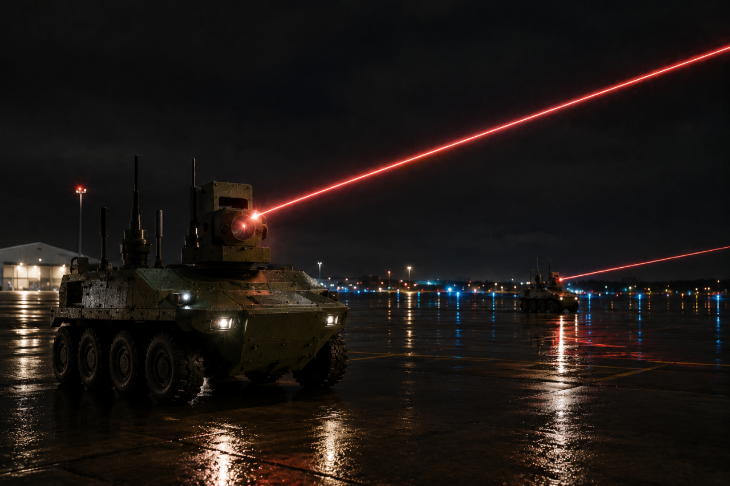
Launched in September and open to UK-based innovators, PANOPTES sought an integrated counter-drone force protection system that could operate autonomously from an Army vehicle and later move onto an uncrewed ground vehicle, targeting cheap and massed aerial threats without draining stocks of conventional munitions. Laser directed energy weapons were the preferred effector, although other novel approaches were allowed, and the ministry put the indicative wider value at £125 million excluding VAT while stressing that this was not an approved budget, as we reported at launch. The first phase was intended to help firms mature existing technology towards a deployable system, initially against Class 1 drones.
The Defence Investment Plan commits £490 million to directed energy weapons over four years, but ministers have declined to say which systems beyond the Royal Navy’s DragonFire laser are being developed, with Luke Pollard, Minister for Defence Readiness and Industry, telling Parliament in August that further announcements would be made when appropriate. In June, Lord Coaker, Minister of State at the Ministry of Defence, said the government was committed to accelerating the development and deployment of directed energy weapons to counter low-cost drones.
The Army has already fired lasers from vehicles. In October 2024, a high energy laser demonstrator developed by Team Hersa, which includes Defence Equipment and Support, Dstl and a Raytheon UK-led industry team, destroyed hovering drones from a Wolfhound at Radnor Range in mid-Wales, and the ministry sought vehicle-mounted lasers able to kill small drones at a kilometre or more the following June, with up to £20 million available.