

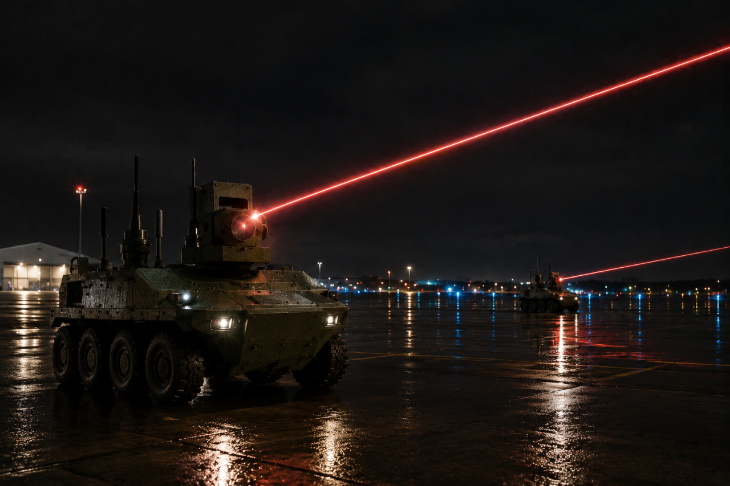
Britain is seeking counter-drone technology that could lead to autonomous laser weapons mounted on Army vehicles and, later, uncrewed ground vehicles, with £5 million available immediately through a new Ministry of Defence competition, the department has said.
Project PANOPTES, launched by UK Defence Innovation on behalf of the MOD, is intended to develop an integrated Counter-Uncrewed Aerial System force-protection capability able to deal with massed and low-cost aerial threats without rapidly exhausting conventional ammunition stocks.
The MOD stated: “Defence seeks additional capacity to detect, track, identify, decide and defeat mass and low-cost threats in a cost-effective manner and without being overwhelmed or exhausting stockpiles. This is particularly acute for deployed land forces, but the problem is applicable to the protection of defence fixed infrastructure in the homeland.”
Although the competition is open to a range of technologies, laser directed-energy weapons are specifically identified as an area of interest. The MOD said: “Based on research, the Authority is particularly interested in capabilities centred on Laser Directed Energy Weapon (LDEW) effectors but is open to submissions relating to credible alternative novel approaches.”
The intended configuration would place the counter-drone capability on a military ground platform. According to the procurement documents: “To address the challenge described above we are looking to deliver an integrated C-UAS force-protection capability capable of autonomous operation, mounted on an Army vehicle.”
The system is intended to protect deployed forces against complex and saturation attacks involving small uncrewed aircraft, including simultaneous threats designed to overwhelm local air defences or force troops to expend comparatively expensive missiles and ammunition.
The MOD stated: “The capability should protect deployed troops against complex and saturation attacks designed to overwhelm existing defences or deplete conventional munition stocks. It should deliver more affordable combat mass against emerging air threats than legacy systems, and should exploit open architectures, platform-generated power, modular design and capable of autonomous operation.”
The initial threat focus covers representative Class 1 UAS and other small aerial targets. These could include individual drones as well as repeated, sequential or simultaneous attacks used for surveillance, targeting, disruption or attempts to exhaust defensive systems.
A later objective would move the capability onto an unmanned ground platform. The MOD stated: “Integration of the capability onto a future uncrewed ground vehicle (UGV) is a planned objective. The solution should provide a scalable pathway towards future Army and Joint Ground-Based Air Defence (GBAD) capabilities as well as considering possible export opportunities.”
UK Defence Innovation has confirmed that Project PANOPTES is open to UK-based innovators and that a share of £5 million is available immediately. Stage 1 will act as an initial screening process, with applicants outlining their proposed technology before successful teams are invited to develop more detailed proposals.
The first phase is not intended to produce a complete operational counter-drone system. The MOD said: “The scope of Phase 1 is to identify and support organisations to accelerate development of their existing technology towards a final deployable system. It is not intended for the Phase 1 competition to seek delivery of a complete operational C-UAS system.”
Successful technologies could then be matured through later phases into demonstrable Minimum Viable Products before selected systems are developed into Minimum Deployable Capabilities for an initial operational user group.
The notice states: “Capabilities that demonstrate operational benefit may subsequently be developed further for wider adoption as part of a future Programme of Record.”
The wider procurement has an indicative value of £125 million excluding VAT, rising to £150 million including VAT. That figure is not an approved programme budget. The MOD stated: “The stated figure in this notice of £150,000,000 inc. VAT is aligned to the current understanding of the Strategic Defence Review, but this does not mean that this funding has been approved and is an indicative figure only.”
Stage 1 submissions are due by midday on 23 September. A launch webinar will be held on 9 September to provide potential suppliers with further information on the operational requirement before the competition moves into its subsequent stages.












They have looked at how much a single dragonfire costs currently?
Just buy Tridon and be done with it. Cheaper, currently better, no new tech needed.
Not exactly future proofing, is it? Tridon is a good quick response to the threat but it’s still got a lot of limitations and certain downsides (for example, throwing out lead over a potentially populated area) that lasers won’t have. There’s more space here for progression in the future. It’s similar to the drone fleet concept – it’s not enough just to think about what works now but what will be able to work 10, 20, or 50 years from now.
Boxer springs to mind as the most obvious platform. Keep production going and shared maintenance.
Do you want to bankrupt yourselve?
Maybe a supacat vehicle. HMT 600
Would that provide suitable crew protection? These platforms will be targeted by FPV’s.
There’s an enclosed cab option. Also, it is meant to be an unmanned vehicle. TBh, I think they will want something smaller.
If the Babcock & Patria 6×6 ever proposal ever comes to anything it would be ideal, certainly better value for money than boxer could provide.
With current government hostility and commensurate rise in anti-semitism particularly on the Left. I hope that if approached. Israel refuses to supply the UK plus withholds any defence equipment currently due. Call it reverse BDS.
What is the use of buying something like this? The Army has been told by government to stop doing
training that’s not a priority to save money.
This government is useless and unfit to rule this country.
The Army has to train for all unexpected events that could effect our country and the population of the UK citizens.
If the politicians are not careful enough our armed forces should go on strike until they started to respect what the armed forces do for this country.
None of the parties are fit to run the country and haven’t been for a while now.
I might have missed something, but how are they planning to power these? I thought the reason they are planned to be fitted to ships was so they could take advantage of the power plant. Not sure how this would work on a small vehicle.
Some type of Dragonfire system on uncrewed Warrior?