

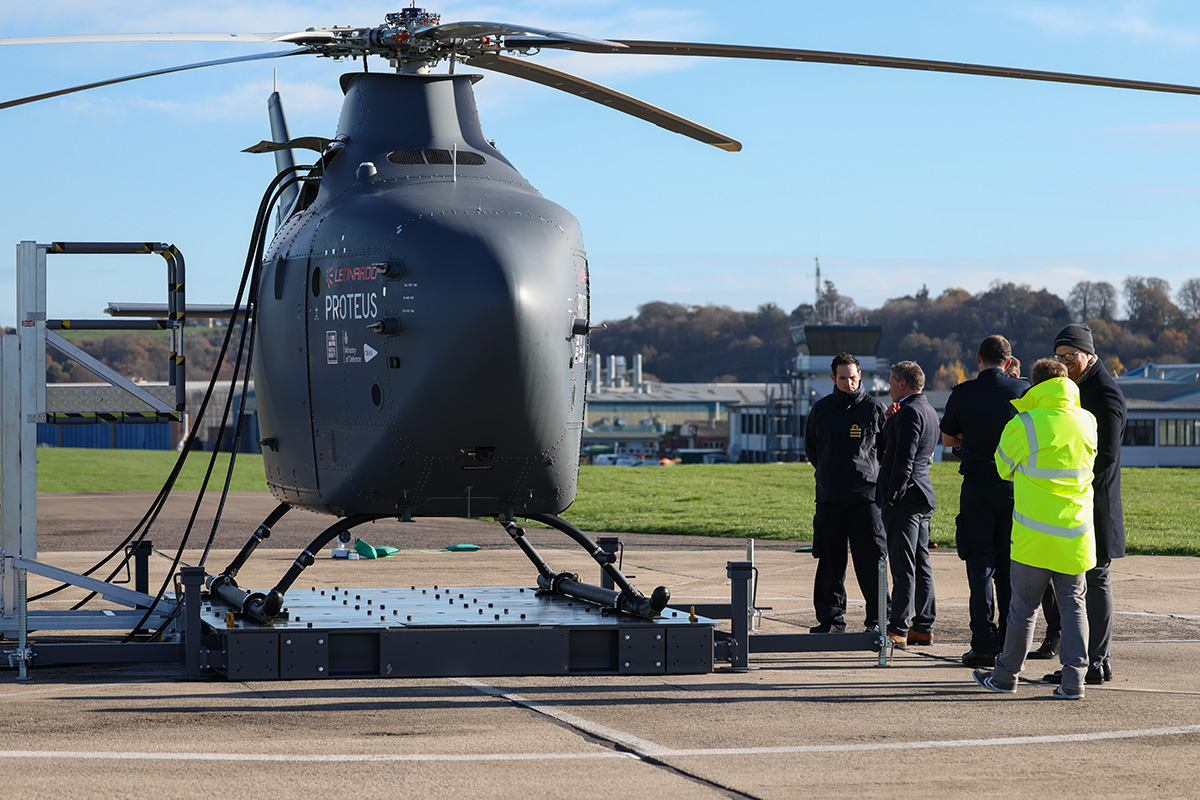
The Royal Navy’s first full scale uncrewed helicopter has moved closer to flight after completing engine, systems and rotor tests at Leonardo’s Yeovil site.
The aircraft, known as Proteus, is the size of a conventional helicopter but operated through remote tasking rather than direct piloting.
Leonardo developed the technology demonstrator in under two and a half years under a sixty million pound programme. Defence views it as one of the earliest attempts to field a medium lift autonomous vertical take off and landing aircraft. The aim is to understand how uncrewed platforms of this scale should be designed and how they could operate alone or with crewed aircraft in a future hybrid air wing.
Senior officers and Ministry of Defence specialists attended the ground running event and were briefed on the software, sensors and artificial intelligence functions that underpin the aircraft. Captain David Gillett, who leads maritime aviation and carrier strike development for the Navy, said the programme reflects close cooperation across defence.
“It’s been a huge pleasure to work with Leonardo and across defence, as one team, to deliver Proteus,” he said. “It combines cutting edge technology and the experience of recent conflicts and has significant potential to shape the Navy’s future hybrid air wing.”
Leonardo’s UK helicopters managing director Nigel Colman said the firm is pushing the boundaries of autonomy and highlighted the aircraft’s maritime design parameters. “Proteus is equipped with advanced onboard software, carrying sensors and systems that allow it to sense its environment, make decisions and act accordingly,” he said. “All of this processing is conducted onboard the aircraft, including in high sea states and strong winds.”
The demonstrator can carry around one tonne of payload and is being positioned as a flexible platform for surveillance, logistics resupply, intelligence tasks or weapon carriage. Its initial assessment focuses on anti submarine warfare. Proteus will be assigned patrol areas and integrate information from ships, submarines, aircraft and fixed sensors to improve detection performance. It will deploy sonobuoys, analyse acoustic signatures and pass findings to a mission commander.
While Proteus is not flown by a pilot, an operator always controls the system within approved safety limits and the rules of engagement.



Good news.
Now let’s hope that Leonardo then transfer over into a productionised helicopter rather than just focussing on the autonomy software, as they were suggesting/threatening at DSEI. It sounded at the time like they didn’t even want to do a prototype and instead wanted to do everything with Digital Twins.
Hard to know what to make of this.
Two and a half years is a long time in today’s tech paced society.
Suggests that it was t put together from MOTS or COTS bits.
Yes. I was worried about this. They even said that they didn’t think the drone was optimal for the task, so I think they want another bite of the cherry. I hope the RN perseveres with what they have here and get some actual operational experience under their belts before doing another round. I know this is only a demonstrator, but it can be useful and should be used. Minimal viable product and all that.
why not invest in the VSR700 instead? it’s already been trialed and tested
That’s a way smaller helicopter
Because that has a Mission payload of 110kg… The Proteus here has an aimed Mission payload of 1500kg.
An exciting time and just the beginning!
Now that is a very big drone – maybe too big however ? Takes up as much hanger space ass a conventional helo and I wouldn’t think much use on an OPV , Peregrine better suited perhaps?
I’m always shocked at how big some drones are, like the reapers. In my mind they are small but when you see a photo of them next to a person it really shows how big they are.
Yes it takes up as much space as a Helo because that’s what we want without the crew element. It’s intended to carry torpedos or sonar tools, you’re not doing that on a peregrine
I suspect this is why the medium lift rotor contract is so up in the air.. the MOD are deciding how many future medium lift are going to end up drones..
To be honest this is the future of rotor aviation sovereign capability in the UK.. because the army and navy will want a fair few of these sorts of platforms for various things.
At 3 tons MTOW and 1 ton payload, Proteus is definitely a lightweight as helicopters go, and still is just a demonstrator. They’ll need to do a lot of work and pondering to get this operational, so waiting on understanding how to integrate drones like this for decisions on NMH is just procrastination. I’m wondering if that might also be waiting on the “NATO” next gen rotor project, which is also supposed to have the three studies conclude this Autumn, and a decision made within a couple of years. It might well come to some conclusions before Proteus does, but it’s still not aiming for delivery before 2035-2040.
Morning Jonathan, I think you are right. But I don’t think its a sovereign capability as such.
As the Government have no intention of uplifting defence spending by a significant amount, I would say these is no money in the pot for Medium helicopters. That can will be kicked down the road until the mis 2030s and combined with Melin replacment. We will get a small uplift in Chinook probably.
I don’t see a bespoke UK solution here either, with a Vertical drone , this will end up being an off the shelf solution. GCAP will be sucking huge amounts of money annually and there simply won’t be money for reinventing the wheel.
Basically, if we want a balanced military capability, incorporating as much national capacity as possible, then it needs substantial development funding.
Our government has shown they have no intention of paying that tab.
So we have to concentrate on sovereign Warship/ Submarine and Military systems development and buy off the shelf for everything else.
2.5 years and still no closer to actually handing over a ‘fleet’ of these things! Sounds about right really. Military contractors are in the business of making money, pure and simple.
No doubt this ‘thing’ could have been rolled out way before now but in reality, the defence industry exists to explore technology, create jobs and make vast profits for their companies and shareholders alike. So clearly it is not in their interests to work ‘at pace’ is it.
Two and a half years? This is the third phase of the project which started in 2013. However, this was the first phase given significant military funding so I think you overstate the case.
Evidence if it were needed as to how sloooowly the defence industry works. Good job there no conflict on the horizon!
In isolation, sounds great… but Sikorsky have already unveiled the U-Hawk, an autonomous or remotely piloted conversion of a full-size Black Hawk.
This is meant to be going on frigates for the primary role of anti-submarine warfare with changeable payload modules. I think it’s meant to complement Wildcats, so it would need to be small. We can also export it.
Did you bother to read what I posted before I commented? Did I suggest at all that we should buy the U-Hawk?
No, I was pointing out how far we are behind be comparison. The Yanks used an existing proven airframe. Leonardo cobbled together a demonstrator instead of using an existing medium-lift airframe.
The U-Hawk can be flown remotely or autonomously, whereas Proteus doesn’t have autonomous capability.
Finally, no this is “not meant to be going on frigates for the primary role of anti-submarine warfare”. It’s only a DEMONSTRATOR, and not planned for mass production. 🤦🏻♂️
Wow, what a condescending prick.
Everyone’s entitled to be condescending to idiot that pretends he’s not, when he knows not.
If I’m a prick, you must be a pussy, because I’ve f@cked you on this topic.
Ok, even if it is a demonstrator, it’s based on the Leonardo Kopter AW09. And from the marketing material I have seen is that the U-Hawk is the cargo variant with the front that opens up, which hasn’t been flown and is still a demonstrator. They have flown an autonomous Blackhawk but not the U Hawk.
Doh! The difficult built is the autonomous flight; which Sikorsky has been doing since 2022, not the ripping out of the human-related gubbins. 🤦🏻♂️
Very big for a drone. Likely there’s a guy hiding in there driving it, just like in Knightrider
What! Knightrider wasn’t real?
He was, ignore fake news.
If Leonardo/RN want to keep the same footprint as Proteus, but increase its max take-off weight. One way of doing this is to turn it into a coaxial, as this can increase the lift by 25 to 35% on the same engine power. A bigger engine will increase lift further. A coaxial is also better suited for maritime ops as its more responsive when taking off, hovering and landing.