

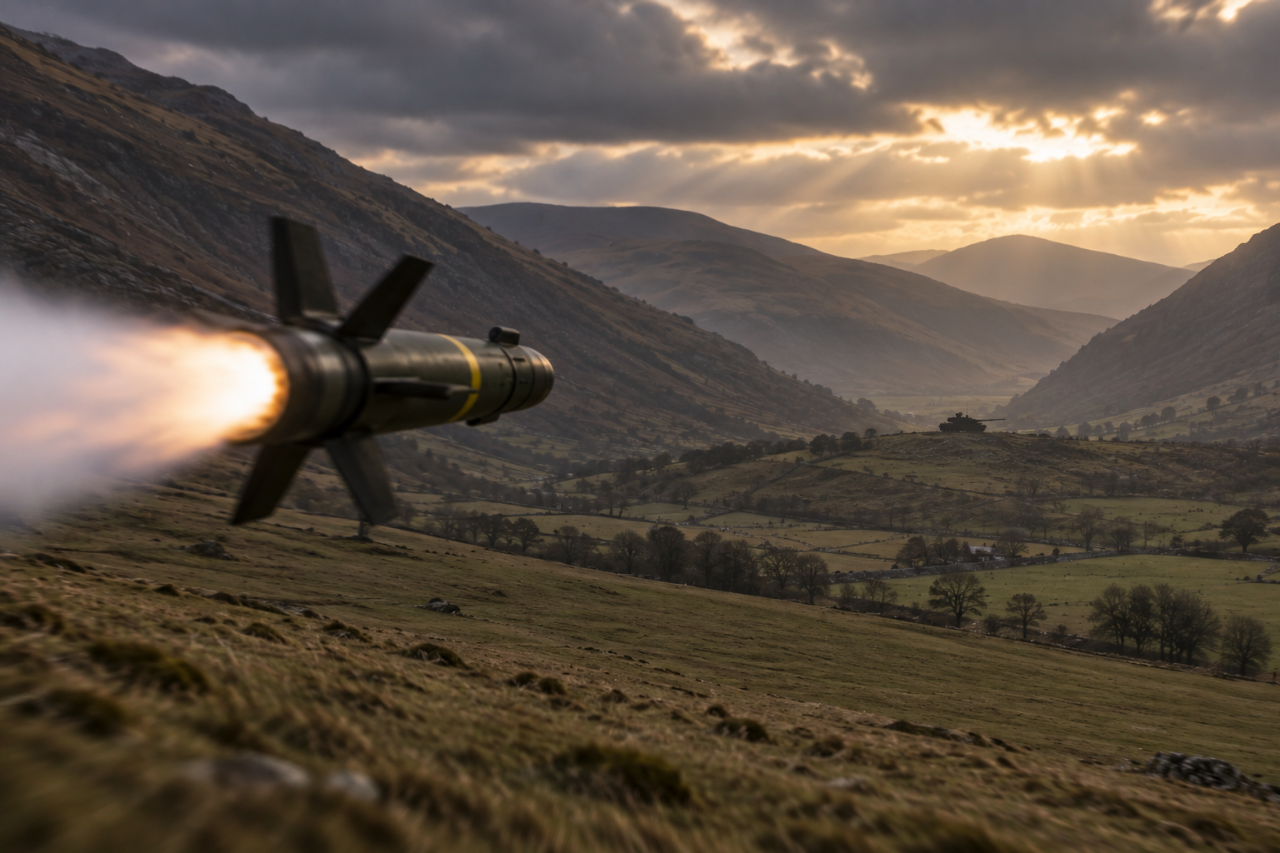
The British Army is moving to restore a beyond-line-of-sight anti-armour capability more than 30 years after Swingfire left service, with MBDA and Thales awarded contracts to explore a new weapon system, Defence Readiness and Industry Minister Luke Pollard has announced.
Speaking at DVD 2026, Pollard said the work would examine technologies for a weapon able to engage armoured targets beyond direct line of sight, improving the ability of British land forces to strike from greater distance while reducing their exposure on the battlefield.
He said: “And thirdly, I can also announce today that we have awarded contracts to MBDA and Thales to explore how we can develop the tech behind a new beyond-line-of-sight anti-armour weapon system, a capability that the British Army has not had since Swingfire, left service over 30 years ago, a capability that can drastically improve the ability of our land forces to strike and survive on the modern battlefield.”
Swingfire was a wire-guided anti-tank missile developed for the British Army and notable for its ability to turn sharply after launch, allowing the firing vehicle to remain concealed while the missile was guided onto a target from another position.
Its withdrawal left the Army without an equivalent long-range ground-launched anti-armour system able to engage targets beyond direct line of sight, with more recent anti-tank weapons generally centred on shorter-range engagements.
The new work with MBDA and Thales forms part of the Army’s wider Recce Strike concept, which is intended to combine surveillance, targeting, drones, armoured vehicles and longer-range weapons into a more connected force.
Pollard described the approach as being built around “better targeting, better battlefield surveillance and more lethal long range fire”, with the aim of improving both the speed and effectiveness of targeting.
The Government is committing more than £19 billion to land warfare capabilities over the next four years, alongside £11 billion for weapons and ammunition.
That includes £190 million for short-range ballistic missiles, £400 million for inexpensive one-way attack drones and weapons, and £220 million for Project Nyx, which is intended to develop armed autonomous aircraft capable of operating alongside Apache attack helicopters.
Another £370 million is being spent on Project Asgard, the digital command-and-control architecture supporting the Army’s Recce Strike model.
Pollard said: “That’s about improving the lethality and delivering against CGS’s 20:40:40 strategy, which has been baked into the Defence Investment Plan. Now, that will be collectively a higher resolution picture of the battlefield and increase the effectiveness and speed of our targeting.”
The new anti-armour work is also being tied directly to lessons from Ukraine, where long-range fires, drones and distributed targeting have changed how armoured forces are detected and engaged.
Pollard said: “Now, these are just three procurements that will not only demonstrate how we’re evolving operationally in response to the lessons from Ukraine, but they’re programmes that demonstrate how we have reformed our procurement processes in response to what we’ve learned from our friends in Ukraine.”
The MBDA and Thales contracts are therefore an early step towards restoring a capability absent from the Army for decades, while fitting into a wider effort to connect reconnaissance and long-range strike more closely across the land force.

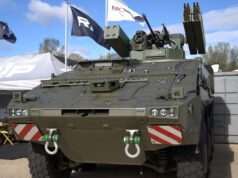








Does this suggests that Brimstone overwatch has now been canned or could that still be the offer from MBDA ? Thought Brimstone (Land) was still up and running and operationally proven in Ukraine ?
Deemed too expensive or does Ukrainian feedback say it isn’t as effective as hoped ?
I’m not sure where this announcement fits in with Project Wolfram? Which is a proper integration of Brimstone with a ground vehicle, with suggested vehicles ranging from Boxer, HMT600 and even the MAN HX6. From my understanding Brimstone has been very effective in Ukraine. Since 20252, Ukraine has used Brimstone in the traditional anti-armour role, but also to target key buildings, being used for drone control centres, HQs etc. Brimstone was created with halting a significant Russian advance when trying to cross the river Siverskyi Donets. It was credited with taking over 40 vehicles, ranging from MBTs to bridge layers. Where its used against the bridge layers caused the Russians to retreat. I believe the main issue is there ‘s not enough Brimstones or vehicles mounted with it.
The UK supplied Ukraine with both Brimstone 1 and 2 for surface launch, fitted to the HMT600 chassis. The Brimstone 2 is credited with a range of around 20km, whilst the earlier version is about half that. Brimstone would easily fulfil the UK Army’s long range anti-tank strike and beyond line of sight requirement.
Or could be replaced by something cheaper and just as effective. Brimstone is great, but isn’t the latest iteration capable of both being launched from a Typhoon and a ground launcher?
Maybe there’s just a need to make the casing work for the short flight it’s fired, not the high speed flight of air launch facilities.
Interesting. It seems that MBDA has indeed put Brimstone 3 forward as an option for this programme. However it’s true to say that it is (based on Brimstone 2 figures) almost twice the weight and of course far greater range than Swingfire ever had. It has been very effective in Ukraine used against serious threats, but really is a gold plated weapon not a mass expendable one which clearly that conflict has demonstrated is needed while beyond short range ‘last ditch’ weapons. So I do wonder if it is deemed, whatever the purchase status/proposal for Brimstone 3, that an intermediate and cheaper solution between NLAW short range and Brimstone long range weapons with capabilities and range between the two, is required for bulk purchase that might be based around base missiles such as Martlet if it’s Thales. Apart from Brimstone not sure what MBDA could offer beyond Akeron. The thinking makes sense mind, Brimstone just can’t be expended at the rate that will be required while NLAW is too limited.
As long as it’s cheaper than a tank then with Brimstone’s kill rate it’s still a positive cost exchange. Might not be though, with Russia’s continued use of museum pieces.
Brimstone is one of the few complex missiles we actually build in bulk, so expanding its use across the Army (why oh why did we choose JAGM for Apache?) will bring the cost down for a very handy capability.
Like so many programmes, the issue was in getting the missile integrated onto the Apache. Going forward, any platform that isn’t open source architecture that can plug and play any missile , should not be bought.
We could have done this a decade ago. It was suggested when Brimstone was first being developed in the 1990s and first formally proposed by MBDA in 2018. Since then Brimstone has been designed onto a vast range of vehicles. What’s changed now?
Plenty of platforms which MBDA have put brimstone on, Ares, Supacat, Boxer, all have potential depending on where they will be used in the OOB. Ukraine really has got people thinking (remembering) and understanding the problem we would have in a real kinetic war against a peer enemy! It’s about the ability to find, kill (at a distance preferably) and move before you can be killed! Pretty fucking simple really!
Totally agree mate. For the life of me I can’t understand the Army’s rationale of not fitting a guided weapon to an IFV. I think the usual mantra is, IFVs are not designed to engage MBTs. Which totally misses the point, that an IFV with a guided weapon, would then have a means of taking on an MBT if the opportunity arose, or as per Ukraine’s experience, an MBT that pops round the corner of some buildings, when you weren’t expecting it, you would have a means of attacking it whilst looking to withdraw.
Spot on mate, Ukraine has turned quite a bit of doctrine on its head, and as platform numbers reduce we should be looking at making as many as possible capable of offensive action! Like you said, giving more options to the local commanders, as you are looking at (for example) extracting at best speed to avoid trouble! 👍
As a least one Bradley has taken out an MBT let alone numerous enemy fighting vehicles with merely its cannon, one can only imagine the capability of something similar with anti tank missiles with reasonable range and non line of sight capability especially when operating with drones which many more flexible vehicles could more effectively operate than a MBT likely could. In many such s enarios I suspect Brimstone would be overkill and as such a simpler, cheaper weapon should be available as I suspect t this project recognises. I would guess combinations like Starstreak/Martlet have shown the way ahead and a similar line of thinking might be being explored for more effective ground attack options giving as much flexibility as possible.
Bradley also had TOW fitted as well
Trust a Para to.put it like that ! 😂👍🇬🇧
Most kind mate 😂👍
Could it be that Brimstone is not long range enough?
I believe that on ground based launchers it can only cover around 6 – 8 miles?
It depends on the version of Brimstone. The range you’ve quoted is about right for the 1st version. Brimstone 2 and 3 is roughly double that, when surface launched.
The question is, what is the minimum and maximum effective range required to engage targets?
What is also interesting is that Luke Pollard said: “awarded contracts to MBDA and Thales, to explore how we can develop the tech behind a new beyond-line-of-sight anti-armour weapon system.” Which to me means that they’ve called for something other than Brimstone to fulfil the requirement.
If the Brimstone technology can be miniaturised further then a more compact version would be nice. It’s apparently at the absolute upper limit of what can be loaded by hand, which is all fine at an airbase but less so on the front line.
Also the shallow launcher slant might be a problem as it doesn’t have Swingfire’s turning ability. Something closer to VL would help, but that would again push out the minimum range.
I suspect if anything it’s considered too heavy and long range in its latest version 3 specs, if a true swingfire replacement is being considered, it’s nearly twice as heavy after all. I think judging by the latest moves to supplement long range strike with cheaper more flexible options that’s the outlook here too to provide mass and the capability for any particular vehicle to operate more missiles, or be more compact. With drones around I suspect it’s seen the less time and effort you have to put into replenishment the better. If a smaller cheaper missile can do the job 75% of the time then you definitely want to have that available and use that than a more supremely capable alternative for those scenarios.
Also the only time a Brimstone missed its target in its ground/sea launched tests was when the range was too short for the target to be acquired.
Swingfire only had a 4km range.
Haha. There was Exactor which was the Israeli Spike in an older version it was.
This is basically a “copy” of Spike NLOS function current version 30km from land 50km from helicopter. They are also in service with USMC and US Army helicopters.
It was so bad we called it “aproximator” on ops.
Now it is considered the best, there were some issues in older versions, this is why the UK actually took part in funding the spike NLOS development
Wiki says you bought version 2, 4 and 5,current one is 6. Version 2 should have been pretty old, maybe 80’s-90’s and was not even called Spike originally.
My first thought is Brimstone costs too much. At 100-200k per missile, it’s a lot more than nlaw for example at 30k.
NLAW has a range less than 1km, plus it doesn’t have a seeker, just a proximity fuse. Meaning if NLAW is used against a moving target at its maximum effective range, which then suddenly stops. The software used to predict where the target will be x seconds, won’t be able to compensate for the location change. As soon as you add a seeker, the price ramps up considerably. Especially for something like Brimstone, where it uses both an active radar and semi-active laser homing sensor to identify, track and home in on to the target. Not to mention Brimstone can also communicate with other Brimstones, to reduce duplicating an attack on a target, but also to designate points on the target to attack. It’s this complexity/capability that adds to the cost.
Exactly, it’s overkill for many situations while NLAW is far too limited and short range. Something effective but cheap as effectively possible is required I suspect if mass armour is still considered a threat and you barely retain a tank force.
Agree, Brimstone is probably overkill, but it’s available now if needed. Luke Pollard’s statement above doesn’t really say what they are looking for in regards to an effective range, except something that is beyond line of sight capable. Which could be interpreted in many ways. MBDA France have produced Akeron, which is a “5th Gen” anti-tank guided weapon, that uses both an IR and visual sensor to detect and track targets. In trials it has hit targets out to 5km or just over 3 miles. But MBDA class this as beyond line of sight, as it can also use a fibre-optic to control its flight and communicate back to the operator, for attacks on targets behind a tree line or over a hill for example.
Akeron however hasn’t got a much greater effective range than the original Swingfire. Akeron weighs around 15kg, whilst Brimstone that can go significantly further, is around 50kg. So perhaps something in the middle is needed, something in the 30kg range? Where it has a similar range to the original Brimstone when surface launched of around 10km (6 miles). The cheaper option for sensors would be to follow Akeron’s, where it uses a Dual-band seeker (infrared & visible low-light TV) + fibre-optic datalink. Which to be honest is probably good enough for most threat scenarios.
This requirement kind of matches what the Akeron LP can give, which is a scaled up version of the basic Akeron originally designed to be launched from aircraft, though they’ve also shown it fitted to vehicles. It also adds a semi-active laser homing capability and pushes the effective range out to 8 to 10km depending on the target (in motion vs stationary). Though I believe it looses the fibre optic and replaces it with a RF datalink. Judging by the way both sides are using fibre controlled drones over longer distances, could it be reinstated? It’s main downside compared to Brimstone is that it is subsonic rather than supersonic.
If you wanted a similar capability to Swingfire’s 90 degree turn. There is the option of fitting the weapon with rear mounted reaction jets, as per CAMM. Not sure how that would work when fired near horizontally rather than vertically! It would definitely add complication and cost. But would mean you could use a crate of the weapons, stacked vertically and wouldn’t have to point the weapon at the target to engage it. Thinking about, it could also mean the shooter and the weapon can be separated by some distance, making it less risky of return fire. Didn’t Swingfire have this option?
One of the key requirements is target flexibility. Much like Brimstone whose target set expanded beyond its original anti-armour requirement. This weapon must be capable of engaging multiple types of threats. Ranging from anti-armour using a tandem charge and top attack options, to lowish speed air vehicles (helicopters/drones etc), any other unarmoured ground vehicle, fortified infrastructure with low collateral damage and even maritime targets.
Do the newer versions of Brimstone actually communicate? I thought that they were just assigned before launch to go for different targets in the order that they were detected. The talking to each other and deciding on the fly was for Spear.
Yep, they do when launched in a pack, Spear-3 builds on this.
Good they are exploring options. A contract for x number of systems sat on x vehicle would be nice, one day.
Money is so short the same Minister was pretty much admitting Stormer will remain in service longer as no money for a CAVS order the other day.
Different role, sure, but reality.
So lets see this in perspective. It’s very early days.
Meanwhile, the BLOS system the British Army DID HAVE I read has been quietly withdrawn.
Exactor.
👏
Blah blah blah from the king of talking not doing.
Mounted on a Boxer? or Ajax based?
With the rise of USV and them being used so effectively by Ukraine but now by the Houtis and Iran isn’t there a case for Brimstone (Sea) to be made again ? I remember seeing a really impressive vid of it being used to defend an oil platform or some such structure against a multiple attack by jetski or FIAC as known back then . Seems like the perfect upgrade for the Batch 2 River’s to I’ve them a real role. You could mount 2 x 8 canister launchers on the aft end of the OPV without impeding flight deck ops or even 4 x 8 totalling 32 at a splash. Add a Bofors 40mm Mk4 on the front and you would have a pretty potent little ship. Oh sorry , I forgot , we don’t need vessels manned by sailors anymore , the whole future is hybrid and that means totally unmanned – not even minimally manned is the way we’re going to go 🏴👎🇬🇧
I believe it was called Sea Spear. There is a definite need for a low cost “effector” that can be used against manned FAICs and USVs. Martlet was chosen for this role, but so far can only be used by Wildcats, which is an obvious mistake. I have never understood the Navy’s reasoning for not integrating other weapons on to the Merlin. If that is your only air asset, why aren’t you using it to its full potential?
The issue with Martlet, is that it is not fire and forget, it uses a form of semi-active line of sight (SACLOS) command guidance. Meaning it can only engage one target at a time. Which is great if there’s a relatively small number of threats, but not if facing a large swarm. Technically you could use incorporate a LIDAR into the guidance, which would then allow multiple targets to be engaged. But I have a feeling the optics used for LIDAR won’t be robust enough for shipborne use.
The advanced precision kill weapon system (APKWS) version 2, is getting an infrared sensor to give it a fire and forget capability. Where the laser initial guides it towards the target. The IR sensor collects data on the target, then uses that to steer towards it. The problem with this is that for surface launch, its maximum effective range is about 6km (<4 miles). So for a ship it would be a pretty last ditch defence.
Which is where you really need a fire and forget weapon. Where you can designate targets, press the launch command, the computer manages the allocation of threats to weapons and the weapon does the rest once launched. Therefore the weapon as a minimum will need either an active radar seeker or a passive infrared sensor and ideally includes a data-link, to make sure it is heading towards the correct target, where if its not, can then be commanded to steer towards the correct one.
Brimstone seems to be the obvious answer, its significantly cheaper than a Sea Venom, which would be a massive overkill against FAICs and USVs. Its active radar can be used in all weathers without serious degradation. Plus it could engage targets out to the ship's visual horizon. It flies supersonically, meaning its time to target will be quite short. The US JAGM which is replacing Hellfire, itself a mirror of Brimstone (but with shorter range), is being integrated on the USN LCS. Where they are fitting 24 VLS JAGMs. Specifically as a means of defending the ship against FAICs and USVs. If the USN believes JAGM makes sense in this role, then surely Brimstone is just as suited, if not more so due to its longer range?
Indeed Brimstone was proposed for that role but the US decided to wait, using Hellfire as a short term option while they produced their own weapon. How very American.
This is really easy to solve👀🤣
Why are we faffing about…again!
A waste of taxpayer money, spike family covers all requirements and most versions can be acquired directly from EuroSpike Germany also most modern western IFVs turrets from Europe to Australia, fire spike missiles… thinking like Labour MP? go for Javelin or the French Akeron but develop something from scratch? a waste of energy in the wrong direction IMO
I suspect it will be a current or more likely adapted missile, it won’t be brand new I’m sure, though that doesn’t preclude delays and cost overruns.
They said some while ago they will focus on “high risk high gain” projects, this is clearly not the case
Indeed, since resources are scarse: i am looking at GBAD disaster what is the point of the developing another missile with a dozen km range?
I thought that the newly upgraded Apaches and their 64-at-a-time Hellfires was the anti-armour solution?
That is presuming that we still have some in the cupboard?
Not sure so few eggs in such a precious and arguably survivable basket would be the best way to go.
Is the overwatch role and Brimstone not a one trick pony? Would the role not be better done by a turretted 120mm mortar (Nemo etc) with a variety of amunition types? If longer range is needed, would a GMLRS type of option not be more useful?, LIMAWS with suitable rockets would have been ideal here.
I’m not sold on the dedicated overwatch idea using Brimstone (or a dedicated anti-armour missile), only works in a very limited set of terrains and tagret types.
The key phrase here is ‘moving to restore’, so just more kicking the can down the road.
Reality check, until there is a significant increase in defence spending, our Armed forces will remain in financial deficit and an endless cycle contracting, managed decline.
Strange decision. Swingfire wasn’t beyond line of sight. It could be directed by an operator positioned away from the launch vehicle but its guidance system was line of sight. So is Javelin which has in effect replaced Swingfire.
For true BLOS, Brimstone has been proven capable of selecting individual targets. So why not Brimstone?