

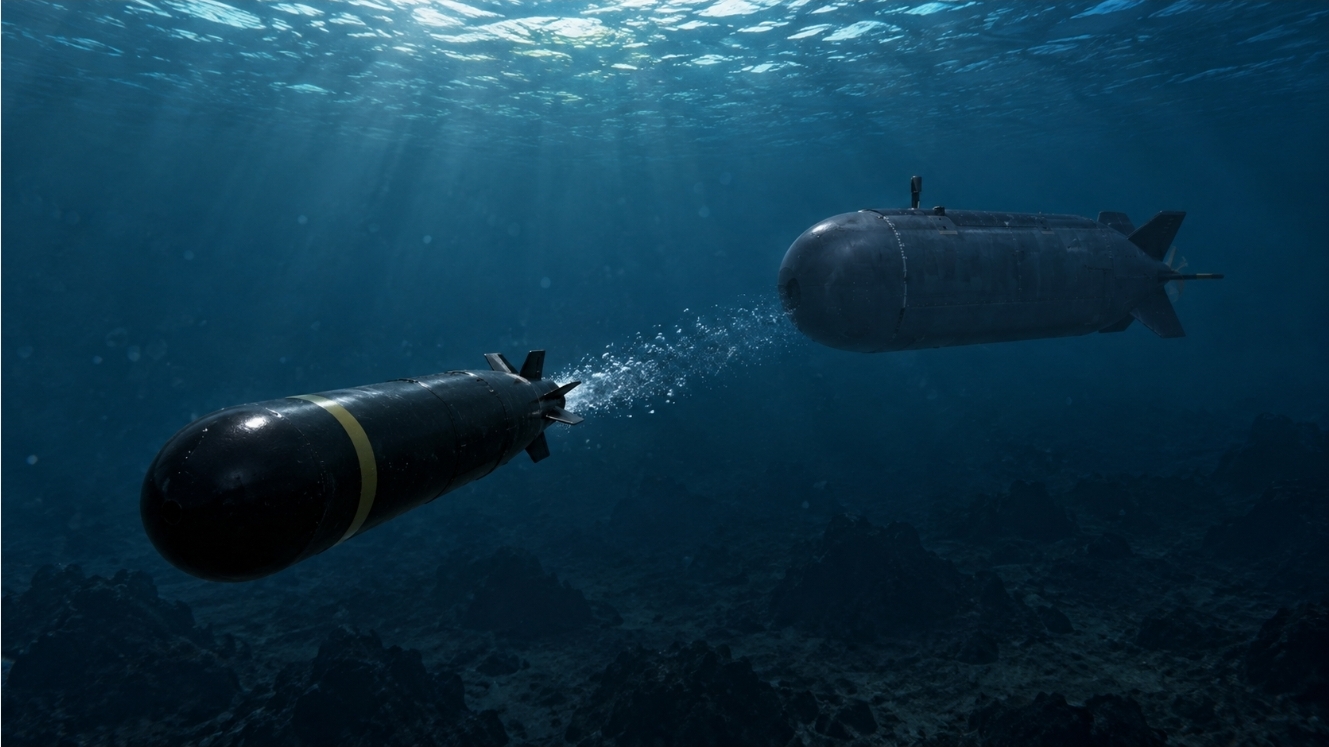
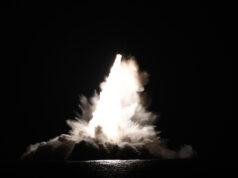
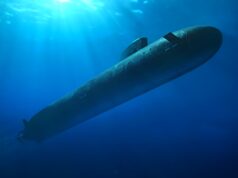
A Royal Navy extra-large uncrewed underwater vehicle has fired a US Mk 48 heavyweight torpedo during trials in Scotland, in what Britain and the United States say was the first launch of its kind from an allied autonomous underwater platform.
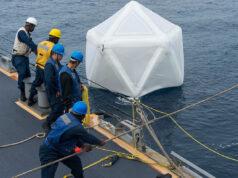
The proof-of-concept firing took place at the British Underwater Test & Evaluation Centre, or BUTEC, on 13 September, using the Royal Navy’s 12-metre XV EXCALIBUR vehicle and an exercise Mk 48 torpedo, according to the US Navy.
The British Government separately described the event as a historic live firing from a Plymouth-made undersea drone, saying it was the first time either the UK or US had launched a heavyweight torpedo from an uncrewed underwater vessel rather than a crewed submarine.
The trial was carried out under Project Broadsword and Trial Iron as part of AUKUS Pillar 2, with engineers proving the mechanical, electrical and software integration required to deploy an American weapon from a British autonomous vehicle.
US Chief of Naval Operations Admiral Daryl Caudle said: “This successful test marks a historic first for allied undersea warfare. Proving that we can seamlessly launch a U.S. heavyweight torpedo from a Royal Navy autonomous underwater vehicle validates our shared vision for true interchangeability.”
He added: “By integrating weapons, payloads, and mission architectures across allied platforms, we are increasing the flexibility, scale, and combat power of our combined forces and ensuring they are ready to meet the strategic demands of tomorrow.”
The Mk 48 is the US Navy’s heavyweight submarine-launched torpedo, designed for use against surface ships and submarines. The US Navy said the weapon used during the Scottish trial was an exercise torpedo, with the work focused on proving the interfaces between the weapon and EXCALIBUR.
The UK Government said the firing represented a major step in developing autonomous undersea strike capabilities and would feed into wider work between Britain, the United States and Australia.
Prime Minister Andy Burnham said: “Our work together already shows what can be achieved when our two countries combine our expertise and innovation.”
He linked the trial to a wider UK-US push on artificial intelligence and autonomy, adding: “That ambition is underlined in our new defence partnership with the United States on AI and autonomy, bringing together the brightest minds to strengthen the protection of critical infrastructure, deter those who threaten our security, and use the enormous potential of AI to our advantage.”
The proposed partnership will bring together the UK’s Rapid AI Delivery Taskforce and the US Department of War’s Chief Digital and Artificial Intelligence Office, with the two sides intending to develop interoperable AI and autonomous capabilities for tasks including the protection of sea lanes and airspace.
Vice Admiral Robert Gaucher, Director of Submarine Programs, said the torpedo firing was an early step towards adding offensive capability to autonomous underwater systems.
He said: “Demonstrating the launch of a US torpedo from a UK extra-large unmanned underwater vehicle (XLUUV) is an important early step in developing lethality in our undersea autonomous systems.”
Project Broadsword was approved by the US Department of the Navy Rapid Capabilities Office in February 2026 and reached the firing stage in less than seven months. The work involved the Royal Navy, US Navy, Defense Innovation Unit, Naval Undersea Warfare Center Keyport and industry partners.
Vice Admiral Seiko Okano, director of the Rapid Capabilities Office, said: “We are not waiting 10 years for a single bespoke platform; we are pioneering a modular, software-defined, open-systems approach that integrates allied hardware with commercial innovation to rapidly scale distributed lethality.”
Further work will now move into Project CUTLASS, using Anduril’s Dive-XL extra-large uncrewed underwater vehicle. That phase will examine payload integration, command-and-control architecture and tactical employment as the three AUKUS countries continue developing autonomous undersea systems alongside their crewed submarine fleets.



This is why SSK’s will become increasingly irrelevant. Very few things they can do that can’t be done by UUV’s at a fraction of the cost.
And the issues around having physical crews with lives to lead etc
The number of people who want to be a Fish Head is limited – some revel in it.
But the cost savings from, the reduced volumes from not having a crew moving around in it; of not having to make sub habitable; the reduced safety margins over those for a crewed sub.
Absolutely.
Hi SB, To me the big thing is what you gain by being unmanned is the dive depth it could go to. Imagine these out in the Atlantic, at 600m, lithium batteries, propulsion off, in a neutral buoyancy state, just gently, drifting in the current with a passive array streamed out the back. Every now and then it powers up on silent elector motors, repositions itself and repeats its silent watching.
If Japan can have an SSK with Lithium batteries stay submerged for a month, how long could this stay down ?
So far the idea of an Atlantic Bastion has been pretty well ridiculed, well IMHO this may well change that. Or take it one stage further and send them forwards into the water north of Polyarny, one sensing and teamed with others that hunt !
I do wonder just where this is going and in 10 years times will an SSBN be obsolete ?🤷🏻
The issue is getting them to communicate.
As I have said previously there are ways to get these to dial home periodically. But I cannot see how to coordinate a real time attack as you suggest.
The ocean is a huge place and covering it thoroughly even with this type of tech is non trivial.
Blue green laser comms could be the way forward.. a couple of hundred meters is thought to be possible..
It can move from the air water interface as well, if you have a swarm of large underwater autonomous vessel and a satellite constellation.. they could essentially communicate without possibility of interference, intercept or detection.. passing on targets along the net.
Essentially as long as you pick up the Russian SSN as it enters the Atlantic via the choke points you can essentially keep it boxed within an ever moving sensor web and as long as your web has a number of armed drones the SSN is screwed..
In the end the whole point of the Russian SSNs heading into the Atlantic would be to try and break contact or only have contact with the one tail that they can destroy because they would alway shoot first.. if they are stuck in a web, the shoot first advantage is essentially gone.
It would be a massive deterrent and I doubt Russia would push its SSNs into such a web as it sees the first role of its SSNs as protection of the SSBN bastions.. it will never consider an SSN as an expendable resource.
I have heard of blue or green lasers for decades. I do not have heard that it works.
There have been a lot of tests on these. The longest documented real-world oceanic test for a blue-green laser underwater communication system achieved a data transmission distance of 120 meters at a depth of 700 meters, conducted by the Japan Agency for Marine-Earth Science and Technology. So it’s a real thing and there have also been tests around air water interface for sat to boat tests.
ABCR,
Probably quite a while before humans removed from nuke release protocols.
I was actually thinking of their vulnerability !
Correct. UK expertise with subs will put us in an excellent position to drive this forward.
We should be able to produce these in quantity and still at a fraction of the cost.
“This is why SSK’s will become increasingly irrelevant. Very few things they can do that can’t be done by UUV’s at a fraction of the cost.”
Haha. Where that have been demonstrated?
Just now off the coast of Scotland 😂
Amazing
…extraordinary… you know all that by just firing a torpedo…
The United States is proving to be an unreliable partner. Why would the UK want to team up with a country that has openly worked against the UK’s defence interests?
How’s Herne doing by comparison.
They’re focusing on ISR, what with Thales’ new mast.
I’d like to see EXCALIBUR launch a StingRay torpedo as that may be able to be carried internally. Either way the issue would be sensors to set up a kill chain.
My question is why Mk48 why not Spearfish?
AUKUS, torpedos are not cheap, we supplied the sub they supplied the torpedo.
It could also well be an older mod5 or mod6 that are held for training purposes.
Apparently it seems to have been a 48 Mod 7…so a new fish.
It may simply be payload issues the MK48 is about 10% smaller and lighter that a spearfish.. about 400ibs lighter and 4 foot shorter.
I am certain that if this was as American sub they would have used a British torpedo…..coff coff.f35 coff coff
AA
Unless man in the loop control can be achieved by secure communication, this is a dead end. Allowing a weapon to be launched by an algorithm to risk starting ww3 is insane.
I expect that’s what they said about the aeroplane, or electric cars, or……
This is quite a serious thing.. but at present its range and endurance are still lacking, it can only really get to the western end of the Norwegian Sea and back.. with a 2000ish km range and 5 days endurance.. I suspend this is why the RN has not ordered more.
If you want a really effective system that would have the Russians utterly shitting themselves it would be A drone that could carry a heavyweight torpedo and have a range of 5000km with the ability to loiter on the seabed for a couple of weeks. That would having them in conniptions.. have a fleet of 30 and you have essentially screwed their entire northern fleet and the SSBN operations in the western hemisphere.
I do not see why… there is no data in real time to give a firing order