

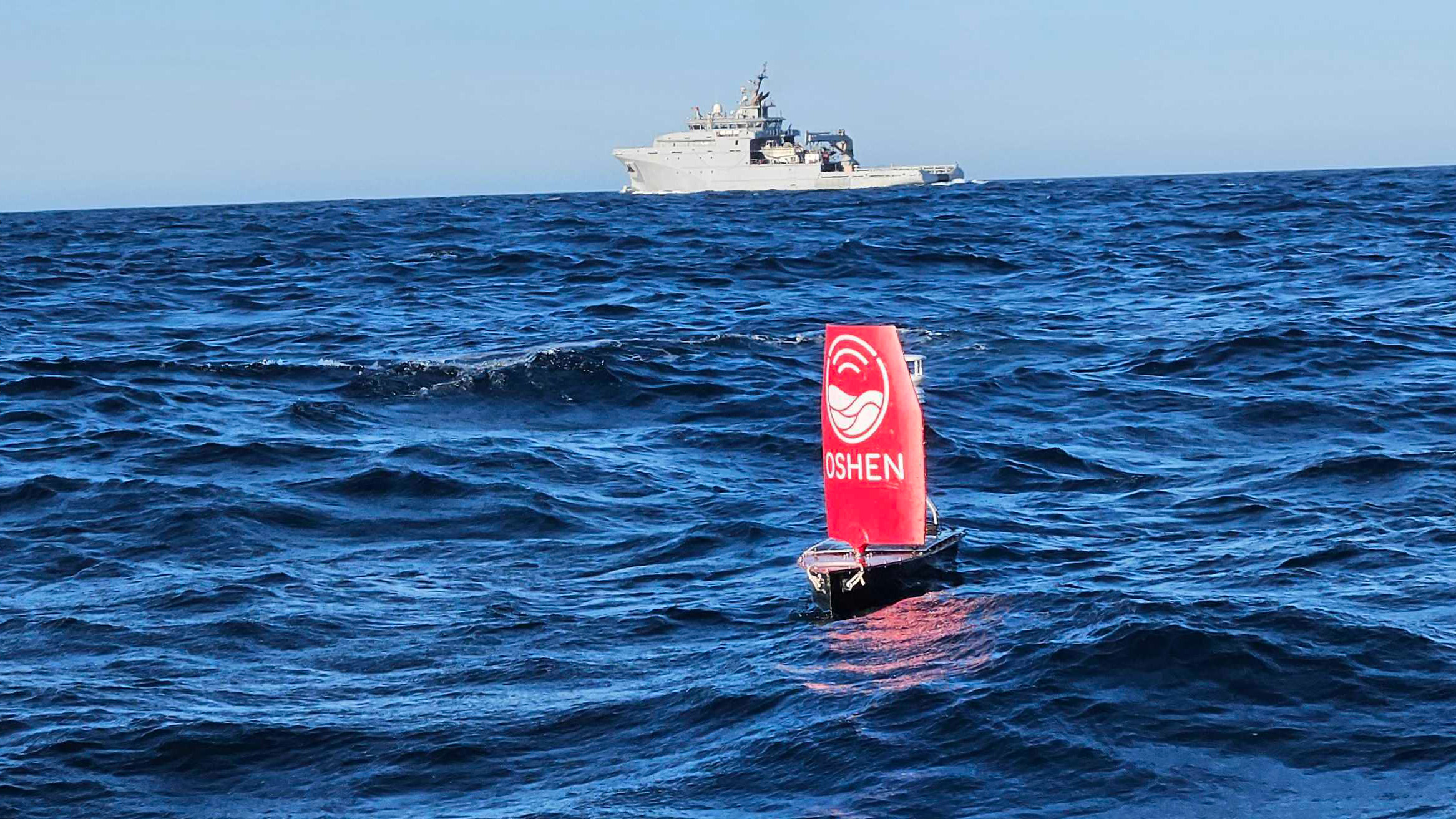
A British maritime technology company is testing a distributed anti-submarine surveillance network made up of six small robotic sailboats at the multinational REPMUS26 exercise in Portugal, with each vessel carrying a hydrophone and operating as part of what Oshen describes as an “acoustic picket line”, according to the company.
The 1.2-metre C-Star uncrewed surface vessels are being used together against live targets for the first time, with the boats spread across an area of water to create a passive listening network rather than concentrating sensors on a single ship or towed array. Oshen says the arrangement could allow operators to change the shape and density of the network as conditions change, while observations from several positions could help determine the location of a contact rather than simply its bearing.
Traditional passive anti-submarine warfare systems can use long towed arrays carrying large numbers of hydrophones behind surface ships. These provide sensitive local detection and bearing information but can be affected by noise from the towing vessel and are tied to the movement and position of a comparatively small number of platforms. Oshen’s approach is instead based on deploying a larger number of inexpensive autonomous sensors across a wider area, with the company suggesting a future network could be used to monitor areas such as the GIUK Gap and cue other anti-submarine assets once a contact is detected.
Each C-Star taking part at REPMUS is fitted with a hydrophone supplied by Systems Engineering and Assessment. Oshen says the vessels can hold station under sail for extended periods and have been designed for operations in difficult weather. The company has previously demonstrated C-Star operations in a Category 5 hurricane and argues that the small size and low profile of the boats could make a distributed network harder to identify and disrupt than a smaller number of larger sensor platforms.
Gordon Jones, Defence and Oceanography Lead at Oshen, said: “A defensive network built from a host of individual hydrophone platforms behaves very differently to one built from a handful of expensive towed arrays. It is wider, more resilient and harder for an adversary to characterise. REPMUS is the first real test of that model against live targets, and it points the way to how persistent undersea surveillance can be evolved.”
A significant part of the exercise is also concerned with command and control. REPMUS brings together maritime systems ranging from small autonomous craft to crewed warships, requiring data and tasking to move between equipment developed by different companies and nations. Oshen said its engineers worked with naval personnel before the exercise to integrate the C-Star command software with NATO systems and to limit the volume of data being pushed across communications networks. Sensor information from the vessels is being fed into a central database before processed information is shared with participating forces.
Anahita Laverack, CEO of Oshen, said: “REPMUS embodies what our technology is designed to do: take a capability that normally depends on a handful of expensive assets and turn it into something that can be deployed at scale, cheaply and continuously. There are many potential applications, including an acoustic picket line to help protect the GIUK Gap.”
The Plymouth-based company is already working on three projects with the Royal Navy, including work through the UK Defence Innovation accelerator programme, and has a Cooperative Research and Development Agreement with the US Navy covering single-beam sonar applications. Oshen plans to take eight C-Stars to the Maritime Big Play exercise in San Diego next month, where the same acoustic picket-line concept will be tested in a US setting.




I’ll bet they work well in the mid Atlantic swells. Quite a lot of wave energy out there…..
One of them has just sailed across the Atlantic non-stop and won the MicroTransat prize (not done before). It covered ~ 2900nm in 127 days
Impressive. I assume they are virtually unsinkable – from a weather perspective.
Think corks
Ah makes sense
I don’t know if it was lifted from a press release but come on. “Sailboats?” We’re British.
It’s one of them sailin’ dinjees. Coooeee! [For those who remember the old Coastguard public information film.]
They are basically unmanned Optimists tbf, 1.2m is ridiculously small and getting into model boat on a pond territory. Working on the ‘too small for the wave to impact it’ principle.
The really awesome development in sailing USVs is going to be Saildrone’s Spectre, which is 52m long and have a 43m tall mast. That will put each Spectre just outside the longest 50 sailing yachts in history and they will be seriously impressive to watch at sea.
Not sure it’s a yacht.
British people say sailing boat, not sailboat. In this case I’d say that the best term would be sailing vessel. Or ‘sailing robots’ if George wanted to stay casual. Americanisms must be avoided at all costs.
We used to say racing car but now it’s almost universally race car, times they are a changing!
Sailbot or Sailing Bot
British empire was built on sail power I’m sure.
I assume these would be deployable by Merlin/ Wildcat? What about by the larger Malloy drones?
Very marginal on a T-150 for weight. Should be possible for a T-400. It doesn’t have a huge range, though: maybe 10 miles out (assuming you want it back again.)
Can’t really seeing them lasting 5 minutes in the Atlantic or North Sea in winter.
So long as the waves aren’t breaking I think they’d just bob up and down like toy ducks, it isn’t like a ship spanning multiple waves.
In a storm, well I hope the deck mounted components can withstand repeated submersion…
Repeat of comment above to Supportive Bloke:
One of them has just sailed across the Atlantic non-stop and won the MicroTransat prize (not done before). It covered ~ 2900nm in 127 days
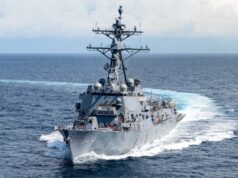
Why is it a french ship on the pic though?
If the photo is from REPMUS in Portugal it should be there ships from several NATO countries.
You’re going to need a bigger boat…. had to be said 🦈
I once proposed crewed sailing boats as part of our anti submarine defences. I think the crew would have found it tough going in Mid-Winter North Atlantic but it would have been heroic stuff coming up on deck in a duffle coat and cup of Cocoa and frozen eyebrows.
The Cruel Sea..!
These can be deployed by ZeroUSV’s 12 metre Oceanus-12 boat. Combined with Thales’ Sonar 76Nano, there’s something very reassuring being put together.
This isn’t very fancy stuff, but could be crucial even if it won’t be perfect and can be breached/evaded. Nothing is perfect, but remember we only need to make it more costly for the Russians than it will be for us.
Just need the money to scale it…