

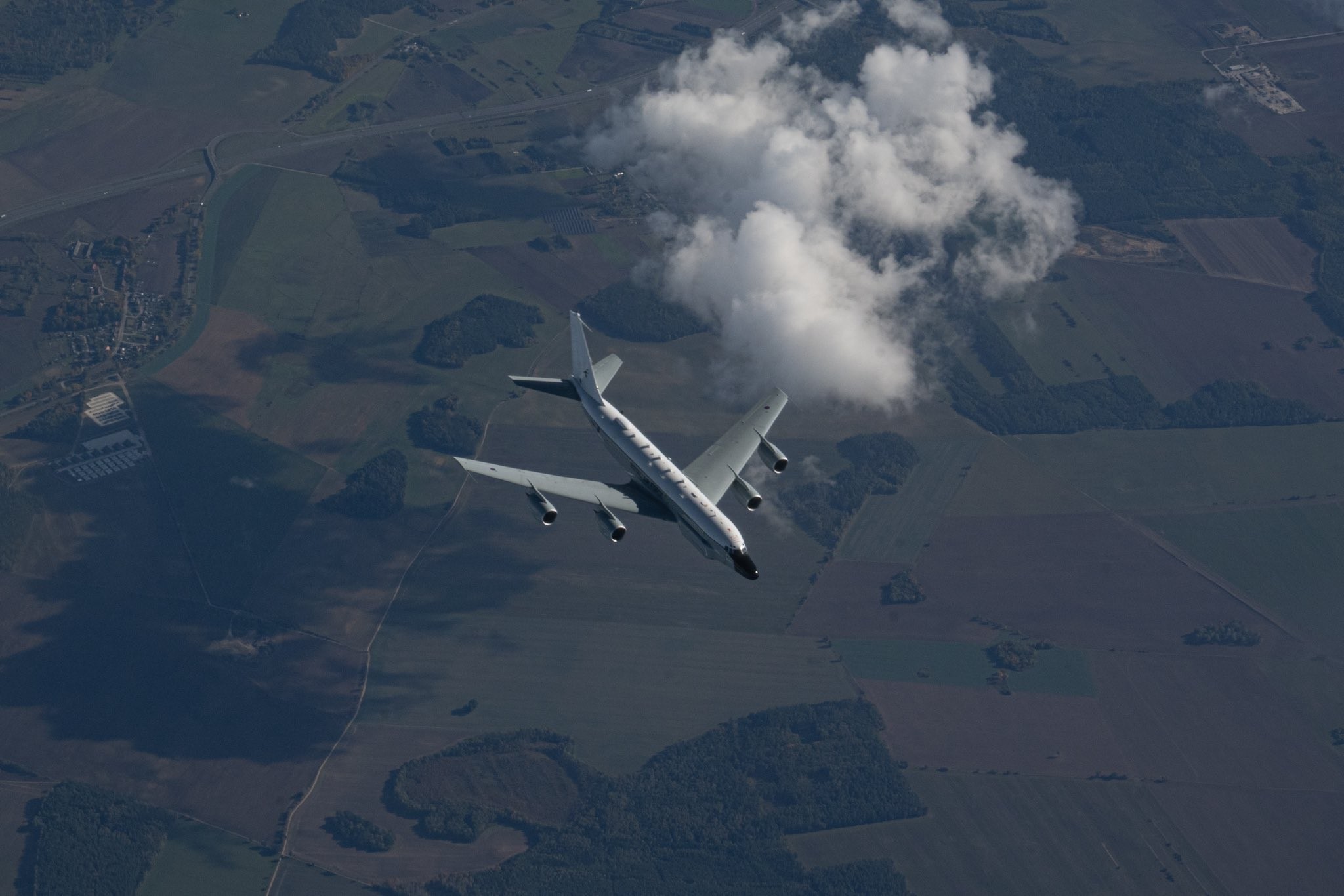
A Royal Air Force RC-135W Rivet Joint electronic surveillance aircraft has conducted a patrol around the Russian territory of Kaliningrad.
The aircraft, ZZ664, operated under the callsign RRR7207 and returned to RAF Waddington in Lincolnshire on Friday 7 August after routing out across the North Sea and into the Baltic.
These flights form part of regular allied intelligence-gathering missions along NATO’s eastern frontier. The UK has carried out such patrols for years, maintaining a persistent watch on Russian military activity well before the 2022 invasion of Ukraine.
Rivet Joint missions are designed to be overt and their tracks are visible on civilian flight monitoring platforms, providing transparency about the aircraft’s presence and allowing observers to verify the frequency of operations in the area. Although British surveillance activity over the Baltic Sea was always routine, the tempo of such flights has increased noticeably amid the continuing conflict in Ukraine. U.S. reconnaissance aircraft are also active in the region as part of coordinated NATO intelligence and deterrence efforts.
Kaliningrad remains one of the most closely watched pieces of territory in Europe. The exclave sits between Poland and Lithuania with no land connection to the rest of Russia, hosts the headquarters of the Baltic Fleet at Baltiysk, and carries air defence and missile systems that reach well into NATO airspace. It also sits alongside the Suwalki gap, the stretch of Polish and Lithuanian border that separates it from Belarus and forms the only land route between the Baltic states and the rest of the alliance.
What does the RC-135W do?
According to the Royal Air Force website, the RC-135W Rivet Joint is a dedicated electronic surveillance aircraft that can be employed in all theatres on strategic and tactical missions. Its sensors soak up electronic emissions from communications, radar and other systems.
“RC-135W Rivet Joint employs multidiscipline Weapons System Officer (WSO) and Weapons System Operator (WSOp) specialists whose mission is to survey elements of the electromagnetic spectrum in order to derive intelligence for commanders.”
The Royal Air Force say that Rivet Joint has been deployed extensively for Operation Shader and on other operational taskings. It had been formally named Airseeker, but is almost universally known in service as the RC-135W Rivet Joint. The UK operates three of these aircraft.
All three were converted from KC-135 tanker airframes under a co-operative programme with the United States Air Force, which operates a larger fleet of the type from Offutt Air Force Base in Nebraska. ZZ664 was built in 1964 and is now 61 years old, an airframe age that is unremarkable for the type given the extent of the rebuild each aircraft receives during conversion.









I saw the Aviation Week are reporting that GCAP’s engine will offer more than 35,000 pounds of thrust, comparable to the F135.
I thought they said not long ago that it was getting scrapped? Or am i confusing it with something else?
Ignore last.. it was Shadow R1
Just like we provide target data to Israel in Gaza and Lebanon.
Perhaps it’s time we stopped complaining about Russia flying in international airspace then.
Not our flag not.our war.
Russians are our friends, they wish is less harm than Brussels.
🤣
Tracked all the way by the s400.
And why is poland unable to map it’s neighbour
Kaliningrad’ isn’t in our area of operations anymore
🙃 🙄 An upside down view of an Ruski troll!
🙃, 🙄, Your world is truly upside down!