

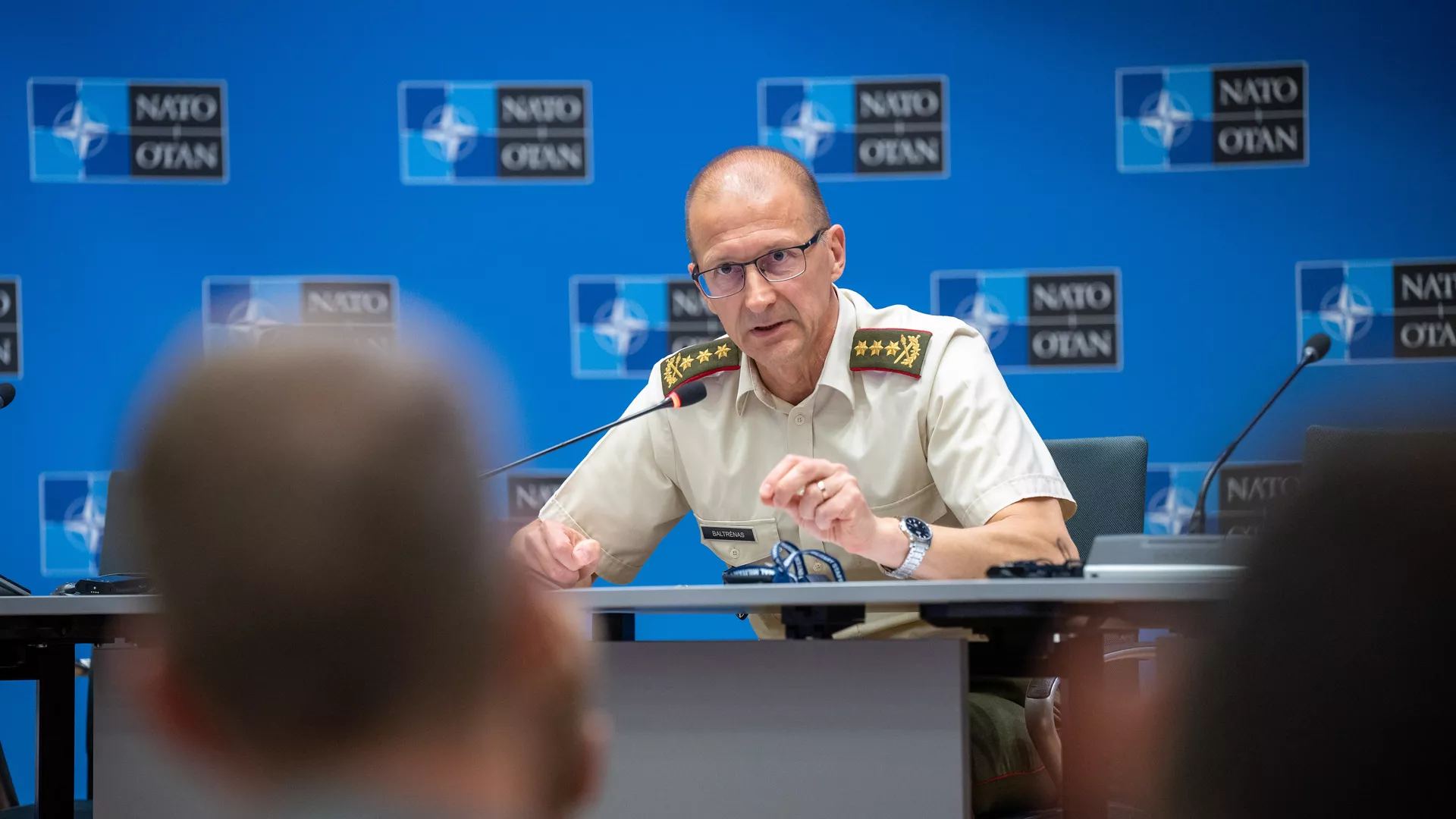
Students on the NATO Defence College’s senior and regional cooperation courses spent a day at alliance headquarters working through burden shifting, the strategic imperatives facing NATO after the Ankara Summit and what the alliance describes as a turbulent security environment, according to NATO.
The visit on 28 September was hosted by Lieutenant General Remigijus Baltrėnas, Director General of the International Military Staff, with briefers drawn from both the International Staff and the International Military Staff.
Baltrėnas used his session to set out what the organisation he runs actually does. “The International Military Staff serves as the vital intermediary between the NATO Military Committee and two strategic commands,” he said. “Its primary responsibilities include: processing information and directing guidance to strategic commands; building consensus to reach agreement among various NATO nations; and providing high-level military strategic advice to the North Atlantic Council.”
He told the students the staff works to a 360-degree approach to military decision making and keeps oversight across land, cyber, digital and joint air and space operations, relying on experts seconded by member nations alongside the expertise held in the strategic commands themselves.
Burden shifting is the term now used within the alliance for the transfer of responsibility for European conventional defence from the United States towards European allies and Canada, a process distinct from the older argument about burden sharing, which concerned how much each ally spent rather than who holds which responsibilities. It has moved from a talking point to a planning assumption over the past two years, and its appearance on the syllabus for the senior course is a reasonable indication of where the alliance expects its next generation of one and two star officers to be thinking.
The International Military Staff numbers around 500 military and civilian personnel from member countries, working at headquarters in Brussels. Its Director General answers to the Military Committee for the efficient functioning of the staff, is empowered to act on the committee’s behalf on routine matters, and in urgent cases can take executive action within established policy.
The Military Committee itself is the alliance’s senior military authority, composed of the chiefs of defence of the member states, and it sits between the North Atlantic Council on the political side and Allied Command Operations and Allied Command Transformation on the military, and its members last met in Copenhagen on 19 September.
The NATO Defence College is based in Rome and runs the senior course for officers and officials expected to move into strategic appointments, alongside shorter courses for partner countries through its regional cooperation programme. Britain sends officers to both, and the college forms part of the same pipeline that feeds the Royal College of Defence Studies at home.






In reality burden shifting is about the decoupling of European and US strategic security. It’s the end of life plan for NATO as was.