

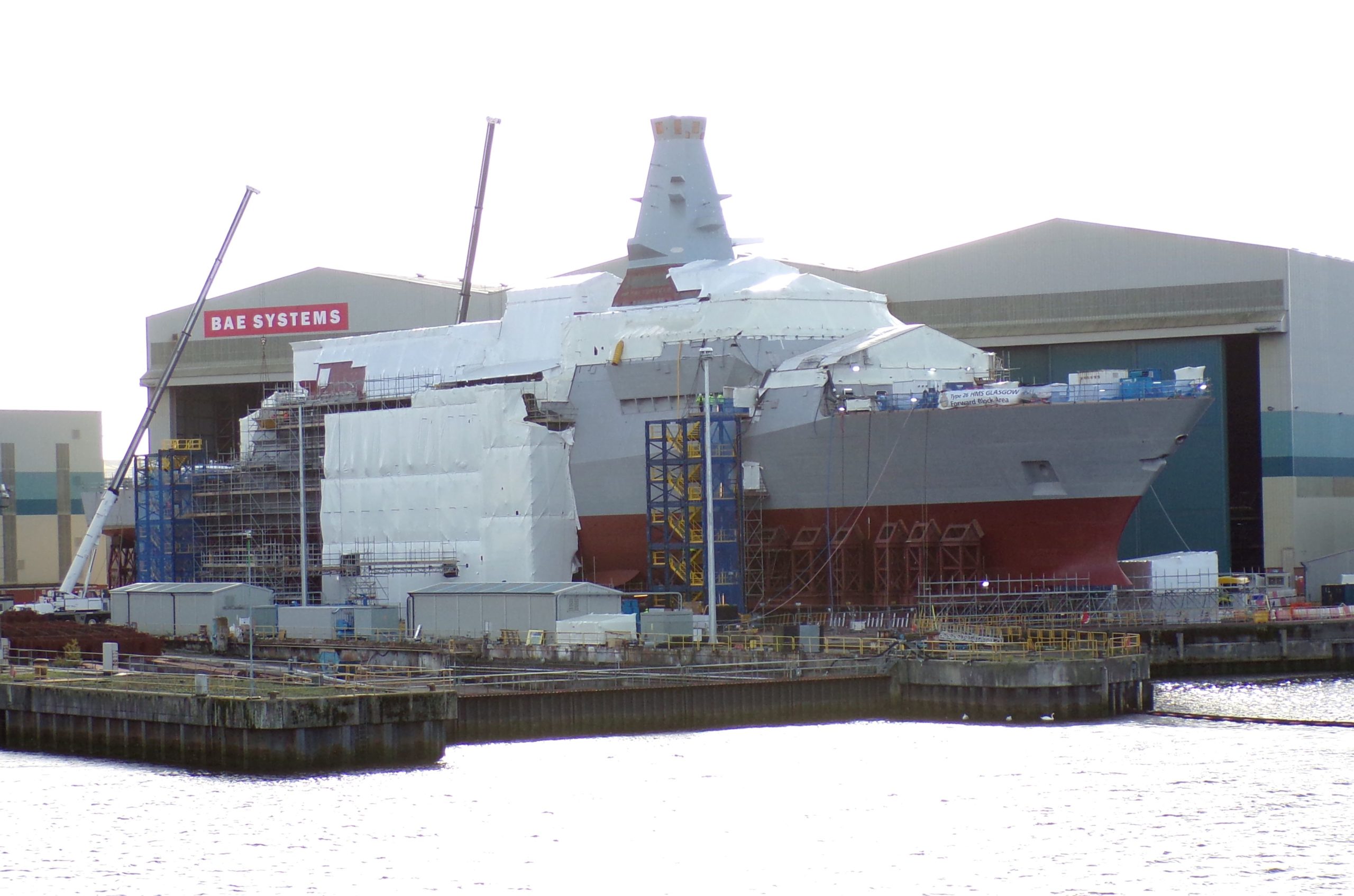
Defence industry representatives have warned MPs that fragmented procurement decisions and short-term ordering practices are damaging UK shipbuilding, limiting productivity gains and weakening the wider industrial supply chain.
Giving evidence to the Scottish Affairs Committee, Andrew Kinniburgh, Director-General of Make UK Defence, said that the lack of predictable, long-term orders was discouraging investment and forcing inefficient working practices across defence manufacturing.
“If you’re a highly rated nuclear welder, you’re seven or eight years before your time is served and you’ve got all your certificates,” Kinniburgh said. “You can then make a great deal of money, but you’re straight into a global scrap for talent. Civil nuclear is hoovering up a lot of really good people from the defence industry.”
He warned that prime contractors were increasingly recruiting skilled workers from SMEs within their own supply chains, hollowing out smaller firms. “They’re actually recruiting out of the businesses that they’re using as suppliers themselves,” he said. “So it’s a tricky one, really tricky.”
Pressed by MPs on the impact of procurement decisions, Kinniburgh criticised recent moves to manufacture Royal Navy tugs, barges and pontoons outside the UK. “It’s an absolutely huge disappointment,” he said. “It’s lazy thinking. There should be a buy UK policy.”
While acknowledging that not all defence equipment could realistically be built domestically, he argued that smaller vessels were an obvious exception. “We’re never going to make everything in the UK,” he said, “but building small ships elsewhere is a disgrace, frankly.”
Warrick Malcolm, Director of ADS Scotland, said reform of defence procurement was essential to relieve pressure on SMEs, particularly those operating in rural areas. “There are certainly things that we could do that would alleviate some of the pressures on both SMEs and rural SMEs,” he said.
MPs also questioned whether industry had sufficient visibility of future orders to plan workforce development. Malcolm said that for many smaller firms, the lack of long-term certainty was acute. “You don’t really have ownership of your future,” he said. “You’re making decisions almost week by week, month by month.”
Kinniburgh illustrated the problem by pointing to submarine and warship programmes where contracts are issued in single units rather than larger batches. “You get an order for one boat, you make whatever you’re making for one boat, then you get another order a year later,” he said. “What that means is you get very small, incremental improvements in productivity because you simply can’t invest.”
He said larger, multi-ship orders would allow firms across the supply chain to invest in automation, machinery and skills. “If you had an order for five ships or ten boats, SMEs could invest in robotics, productivity improvements, or new machinery,” he said. “Because everything is incremental, the improvements are incremental too. It drives all the wrong behaviours.”
While acknowledging that international programmes such as AUKUS inevitably add complexity, Kinniburgh said the fundamental issue remained procurement structure rather than partnership. “It does add complexity,” he said, “but it should also add strength that outweighs that complexity.”












Question is, Do we want to be a Manufacturing superpower again ? It’s the amount of work in the pipeline that drives the training of the trades, just like It is In every other line of business. The more work, the more employment and specialist training.
Just looking at Hincley the other night, It’s a massive site busy as hell 24/7 so I can only Imagine how many skilled people are lured there for the money and secure employment.
This National Shipbuilding Plan needs stability and orders, long term.
like A field of dreams quote says,
“Build It and they will come”
Superpower? I’ll settle for moderately competent.
The place to start with this philosophy is Rosyth. If we agree that we will order a ship’s worth every 15 months at £400m a ship (in 2026 prices) indefinitely, we won’t have to decide too far ahead of time if that’s a T31, a T32, an MRSS or three OPVs. The ordering deadlines will be known. If we screw up and don’t leave enough time for a new design, we know we’ll still get something using an old design. If we can’t settle on the MRSS design quickly enough, we’ll build an extra T31 and MRSS will come a year late. The budget would be agreed and from then we wouldn’t have to get Treasury approval for each individual ship type; rather the Treasury would have to be able to show good reason to stop it. It would be a joint venture with Babcock including modernisation agreements and it would only be cancelled if the work was substandard or always late. That would cost us £320m a year for the production, well within the naval surface procurement budget (£2.1bn – old figures). We’d be getting second tier ships turned out on a regular basis.
Given enough stability, perhaps Rosyth could pick up some orders that would previously have gone to Damen.
I would much rather be a service super power (which we are) than a manufacturing superpower.
Compared to services, manufacturing is always likely to be lower skilled and lower paid. Our over reliance on manufacturing and fossil fuel extraction was what lead to the economic calamity of the 70’s.
Much better to do services (especially science and design) while manufacturing high end finished products and high end components.
We need to be able to build warships and fighter planes and selected armoured vehicles but not necessarily everything.
firstly, there is only 1 manufacturing superpower in the world (China) and the UK is not as awful at manufacturing as people think
The question is do we want to have certain manufacturing capabilities within the UK. I believe the answer is yes and we can. If you look at what Finland, Sweden, Norway and Demark produce from a combined defence budget half of ours it is certainly doable. We have the required scale its just poorly spent (also look at Italy, France and Isreal as well)
with robotics, AI and micro manufacturing the main advantage of china (cheap workforce) is dissipating. So the UK can take back some manufacturing capability.
Prime examples where we can manufacture at scale are Healthcare (as NHS is a giant of procurement globally) – some defence (T26/T31 are world class and competitively priced) and space, we are also pretty good at AI.
Look at what the dutch have done with there industrial farming strategy – its all about commitment and the vision/strategy to see it through, which UK governments don’t have unfortunately
if we had a navy of 75 ships over 70m then that is 3 ships pa every 25 yrs – a decent drumbeat that industry can get behind – we are nowhere near launching 1 ship pa. that’s how bad it is.
I am sure Babcock have processes in place to reduce the risk of skilled welders, or others, re-locating to Somerset. I have no idea how you stop such movement from BAES (or others) to Babcock at Hinkley.
It is in the papers that Babcock recently hired 300 Filipino welders for uk defence industry
Their welders are from the Philippines so not allowed to transfer to another employer.
They are indeed hiring foreign welders. I did not say they hadn”t. I only said they were not encouraging people to transfer internally, despite the fact that they cannot force people to stay.
I am sure there is more than one UK citizen welder remaining at Rosyth.
This is more why the much delayed DIP is a national disgrace.
There needs to be a long term ramp up in orders to drive skills increases.
Suddenly turning the ordering taps on full blast would just mean costs rocket.
There must be some horrific arguments going on given the £28,000,000,000 black hole and the promised GDP % Up lift seeings as It’s being kicked down the road to a distant date ?
It Is my understanding that all the points raised in the SDR were agreed and that action would be taken accordingly.
Yet here we are still. Nothing, Zilch, only empty words and vacant looks from a Primeminister that acts like a Wet Flannel.
If they somehow enact the recommendations of the SDR it will be a huge fudge, with little in the way of firm timescales. The money hasn’t been allocated so what else can the MOD do. The DIP is going to be a huge let down I’m sorry to say.
Now to say something positive, ummmmm, errrrrrrr, darn it I have nothing.
I hate these black hole figures. £28bn is over 4 years and we have no idea of the timing. If it’s evenly spread that would be £7bn a year. Does it include or exclude expected £6bn a year coming next year? Is it prepared assuming that all projects will go ahead or that some won’t, because I recall in 2023 different services used different assumptions. That means the £28bn might come from a mix of figures.
And none of it matters, because a halfway decent defence will cost the country 4% of GDP going into conventional UK military capability, with nuclear deterrence on top of that. That’s about an extra £75bn a year: the real black hole. If the risks keep going up, it’ll be £100bn a year. £7bn here or there is almost irrelevant.
In the pub last night, I was approached by a very nice man who bought me a drink and asked if I knew of anyone looking to buy two new surplus T31 frigates. All offers however derisory will be considered.
Could be nothing, but I though I’d mention it here in case.
The Danes would bite your hands off. But tell me, what sort of pubs do you frequent where nice men ply you with drinks?
Don’t tell me, You both got drunk and you woke this morning with two ships in the front garden ?
It’s easily done !
No great surprise here. Any business needs to have a framework within which current and future orders are planned for. We haven’t had any cohesive ordering for two years now and with DIP (aptly named) delayed again how are our shipbuilders supposed to function.
CDS hiding behind the OSA to not give any financials to the Defence Select Cmtte makes a mockery of Parliament; we could probably all understand why he did it but, this is a public debate that needs to be inclusive not secretive.
It is an open goal for any Party that wants Defence front and centre in their politics; unfortunately, there is no horse I would back.
Which leads to building in Britain: until we understand the funding of defence, there can be no meaningful planning or investment.
If you compare to the Army supply sector, the UK has already destroyed its sovereign capability and are left – if we look at A vehicles for example.
Every single project Ajax, WCSP, Boxer, Challenger 3 is reliant on foreign companies for design, supply & test. WCSP cancelled. The other three we have no competent control of and no idea of in service dates. All are massively expensive.
Many senior staff from CDS down to key members DE&S, ATDU, REME now reside in supplier boardrooms down. Or, work as Consultants for foreign companies. Contract rules are cut to suit foreign companies and zero enforcement contracts regarding sovereign content, jobs, capabilities or export performance. Common sense and normal contracting law have gone out of the window.
There is no national plan or vision
Yes, if only we were building those barges and tug boats here we could afford to pay that 8 year qualified nuclear welder a six figure salary instead of bringing in 300 welders form the Philippines on minimum wage.
It’s all the MoD and Scottish governments fault for not giving us more work and more money.
On the basis of his ascertain what’s the point in the Scottish government spending money training this nuclear welder if they are going to leave Scotland to go somewhere else for more money.
Where is the economic logic in that instead of spending money on developing code skills to work in Edinburgh’s thriving Fintech sector or paying for trading as a cooper for the Scottish whisky industry.
Huh , one Nuclear Welder = 300 Philipinos ?
Not sure on the Math(s) there Jim. 🤔
Short term planning harms absolutely everything without exception. Yet successive uk governments are incapable of grasping this.
The real black hole is the 150bn a year deficit. We haven’t had a balanced budget since 2002, thats why our debt interest is now 120bn every year. You can only kick the can down the road so long. Its not only Britain to be fair, its every Western country, particularly the US. What the US has though is economic growth, something us Europeans havent had for two decades.
Theres an economic crash on the way that’ll make 1929 look shallow.
The idea that we can feed all our shipyards with a steady flow of timely government contracts stretching over the horizon is j
unrealistic.
If we had double the budget, maybe. The RN’s equipment and equipment support budget in 2023 was £2.48 bn a year. Once the support bit is deducted, I doubt there is £1.24 bn available for new ships. (Support looks to include repairs and upgrades, so carrier propeller shafts, the T45 PIP extravaganza, T23 Lifex, and I think regular maintenance, equipment upgrades and any manner of other things, quite possibly including a slice of the operating costs). That would pay for ONE batch 1 T26 frigate a year.
Over the next 10 years, the RN is already committed to 20 new ships, so two a year. That doesn’t include T83, River 1 and Scott replacement or MRSS or a T32 frigate, which I would think can’t be afforded until post-2035. If we can only build 20 surface vessels over 10 years, it will take at least 25 years to get back to a 50-vessel surface fleet. (Not that a lot of our vessels are built for a 25 year active life).
All this to say that providing a steady stream of orderly contracts for the 4 surface ship yards is not so feasible. BAE Govan has a good order book with 13 T26. Babcock, H&W and Cammell Laird, not so much. The normal business route for government-subsidised yards in France, Italy, Spain etc, is to win some export orders, that’s how they plug the gaps. Our yards have not been very good at that for a while, maybe that will change.
With only two ships a year to feed 4 yards, they are not going to be getting this stream of steady orders without gaps
We must build all our defence equipment here, all of it, right down to smelting the steel from ore and the silicon. People will respond to the demand this creates by training for a future that is secure and prosperous. Sending money out of this country is precisely why the taxes go up, unemployment is sky high and benefits bill soars.
Yes, it takes time for people to train up in skills so apprentice them to some doddery old ….s like me who can do the job and we can TOGETHER provide what we need NOW and the workforce of the future. My local school is getting rid of all it’s wood and metal work kit ‘because it can’t find a teacher’s, that’s bullshit, it hasn’t advertised and it hasn’t taken some old boy on who can do it and perhaps, if required, put a ‘trained teacher’s with him to help him understand about the curriculum bullshit and behaviour control (noy that I expect a behaviour problem if we give kids something productive and interesting to do). No imagination and no ability to think beyond the current ‘regulation’ seems apparent in anything this country does. We have a direct threat from Russia and a direct threat from the USA to consider, they are clearly enemies and working together.