

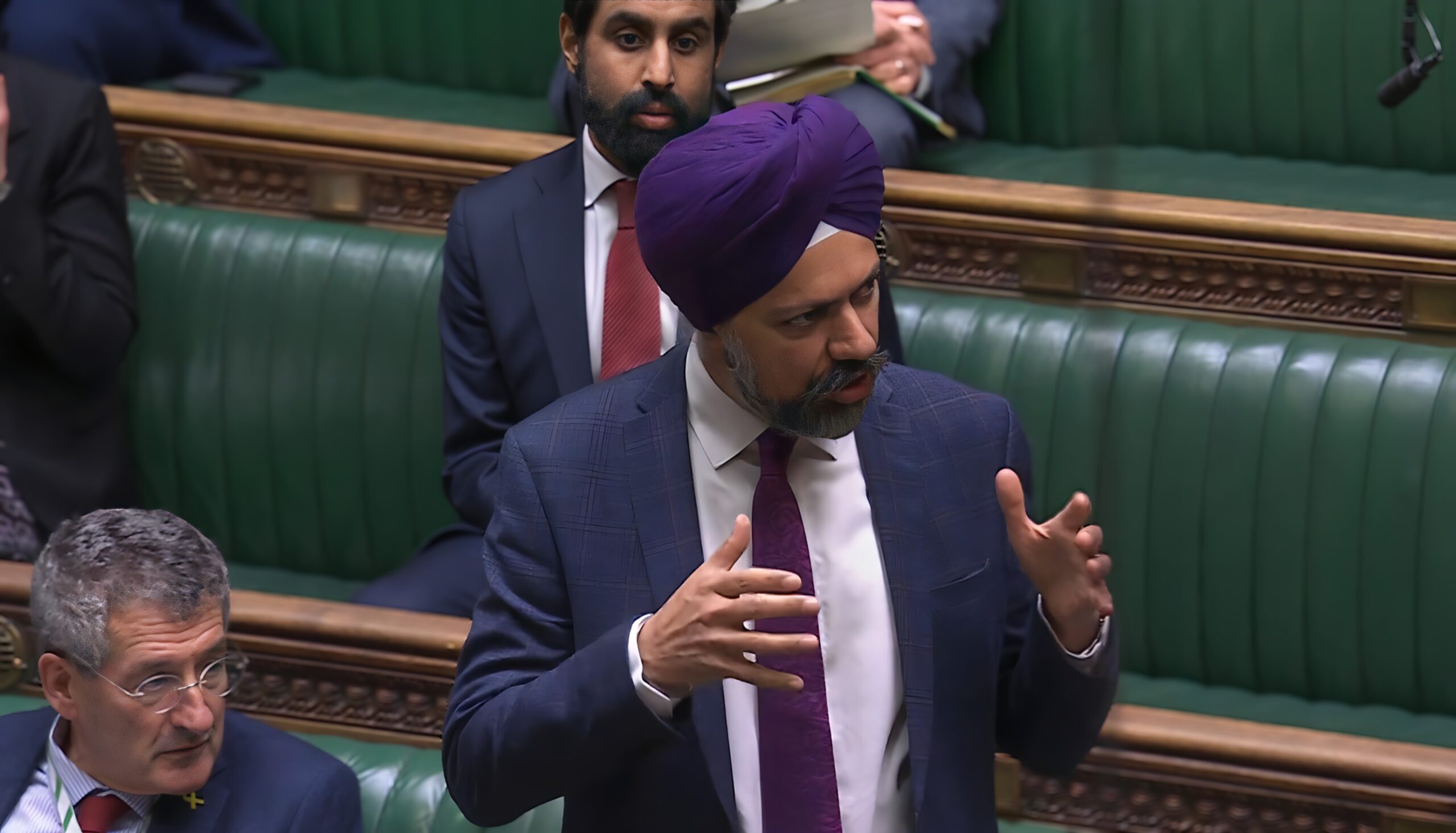
The Prime Minister has told the Commons that he has already committed to a pathway to spending three per cent of gross domestic product on defence, in response to a question pressing him to do so urgently rather than waiting for a future fiscal event.
Tanmanjeet Singh Dhesi, the Labour MP for Slough and chair of the Defence Committee, put the question at Prime Minister’s Questions on Wednesday.
He said: “The British people should be under no illusion that the nation faces a significantly increased threat level, especially from Russia, but also that we have a US leadership for whom European security is no longer a focus or a priority. That is why it is imperative that we invest in our armed forces in the here and now, rather than being sorry later. Indeed, defence is definitely one area where vibes alone just will not be enough.
“Rather than kicking the can down the road, waiting for a fiscal event in a future year, will the Prime Minister urgently commit to charting a pathway to reaching 3% of GDP being spent on defence by 2030? As his Chancellor rightly noted, that is critical to keeping our country safe.”
Andy Burnham replied: “I have made that commitment, I have made it very clearly, and I have done so for a considerable time. I was in Ukraine last week for a very specific reason: to repeat it on the world stage. My hon. Friend can be absolutely sure of that.”
He went on: “Alongside our commitment to defence, we also have to build the resilience of Britain. We need to ensure that the maximum amount of the funding committed to the defence investment plan goes back into the reindustrialisation of our communities. We should do more to maintain sovereign manufacturing and production capability here, and that will be a theme of my Government. We will make sure that British taxpayers’ money goes to supporting industry in our own country, to make us more resilient going into the future.”
The exchange turns on a distinction between committing to a figure and setting out how it will be reached. Dhesi’s question asked for a pathway, and specifically for one that does not wait on a future fiscal event, which is the point on which the government has previously declined to be drawn.
Wes Streeting, the Defence Secretary, has argued that announcing a spending figure without setting out how it will be funded invites a loss of market confidence and rising borrowing costs. He has said he has every confidence the Defence Investment Plan will be fully funded, and has not ruled out tax rises as part of the answer.
The Office for Budget Responsibility has previously put the cost of reaching three per cent at an additional £17.3 billion in 2029-30. Behind the domestic argument sits NATO’s push towards 3.5 per cent of GDP on core defence by 2035, agreed at the alliance summit in The Hague.
The second half of Burnham’s answer picks up a theme the government, current and former, has been developing through the Defence Industrial Strategy and the Defence Investment Plan, which commits £298 billion to defence over four years.
The department has pointed to figures published last month showing that spending with industry supported 274,000 jobs across the United Kingdom in 2024/25, with £31.9 billion spent, including 12,200 direct jobs in Scotland where shipbuilding and submarines account for 7,900 of them. Jobs supported by spending on weapons and ammunition manufacturing rose 51 per cent across the country over the same period, an increase the department attributes to the drive to rebuild what it calls an always on pipeline of munitions supply.












Committed to producing a pathway to something not even in this Parliament. That’s an awfully long way from actually reaching 3%. First the commitment, then the pathway, which will be produced nearly three years into the five-year Parliament. Three years to get there of which two years will be in this Parliament. And that’s the easy part as there are still things that can/will be fiddled by bringing current spending under the defence umbrella, rather than actually increasing spending.
I’m minded of an old proverb about charity: what you give now is gold, what you promise to give in your lifetime is silver, what you give after your death is mere brass.
Please take a look at my post down below for that pathway.
🥱
I do not see 3% by 2030 being remotely feasible. Finding the extra £17bn per year would require taking a scythe to not just welfare spending but right across public services. No government is going to do that, because the public would rebel against further cuts to key services that have already been cut to the bone during the many years of austerity.
Fellow NATO members are in the same boat, except that EU members can draw funds for equipment and infrastructure from the EU’s SAFE scheme. (Long-term, low interest loans guaranteed by an EU fund). The Treasury is apparently against this approach, because it means more borrowing and interest. But in Germany and elsewhere, the SAFE money is being excluded from.the national debt, because it is, in City terms, a long-term, repayable investment, not borrowing to pay for day-to-day running costs. Unless we have that kind of option.open to us, getting to 3% in under 4 years is a forlorn hope.
As it stands, HMG has to first find the missing £5bn from the DIP equation. Healey needs to do that in next month’s budget or cut some of the planned defence capabilities. The signs are that he will find the money.
At next year’s spending review, HMG will lay out the plan for how we get from 2.5% to 3.5% by 2035. It will most likely be a linear increase of 0.15% or so every year from 2028/29 to 2035/36. That would get us to something like 2.8% by 2030/31. It is probably the best we can hope for. On the positive side, defence spend will be up 20% on what Labour inherited in 2024. So pint half full.
Healey’s big challenge is to break Treasury orthodoxy regarding avenues to top-up defence budget, such as the SAFE-style fund proposed by Canada and Carney, or defence ‘war bonds’, or a sovereign defence investment fund involving the City, or some such plan. Failing that, HMG is going to have to bite the bullet and put a penny or two on the tax of middle and high earners, which will get a squeal of protest from predictable political quarters.
For Kemi to be banging on about 3% by 2030 is a bit rich, given the hammering defence spending took in the previous 14 years of Conservative management.
Pretty well spot on except IMHO “Healeys big challenge” isn’t dealing with the “Treasury orthodoxy” thats the second problem he has to deal with. His Big challenge is how to find the money as that either involves welfare cuts or breaching the Labour Financial Mantra of no tax increases which was their 2024 Election Manifesto.
It’s Cuts or Taxes to get the £££’s and then deal with the Treasury Mandarins.
Quite why HMG just doesn’t just turn round and justify a combination of cuts and tax rises purely to fund the Defence commitment is beyond me. It’s a simple case of saying the Manifesto was written before we signed up to the NATO spending commitments and we now have zero option but to fund extra defence.
The moment anyone propose a spending cut or tax increase there is a huge out cry and a massive campaign to stop. Farmers,pensioners, high rate tax pays, people on all sort of welfare and then you get cost of living crises being shouted from the roof tops.
Welfare or Warfare is the wrong discussion as I’ve posted below. Please take a look.
He may be a Labour MP but I have a great deal of respect for Mr Dhesi, he does the job of being Chair of the commons Defence Committee with dignity and a relentless attitude to holding HMG to account. He doesn’t pull his punches and is now hammering away at his 2nd PM, which isn’t bad when you consider the PM is his boss. Shame they don’t have the guts to actually give him a straight answer !
Sunak, Starmer and now Burnham both fine upstanding PMs who talk a good game but have delivered very little as the Political cost is just to high for them to deal with, so they kick the can down the road yet again. Gutless !
I suppose it’s understandable when you consider that he knows damned well that the average term in office for his 5 predecessor’s is 2 years and 3 days so odds are his Backbenchers will shaft him in August 2028 with 1 year till the next GE. So delaying the plan till the next spending review (next June ?) get him halfway, costs zilch and he gets a nice Pension and expenses as another failed PM.
Well the Can is rusted to hell and all of NATO including TANGO Man are wise to this stunt so we know this is going to hurt.
If Burnham and Healey actually want to get serious then just do it in an open and honest way, I suspect that if it’s done like that they will get a lot of support and may actually survive a bit longer.
Do it simply put 1% on income Tax, cut all welfare payments by 1% and spend it all on Defence. And just have the guts to says “it’s actually my job to do this, it’s going stay in place till either the threat decreases or the economy improves to take up the slack”.
Instead the overall objective is to not breach the 2024 Labour Manifesto commitments, so no money will be forthcoming.
ABCR,
Certainly agree that at some point in the foreseeable future, a British PM w/gravitas should attempt to explain to the British public the concept of increased defence spending, correlated w/ enhanced deterrence. Casual perusal of Wiki reveals UK expenditure of 7.4% of UK GDP for defence in 1938, subsequently rising to a maximum of 55.3% in 1943. History should suggest that relatively modest investment now, may forestall the necessity for serious investment later. If necessary to convince the public, broadcast historical video of the bombing of Coventry and London, or contemporary video from Kiev. Basic contention is that the body politic will not be pleased w/ HMG if subjected to ruinous attack which could have been anticipated. Personal opinion, there is little need for the UK to underwrite the defence of Ukraine w/sovereign funding, when $300+Bn in Russian central bank reserves are being w/held in the EU simply because of the threat of future litigation. Invest the billions thus made available across defence. Although Uncle Sugar may have serious issues currently, at least defense investment has been maintained.
The sanctioned capital problem is easy to solve because national banking law applies in each nations jurisdiction not international law as muscovy pretends.
Specifically, Anti Money Laundering regulations are mainly against criminals so just require clarification that terrorists are criminals so subject to the confiscation of the proceeds of crime. Organised crime in stateside lingo. RICO.
Once all European nations update AML regulations they can confiscate all terrorist funds and the world will be safer. No problem for banks or government since investors are reasonably required not to be terrorists or other criminals. Dirty money isn’t welcome.
Please see my post below on the Defence Investment issue…
Sensible thoughts ABC. Much as we want to see defence spend increased ASAP, we have to recognise that it is not the only item on the national agenda.
HMG has to find the funds to take water and rail into some kind of public-private ownership. Building some social housing is long overdue. More prisons and prison officers. Courts are in a chaotic condition due to previous funding cuts. Ditto social care and maternity services. Farmers needing financial help due to heatwave effect on crop yields. More police officers, if Middlesbrough is symptomatic of crime levels. And so on.
Everywhere you look there are legitimate calls for more government expenditure and usually sooner rathet than later. Even if there is a genuine desire by the government to increase defence expenditure to 3% by 2030, we are in a rugby scrum of competing claims. Put a penny or two on tax, ring-fenced for defence, and the government will be caught in the grinder between 50% opposing any tax rise and 50% arguing that there are other equally pressing needs that need tax rises.
If everything else was fine, a small tax rise for defence would be achievable and accepted by most.
That is why I think Healey and Treasury need to be looking for some off-balance-sheet source of additional.finding for defence, not solely dependent on the slim government purse.
I watched the debate, and Andy Burnham made a bit slip and he gave an assurance that they will provide 3% by 2030.. which I don’t think they want to formally recognise until they have it costed… a British government especially a labour one can’t get away with any uncosted promises at present.
But I suspect we will see the 2027 show a 3% by 2030/31..
So I’m betting we get
2.7 for 27/28
2.8 for 28/29
2.9 for 29/30
3.0 for 30/31
Essentially for every year that’s an extra 3.7ish billion + any increase in GDP. The government can find that.
I read that there was a later clarification somewhere saying Burnham wasn’t, in fact, committed to 3% by 2030 but just repeating his wider commitment to Defence as a whole. So just pure waffle.
I’m not so sure, I suspect a slip. They cannot say 3% until it’s costed or everyone will go apeshit..
I would give it an over 50% that we get to 3% by 2030.. to be honest the rest of that double is made up if 2 situations..
1) Russia collapses and the Euro threat disappears.
2) we are at war..
He’s saying the government is doing something it isn’t, or he’s just leaked something that was supposed to wait. Either way not a good look. Fingers crossed for the latter!
Interestingly another Labour MP was on newsnight tonight making it clear he expected 3% by 2030.. I think they are warming everyone up to it… remember most of the British public want potholes filled and tax cuts.. not more spending on what they see is unnecessary to their lives…
Interestingly according to YouGov there’s +7% net approval for raising the higher rate of income tax to fund Defence, and +6 for cutting unemployment benefits.
But as we know the general population has a wildly optimistic view of the state the armed forces are in, because they only hear about the headline failures rather than the infrastructure, procurement etc.
Leadership, government, is about prioritisation and decisions. It is not easy…but it is simple.
Actually, in this case, it is both easy and simple.
The Department for Business, Energy and Industrial Strategy once estimated £70bn a year for net zero by 2050.
‘Spreadsheet’ Hammond said: “On the basis of these estimates, the total cost of transitioning to a zero-carbon economy is likely to be well in excess of £1tn.’
The climate scenario upon which net zero is based everywhere has been rejected as implausible.
There’s your defence spending uplift right there, no increase in taxes or borrowing.
The nation’s angst resolved, a pint of foaming wallop beckons…
There has been a Labour MP on newsnight saying he thinks it should be and will be 3% but 2030.. i essentially think the government are worming up the public and bond markets.. remember most people would want their pot holes filled over another Merlin,
Entirely correct.
But this is a representative democracy. Our representatives are supposed to be considering the best interests of the country at large on our behalf, while we get on with the real work.
That requires leadership from senior politicians. We see that from the Conservative leader but from no-one else.
The rot set in after 1993; Clinton’s concept of permanent electioneering aped by successive governments in this country.
And now we are going back to the failed socio-economic nostrums of the 1970s as well.
For the British Army, that means cancelled exercises today, as in 1973, for lack of money.
Democracy:the least worst system of government.
I think unfortunately this is where social media has become a problem.. once we got news once a day and essentially the day to day governance of the country was of little interest and the parties had a general consensus on not going loco on elements of national security.. now everything it’s immediately reported on and criticised over every element.. the bond market reacting over every social media led hype event..
I think it makes democracies almost ungovernable.
Britain must maintain both monetary and fiscal credibility in order to provide reassurance to a wary bond market and to avoid any perception that the government might be rolling back on its promises of fiscal consolidation.
With that in mind, next month’s Budget needs to be seen as part of the sequence of steps towards the goal of restoring and enhancing the UK’s fiscal credibility in the eyes of an increasingly sceptical bond market. To that end, it is not only the decision on consolidation that matters but also its composition. The market’s patience can only be tested so many times before fiscal scepticism morphs into the preconditions needed to see a full funding crisis.
That means a massive roll back of the state to dramatically reduce public spending, accompanied by reductions in taxes, particularly business taxes, to encourage economic growth.
It is the failure of this government, the lack of any real leadership, to implement pro-growth policies that has made its task so difficult…and that will not change under the new retro 1970s style Prime Minister. This government is moving in precisely the opposite direction, the same direction that led to Britain having to go cap in hand to the IMF all those years ago.
I think we need to wait and see, all he’s really done at preset is cut a couple of minor taxes.. the budget will give the answer…
Indeed so.
But the omens are less than propitious
‘Burnham suggested to MPs the Brexit vote had been a response to “a series of wrong turns” made by Britain in the 1980s onwards, that were then compounded by leaving the EU.’
In fact it was leaving the EU that permitted him the opportunity to make the tax adjustments that he made to VAT.
Since they’ve specifically identified UK Defence Industry as an engine for growth, and are by definition the customer providing demand, heralded by SDR and DIP documents, they have no choice but to show they were serious and deliver or be very clearly and unambiguously found out ..
Investing in UK industry for the national security interest (1st responsibility of gov.uk) must deliver growth and sustainment of sovereign capabilities that are required to justify deterrence and national independence. Growth generates jobs, profits and taxes, which are not assured without that demand. It’s complementary with other themes like devolution and industrial regeneration…
Since they’ve specifically identified UK Defence Industry as an engine for growth, and are by definition the customer providing demand, heralded by SDR and DIP documents, they have no choice but to show they were serious and deliver or be very clearly and unambiguously found out ..
Investing in UK industry for the national security interest (1st responsibility of government) must deliver growth and sustainment of sovereign capabilities that are required to justify deterrence and national independence. Growth generates jobs, profits and taxes, which are not assured without that demand. It’s complementary with other themes like devolution and industrial regeneration…
The Peace Dividend delusion has allowed politicians to safeguard their electoral prospects by shifting Defence spending to social provision and even war in Europe hasn’t enabled them to pivot back to Defence.
The UK Defence Investors’ Advisory Group (DIAG) is a logical step having realised that public funding can’t cover the Defence Investment Plan so private investment is required.
Welfare or Warfare is the wrong discussion, assuming that only taxes are available.
We bailed out the bankers in 2008 and now its their turn to invest in Defence since their business depends on peace and stability. Lower risk means lower cost for Defence Investment Bonds than standard Gilts.
Thus the 3.5% GDP Defence spending target for 2030, and 2.7% GDP for 2027 are affordable without tax increases.
A long term investment plan for national security. A requirement for a banking licence, a duty in law.
Ethical investment means defending people that you expect to profit from. Defence Investment Bonds bring certain profits (carrot), or Windfall Taxes (stick).
Over to UK & European Finance Ministers to make it happen. They all have this same problem, having committed 3.5%.
UK & European banks must do their Duty or face Windfall Taxes.