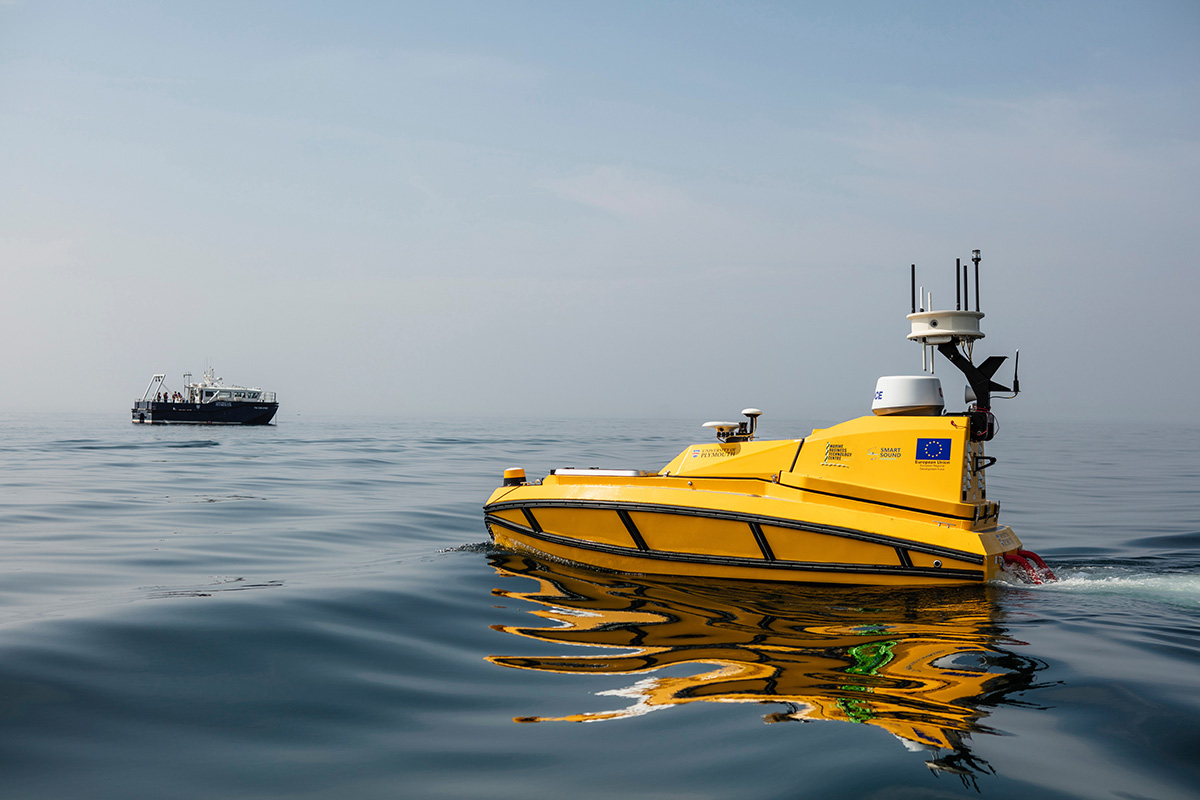
On a crisp, sunny morning in Plymouth Sound, an uncrewed vessel glides serenely across the water. It’s not a prototype for a distant future – it’s part of a live experiment shaping how the Royal Navy will operate tomorrow.
Behind this scene lies a story of city-wide partnership: the armed forces, defence primes, and a globally significant SME ecosystem, working with further and higher education providers to drive innovation and align skills to meet national security challenges in the maritime domain.
This article is the opinion of the authors, Professor Richard Davies, Vice-Chancellor of the University of Plymouth, and Jackie Grubb, Principal of City College Plymouth, and not necessarily that of the UK Defence Journal. If you would like to submit your own article on this topic or any other, please see our submission guidelines.
The present and future of defence is autonomy, including advanced marine technology that incorporates AI, real-time analysis of vast data streams, rapid technology innovation, precision, security and agility. The UK cannot afford to spread resources thinly across every region and every technology. Instead, it is focused on building clusters of excellence – places where research, industry, and talent converge to deliver strategic advantage. Plymouth is one such place.
For centuries, our city has been synonymous with naval power and now that heritage meets cutting-edge innovation, reflected in its selection as the National Centre for Marine Autonomy, plus a £4.4 billion investment in the Devonport Dockyard, which is home to western Europe’s biggest naval base.
Further recent announcements signal the scale of intent and ambition. The first stage of wider funding for Plymouth will be a share of £250 million for defence innovation. And Helsing’s newly opened resilience factory brings AI-driven defence analytics and resilience solutions to the city, creating demand for skilled people ranging from the ability to build and test marine gliders, to PhD-level expertise in autonomy and big data.
Team Plymouth is our city’s response to the opportunities and challenges presented by the city’s Defence Growth Deal. And education and skills are at the heart of that broad civic partnership which aims to secure a ‘defence dividend’. As the city’s largest university and further education college, we are vital to the city’s future success; City College Plymouth leads on Skills (Post-16), and the University of Plymouth leads on Business, Innovation and Marine Autonomy. Each institution is represented on the other’s Team Plymouth workstream, and both sit on wider groups covering areas like urban regeneration, transport and delivering social value.
Higher and Further Education (HE and FE) have distinctive but complementary and overlapping offers, and even greater collaboration in Plymouth will deliver on the Government priorities identified in its Post-16 Education and Skills white paper.
The University of Plymouth has research and innovation capability through its academic expertise and unique facilities, including its Cyber-SHIP Lab, Coast Lab and Marine Station. It also has an award-winning network of further education colleges spread across the South West, delivering higher level skills and knowledge through Foundation Degrees at a local level. It is through that long-standing partnership, for example, that City College Plymouth is the only college in the UK to offer a Foundation Degree in Marine Autonomous Vehicles, accredited by the University.
At the College’s Centre of Higher Technical Innovation & Maritime Skills in Oceansgate, students learn in world-class facilities that include advanced marine simulation labs. They build practical experience across the full cycle of marine automation production. Employees and apprentices take part in hands-on projects where they design, produce and refine products and solutions that improve efficiency in the local marine sector. Each course has a clear progression route into provision at the University, which also offers an ever-growing range of continuing professional development modules and qualifications.
Together, our work with further research and commercial partners includes assets like the Smart Sound – a deconflicted area of ocean, extending 20 nautical miles from Plymouth, that provides an offshore testbed for marine autonomy development – and the Future Autonomous at Sea Technologies (FAST) cluster; the UK’s largest marine autonomy cluster.
It’s within the context of these existing resources, plus the Plymouth and South Devon Freeport, that we are collaborating through Team Plymouth to develop a new education, technical and business ecosystem. And it’s why, with strong support from the University, the College is now progressing with a bid to become one of five new Defence Technical Excellence Colleges.
Universities and Colleges: A flexible and inclusive offer
UK Government policy proposals for post-16 education push for greater alignment between further and higher education – something the University of Plymouth and City College Plymouth have led the way on through a longstanding partnership. Spanning decades, our close relationship is part of an award-winning network of education providers that spans the South West peninsula.
But, while the value of a ‘degree on your doorstep’ remains strong, we recognise that now is the time for further innovation. Together, we must accommodate learners through more flexible and diverse routes into academic study, vocational training and a mixture of the two.
While some students still want full-time, on-campus study, others need options such as blended online and face-to-face tuition, or the ability to move seamlessly in and out of the education system, as work and life demand. And it’s not just the traditional conveyor belt of 16 and 18-year-olds we must cater for. Adult learners will seek to develop new skills, competencies or even directions over a lifetime of learning, and they must also have choices, such as returning to education for modular level provision, or choosing from an increasing array of short courses and skills bootcamps designed to support both up-skilling and re-skilling.
Providing agility for all learners will help drive productivity and support the skills gaps identified across the defence and maritime sector, as well as in other professions that will be needed if Team Plymouth is to deliver on its promise of a brighter future for our city.
Delivering a better Plymouth together
Defence innovation depends on a skilled workforce – engineers, data analysts, technicians and more – ready to operate in both military and civilian contexts. That’s why we are working hand-in-hand, creating skills escalators where learners can move from an apprenticeship in advanced manufacturing to a degree-level programme in autonomy or cybersecurity, for example. Our partnership is ensuring that talent flows seamlessly between classroom, dockyard and deployment.
Our collaborative approach doesn’t just serve defence – it strengthens the wider economy, creating dual-use skills. The investment we’re making will create opportunities in disciplines such as engineering, computer science, business management, town and city planning, environmental science, gamification, psychology and much more.
We hope that our shared programmes and wider collaborations will also inspire people to realise Plymouth is somewhere they can not only come and study, but stay and secure highly skilled, well-paid employment, create their own businesses, or lead our city into the next generation.
Plymouth’s story is one of how a university and a college are working together with employers to deliver local growth and national security. In an era of growing uncertainty, resilience and innovation will depend on purposeful partnerships such as ours.
Authors: Professor Richard Davies (Vice-Chancellor, University of Plymouth) and Jackie Grubb (Principal, City College Plymouth)