

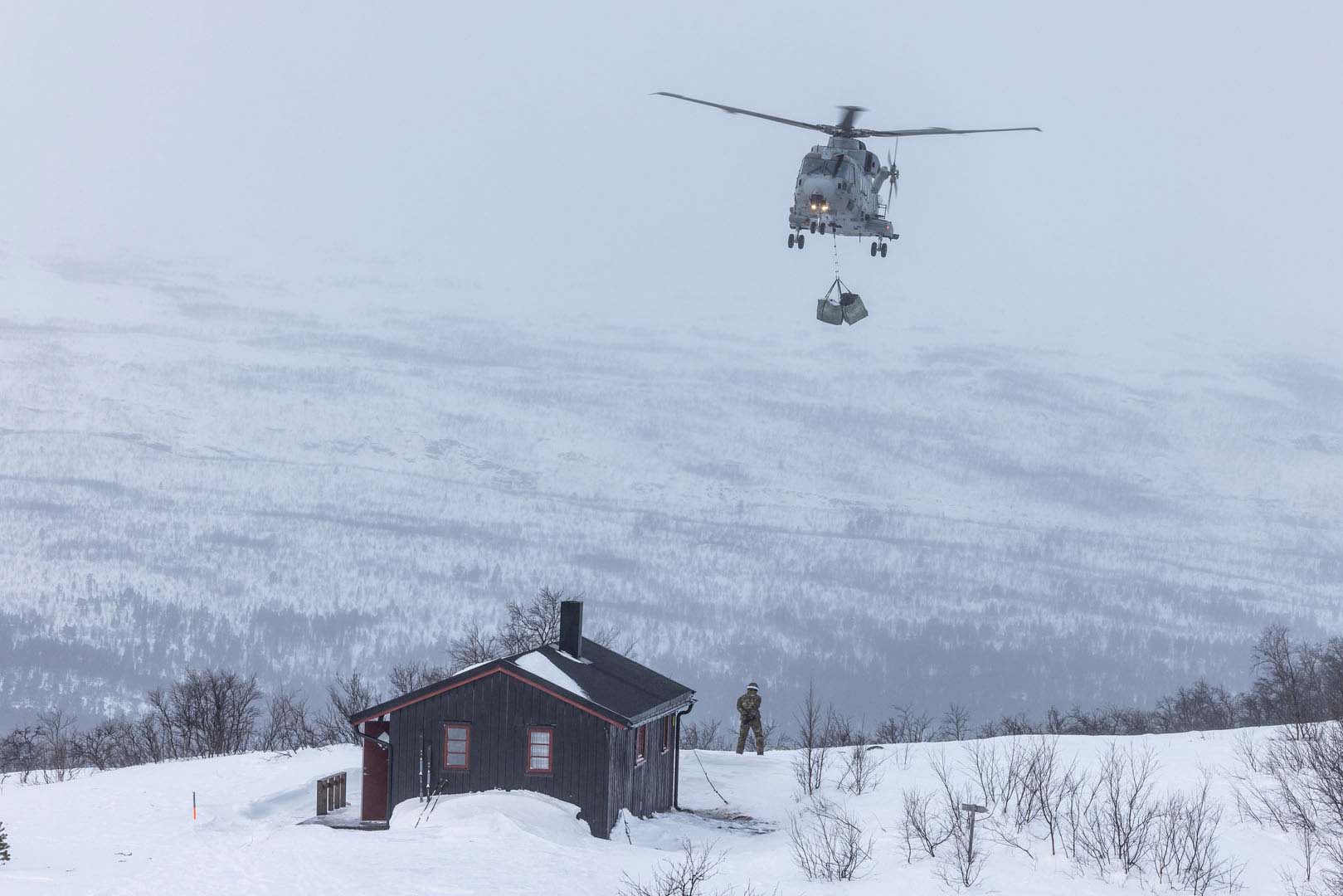
Labour MP Graeme Downie has called for a coordinated Western strategy in the Arctic to reduce dependence on Chinese critical minerals, warning that the region is becoming central to future economic and security competition.
The remarks come in a foreword written by Downie for a report by Dr Helena Ivanov of the Henry Jackson Society on the strategic importance of the High North, the UK Defence Journal understands.
Downie describes the Arctic as an increasingly immediate strategic concern. “The scramble for the Arctic is not an abstract geopolitical contest, it is a strategic race with immediate consequences for our security, our economy, and the everyday lives of our people,” he wrote.
He links this directly to access to critical minerals, which he describes as essential to modern industry and defence. “As the ice retreats and the High North opens, the region’s vast deposits of critical minerals… will become frontline strategic assets,” he said, adding that “how the Western alliance responds will determine whether we secure a more resilient supply chain or remain dependent on a single, coercive supplier.”
Downie argues that reliance on China represents a long-standing vulnerability. “For too long, Western economies have accepted a structural vulnerability… that dependence is not merely an economic inconvenience, it is a strategic lever,” he wrote, adding that the Arctic “offers a way to change that calculus, but only if we act with unity and purpose.”
He calls for the region to be treated as part of a broader industrial strategy. “Greenland and the wider High North can no longer be ignored as remote territories. They are potential sources of the minerals we urgently need to diversify mineral supply and build our processing capacity,” he said.
At the same time, Downie stresses that development must be managed carefully. “Mining in the Arctic cannot be a race to the bottom and must be a model of responsible development that strengthens our supply chains while protecting fragile ecosystems and respecting indigenous rights,” he wrote.
He also points to growing activity by rival powers, saying “Russia and China already know the value of the region and are acting accordingly,” he said, calling for deeper cooperation with NATO allies and Nordic partners and a “shared framework for investment and the highest regulatory standards.”
Arctic resources will not instantly replace existing supply chains… that is why early, sustained investment and a clear policy direction are essential now,” he wrote, adding: “Delay will only deepen our dependence and cede influence to rivals.”
He concludes that the Arctic represents a strategic opportunity for the West, but one that requires decisive action. “The Arctic presents a strategic opportunity to reduce Western dependence on a single supplier of critical minerals, but it will not deliver itself,” he said.







Svalbard should also be considered of strategic interest for minerals and NATO.
Also Canada
It seems mental to me that countries like the UK and especially the USA that are sitting on sufficient rare earth metals to last for centuries but refuse to tap them due to expense think there are some magic minerals in Greenland that can remove china from the equation.
Has nobody considered nanotechnology????
‘The remarks come in a foreword written by Downie for a report by Dr Helena Ivanov of the Henry Jackson Society on the strategic importance of the High North’
Has no-one considered junking this, frankly, mad net zero nonsense?
Part of this report’s conclusion is:
‘…the West’s current predicament is equally clear. As it accelerates its transition to Net Zero, it requires reliable access to REEs (Rare Earth Elements) yet remains dangerously dependent on China for their supply.’
The idea that ‘net zero’ will have any effect on the climate whatsoever is unevidenced at best.
Furthermore, we know that intensive mining for REEs is an environmental catastrophe:
‘Mining for rare earth elements involves open pit mining followed by complex chemical separation using large amounts of energy and huge volumes of water. This generates significant waste including toxic tailings, acidic wastewater and sometimes radioactive by-products, due to associated thorium and uranium in many ores.’
‘The rare earth elements neodymium and praseodymium provide the best magnets for wind turbines and EVs…To produce one tonne of the material, it is estimated that up to 12,000 m3 of waste gas is produced along with a tonne of chronic radioactive residue. Up to 2,000 tonnes of toxic waste including slurry tailings mixtures that can leak into ground water supplies are produced.’
‘The Complicated Legacy of Rare Earth Mining’ Harvard International Review
Millions of bats and thousands of raptors are killed every year by wind turbine blades across the world.
The idea of despoiling one of the last great wildernesses in order to further damage the environment and its wildlife is, quite simply, mad.
The delusion that climate change is affecting the frequency and strength of ‘extreme weather events’ (dedigned to support the quixotic pursuit of ‘net zero’) inevitably has its roots within U.S. ‘lawfare’:
‘…event attribution history,..derives from the inability of the Intergovernmental Panel on Climate Change (IPCC) to achieve high or even medium confidence in the detection and attribution of most types of extreme weather events. This has been politically problematic for climate activists, who have therefore pushed for rapid extreme event attribution in order to pursue climate litigation against fossil fuel companies. The origins of this climate lawfare drive date back to a 2012 meeting of US environmental advocates, climate scientists and others, which attempted to mimic strategies from the 1960s campaign against smoking tobacco.
It was at this meeting that the idea of reframing the
attribution of extreme weather to climate change was
born, bolstering the political narrative that we are now in
a climate crisis…’