


An online forum organised by students at the University of Edinburgh and Kyiv National University brought together Ukrainian and UK speakers to examine drones, disinformation, civil resilience, and energy security. The event underlined how quickly “future warfare” has become today’s reality, and why Europe’s learning curve is now a matter of deterrence.
The student-run forum linking the University of Edinburgh with Kyiv National University offered a concentrated look at how Ukraine’s wartime experience is reshaping security thinking across Europe, from air defence economics to the politics of disinformation.
Hosted online, the event drew an audience that the organisers said exceeded expectations for a specialist academic discussion, particularly given the sensitivities involved. The organisers set clear ground rules: discussions would follow the Chatham House Rule and certain segments would be flagged as potentially distressing. That framing mattered, because the theme running through the forum was not theory in the abstract, but the lived consequences of technological change in war and the way those consequences spill across borders.
Drones, civilians, and the future of accountability
One expert contribution focused on the deliberate use of drones against civilians in Ukrainian frontline regions, describing how small unmanned systems have become a constant presence that can hover, stalk, and terrorise in ways artillery cannot. The discussion highlighted a key point for Western audiences: drones are also an instrument of coercion aimed at depopulation, psychological pressure, and social fracture. The speaker drew attention to the wider implications for international law and accountability. If attacks on civilians are prohibited but perpetrators face limited consequences, the deterrent value of the rules erodes precisely as the means of violating them becomes cheaper, more accessible, and easier to scale.
The normalisation of drones as tools of intimidation is also about persistent, low-cost systems that can impose fear and disruption at a tempo that traditional frameworks struggle to match.
Hybrid pressure and the problem democracies face
A second talk examined Russian information operations and wider hybrid tactics across Central and Eastern Europe. The argument was blunt: the openness that makes democracies resilient also creates attack surfaces, and malign actors exploit pluralism, fragmented media environments, and polarised politics to weaken cohesion.
What stood out was the emphasis on method rather than ideology. The goal, as described, is less about promoting a consistent worldview and more about amplifying disruption, backing the most divisive narratives available, and degrading the sense that democratic states can act in a unified way.
Ukraine’s drone lessons collide with NATO’s cost problem
Students then presented research across drones, NATO posture, and the economics of air defence, bringing academic framing into direct contact with recent security debates.
One presentation highlighted the rapid evolution of small, operator-guided drones, including the way fibre-optic control and improvised modifications can reduce the effectiveness of electronic warfare and complicate interception. Another examined how drone incursions and aerial boundary-testing create recurring dilemmas for NATO: what constitutes “acceptable” provocation, what response is proportionate, and how to avoid dangerous ambiguity.
A key issue raised was cost exchange. If relatively cheap drones can trigger the launch of very expensive interceptors, the defender’s approach can become economically unsustainable over time. That is central to how Russia probes, exhausts, and conditions the environment.
The takeaway was not that Europe should copy Ukraine’s model wholesale, but that it should absorb the logic behind it: rapid iteration, mass where appropriate, and defensive options that match the price and scale of the threat. That implies more layered defences, more autonomy in production, and quicker feedback loops between operators, industry, and procurement.
Energy infrastructure as a frontline
One student contribution focused on energy systems as a target of hybrid warfare, arguing that Ukraine’s experience shows why resilience policy should be treated as a security policy. The basic point was that attacks on generation and distribution are about confidence, continuity of governance, and social stability.
The presentation argued for decentralisation and renewable integration as part of resilience planning, not as a purely environmental agenda. Whether or not every policy conclusion holds in all European contexts, the strategic framing is hard to dispute: infrastructure is a battlespace, and modern coercion often seeks to impose costs without crossing the threshold of open confrontation.
Civil society as an operational capability
Another student talk challenged a familiar Western assumption that civil society necessarily “shrinks” under wartime conditions. Ukraine was presented as a counterexample: a society that mobilised to fill capability gaps, provide training and equipment, and conduct open-source investigations that support strategic communications and accountability efforts.
For European defence institutions, the lesson is to recognise that resilience also comes from networks, volunteers, and civic capacity that can adapt quickly, counter narratives, and sustain effort under pressure.
AI-enabled disinformation scales faster than debunking
The forum also examined how disinformation has evolved, moving from persona-driven manipulation to more automated, AI-assisted volume operations. The core problem is speed and asymmetry: a fabricated claim can spread in minutes, while verification often takes days, and social media consumption habits reward the first emotionally compelling impression.
That dynamic matters for defence because it directly affects escalation control, public support, trust in institutions, and the decision space available to governments. If adversaries can cheaply flood information channels at scale, they can shape the environment in advance of crises, including by framing defensive actions as provocative or illegitimate.
Why this event matters
Events like this are easy to underestimate because they are student forums. That would be a mistake.
First, they function as a bridge between those with direct wartime experience and those who will be shaping policy, procurement, research, and media narratives for decades. Second, they normalise engagement across different security cultures, including frank discussion with Ukrainian military-linked students whose professional context is often absent from Western seminar rooms. Third, they compress a broad set of issues into a single conversation: drones, law, public opinion, infrastructure resilience, and the information environment are not separate topics anymore.
Europe is already encountering the edges of the problem through airspace probing, infrastructure anxiety, and disinformation pressure. Ukraine is encountering the full expression of it. The strategic value of this kind of exchange is that it reduces the lag between experience and learning.
If European security planning is to keep pace with what is emerging, it will need more than new equipment. It will need faster institutional learning, clearer thresholds, stronger resilience outside the barracks, and a more realistic understanding of how cheap systems can generate expensive dilemmas. The forum I was lucky enough to be invited to was the perfect way to start on that path.




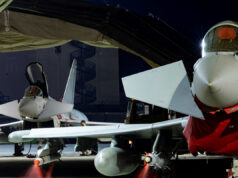



That’s the thing about On-line Forums, It brings together forward thinking people from all over the World, who Impart their knowledge and experience In a focussed manner to push the envelope of Military stratagy and future thinking.
Proud to be a member of this font of forum knowledge.
😎