

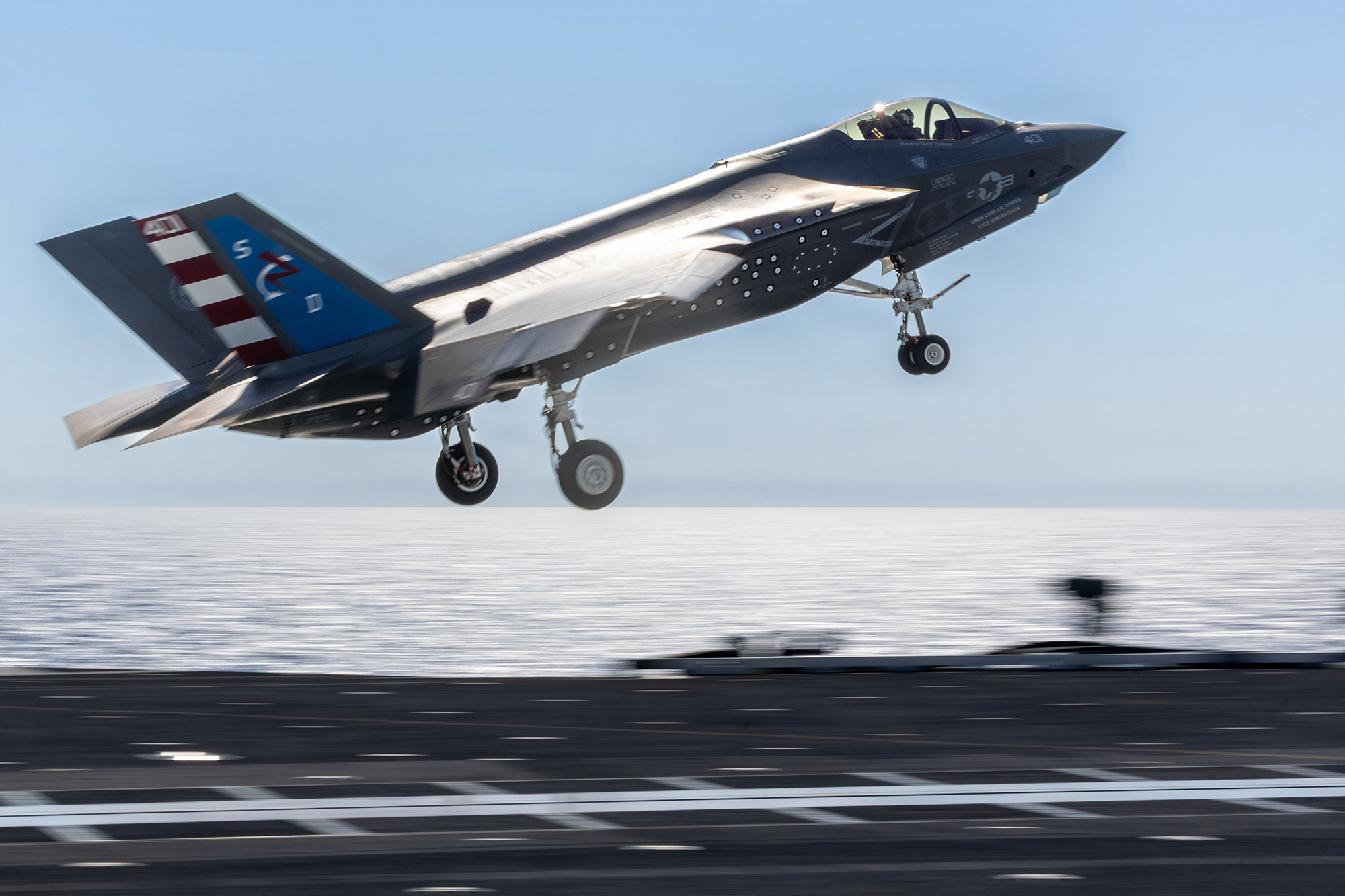
A US Navy F-35C Lightning II has completed the first arrested landing by the type aboard a Gerald R. Ford-class aircraft carrier, with the milestone taking place aboard the future USS John F. Kennedy during aircraft compatibility testing in the Atlantic, according to the US Navy.
The landing took place on 13 October aboard Pre-Commissioning Unit John F. Kennedy, designated CVN 79, as the second carrier of the Ford class continues testing ahead of its planned delivery to the Navy.
Aircraft from Air Test and Evaluation Squadron 23, known as the “Salty Dogs”, have been operating from the carrier during the trials. Imagery released the following day shows an F-35C conducting a touch-and-go from John F. Kennedy’s flight deck as testing continued on 14 October.
The current programme is focused on Aircraft Compatibility Testing, which assesses whether the ship’s launch and recovery equipment can safely and reliably support the different aircraft expected to operate from the carrier during service. For the F-35C, that means operating with two of the defining systems introduced by the Ford class: the Electromagnetic Aircraft Launch System, or EMALS, and Advanced Arresting Gear.
EMALS replaces the steam catapults used aboard the preceding Nimitz-class carriers with an electrically driven system for accelerating aircraft from the flight deck. Advanced Arresting Gear performs the other half of the carrier aviation cycle, absorbing the energy of an arriving aircraft when its tailhook catches one of the arresting wires stretched across the deck.
The F-35C is the carrier variant of the Joint Strike Fighter and was developed specifically for conventional US Navy aircraft carriers. It uses larger wings than the F-35A and F-35B, strengthened landing gear and a tailhook for arrested recoveries, allowing it to operate from carriers equipped with catapults and arresting gear.
Testing continued on 14 October with touch-and-go operations from the carrier. In imagery released by the US military, an F-35C from VX-23 is seen just above John F. Kennedy’s flight deck with its landing gear extended during one of the test sorties.
The US Navy said the carrier was underway conducting Aircraft Compatibility Testing, describing the work as an assessment of the operational capabilities of the ship’s aircraft launch and recovery equipment with Navy aircraft.
John F. Kennedy is the second Gerald R. Ford-class carrier, following USS Gerald R. Ford, which entered service in 2017. The class introduces a substantially redesigned aviation system compared with the Nimitz class, including EMALS, Advanced Arresting Gear, a revised flight deck layout and increased electrical generating capacity.
The carrier displaces around 100,000 tonnes at full load and is powered by two A1B nuclear reactors. Its flight deck measures more than 330 metres in length, with the class designed to operate a large embarked air wing including F/A-18E/F Super Hornets, EA-18G Growlers, E-2D Advanced Hawkeyes, helicopters and F-35Cs.
John F. Kennedy also differs from the lead ship in several areas, including its radar fit. From CVN 79 onwards, the class uses the AN/SPY-6(V)3 Enterprise Air Surveillance Radar together with the AN/SPQ-9B surface search radar rather than the dual-band arrangement installed aboard USS Gerald R. Ford. The ship remains in its pre-commissioning phase, with delivery expected in 2027. The latest aviation trials are part of the wider test programme required before the carrier can enter service and begin the process of integrating a full air wing.
The arrested landing on 13 October marked the first time an F-35C had completed a carrier recovery aboard a Ford-class ship, followed immediately by further flight deck testing as John F. Kennedy continues preparations for operational service.




Just goes to show another massive positive for the F35B/ CVF design over the other option of selecting F35C and Catapults. It’s taken the USN with its decades of experience and near infinite budget more than ten years to get its latest carrier plane on its latest carrier.
Given just how much more capable F35 is over any other carrier capable aircraft including Rafale and F18 the Queen Elizabeth class with 24 F35B onboard remains one of the worlds most potent naval weapons.
Whilst I partially agree with you Jim, there are two points that are interesting to consider:
– First, I was watching a fascinating youtube video; a lecture by the USN guy who oversaw the requirements that led to the FORD class. The USN actually considered a switch to STOVL for the FORD class. They rejected it, because whichever way they ran the numbers, they couldn’t get past the “half the payload, half the range” issue.
– Second, they have had F35C in their airwings, just not on the FORD. And that is really because FORD didn’t have the maintenance facilities for F35 fitted when launched. The QE class however, are literally built around the aircraft. We have three maintenance systems for our F35s to plug into; Marham and the two carriers.
It would be interesting to understand if we had converted to CTOL and F35C, would we be in a similar position to the USN or ahead of them?
Considering we were looking at the same GA EMALS and AAG I think we can safely say the same which would mean worse because we’ve had years of operating full wings of Gen5 aircraft aboard our carriers now where in the CATOBAR config we would have had nothing to fly from them that was cleared until now.
They literally would have been the white elephants that a great many people insist they are.
Maybe. Part of the problems in getting the F-35C certified on the EMALS has been the lack of at-sea EMALS available to the USN. Having two extra flat-tops probably would’ve sped up integration somewhat.
Being a test dummy for helping ‘derisk’ new USN tech is not an enviable position. With the disparity between budgets there’s every chance the USA would have simply walked away after discovering problems (as Trump might be doing now) and left the RN with an orphan technology.
But the F35B has significantly more than half the payload and half the range than the F35C. Stats below. More like 75% of the range and 80% of the payload.
Specification F-35C (Carrier Variant / Navy) F-35B (STOVL Variant / Marines)
Total Weapons Payload 18,000 lbs (8,160 kg) 15,000 lbs (6,800 kg)
Maximum Range ~1,200 nautical miles (2,200 km) ~900 nautical miles (1,700 km)
Combat Radius (Internal fuel) ~600–750 nautical miles ~450–510 nautical miles
Internal Fuel Capacity 19,750 lbs (8,960 kg) 13,500 lbs (6,125 kg)
Max Takeoff Weight 70,000 lbs (31,800 kg) 60,000 lbs (27,216 kg)
The Queen Elizabeth may have been built around the F35B but it was certainly not built around the F35C. The ship would have needed massive renovations to install catapult and arrestor gear and the F35C entered service years behind the F35B and the F35C remains the least produced version.
If we had followed through on the madness of the CATOBAR conversion we would have no carrier and probably no F35’s.
We would also not have the kind of flexibility that we see with the Queen Elizabeth class, able to move effortlessly from carrier strike with 24 F35 onboard, to a littoral strike capacity embarking 8 F35 and more than a dozen helicopters and large embarked commando force.
The USN developed a similar concept in its USS America lightning carrier concept. It worked exceedingly well but was found the ship was too small at 40,000 tonnes to be truly effective, soemthing our own design studies also showed which is why we went 65,000(t)
The only issue with the Queen Elizabeth class is the frankly daft comparisons made with US Super carriers of the Ford and Nimitz class. The ships perform very different roles. Personally I think the US would be better off with 40 Queen Elizabeth’s rather than 10 Nimitz/ Ford + 10 wasp/America class IMHO.
It’s just a much more versatile platform, built and operated at a fraction of the cost of a CVN.
Or a mix of both? So look at the gulf at the moment where they have 2 or potentially 3 CVNs on station. You could have 1 CVN and 3 or 4 QE2 class on station for less money? And a lot more 5th gen aircraft.
Yes, a lot more decks with a lot less personnel and a lot more 5th Gen aircraft.
The Queen Elizabeth’s can also dock at many ports meaning the crew does not have to spend 270 days at sea. To my knowledge no one in CSG 21 or CSG25 attempted suicide. Indeed everyone seemed to have a pretty good time despite spending 28 weeks at sea (but with frequent shore breaks)
I think the reason they didn’t put into a port was because their normal port they could have gone into was, erm, well mostly damaged by the Iranians. So their supply ships had to go much further, the sailors couldn’t get leave meaning the whole thing was a real struggle. A QE couldn’t have docked either.
Yes a QE could dock in other ports that a Nimitz can’t. The main issue the USN had is a lot of potential ports won’t allow a nuclear vessels to berth.
In Singapore for example the Queen Elizabeth pulls up on the cruise terminal. CVN normally stay offshore or require special docking in a handful of allied nation ports.
But Singapore is 4000NM in a straight line from where it was operating. That wouldn’t have been viable anyway.
I genuinely do get the argument but I don’t think the nuclear vs conventional power one is relevant in this case. If anything imagine the logistical burden of a conventional carrier unable to dock near the war zone. Even more tanker legs taking weeks each. They already had to do it for aircraft fuel, I’d hate to imagine the volumes if they also needed diesel.
One only has to look at what USN crews were forced to eat on several long deployments to blow the entire conventional vs nuclear carrier argument out of the water.
The easiest thing to get to a carrier under way is fuel and all the planes plus escorts need to fuel up anyway.
Just because the carrier has enough fuel to stay at sea doesn’t mean it has enough food.
The USN don’t intend to put anymore than current complement of F35. So adding more 5th generation is not going to happen. The block three Hornets are there until the 2030s. Their planned replacement is a sixth generation aircraft.
Yes but their planned replacement is a Boeing aircraft as well with an another aircraft ahead of it in the development queue. Boeing does not exactly have a good reputation at this point for delivering aircraft.
The US budget deficit is also massive and unaffordable. I just can’t see the FA XX program lasting IMHO.
The USN may have to learn to love the F35C yet.
There are many vagaries involved budgets, new presidents, new house and senate. Multiple changes and possibilities.
Just can’t see the USN being willing to accept more F35. They were hostile to the F35 from the start. Two main reasons cost and single engine. The joint chiefs forced them into a position which at best could be called reluctant partner. That has not changed. The USN have spoken in glowing terms of the stealth aspect. However their main objections remain with the added one of serviceability. It maybe you are right and they will be forced to accept more who knows. My thinking though is that move heaven and earth to stop it.
I agree the USN is reluctant but that doesn’t justify their position. They are like spoiled children. Too much money which they waste and their solution to everything is more money. The waste in the USN is scandalous. All that money and they have less than 70 surface combatants.
Their F35 procurement has also been scandalous. Forcing LM to design an entire new variant then basically not buying it and now the USMC has had to buy more.
I suspect they are going to have a budget reckoning soon and they will be thankful to have the F35C to fall back on.
The us military pulls this shit all the time. It was the same with the F22, shutting down production because the F35 would solve all their problems.
The issue is that as it is single engine the maintenance standards have to be higher: failure is not an option!
That is just statistics where you cannot afford to get into the long tail of reliability.
A lot of testing was done to prove single engine reliability for F35C and to my knowledge it’s never been a factor in an accident nor in low availability rates which seem to be far more a result of skin coatings and lack of spare parts.
Two engines takes twice the maintenance.
Errrr no.
The approach to engine failure is statistical.
It must have a failure rate of less than a certain %
If you have two engines it is {certain %}squared – in rough terms
So the reliability demands on the single engine are onerous to put it mildly and a lot of preventative part changing is required.
I suspect that the UK Duty Holder has mandated a very low % failure rate so the parts changes are crazy higher than anywhere else. Add to that the known parts availability and the no-money-for-parts-stockpiles and you have a magic toxic cocktail.
I wouldn’t mind betting that lot of that logic has been extended to other parts of F35B as well such as the lift fan.
With a mechanically complex plane like F35B that will spin out like topsy.
Mind you: how many F35B’s dropping from the sky due to engine failure is acceptable?
Well put Jim. The QE Class and the F35B are the best overall bang for our buck. We aren’t trying to be a Nimitz class carrier group. But the ability to deploy 5th gen capability at our choosing, is a very capable option. Add in CCA further down the line, T26, T31s, Upgraded T45. Spear3 and FC/ASW or whatever its called now, The new solid support vessels and you have one very capable carrier group.
It totally agree.
With the T45 issues now in fix and the upgrades programmed in that side of things is on the mend.
I just wish that we could get some frigates out of BAE and Babcock into trials and the ASTUTE engineering issues sorted out.
It seems a plan is in place for the dry dock facilities, and huge sums are going to be spent on Faslane. But it will take a few years to fully take affect.
I suspect we are going to see ASTUTE availability improve in quite short order. I don’t think that it was all dry dock based issues.
I further suspect that a lot of people who were working on Achilles are working on fixing the issues with the others. Maybe using the parts earmarked for Achilles to get the others back to sea….
Let’s hope so. They are incredibly capable machines once at sea.
And the range issue evaporates if AARUAVs become real.
It is a big IF but USN are working on it for a reason.
With all due respect Jim, the book figures don’t tell the whole story, at least not for naval aviation.
The F35B has a bringback weight of just under 5000lb (similar to the F/A18C and D), much less than the c.11,000lb bringback of the F35C and Super Hornet.
The still as yet uncertified SRVL technique would maybe add another 2000lbs bringback for the B, but that is still much less than the C and F/A18E/F/Gs.
So, while you can fuel and bomb up an F35B to the amounts you quoted and bring back a fair amount of that to a land base, if you want to bring the aircraft back to the carriers you’ll need to dump a lot of excess fuel and most of any stores you haven’t expended, just like Harrier FA2s couldn’t land back on board with AMRAAM attached in hot and high places like the Gulf.
That’s not to say we should have switched from the B to the C, but it is being honest and acknowledging the difference/deficiency in some areas between variants. We are very lucky after all to have the USMC get the old P.1154 concept made for us, wrapped in stealth and filled with advanced sensors, no less!
We went for a STOVL carrier design as it was deemed the best compromise between capability and cost, and given the available tech at the time of main gate, it made sense. It was nothing to do with global port access, or the ability to use the carriers as helicopter assault ships (at a time when we have already said Albion and Bulwark are redundant there’s no way we are parking a 60,000t carrier within helicopter range of an enemy coast), or even the perceived benefits of ski ramp launches over catapults in high sea states. It was all about the least risk and most bang for the buck, and the carriers as designed at the time offered that. If we were designing a new carrier in the 1980s, maybe we would have gone for catapults and a COSAG arrangement, as we still had the institutional engineering knowledge. Maybe the next generation of RN carriers will be using EMALS and COGES. But in the 2000s, the STOVL was the safe choice for us.
That doesn’t mean we should pretend it is some wonder weapon, that we alone know better than others, or that there aren’t still issues with UK carrier groups which we need to solve, namely around organic AEW and AAR, and overall availability due to fewer airframes being ordered than originally envisaged, and those being shared between RAF and Navy ops. Hopefully though, carrierborne UCAS aircraft suitable for the QE carriers will address these issues soon.
Being ahead of USN on this would have been killed by budget.
Not quite true regarding the Ford, it’s far more widespread a problem with the EMALS system it operates. The reality is that the ship was being designed and modified in a similar timeline to the F-35C design specs still being a little nebulous too, neither therefore had a consistent model of the other that they could incorporate into their design as they both fixed their overall design and solidified the embedded technology. The serious problems in making EMALS work reliably consistently took priority on the Ford itself requiring that focus on known quantity aircraft rather than accept further long term delays in trying to solve both the system’s technological problems and make the system compatible with the evolving F-35 as well. It simply wasn’t deemed predictable or viable (especially as it would very possibly delay following ships too). So it was decided to not try to do so on the Ford, instead perfect the system for legacy aircraft, make it reliable, learn the lessons and incorporate the reworked upgraded and perfected version on the next in line carrier while waiting for the Ford itself to enter its major mid life works to modify it, which shows the extent of the actual modifications deemed necessary.
So if Britain had incorporated the same EMALS system on our carriers we would have encountered the exact same problem meaning our carriers would either have literally have had no planes at all to fly or would be entering serve with the F-35C about now most like. Imagine what a scandal that would be by comparison to today’s snarking commentary by some of the media. As others have said there is then all the relearning of the skills required for CATOBAR. Doesn’t sound promising sadly so it seems we, by luck or judgement chose correctly, considering the timeline we were on.
Agreed. We ended CATOBAR operation in 1978 and regenerating that capability from scratch would have been far more complicated and expensive than moving from joint force Harrier to an updated equivalent with the F35B.
But mission availability remains low and we still have to find an AEW successor to Crowsnest.
Don’t know where you got the idea the F35 is more capable than the the F18. Clearly the USN does not think so. F18 will carry on until the the sixth generation becomes available in the 2030s. The USN will not be putting anymore than 10/14 F35 on any carrier. To do otherwise would lose to much capability.
Suggest you check out the available red flag data on F35 kill ratio vs F18 and other 4th Gen aircraft. It’s 15 to 1.
So that’s where I got my idea from.
Proof is very much in the aircraft make up of a carrier air wing. Never going to be more than 20 F35.
Your idea not shared by the USN.
Yes but as previously discussed the USN has a bunch of non combat related reasons for not choosing more F35’s
The USMC has gone all F35, does that make them dumb but they navy smart?
The problem is that this is specifically stats in air to air combat which is not really the prime role of either airframe, though not to be discounted clearly or enemy aircraft that stat reflects the main threat to the carriers. Overall performance is not dissimilar tbh in speed, range, weight and manoeuvrability. Obviously stealth is the big differentiator though head on I believe the F18 Super Hornet has the smallest radar signature of any Gen 4 fighter. So when stealth is the priority the Lightning is far superior (unless external ordinance is considered) otherwise there is little to choose in capability. The F-18 is many times cheaper to buy, the F-35 claimed by LM to now actually be cheaper to operate though I do wonder about that, seems to be a lot of work to improve the aircraft’s once terrible image in that regard to help the manufacturer sell it. An older aircraft of course has its own added maintenance costs to consider.
Either way neither seem to be considered the ideal aircraft for the job required of them moving forward by the Navy and one of the reasons the original plan to replace all GEN4 Super Hornets has been revised. Range of either is now seen as far too limited to operate effectively while keeping the battle group safe from enemy attack in a peer to peer conflict, (Iran was threat enough apparently) which will be critical in the thirties. So the mix will be retained as long as possible it seems till the new F-47 derived replacement arrives to take over the premier role. The 6th Gen replacement itself stuck in limbo since 2013 has now as a result become high priority despite few in power wanting over the years to grant the funds.
Except, the F-35B is a whole lot different than the F-35A. Compared to the F-35A, the F-35B has a smaller weapons bay, no internal gun, less internal fuel load, and because the weight of the vertical lift components, is less maneuverable (9g versus 7g) .
So, once the internal 4-6 AAMs are fired off, the F-35B isn’t capable of shooting down other aircraft and would be better off returning to base.
Hi Wallace, I suggest you look at what mission factors the marginal reduction in performance has.
The F35C is also limited to 7g but 7g is quite a lot. The F18 is also limited to 7G.
The F35A can do 9G but if you do 9G in a sustained turn there is a good chance you will break the aircraft. You will certainly cause major maintenance issues. No one needs to do 7G much less 9G when you can fire off boar sighted miles.
In terms of missiles they could all only take four internal until recently. However if you can show me any time in the past 50 years when an FAA plane had gone full Winchester with four radar guided missiles I’ll be impressed.
Jim, every navy fighter is less maneuverable than a land based fighter, largely due to the reinforced structure and, to some degree, larger wings. And, there’s always a safety factor when it comes to g-loading. If a fighter is rated for 9gs, it could probably survive 13 to 14gs, though its flying days would be over.
But, without an internal gun and limited number of missiles, you’re limited to how many aircraft you can engage. Sure, you could carry more externally, but that makes the B less stealthy.
The British F35B can carry four internal AMRAAM/ Meteor and two external ASRAAM in an LO configuration.
Honestly we have no need of carrying more in an air defence role.
We would run out of missiles and Russian aircraft to target long before having 8 instead of 6 air to air missiles became an issue. Not having a gun is even less of an issue. Any British F35 pilot going anywhere near a gun kill clearly didn’t do their job and would be risking an irreplaceable aircraft for little benefit.
As you will be aware the Royal navy operates a four layered air defence umbrella with the F35 representing just the outer layer. As soon as it runs out of missiles it heads back to the ship and it’s replaced by other aircraft. Any air target that gets through should be intercepted by ships missiles and guns.
It seems a plan is in place for the dry dock facilities, and huge sums are going to be spent on Faslane. But it will take a few years to fully take affect.
The external gun pod is available for the F35B if it became a requirement for the RAF/RN.
The gun pod has 220 rounds,. So, you better aim carefully.
Typhoon carries 210. Very few fast jets can carry large amounts of ammunition for the gun.
F-35C is replacing F-18C/Ds. That was always the plan as the F-18E/Fs have a lot of life left in them and wont need replacing until 6th gen. The F-18E/F was the top fighter on the carrier with the C/D variants being the lower tier. Now the F-35 is the top tier with the 18E/F being the lower tier. All the USN F-18C/Ds have been replaced at this point with some USMC units still operating F-18C/Ds (but not off of carriers anymore i believe)- the USMC is purchasing a large amount of F-35Cs to replace the last of their hornets within the next couple of years.
Also a big reason why the USS Ford hasn’t gotten upgrades for the F-35 yet is because the F-35s are prioritized for the pacific fleet as they are delivered. Ford is Atlantic fleet. Eventually all the Atlantic fleet subs including Ford will get F-35s. Again, that has always been part of the long term plan.
The Ford can’t operate F-35s presently due to limits in its Gen 1 EMALS system amongst other things till substantial upgrades, not planned presently until its midlife upgrade works. Don’t think the US would have willingly been left without stealth navy fighters during its war on Iran.
“The USS Gerald R. Ford (CVN-78) is scheduled to receive its F-35 Lightning II integration upgrades during its current Planned Incremental Availability (PIA) maintenance period, keeping the carrier sidelined until late 2027 or early 2028 for post-availability sea trials and training.”
left our more info:
“• Current Status: The carrier entered a planned maintenance availability at Norfolk Naval Shipyard in mid-2026 following a 326-day deployment.
• Upgrade Work: Technicians are installing the specialized facilities, classified data networks, and modified jet blast deflectors required to support the F-35C’s sensitive mission systems and high-temperature exhaust.
• Full Operational Return: After the refit concludes, the ship requires extensive sea trials and integration training before returning to active action with F-35Cs by late 2027 or 2028.
I had read sources claiming that the Ford would not become “C capable” until much later, so news that she will be carrying C’s by 2028 is welcome.
Thank you for posting that!
It looks like the USN is slowly allowing the C to creep into the fleet.
Now if LM can get the mission readiness rate up across the board…
My understanding is it’s also limited by the jet deflectors not being able to handle the super high heat exhaust from F35 and not having work shops capable of dealing with 5th gen aircraft.
Shocking that this first f35c landing on emals deck October 2026
Must admit I don’t know (with the Ford unable to test them at all with its present system) whether they could have tested them earlier if the Kennedy had been ready earlier or if the EMALS fitted to it itself had only become capable of launching/recovering F-35 at this point. The ship has probably only just worked up to be ready to do so is my guess.
Or perhaps if we have converted the Queen Elizabeth and worked out all the kinks for them. Would have been like the Corsair all over again. 😀
That’s some high AoA in the main picture…one of the reasons the USN has been lukewarm on the F35C – it’s carrier landing characteristics aren’t great…