

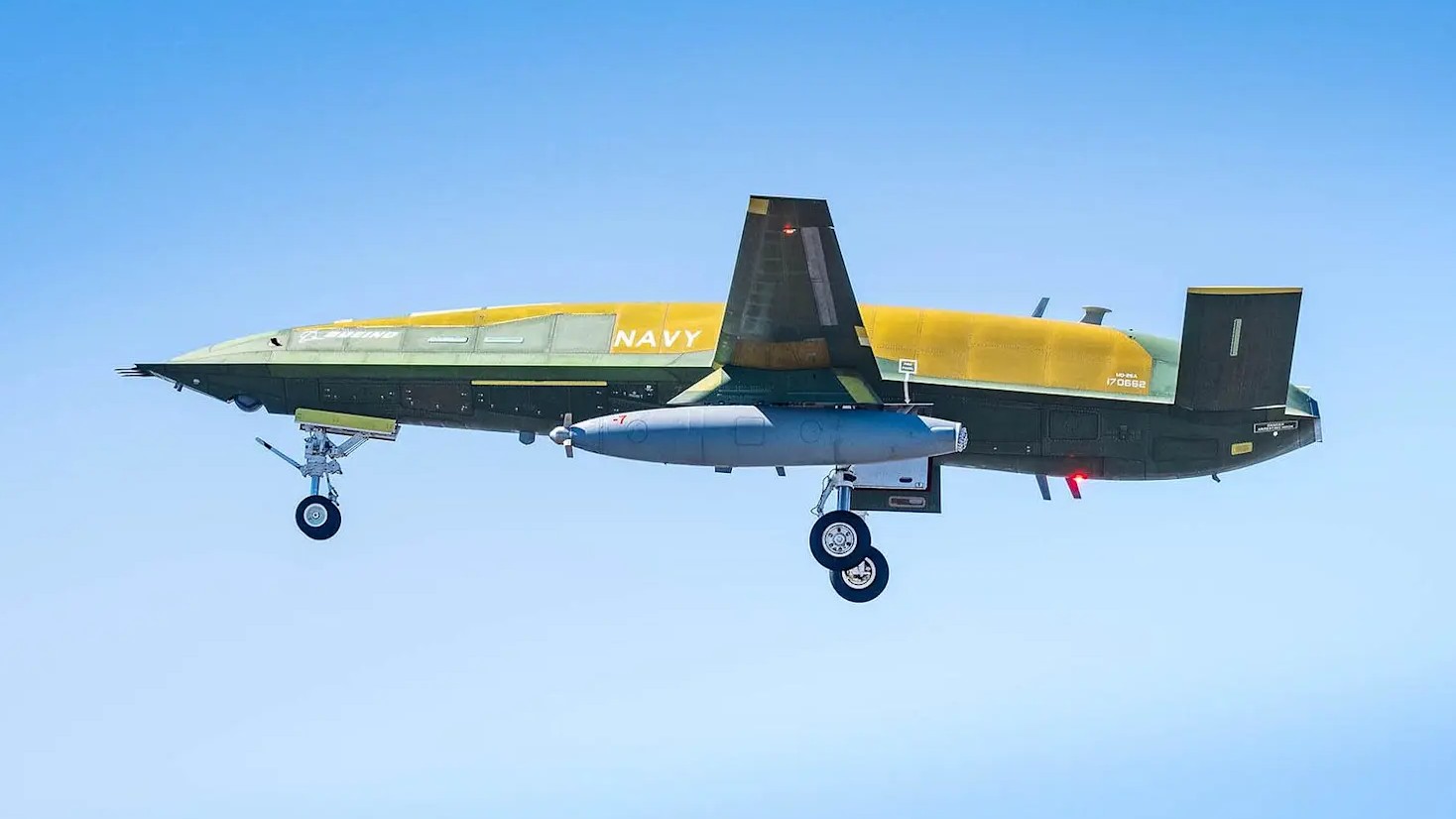
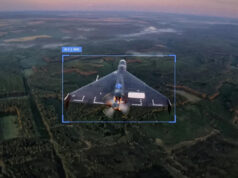
Boeing and the U.S. Navy have completed the first test flight of an operational MQ-25A Stingray unmanned aerial refuelling aircraft.
The two-hour flight took place on 25 April over southern Illinois, during which the aircraft executed a series of tests and manoeuvres to validate its basic flight controls and operations with the Unmanned Carrier Aviation Mission Control System ground control station.
The Stingray autonomously taxied, took off, flew and landed following a predetermined mission plan, with Air Vehicle Pilots monitoring the aircraft’s health and performance and retaining the ability to abort or modify the mission profile as needed.
The MQ-25A operates with a human on the decision-making loop rather than fully autonomously, with Air Vehicle Pilots creating flight routes and establishing waypoints before giving the command for the aircraft’s onboard autonomy to manage all systems including propulsion, guidance and flight control throughout the mission.
Dan Gillian, vice president and general manager of Boeing Air Dominance, said the flight built on years of learning from the MQ-25A T1 prototype and represented a major maturation of the programme, describing the Stingray as “the most complex autonomous system ever developed for the carrier environment.” Troy Rutherford, vice president of Boeing’s MQ-25 programme, said the achievement would not have been possible without the work of the Boeing, Navy and industry team, adding that together they were “redefining the future of naval aviation and pushing the boundaries of what’s possible with autonomy.”
The MQ-25A is intended to serve as the US Navy’s primary carrier-based aerial refuelling platform, freeing F/A-18 Super Hornets currently performing the tanking role to focus on their primary strike fighter mission. By extending the operational range of the carrier air wing, the Stingray is expected to significantly expand the reach of carrier-based aviation without requiring additional crewed tanker aircraft.
Boeing and the U.S. Navy will conduct additional test flights from MidAmerica St Louis Airport to further validate the aircraft’s flight controls and capabilities before the aircraft transitions to Naval Air Station Patuxent River in Maryland to prepare for aircraft carrier qualification trials. The Boeing-owned T1 prototype, which first flew in 2019 and accumulated approximately 125 flight hours over its lifetime, laid the groundwork for the operational aircraft that completed Friday’s flight.




Sir, are you alright?
what is this guy talking about
Not sure if you’re able to, but might eb worth touching base with George- that chap sounds unwell as opposed to trolling…
I’ve gained $17,240 only within four weeks by comfortably working part-time from home. Immediately when I had lost my last business, I was very troubled and thankfully I’ve located this project now in this way I’m in a position to receive thousand USD directly from home. Each individual certainly can do this easy work & make more greenbacks online by visiting
following website—.,.,.,.,.—>>> JobatHome1.Com
The U.K. need this to extend the range of the F35B and to act as loyal wing men. I am wondering if we could launch it with disposable rockets but we would still need arresting gear to land it.
It is clear that the F35B without a mid air refuel capability will bring the carriers to close to shore.
I’m surprised that the Stingray hasn’t had more discussion. For the US Navy the ability to do mid-air refuelling from a platform launched by the carrier, will be a game changer. Granted it’s no Voyager, but it should be able to significantly increase the range of both the F35C and F18s that the ship carries. But perhaps significantly either push out the range of the combat air patrol or extend its duration for defence, whilst increasing the reach offensively. The USN are expecting the Stingray to be in-service by Summer 2027, with an initial buy of 76 airframes. Depending on were you read the information, the airframe is expected to cost between $136M and $209M, which includes development costs. So will the actual airframe cost less than a F35 otherwise its going to be exorbitantly expensive.
Sadly for our carriers to get the Stingray, it will need a catapult, angled deck and arrestor system modification. Which under the current fiscal issues is very unlikely to happen.