

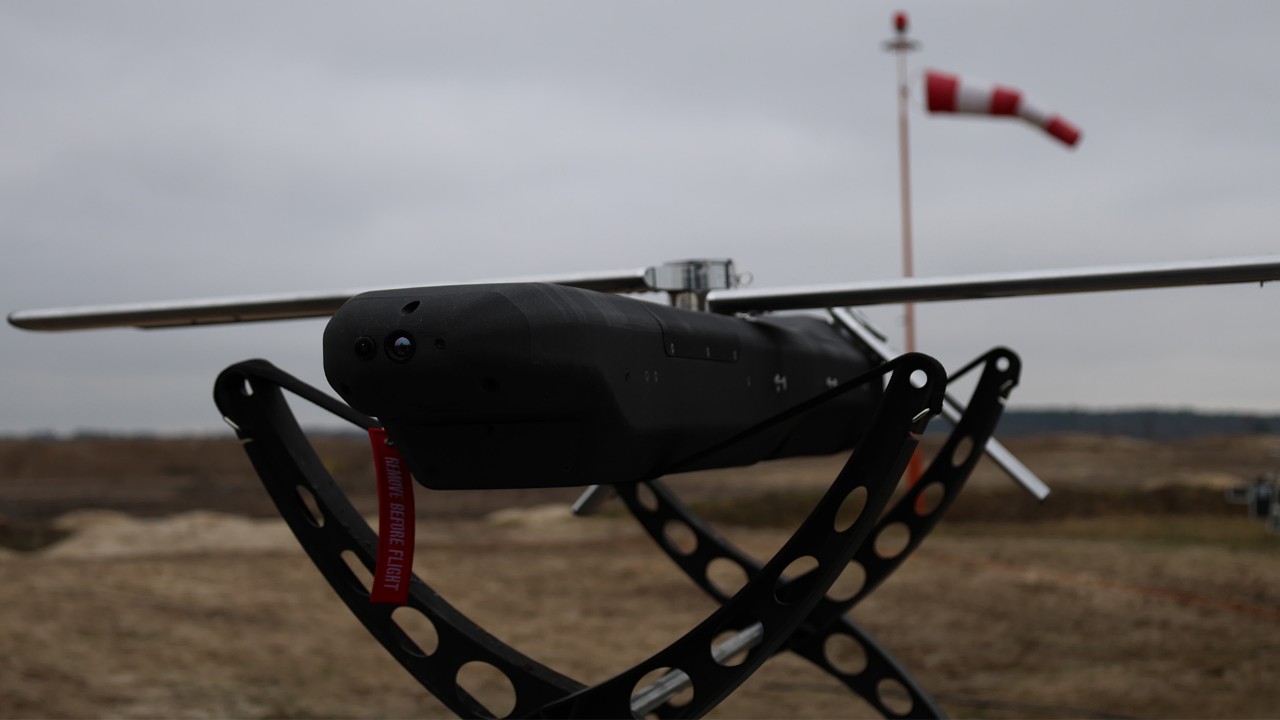
A new British-built interceptor missile designed to counter Shahed-style attack drones has been successfully tested in Jordan, less than two weeks after the Ministry of Defence signed a contract to buy the system for the UK Armed Forces, according to the government.
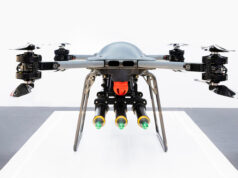
The Skyhammer missile, produced by UK veteran-led start-up Cambridge Aerospace, was tested at one of Deep Element’s defence development facilities in Jordan in demanding desert conditions, witnessed by Minister for Defence Readiness and Industry Luke Pollard during a visit to Kuwait and Jordan for discussions on regional security and defence cooperation.
Pollard said the trial was “a perfect example of a UK start up innovating, with the backing of this government, to deliver cutting edge technology” and described it as demonstrating how UK defence industry could deliver at pace, learning lessons from the conflicts in Ukraine and the Middle East. He said the visit showed “the UK is standing by our long-term partners and delivering on our promise to provide support.”
Steven Barrett, CEO of Cambridge Aerospace, said the trial had “proven that our interceptors are not only cost-effective but also highly capable and will be able to counter the rising threat posed by aerial attacks” and welcomed the MoD’s support as the company looked to protect the UK and its partners with high-performance, rapidly deployable air defence systems.
Skyhammer has a range of 30 kilometres and a maximum speed of 700 kilometres per hour. The first tranche of missiles and launchers will be delivered to the UK Armed Forces in May, with more to follow within the first six months of the agreement. The multi-million-pound contract is creating over 50 new jobs and supporting 125 existing positions at Cambridge Aerospace.
During his visit, Pollard met Kuwait’s Minister of Defence and paid tribute to the efforts of Kuwaiti Armed Forces and UK personnel who protected civilians and critical national infrastructure during Iran’s missile and drone campaign prior to the current ceasefire.






Good news. This is what is needed, now need to develop a swarm anti swarm.
It’s astounding just how many quality small British companies there are nocking out some of the best weapons in the world right now.
The garden shed will always remain Britains most important defence research infrastructure 😀
We should order a shed load then.
Since the invasion of the Ukraine the government has been quietly financing lots of projects in British SMEs to develop new weapons, defences, etc. 😉
It’s not the Ukraine it’s just Ukraine, ya know because it’s a proper country.
🥱
tbf to the other commenter, calling Ukraine “The” Ukraine is a moniker used almost exclusively by pro russia shills and RW sympathisers. It’s a dogwhistle, although I don’t think you’re using it that way – but it is understood in that way by Ukrainians
No it’s the monika used by us oldies that were taught it was The Ukraine SSR, the capital of China was Peking, the island threatened by China was Formosa, Burma not Myanmar, Rhodesia not Zimbabwe, etc, etc.
Fair enough, but the meaning of terms evolves and the use of it now is pretty contentious for Ukrainians. I made a point of avoiding saying it when I found out what it’s being used to convey currently (a dismissive attitude to Ukraine’s sovereignty, which “isn’t a real country anyway” and is basically “an region of Russia in all but name”).
Just something to be aware of, particularly online, as people will make assumptions when they see it.
Well none of my real-life Ukrainian friends have any issues with this term, but I’m sure there’s scores of keyboard warriors that will seize on any petty thing to argue over.
Absolutely so Jim it’s one of the few aspects of British industry that gives me hope should a conflict break out. Outside of Ukraine due to its circumstances I think we are the best in the World in this regard and long have been. Probably the offspring of our former innovative history. So many small and start up businesses that create such innovative and effective solutions so very quickly with little support and much of it inspired by our domination of formula 1 and our Universities. Sadly it’s as they grow that we are so damn bad at giving them the support and investment required because at that level safe decisions take precedence over opportunities to develop the technologies of the future and outsiders tend to take advantage or companies are left to fail.
Shahed drones cost between $20000 to $50000 depending on the model I guess.
So if this missile cost less than $20000 to produce (which I doubt knowing western weapons procurement) it should more than pay for itself
Iirc Hammerhead is ~£30k (so, more expensive than a Shahed)? However, it’s not the cost of the Shahed itself but of the potential damage averted by the interception that would make it cost effective or not.
Are you talking about Skyhammer? If so, the manufacturers have stated that they think they can produce them for less than the cost of a Shahed or Geran and so become cost-positive. Otherwise there is no deterrent against the enemy firing them.
I do think the cost of the damage caused is an important issue in terms of cost effectiveness. If they can be produced anything like as cheaply, arguably 25% more they can still work out very cost effectiveness indeed, certainly if used sensibly. How any defensive option is used will play a part in how cost effectiveness it is, or is not. How many you have to use for a desired effect is very much a consideration in that respect too.
If this defense system stops destruction and the loss of human lives then its obviously essential…
And worth its. Money definitely pays for itself 👍
Not really. You can’t build more than your GDP which is measured as yearly output, in reality it is obviously even much less -food, transportation, energy, government, healthcare, etc etc are part of said GDP… but a country like UK have build and accumulated wealth in assets for centuries from bridges, buildings etc etc. and a country don’t have resources to protect them all. Then there are industrial limitations(workers management) and armed forces manpower.
You also need to consider that the kinds of Shahed derivatives Russia is now deploying in Ukraine are substantially more advanced than the original Iranian models, with a variety of additional equipment fitted to overcome Ukrainian countermeasures. These more advanced models are substantially more expensive than their simpler relatives.
I think Shaheds cost closer to $50kUSD to $60kUSD per unit this year rather than the original estimates of $20kUSD. I have seen recent estimates that put the upper end of cost for a Shahed at $70kUSD. Most of the estimates on the Skyhammer seem to agree that it will cost the same as older reports on the price of a Shahed, so a similar $20k to $50k price in USD is probably not far off.
But if more orders for Skyhammer come in, I hope and believe that that cost per unit will drop by a good amount as the economies of scale kick in. Of course in the years to follow the increase in graft will probably drive that price back up again, but in the short to mid-term, the price will probably drop.
Whereas the Shahed cost per unit seems to have long ago reached its nadir and actually started rising considerably, as Daniel notes.
Positive news that an order has actually been purchased. Wonder how many systems. Could be a good addition to a layered air defence when combined with land captor.
Wonder if systems like that will be adapted for a last ditch defence for submarines in future, some form of podded torpedo launcher , inflatable base that sits on the surface, simple ramp, rocket motors to get them airborne. X band seeker to search for suitable targets.That would make life unpleasant for dipping ASW helicopters and some MPA depending on altitude.
Hopefully they buy lots, the manpower might be an issue.
There are already some submarine launched SAMS- the Germans have one- but a loitering munition would be much more useful by being able to clear the air and act as a deterrence for a period while the submarine slopes off.
It would have to be a bit bigger than Skyhammer to make a dent in an MPA, however!
Allow me it introduce the concept of a large goose and an aero-engine. Size doesn’t matter if it hits the wrong spot for the plane.
Submarines are meant to be Invisible under the Surface, doing their job by Stealth, I don’t think putting an Inflatable Platform on the Surface is a particularly good idea – do you think it should have a Bullseye painted on it ? 🤔
Shows what can be done when there is a will. We need to ditch the committee mindset more often and just get on with addressing needs.
Fantastic news. A small start-up Veteran led company, showing what can be achieved. As already said above, there are dozens of these companies out there.
Hopefully this will encourage the MOD to cast their gaze further, and not only look at larger companies, who’s main focus seems to be their eye watering prices for everything.
The combination of speed, range and cost make Skyhammer an absolutely fantastic capability.
Hopefully they have success with Starhammer. Adding ballistic missile defence at a reasonable cost would be excellent if achievable. Also a massive export success I’m sure.
The Geran is actually becoming more and more costly..
The $20-30,000 dollars quoted is for the older base model from Iran.. essentially Russia has been constantly upgrading to counter Ukraine defensive measures and they are now over $80,000 apparently some well into the high $100,000 mark.
Good.
How many?
Who will operate them?
What’s the deployment ratio?
Or is it more spin and we are buying two for trials?
The original order was ‘in the hundreds’, CA say they could build thousands a year if required.
I’ve never seen any material whatsoever indicating how they are deployed beyond ‘tube launched’, publicly at least we have no idea what sensors they will use, magazine depth or any of those things. As a result it’s quite hard to guess who will operate them, though my bet would be on RAF reg given their newly rediscovered roles and that the field army don’t have many dealings with OWEs.
The hundreds. Good, thanks.
Well done MoD and Pollard.
That’s clever! A missile that flies at 400mph; just fast enough to intercept a shahed. The 30km range is decent, too. Ingenious!
Wonder if this can be containerised for ship launching as a container of these on the deck of many of our ships would an interesting and effective anti drone defence.
30km range is pretty healthy too.
I’ve gained $17,240 only within four weeks by comfortably working part-time from home. Immediately when I had lost my last business, I was very troubled and thankfully I’ve located this project now in this way I’m in a position to receive thousand USD directly from home. Each individual certainly can do this easy work & make more greenbacks online by visiting
following website—.,.,.,.,.—>>> JobatHome1.Com
Good news but as Ukraine has demonstrated drone technology evolves rapidly so do you go for hundreds now or keep options open for companies to prove they can keep up?
Having seen some of the fpv video of drone intercepts, how long will it be before the interceptor drones are armed rather self destructive? In theory it looks like say a shotgun cartridge could be fired by the interceptor reasonably accurately and at close range I’d imagine it would easily down a shahed type drone.
I have seen recent video from Ukraine of a shotgun armed drone downing Muscovite drones. It seems drones are developing along a similar path in some ways to aircraft in the early years of the First World War.
When warfare evolves this rapidly, you need to employ the same tenets of natural selection that Ukraine has understood. Their advantage has come from variation …. many, many ‘garden shed’ and basement innovators developing different designs which can be tweeked or adapted quickly. What doesn’work can be disgarded without much investment loss and what works is reproduced at decent scale. Russia is falling behind in the technological battle because it prioritises production at scale at all costs. Such weapons can become obsolete and redundant very quickly but production cannot pivot fast enough to accommodate the rate of technological change Ukraine can employ. In short, we should be careful not to rely too heavily on a small number of systems.