

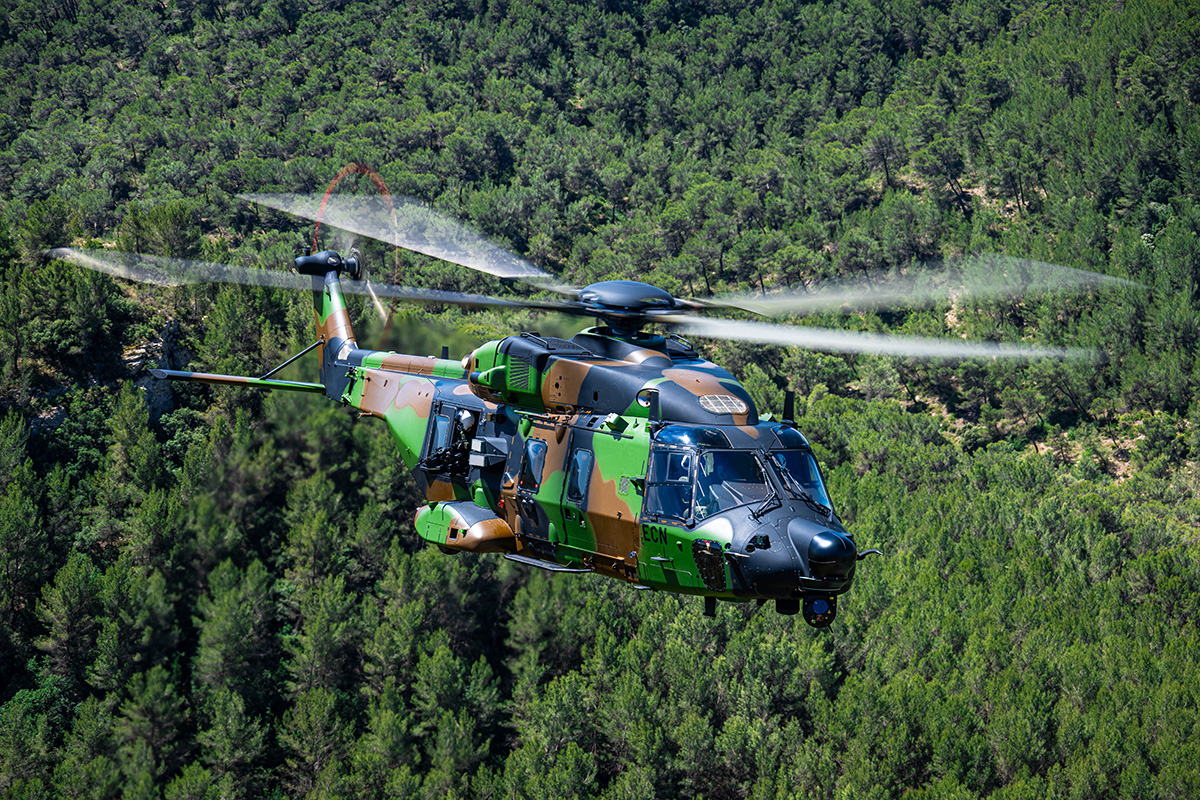
Airbus Helicopters has delivered the first NH90 Standard 2 to the French Armament General Directorate, a variant of the NH90 TTH designed specifically for special operations, according to the company.
France has ordered 18 of the type, with deliveries running to mid-2029. They will be operated by the French Army Aviation’s special forces squadron at Pau. Spain joined the programme in December 2025 with an order for 31 aircraft in a similar standard.
Matthieu Louvot, CEO of Airbus Helicopters, said: “We are honoured to deliver this NH90 Standard 2 to the French armed forces. This new standard builds upon the proven capabilities of the NH90 TTH with new breakthrough features designed specifically for special forces. More than ever, special forces operators will be able to execute their difficult missions in the toughest environments.”
He added: “We are very pleased that Spain has also joined the development of the features that will enhance the crew’s situational awareness. It shows that this new standard of the NH90 is on its way to becoming the benchmark for special forces across the world.”
The Standard 2 configuration integrates the Safran Euroflir 410 D electro-optical system and a new digital map generator, along with installation for a third crew member and enlarged rear sliding windows able to accommodate self-protection guns.
It also carries provisions for rapid integration of the Direct Aperture System, currently under development, which Airbus says will provide better visibility in poor flight conditions including snow, dust and fog, by day and night. Further upgrades will include a fully digital Thales TopOwl helmet capable of simultaneously displaying imagery from both that system and the electro-optical system on the visor.
The Standard 2 programme was ordered in 2020 by the NATO Helicopter Management Agency from NHIndustries and its partner companies, Airbus Helicopters, Leonardo and Fokker. NHIndustries is owned by Airbus Helicopters with 62.5%, Leonardo with 32% and GKN Fokker with 5.5%, and is responsible for the design, manufacture and support of the NH90.
The NH90 was developed as a multi-role medium helicopter for NATO nations, produced in the TTH tactical transport variant used by armies and the NFH naval variant configured for anti-submarine and anti-surface warfare from frigates. More than a dozen countries have operated the type, and it has seen service in Afghanistan, Mali and elsewhere.
The programme has had a difficult history, with several operators raising concerns over availability and support costs. Norway withdrew from the programme entirely in 2022 and sought to return its aircraft, while Australia retired its MRH90 Taipan fleet early in 2023 following a fatal accident. Airbus has since pursued a series of upgrades and revised support arrangements intended to improve the fleet’s availability, of which the Standard 2 configuration forms part.




This would have been a good replacement for the Puma. One production variant has a rear ramp.
The ramp is not so much efficient unfortunatly and is not used most of the time.
But the chopper has powerfull engine and a very good range indeed
The extended range sf chinook is well over double that.
For special forces roles, Chinooks are normally too big and too loud. Although no mention of improvements in accoustics which is normally a special forces requirement.
Interesting as Australia ditched their’s as being unreliable and expensive to operate. Lets hope the UK buying another Eurocopter AW149(?) works out ok in those metrics.
L’Australie a particulièrement mal géré la logistique d’entretien de cet appareil. La Nouvelle Zélande qui utilise aussi cet hélicoptère en dit, au contraire, beaucoup de bien. Seulement eux, ils n’ont pas attendu que la panne arrive pour commander des pièces de rechange, en particulier pour celles qui sont longues à fabriquer et à expédier. Ils ont anticipé sur les pièces de rechange les plus délicates de telle sorte qu’elles sont disponibles lorsqu’il faut les changer sur un appareil. Cela s’appelle la prévoyance.
Maksy,
Ouais mais, non mais…
En fin de compte, l’Australie a mis fin à l’ensemble du programme de plusieurs milliards de dollars 15 ans d’avance et l’a remplacé de manière cruciale par une acquisition urgente de ventes militaires à l’étranger des États-Unis éprouvés. UH-60M Black Hawks parce que le Taipan était devenu un trou noir logistique. Alors que les choix de gestion locale ont exacerbé les retards et les dépenses, l’écosystème de soutien fondamental de l’avion et l’inadéquation structurelle avec les besoins de guerre australiens ont fait que le programme était largement considéré comme irrécupérable.
Plusieurs autres pays ont connu de graves difficultés opérationnelles, des retards chroniques et de faibles taux de préparation avec le NH90, ce qui a conduit plusieurs pays à annuler ou à éliminer progressivement leurs flottes aux côtés de l’Australie.
Norway.
Belgium.
Sweden.
Germany.
D’autres opérateurs, tels que les Pays-Bas et la Nouvelle-Zélande, ont également documenté des coûts opérationnels élevés, de graves pénuries de pièces de rechange et une corrosion inattendue du fuselage provenant de déploiements maritimes.
Veuillez excuser mon mauvais français.
Bonjour Magenta et félicitations pour votre excellent français !!
J’admets bien volontiers que le NH90 a connu des débuts un peu difficiles et des soucis de jeunesse.
Peut-être une mise sur le marché un peu trop tôt ?
Il n’en demeure pas moins que ceux qui continuent de l’utiliser trouvent que c’est une excellente machine maintenant qu’elle a effacé ses problèmes de jeunesse.
Les retards d’approvisionnement ont été améliorés et une logistique intelligente permet, au prix de quelques stocks, de faire face rapidement aux pannes éventuelles.
Les problèmes de corrosion ont été résolus aussi.
L’armée française n’aime pas jeter l’argent (rare !) par la fenêtre et si elle commande encore cet hélicoptère, c’est qu’il est bien meilleur que ce que certains disent.
Je vous souhaite une excellente journée.
Maksy