

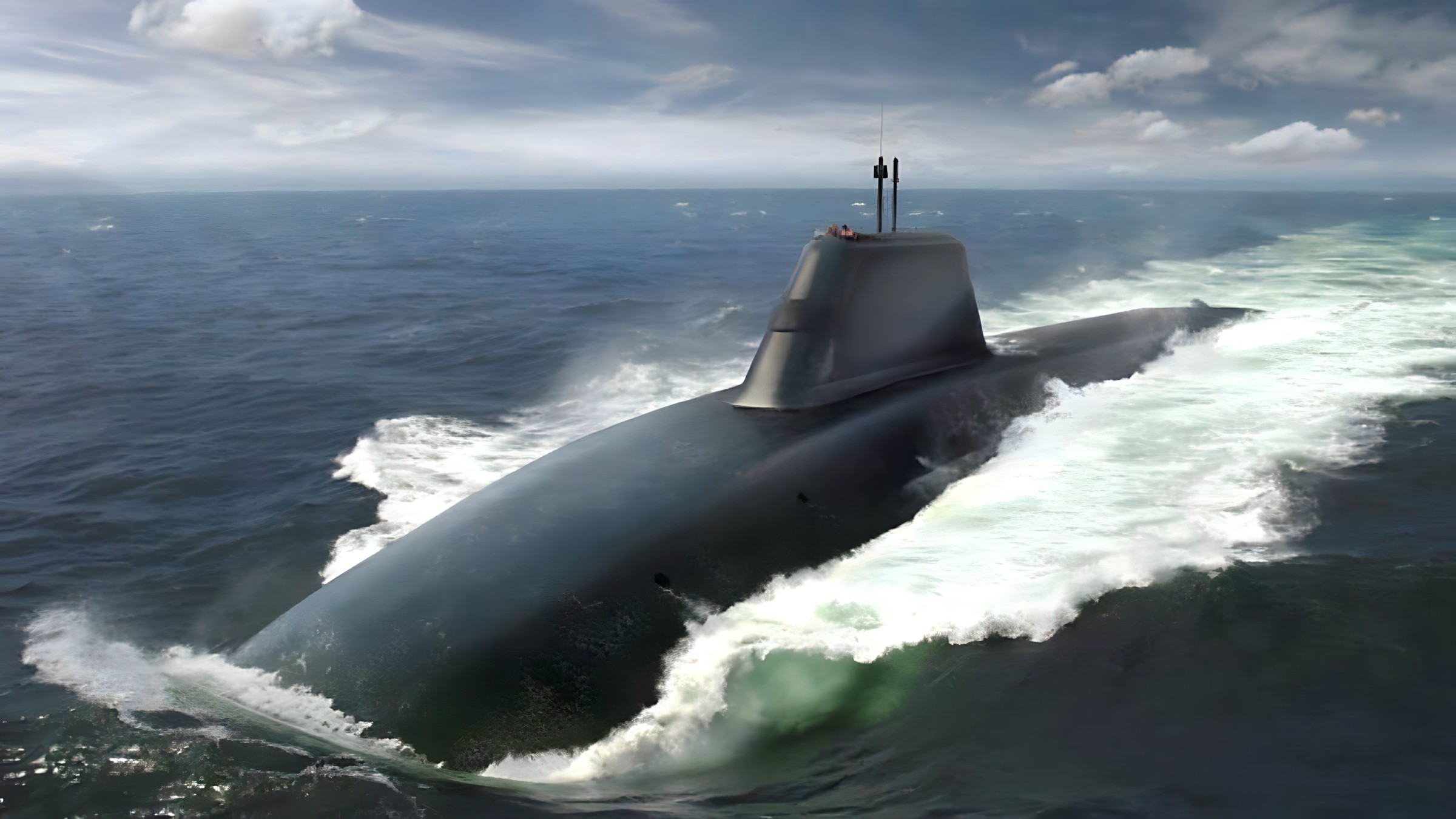
The Government has confirmed that it has accepted a Strategic Defence Review recommendation not to extend the service lives of the Royal Navy’s Dreadnought-class ballistic missile submarines beyond their intended end-of-service dates from the mid-2050s.
The position was confirmed in a written parliamentary answer to Conservative MP Ben Obese-Jecty, who asked whether ministers had committed to Recommendation 34 of the 2025 Strategic Defence Review.
Defence Minister Luke Pollard replied: “The Government accepted this 2025 Strategic Defence Review recommendation and is in the process of implementing it.”
Recommendation 34 explicitly calls on the Government to avoid repeating the costs associated with extending ageing submarine fleets and to begin planning for the system that will eventually replace Dreadnought.
The Strategic Defence Review stated: “To avoid the costs of the past, the Government must commit to not extending the life of the Dreadnought class submarines beyond their intended end-of-service dates from the mid-2050s. It should start to define the requirement for the post-Dreadnought nuclear deterrent within this Parliament.”
The Government has also confirmed separately that work to define Dreadnought’s eventual successor is beginning as part of wider investment in the Defence Nuclear Enterprise.
In a written answer in July, Obese-Jecty asked what plans the MOD had to define the requirement for the post-Dreadnought strategic deterrent.
Pollard said: “As announced in the Defence Investment Plan, this Government will invest over £20 billion more in the Defence Nuclear Enterprise over the next four years than the previous four years to modernise and sustain our nuclear deterrent, the cornerstone of our national security.”
He added: “This will fund our new deterrent submarines and warheads, establish a nuclear fuels programme, start defining the Dreadnought successor, and upgrade our infrastructure across the defence nuclear estate.”
Pollard said this would allow the Government to meet its commitment to begin defining the future system during the current Parliament, stating: “This will allow us to meet the Government’s commitment to start to define the requirement for the post-Dreadnought strategic deterrent within this Parliament.”
The Dreadnought class is being built to replace the Royal Navy’s existing Vanguard-class ballistic missile submarines and will carry the UK’s strategic nuclear deterrent through much of the middle of the century.
The Strategic Defence Review recommendation is intended to avoid the additional cost and complexity that can arise when major platforms remain in service significantly beyond their originally planned lives. Rather than relying on a later life-extension programme for Dreadnought, the review calls for work on its eventual successor to begin decades in advance, with the requirement-definition process now being funded through the wider Defence Nuclear Enterprise programme.








Good god, a British Government actual indulging in long term planning..! Seriously!
Good news if it actual bares fruit, and hopefully they will start to plan for SSN-A replacements from the mid 2030’s.
The trouble is this apparently enlightened long term approach has two big risks associated with it. 1) The next government will cut the ‘too early’ program for short term savings and secondly it will get into a kind of analysis paralysis doom loop with no immediate deadlines to focus minds. These are risks, so with good management and leadership they are avoidable.
I won’t be around to see the outcome, but I’ll keep my fingers cross all the same.
Cheers CR
This is very good news, it should also help address issues such as skill shortages, training pipelines and succession planning. I do wonder what the next generation SSBN’s will look like. Unmanned systems would be a very good match if executed correctly.
I agree that skills shortages would be a key thing to tackle over the long term especially in light of recent and on-going experience with trying to get the Astute class into service…
Not sure that I would like to see nuclear weapons in under the control of an AI, which is implied by the idea of using an unmanned system. Especially given recent comments by the growing number of AI researchers coming out and saying these things could ‘wipe out’ humans in the next decade – which was basically what one of them has recently been reported as warning. These AI agents seem to be so ‘task’ focused and their ‘learning’ so lacking in any form of a conscience that they are capable of significant criminality..! So far limited to hacking, but..!
Cheers CR
Good point CR. May need to rethink the use of unmanned systems 😉
Well if the AI scare stories are right we won’t be around to worry anyway 🙂
Astute is a charlie foxtrot because of bad decision making that led to delays in build and allied with 1940s/50s decision to build an atomic plant at Windscale AKA Sellafield; all the workers saw no future and left for Sellafield who had been gifted a shed load of cash and could offer enormous salaries in 2017 of £70K for a cleaning supervisor and give £39K to a bloke who agreed he would work unsocial hours on top off his unsocial hours and regular salary.
Govt just does not do joined up thinking – we have 80 years of proof at least for that statement.
The world will be vastly different in the 2050s, many of us will not be here, ‘not my problem,’ but Govt has absolutely got to deliver far more joined up thinking. That paragon of free market thinking, hand sock wrenching and drenching momentum, Thatcher, screwed the world economy with her banking liberalisation in the late noughties and further screwed us with the opening of the Channel Tunnel, so that today, with have very few primary industries and train drivers on the Cumbrian Coast line command salaries of over £70K/year for a job that involved driving up and down a sleepy tertiary line – forget secondary; at which point, all the other railway unions pile in for parity wages. Good luck getting the railways back under public control when CCL conductor/guards have gone to be cleaners/security in Sellafield and Devonshire Dock Hall and the DNE.
Late 80s/early 90s banking lib. Economic crises came about in 07/08.
We need an edit tool for the website.
Talking about long term planning. Completely different thing.
This is the sixth paragraph, “The Government has also confirmed separately that work to define Dreadnought’s eventual successor is beginning as part of wider investment in the Defence Nuclear Enterprise.”
This suggests that they are already starting to think about the Dreadnought’s successor which given the former isn’t even in service yet I would suggest counts as long term planning – all be it very loose planning at this stage.
Cheers CR
These boats have an ‘early 2030s’ introduction date it seems, if no delays, so a proposed 20-22 year life span apparently. Seems very short for such an expensive platform. If financially and operationally it still makes sense as 20 years takes its toll on them so be it, it’s certainly good to plan ahead (and better to be conservative than over optimistic obviously) but these assessments are well above my pay grade to determine, so can’t really question it further and hope it indeed makes sense.
This seems incredibly unlikely, and meaningless. Dreadnought’s reactor will run for some 30, maybe 40, years. She’ll be viable into the 2060s.
Trying to build 12 SSN-A at 18 months a hull delivery rates means that you’ll be building SSN-A out till 2055.
LIFEX decisions will be made in the 2050s. Why is the current government attempting to call the shots on early retirements more than three decades in the future? It’s meaningless.
Actually, if you want to build the next SSBN by 2060 then you will need the design ready to go around 2050, if not sooner, as the long lead items, i.e. the reactors, will need to be in production a few years before they are needed on the submarine production line. So with design times as well detailed design work need to start around 2040 at the very latest so research, concepts, etc. even sooner say 2030..?
Also, by your estimate SSN-A production will be drawing down from about 2052 ish to finish by 2055, so you will want the the next SSBN ready to hit the stocks from about that time as there will need to be an overlap in production to ensure the production lines and supply chains are kept busy from end to end.
I don’t know how long it takes to design a reactor or a nuclear submarine these days but I bet it is a good few years and, if I understand things correctly, some detailed design work is still on going for the SSN-A boats and at least the reactors are on the production lines already. The lead times are huge.
All of which means the start pistol will likely need to be fired soon. We live in complex times it seems, so perhaps this more sensible than it initially seems, especially when you throw in the disruptive impact of AI.
Cheers CR
This is exactly the sort of wishful thinking that got us in the current mess. Savings taken in not starting the Dreadnough programme and in not doing enough maintenance on Vanguards in the 1990s and 2000s meant the Vanguard life extensions took huge amounts of money, resources (eg dry dock time, nuclear welders…). Starting Dreadnought late meant more Vanguard life extension than reasonable was needed.
And then shit happened, like the PWR2 problems.
With Effectively.. a FULL 16 boat programme commitment to Barrow .. This brings the greatest stability to the Workforce and Suppliers Possible and Should Ensure future Unit Costs are at an Optimum..!
But as we all know MOD/HMG/HMT/BAE Find the most Peculiar ways to Cock thing up…!
Yeh especially we are talking about 30 to 40 years into the future… that’s loads of time to really s***w things up 😉
Happy days
CR
Until hammers are ringing and workers are grumbling about not being paid enough, the government’s determination to bring us new ships means about as much as a fart in a hurricane.
Once work is underway and proceeding well (both of these factors are apparently getting rare), I’ll celebrate with everyone else.
I think this will change the moment any kind of meaningful money needs to be spent on the project.
I’m floored by this. Floored, I tell you.
The government has decided to accept its own recommendation that it not spend any money.
I mean it must have been real knife-edge stuff when they were debating this. 😊
Seems fairly sensible to me, that said I suspect the decision is more about payload than the submarines themselves. Hard to commit to extending trident beyond current OSD as too many unknowns. Building the successor subs is likely to be the “easy” bit of this endeavour figuring out, if we will/can link up with the US on a trident replacement (or indeed if we even want to) i’d leave up for debate.
I wonder if this is a cut, to avoid spending money on designing & fitting extra access points, for a mid life SLEP?
Barrow boat builders just need a steady continuous build into the decades ahead.
If we built them right in the first place they should last longer than 20 years.and be able to be down graded to other tasks as have always done with our sub fleet.
The US repurposed the Ohio to cruise missile platforms.