

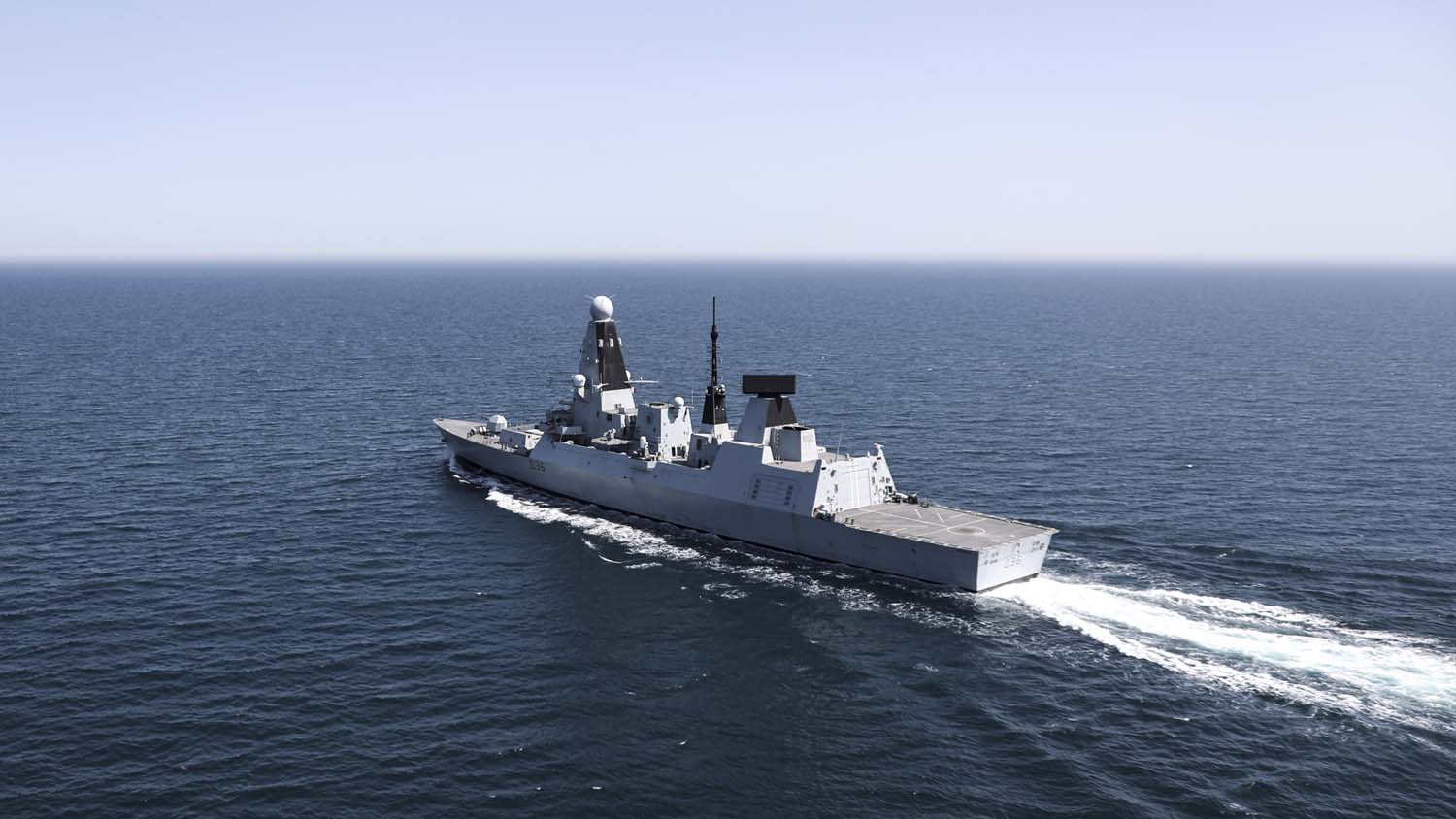
Three of the Royal Navy’s Type 45 destroyers have now completed the long-running Power Improvement Project (PIP).
Defence Minister Luke Pollard formally listed the vessels in a written answer to Parliament, saying that “as of December 2025, three Type 45 Destroyers have completed their Power Improvement Project (PIP) upgrades: HMS Dauntless, HMS Daring, and HMS Dragon.”
HMS Defender and HMS Diamond remain in refit undergoing their conversions, while HMS Duncan continues in operational service and will enter the programme “concurrently with her next docking period at HMNB Portsmouth.”
The minister declined to provide further detail on the future upgrade schedule, stating that releasing a forward programme “could risk revealing future capability levels to our adversaries.” He added that progress hinges on balancing dock availability with the Royal Navy’s operational commitments, a factor that has previously slowed major engineering work across the fleet.
Despite this, Pollard reiterated that the project remains on its planned trajectory, with all six destroyers expected to receive the upgrade by 2028.
The Power Improvement Project, delivered under the wider diagnostic framework of Project Napier, is intended to resolve the class’s long-standing propulsion and power-generation failures. These issues, often triggered in warm waters or under high electrical load, have periodically taken ships offline and constrained global deployments.
Under PIP, each destroyer has its two original diesel generators removed and replaced with three larger, more reliable units. The Ministry of Defence states that this modernised arrangement improves redundancy, strengthens the high-voltage distribution system, and provides a more resilient power architecture capable of sustaining the Type 45’s demanding radar and weapons suite without unexpected electrical loss.
The work is among the most intrusive engineering efforts ever attempted on an active Royal Navy surface combatant, requiring significant hull cuts and internal reconfiguration to accommodate the new machinery. Pollard noted that completing PIP depends on “the availability of ships to undertake the upgrade, balanced against the Royal Navy’s current and future operational commitments.”
With global tasking increasing and the Type 45s forming the backbone of the UK’s area-air-defence capability, maintaining class availability while rotating ships through such extensive engineering work remains a persistent challenge. Nevertheless, the Ministry of Defence maintains that the programme is on target, and class availability is being managed to ensure the Navy continues to meet current commitments while pushing upgrades forward.









So… We have jack shit but half are OK… Great news.. What about the rest??… Subs….. Armoured cars… Tanks…. One great big joke……
Why are T45 “jackshit”
Where did he say they were ?
What an ignorant comment – you clearly know sod all
You need to improve the quality of your trolling, Ivan.
That’s a very negative comment. The power improvement package has been proven to be complete success, as HMS Dauntless has shown this year while on deployment to the far east and back. Yes we only have six of them, but despite the lack of numbers and various other constraints, engineering, past manpower problems etc, the ships themselves have performed superbly. Availability is also on the increase.. So let’s look ahead with a more positive vibe shall we?
And half is three. Just three destroyers. Shameful really when you consider where the RN was 100 years ago.
utter nonsense – while the RN is small these days – with too few combat escorts – comparisons with our Imperial Might 100 years ago are completely irrelevant
Thank you, absolutely.
100 years ago the RN was in a much darker place in a dangerous world with no allies, no deterrent and the responsibility of defending a quarter of the worlds land area an its entire sea area.
The RN of 100 years ago was legally banned from building new ships.
Huh?
Jim’s talking about the Battleship Holiday that was brought in by the Washington Naval treaty.
Not technically true that the RN was banned from building any new ships, but in terms of Battleships and Carriers, yes the RN was banned from building new ones. That’s why after starting work on the Nelsons in 1922 the UK didn’t start work on a new Battleship until 1937. Same for the US, after the Colorado’s in the 1920’s no new Battleships until 1937.
The rule of 8 should apply to classes of escorts in future. This would have been very much less painful and we could have kept 5 in commission throughout although the process would have taken longer.
Unfortunately this is one of the reasons more is better and that maritime wars are won by numbers and mass.. time and space matter in maritime wars.. HMS massive will always lose the war to the correct number of HMS “just adequate for the job” class ships.
An inconvenient truth for our politicians
I disagree especially in under sea warfare, it’s much more like air to air combat. One Astute or Virginia will kill multiple type 93’s.
Combat between such platforms is likely to be so one sided that it will be pointless for the other side to even try.
The same will be true for carrier and surface combatant fights with modern jets and missile systems. The F35 scores double digit kill ratios against F15. Against J15 it will be like spitfires vs jet fighters.
Certainly different for a global constabulary mission but these types of missions are easily done by OPV’s.
Jim you are falling into the trap of mistaking the tactical for the strategic.. you can win any number of battles and loss a war..
Very basically why
You have 1 HMS massive and he has 10 HMS barley functionings.. now if your war is in a 20NM by 20NM arean at 12 noon on day 1 ( a battle) HMS massive is going to kill everything and be home for tea and biscuits by 13.00 hours..
The problem is that is not your war.. your true martime war is a beast it’s spread over 100 million square miles and 32,000 hours in 1400 days.. and across those 100million square miles and 32,000 hours you have to defend 50 ports, 15,000 miles of sea lanes and say 100,000 merchant vessel journeys ( that’s how many merchant ship visits we have to UK ports ).. now those 10 HMS barley functioning can attack any port, and any one of those 10,000 merchant ship visits across those 50 ports and as they travel those 15,000 miles of sealanes during any one of those 32,000 hours cross 1400 days and hide in 100 million square miles of ocean.. and HMS massive can be at one place on any one day.. so yes every time HMS massive is in the right place at the right time you win a battle.. but statistically it will almost always on any one day be in the wrong place.. and those 10 HMS barely functionals will destroy a bit more of your nations ability to fight.
That is why in the last 19 or so biggest naval conflicts in history the side with the most ships won 17 times out of 19…(that is a from a world renowned naval historian).. who also essentially noted the RN was not good Simply because it was good it got good because it was bigger and being bigger allowed it to be everywhere and practice..at the same time shutting down its enemies…. Infact the RN through most of its history had worst ships than its enemies and it was its enemies that has HMS massive.
Having your assets in the right place at the right time depends on the quality of your C4ISTAR capability. Throughout most of history vast military forces have thrown vast amounts of ordnance around in the vague hopes of hitting something that they were trying to hit. Precision strike is a new and rare capability.
Yes but you still need to have the assets to find fix etc as well as the effector in place.. so maybe you find one of the many assets of the enemy but it’s just about to attack a shipping lane 2000km away from HMS massive.. your still fucked you just know your going to get fucked…🤷
Sounds impressive until you get to the “3” bit. Especially since the problem first manifested itself 15 years ago.
And has the DS who I read ignored BAES advice on the right engine faced the music?
No.
Why?
Possibly because they have retired long ago or perhaps they have died. Just a guess. I think we need to accept that when we are talking about these sort of projects lasting decades all we can do is try to prevent it happening again in the future.
Also we need to move to rapid development techniques – especially with drones. Assume it is going to be obsolete in 6 months time therefore the development time needs to be 3-6 months. Tricky but not impossible. We also need to build in quantity.
Because the choice was made by a politician against advice
*Hoon made it it the pursuit of votes in Rugby. Useless git.
Should never have built just 6 of these. 8 is and always was the obvious minimum.
Just as 10 is the minimum T26 required.
Just as 8 is the minimum for T31.
Just as 10 is the minimum for Astute.
These are not ambitious targets, people.
12 should have been the number, 10 was cutting it fine, 8 was being very risky..
In the end 12 would secure you 4 deployments 2 for a carrier battle group and 2 for an amphibious group… T45 did not change the laws of physics or the requirements of time and space across the oceans.
Got to agree with the maths if UK has/had 4 Groups to protect. I’d rather we stuck to the rule of 3 going forward and 9 T26s, 9 T31s (with ASW) and the MRSS with their own VLS for defence. That reduces the reliance for the T45s to cover both CSG and Amphibious vessels.
Ground based air defence is not RN responsibility.
Oh wow they’re starting to work only twenty years after being built – what a time to be alive!
The Type 45s.were supposed to be built at Barrow which won the contract after tendering for them against the Scottish yards.We had successfully built the Wave Knight,Albion and Bulwark in six years from 1998 until 2004 .These ships went to sea and by all accounts were pretty reliable.
After we won the order the government of the day had an election coming up so they transferred the order to the Scottish yards.At the time I challenged our MP one John Hutton now Lord Hutton about the orders being transferred to Scotland as I had just witnessed the launch of HMS Bulwark.After the launch I had seen the slipways and drag chains being loaded onto wagons and when I asked them where they were taking them they told me Scotland.Upon challenging John Hutton who told me the orders were not being transfered I called him a liar and told him what I had just witnessed.Needless to say he couldn,t really deny it then and appeared very embarrassed.
If you look at the history of the Tyoe 45s and the carriers every one of these boats has had problems.Surely that points to the quality of the workmanship in those yards.
Even HMS Ocean which was built in Govan and was brought down to Barrow with a bent propshaft along with a lot of other faults which the Barrow workforce had to put right.
I know because I worked on her at Barrow,Plymouth and Portsmouth.
Hi Mike, a very interesting reply to my fairly flippant comment, certainly Barrow has a quality workforce. My understanding is that the Type 45s problems are by design rather than poor build quality. If I recall correctly, BAES wanted to use a trusted propulsion arrangement but the MoD wanted a untried new one that turned into the farce we know today.
It’s actually great news the PIPs are starting to deliver as the 45s are our only active class with life left in them as the 23s are knackered, we need our destroyers available.
Yet somehow we’ve got fit Aster Block 1, CAMM and NSM yet.
Yes, the generators not being big enough for the ships electrical requirement and over heating in warm water was all the result of ship builders in Glasgow, f**k sake sort your self out you muppet, was it the ship builders in Barrows fault that led to Astute having all those turbine issues? Or was it the people who design and ordered the Turbine?
At no point was the T45 ever getting built in barrow and it was a BAE commercial decision to consolidate on the Clyde because Barrow was up to its ears building submarines and still is.
They wont fit in the doors of the ship shed at Barrow. You are talking nonsense
I’m not going to get in the politics of the way we consolidation of our shipbuilding, because we all know it was problematic at best. But in the case of the issues with the T45 it’s bad design not bad building.. and it was the MOD that had final decision on the power supply for the type 45.
Surely the big story here , is when Daring getting back to sea ?
Very soon. Sea trials most likely in January, then returns to the fleet.
Finally someone saying something relevant!
It’s like hens teeth around here 🤷🏻♂️
Personally I think why the hell did the fuckwittery brigade at HMG only build six is profoundly relevant.. after all if we had 12 dragging them off for refit would not be an issue at all.
Actually we are quite lucky that there are any at all.
RAF were campaigning against them with the logic that they could provide top cover.
Army were also unkeen to put it mildly.
Everyone was asking ‘what are they for: who is the enemy we would used them against’ to which there was no good answer at the time with Russia sending ship to RN ports for Navy Day.
Headline version
RN wanted 12 and estimated the cost of 12 ships via the Horizon program at ~£6Bn
Treasury gave a budget line of exactly that
Entered Horizon Program
The arguments around French tech being used rather than SAMPSON surfaced
RN left HORIZON – which is fortunate as it meant that UK still has sovereign Radar capabilities – that was what was secured in this you can debate that but UK now has a good path forwards
Then the £6Bn had to fund the remainder of the SAMPSON development as well as the development of the T45
Money was therefore very tight
This lead to the disastrous decision not to have a WR21 land test rig and rely on simulation
This then left a budget for 7 and a half ships
However, rather than order 4 follow on ships after the first batch of three the second batch of three was ordered.
Various attempts were made to get a bit more money to build ship 8 but this fell on stony ground
BAE were not interested in building a single T45 destroyer which couldn’t by then be efficiently built as the long lead items has not been ordered.
So the money for T45 – 7 (and a bit) was reallocated to accelerate GCS – this was sensible as it recognised that T23 lifespan would become an issue
G Osbourne then cut the money from GCS and Treasury trousered it – leaving another one of his very expensive defence messes as his legacy to add to the mess made by pushing renewal of SSBN to the right as well.
That is the insanity of procurement in the post Cold War. The assumption that somehow there was no enemy.
“Assumption is the mother of all fuck-ups”.
I find the phrase “Navy continues to meet current commitments” ridiculous. For one they keep cutting cutrent commitments and for another thats great providing they dont have to fight anyone.
Interesting, can you provide the facts, figures and evidence for this? You may well be right but you need to back up statements like this with verifiable information. I know I have annoyed others on UKDJ by droning on about this rather basic point. But this is journal not not a rag. Cheers.
In other words, future Type 45 upgrades will have to be deferred/cancelled as we need them in service to cover for missing frigates.
T45 upgrades will be creatively scheduled 🙂
Half? That’s two and a half ships… Good stuff🤡if it was from 10-12 it would be ok.
3 1/2, I think? HMS Dauntless, HMS Daring, and HMS Dragon make 3 and I suppose HMS Duncan makes the half?
6 divided by 2 equals 3
Guess you flunked your maths exams 🤷🏻♂️
So are the great British public supposed to stand up and go “hip hip horahhh, simple because the long-standing propulsion and power-generation failures have been fixed on a couple of ships?
So type 45’s: – Long-standing propulsion and power-generation failures
Elizabeth class: – Propulsion issues
Ajax vehicles: – Plagued with issues, including causing personnel to suffer motion sickness.
Mann and other vehicle issues: –
Do the UK armed forces have any decent kit, that is worth mentioning?
Try and get the facts right before commenting.
You only end up embarrassing yourself with such blunders.
Not much of a rebuttal Spock…
You anything to add apart from your usual childish insults?
If an idiot insists the earth is flat, do I need to launch into a treatise of the numerous observations that clearly demonstrate the earth is a globe, along with the mathematical proof first devised by the Greeks as to it’s circumference?
No I don’t, pointing out the stupidity is enough.
Do you have anything useful to add aside from your lame, pointless remarks?
You having issues at home or something?
Being this level of petulant and argumentative is pretty sad, looking at all your previous replies.
Its sad man, step away from the keyboard for a little while
It’s always amusing watching an idiot role-play as a psychoanalyst… especially when it’s clear he’s the one that clearly needs help.
So according to you, those issues do not, did not exist??? Tell you what mouthy, go fly a kite, and take your caustic drivel with you!
No they doubt. As you don’t know the facts, let me explain them.
• Type 45 – had power generation in some particular circumstances due to American intercoolers. Three fixed, 2 undergoing upgrades, one still in service under revised operating procedures until fixed.
• QE class – had some teething issues, as do all new ships – especially first in class. Fixed, and far fewer issues than the Yanks still have with their new carriers.
• Ajax vehicles – issues caused by a third of those produced, so seems to be manufacturing rather than design problem. Manufactured by an American company…
• Simon already dismissed your ranting over Man trucks (you couldn’t get the spelling of their name right 🤦🏻♂️).
Maybe if you bothered spending a fraction of the time that you currently spend on commenting instead on actually reading defence websites you wouldn’t be so ignorant 🤷🏻♂️
the Man truck issue was due to a replacement part being fitted incorrectly to a small number of them. it doesn’t seem to be a huge issue
There is also the issue where they purchased the wrong ones…..
BFBS were suggesting it was incorrect fitting, rather than incorrect parts
Any further news on the T45 CAMM “farm” upgrades? I guess it’ll be 24 CAMM but seems a missed opportunity for more with mk41s and or ExLS but someone has decided that’s enough. Dragonfire, Ancilia and NSM also to come on board with Aster. Does anyone know if they’ll keep the 30mm and Phalanx’s or will we see the 40mm?
Dragonfire will cost £90 million for a set of two. I think I’d rather have the 40mm Mk4 gun with it’s intelligent ammo. At least the 40mm has a much greater range & can fire in mist & rain, as well as being less expensive. Just swap the two existing 30mm with 40mm Mk4 & forget the limited ranged, fairweather friendly Death Ray.
Dragonfire can fire in mist and rain, it’s just its effective range is reduced. Unlike the 40mm it won’t run out of ammunition.
It’s a sensible approach to have a variety of weapons available, each covering for the others weaknesses.
Why haven’t any been fitted with NSM yet?
One of them has been fitted.
Although I do find it more than odd that the basics such as the racks haven’t been fitted to all of them.
None have been fitted to T45 yet
I believe only fitted to HMS Richmond, HMS Somerset and HMS Portland so far.
Hms Duncan has just come back from Norway, no sign of NSM that I can see.
I suppose we should take a positive from this that there service rate is now a lot better ( from a very low starting point) justas well as the type 23 are dropping likes fly’s
I dont understand why NSM and Sea Ceptor is not being added to the work plan for the remaining 3 units. Why must ANOTHER time in dry dock be scheduled if they know the work is to be done ?
Because we need ships at sea now to cover for lack of frigates. It’s not a small job installing the new vls
…and what about progress on the Type 83?
We’re at least 15 years off one of those being commissioned
That is sort of my point. So much for the UK being on a “war footing” as per National newspaper headlines and many screaming for such. No sign from this Government, despite all the hot air.
Absolutely. The reason I say at least it because the program will inevitably be pushed to the right.
“ and provides a more resilient power architecture capable of sustaining the Type 45’s demanding radar and weapons suite without unexpected electrical loss.”
Somewhat less than inspiring base to install a directed energy weapon on.
I do hope we’re not about to open up another box of tricks by installing a high energy demand weapon on a platform with energy production issues.