

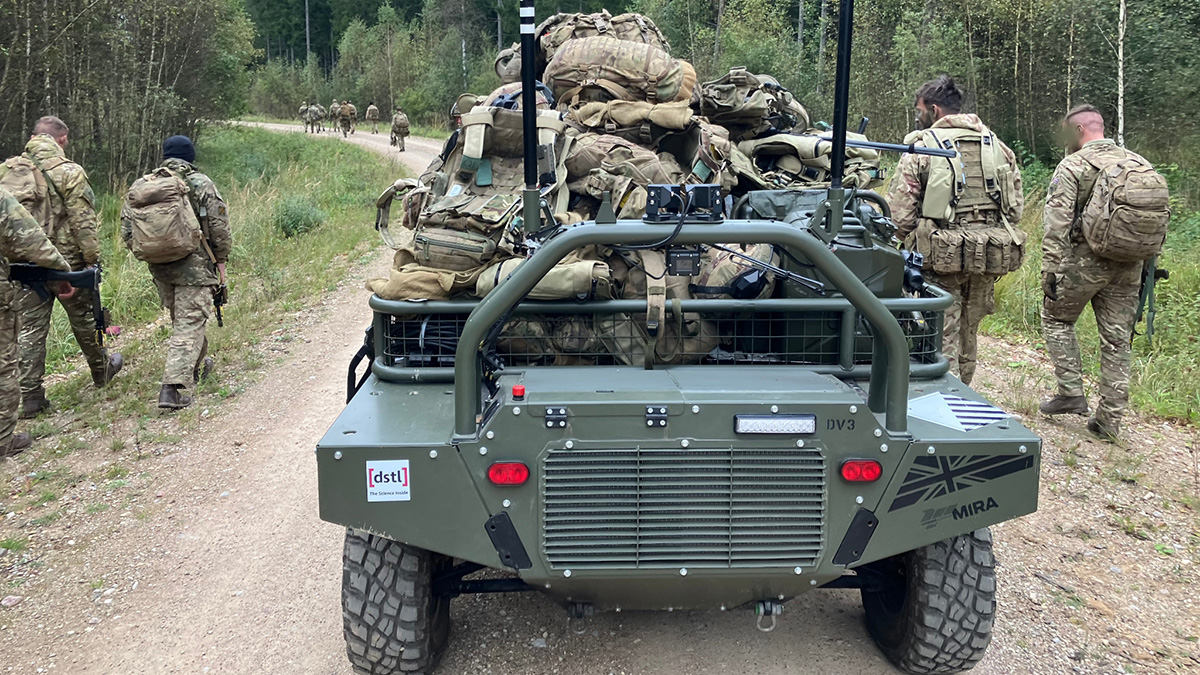
Iveco Defence Vehicles UK has outlined the latest development path for its Viking uncrewed ground vehicle, as interest in autonomous land systems begins to re-emerge across European defence forces.
Speaking to UK Defence Journal, Dr Geoff Davis, Managing Director of IDV UK, said the platform is the product of more than a decade of experimentation rooted in early UK Ministry of Defence work on remotely operated vehicles. “The team that came into IDV has probably the best part of 20 years working with the UK MoD on remote control systems and uncrewed ground vehicles,” he said, tracing the company’s origins back to early off-road trials and operational experimentation.
That work later expanded into deployed systems, most notably through the Panama project, which involved converting Land Rover Snatch vehicles into tele-operated platforms for IED detection in Afghanistan. “Those vehicles were tele-operated and fitted with ground-penetrating radar and other sensors. That was a real success,” Davis said, describing the programme as a turning point that accelerated development of dedicated uncrewed platforms. From this experience, IDV began developing a purpose-built vehicle in the absence of clear military requirements. “No customers really knew what they wanted. There was no clear requirement,” he said.
“So we designed a platform that has basically become what is now known as Viking.”
Today, Viking is a six-by-six uncrewed ground vehicle weighing around 1.3 tonnes and capable of carrying up to 750 kilograms of payload. The system is designed as a modular platform able to support a range of mission kits, including logistics support, casualty evacuation, ISTAR, CBRN reconnaissance and remote weapon integration.
Davis compared the architecture to a flexible base platform rather than a fixed vehicle design. “It’s like a skateboard for the military,” he said. “You can put whatever payload you want on top, and then we integrate that payload to leverage the uncrewed capability and the AI toolkit we use.”
While the vehicle is not yet industrialised for mass production, IDV continues to deliver small numbers to customers for testing and experimentation. “We’re not producing at scale,” Davis said. “We’re still producing low volumes for customers who want one, two, three or five vehicles to trial and assess how best to use uncrewed ground vehicles.”
He added that Viking remains a UK-designed and UK-built system despite IDV’s Italian ownership. “This is UK sovereign capability,” he said. “There isn’t another manufacturer in the UK developing this kind of solution with a UK team.”
Alongside its work on uncrewed systems, Iveco Defence Vehicles has been positioning itself more broadly within the British Army’s evolving land mobility landscape. The company has signalled interest in several areas connected to the wider Land Mobility Programme, which aims to modernise and rationalise large portions of the Army’s ageing vehicle fleet over the coming decade.
At recent industry events, IDV has showcased manned platforms aligned with these efforts, including variants of its Military Utility Vehicle aimed at the Light Mobility Vehicle requirement, a core element of the wider programme. Separately, the company has also promoted its heavy truck portfolio in connection with the Army’s requirement for a new Heavy Equipment Transport capability driven by the introduction of Challenger 3.
However, uncrewed ground vehicles currently sit outside the formal scope of the Land Mobility Programme. As Davis explained during the interview, existing requirements remain focused on crewed platforms intended primarily for personnel transport and logistics. “As it stands today, the Land Mobility Programme has no reference to uncrewed platforms,” he said. “There is no signal from the customer at the moment to feature uncrewed systems.”
IDV is now preparing a next-generation variant of Viking, due to be unveiled at Eurosatory. According to Davis, the update reflects lessons learned from customer trials rather than a fundamental redesign. “The new variant is very much about taking lessons learned and putting them into the product,” he said. Changes include a transition from a parallel hybrid system to a series hybrid configuration, enabled by advances in battery technology, motors and power electronics. “That simply was not physically possible previously at an affordable cost,” he added.
The updated platform will also feature improved compute capability, revised sensor placement and refinements intended to simplify manufacture and maintenance. “It’s about reliability, ease of build and cost-down improvements,” Davis said. Recent trials have increasingly focused on complex mission profiles rather than basic logistics support. “Five years ago, I would definitely say the focus was on soldier support,” he said. “Now we’re seeing much greater interest in applications where uncrewed capability is paramount.”
Examples cited included CBRN reconnaissance, where personnel can be kept clear of contaminated environments, and persistent surveillance missions supported by autonomous monitoring. “You want people nowhere near an infected area,” Davis said. “With AI and data models, you can survey large environments and geolocate contamination without anyone being near the scene.”
He also described growing interest in cooperative operations involving multiple uncrewed systems. “You can have vehicles that hide, monitor an environment, detect a threat and then cue other platforms,” he said, noting the advantages of electric operation. “They’re not seen, they’re not heard, and they have a very low thermal signature.”
According to Davis, interest in such systems has increased in recent months across Europe, the UK and North America. “We’ve seen a real ramp-up in interest,” he said, adding that Western forces are still largely in an experimentation phase as they work out how best to employ uncrewed technologies at scale. Looking ahead, IDV’s longer-term ambition is to transfer its autonomy technology beyond dedicated UGVs. “Our strategy is to take the tech stack, the brains of the system, and incorporate that into other platforms,” he said, including optionally crewed trucks and third-party vehicles.
Despite ongoing uncertainty around defence procurement timelines, Davis argued that the UK retains a strong industrial base in this area. “We’re a proud UK-Italian company with a UK heritage,” he said. “The UK team developed this product, and it’s recognised globally.” However, he warned that sustained progress would depend on clearer signals from government. “We really need to see the UK customer step up and invest in UK solutions,” Davis said. “That’s how you accelerate capability and unlock export opportunities.”




So after all those decades of work, always comes to the key crunch.
How many are HMG buying?
Who uses them, by unit?
What weaponry does it use?
The testing and experimentation in small numbers is never ending, like the Rheinmetal example, of which I recall the Army has about 20.
When do we take the plunge, if ever?
Well said, Daniele!👍💯
We used to call these “Horses” If i’m not mistaken.
They’ve re-invented the Donkey but It’ll take massive manpower to keep them working.
In fairness, keeping Donkey’s and Horses working is very manpower intensive.
It does remind me of the 1930s, where we would build small batches of tanks on an experimental basis, resulting in tank units having several different types in one squadron: The failure of this government to commit to actually ordering anything is painful,
Think can blame the MOD and not the government for that one, they have been indecisive on kit going back to the 80s at least, and probably far further.
BBC are reporting that the targets for increased defence spending are being brought forward, obviously the treasury is throwing a tantrum at the idea. However it’s looking more than likely we are going to see an increase in defence spending soon. Obviously not as much as people would like but it’s better than nothing.
I will believe it when I see it, lots of promises coming out but still no sight of the DIP! If it happens, great, I have my doubts.
I’d imagine if there is any increase it will come out at the same time. Hopefully that’s why it’s taking a while as there getting there costing sorted.
The back tracking has already begone, sources are saying they want to fast track increased defence spending but not in this parliament. Bunch of twits all of them.
Even if Starmer announced it, how long before he U-turns?
Days since last humiliating U-turn: 0.
I’m not sure.. it’s popping out in more and more places and the FTSE100 started to go up after it starmer indicated defence spending would be increased..
May have had something to do with the derisory response to Starmer lecturing Europe about greater cooperation and spending on defence last week. We complain about being patronised and insulted by the Europeans often understandably. but that was rather excruciating considering how far down the European spending league we have sunk of late. Does Starmer ever read the room? If he did maybe there would be fewer U-turns.
We must move forward and create the structure within our Army!
Platoon, Company, and Battalions
UGVs for evacuation and logistics
UGVs for Defensive support roles
UGVs for Offensive support roles
Same for the FPV drones
All we hear is waffle about trials and operational experimentation
I thought Viking was a twin-cab, rubber tracked thing..
I thought It was a Horny Bloke with lots of blonde hair and a sword ?
It is.
This is the new Ajax – but the UK can’t afford it 😂.