

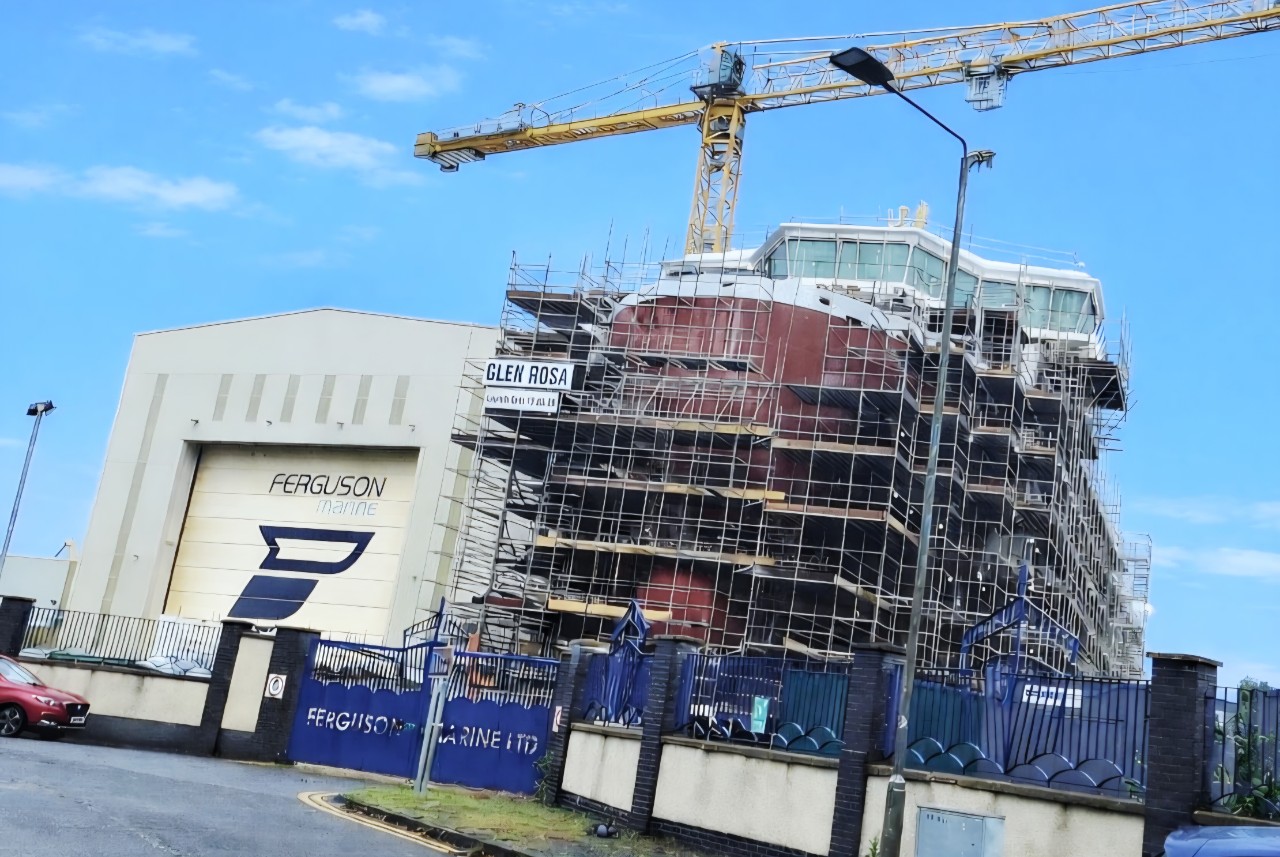
Ferguson Marine has opened a voluntary redundancy programme expected to see up to 70 employees leave the Port Glasgow yard, as work on the ferry Glen Rosa winds down and before contracts for four new vessels are finalised, the company stated.
The yard is moving into the final outfitting and commissioning phases of Glen Rosa ahead of delivery in the fourth quarter of 2026, and says the workload is naturally reducing as a result. Formal consultation has begun.
Graeme Thomson, chief executive of Ferguson Marine, said: “Our immediate focus remains the safe, high-quality handover of Glen Rosa in Q4 2026. However, as the vessel nears completion, we face an inevitable gap in workload while we work with the Scottish Government to make the relevant preparations to enable us to proceed with contract negotiations.
“Shipbuilding capability relies on continuity and while changes of this nature are difficult, taking proactive action now ensures we protect the long-term viability of the yard and remain lean, modern, and ready to cut steel on the new fleet as quickly as possible.”
He said: “We take our responsibility to our workforce and community incredibly seriously. By offering a voluntary redundancy path, we want to support team members who have given so much to shipbuilding on the Clyde as they consider their next steps. At the same time, we are doing everything in our power to ensure the yard is structured to offer secure, long-term careers once the new build programme gets underway.”
The Scottish Government announced in March 2026 that it intended to make a strategic direct award to Ferguson Marine covering four vessels: two ferries for Caledonian Maritime Assets under the Small Vessel Replacement Programme, along with a marine protection vessel and a marine research vessel. Due diligence on that award is still under way.
Ferguson Marine says the changes announced are designed to address the size of the business and align skills across the yard so it is ready to begin work as soon as the contracts are settled, and that the consultation will not affect the remaining work or the delivery schedule for Glen Rosa. A phased transition plan is in place across active projects.
GMB Scotland, the largest union at the yard, called the job losses a betrayal of a blameless workforce and blamed ministers for failing to deliver new contracts while sending work overseas.
Louise Gilmour, GMB Scotland secretary, said 70 jobs are at risk while the Scottish Government refuses to sign off contracts promised before the Holyrood election in May.
She said: “Shipbuilders needs ships to build so where are those promised to Ferguson Marine? If they ever come, who will build them? Fergusons was once Scotland’s ferry factory with a worldwide reputation for excellence and should be again.
“Instead, skilled and experienced shipbuilders are being encouraged to leave as those in charge send contracts everywhere but here. The lack of support, ambition and industrial strategy is abject.”
Ms Gilmour, who noted that a third of CalMac’s current fleet was built at the yard, tied the losses to a long-standing failure to open a pipeline of work after Glen Rosa and Glen Sannox.
She said: “Its reputation has been battered for ten years because of two calamitous contracts decided and driven by those in charge of our ferry network. Their hubris and incompetence have failed a blameless workforce that deserves the chance to turn the page.”
Glen Rosa is the second of two dual-fuel ferries ordered for the Clyde and Hebrides network in 2015, a contract that ran years late and far over budget, and which led to the yard being taken into public ownership in December 2019 after Ferguson Marine Engineering went into administration. Her sister ship Glen Sannox was handed over in early 2025, around seven years behind the original schedule.
The pattern the redundancies illustrate is the one that has dogged smaller British yards for decades. A yard that finishes one order without another already cut in steel loses the people who built the first, and the welders, pipefitters and outfitters who leave rarely come back. Ferguson Marine is arguing that shrinking now protects its ability to staff up when the new programme starts.
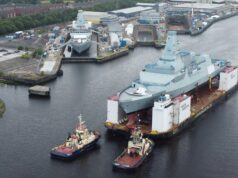
The yard also carries out fabrication work for BAE Systems on the Type 26 frigate programme, producing structural units that are shipped up the river to Govan for assembly, and is partway through a transformation project intended to modernise the site.
Ferguson Marine has operated at Port Glasgow since 1903 and is the last commercial shipbuilder on the lower Clyde.








I can imagine it will take about two seconds to get 70 volunteers for redundancy and everyone of them will be punching their ticket up the river the next Monday for BAE.
We need to stop the constant political nonsense about ship building jobs because it puts youngsters off from joining the industry. These are skilled men and women in demand across multiple industry sectors but just like in any industry it necessary for people to move around to where their skills are most needed.
Personally I can see a bright future for either ship building or unmanned building all around the country. We need kit of all varieties and quickly.
I could not think of anyone who would put people off joining the defence industry than a drug addled useless AI poster than you. What a useless little faggot
Don’t beat about the bush there David,. tell us what you really think.
Or maybe not, as you seem to be consumed by some personal angst, for which there are surely more appropriate medical forums.
Hopefully those people will get jobs in UK shipbuilding otherwise it is a waste of skilled people who have at least some experience under their belts. This is typical of UK governmentS from top to bottom tier, no idea of how to make timely and effective decisions (note I do not say ‘the right’ decisions) so industries across the country cannot plan effectively.
Our governments could do a lot to improve economic ‘policy’ by the simple expediency of simplifying and speeding up decision making. However, we should also recognise that our media are too quick to blame someone if things don’t go the way they think it should have. Any decision is only as good as the information available at the time the decision was made and in the case of long term decisions that information is entirely dependent on how good you crystal ball is (assessment / modeling). Some tolerance and understanding might help with the total risk aversion problem as well..1
Perhaps these works will find work at BAE Systems, I hear they have 10 to 15 years of work lined up!
Cheers CR
Furguson Marine looks all but dead to me.
I think that sea trials for the T26 & T31 which are happening soon or in the near future should decide if there is any future in either or both of these vessels. Because of the difficulties with power on T45 everyone is a little nervous.
I think the UK need to forget the drumbeat message of getting ships out. It hasn’t worked in the past and quite frankly we need to get closer to a war footing with our ship production. We need a few more build halls popping up left right and centre which are Government owned. These then could be used for building all sorts of kit including unmanned and kit for other countries.
The last thing we need is government run build halls. Did you ever learn about the British Rail sandwich?
Now you can have a Great British Rail sandwich……
If anyone thinks the old BR was a paradigm for anything then dream on.
SB to be fair BR got on with the job most of the time. More delay now than then. True the rolling stock was s**t the staff didn’t care and literally anything could happen. But it got you from A to B (most of the time).
Let’s be clear the build halls should be Government owned.
When in use they would be leased to BAE, Babcock, or whomever. The Government pay for it in the long term anyway – no problem with them taking the risk if the work dries up and encourages them to keep the halls busy.
Oh and I experienced many British Rail sandwiches – and they weren’t getting there.
I agree with the sentiment (not sure about UK owned yards though). We really need to be transferring money from welfare to warfare. Order more T26’s to keep BAE going for a substantial amount of time, get the T31 on a continuous order, rebuild the RFA in Belfast, a new yard to build a proper replacement for the T45 air and a decent increase in OPV numbers. Should keep the industry busy for a while.
Excellent! those 70 workers can go to BAE and Babcock and speed the work several fold!!!
Better prospects than FM you would have thought.
Like those workers would have such a great resume 🙄 Every ship they worked on was late, poor quality and over budget.
Not necessarily the fault of the workers although it could be an indication of their training and work ethic.
that ignorant thing to comment it not the work forces fault for terrible decision made by the former management and the board of CMAL , anyone who knows anything about Ferguson or shipbuilding on the Clyde know that most of the workforce has worked for both BAE systems and Babcock they aren’t cowboys
Does that include the Araldite warriors?
sometimes it doesn’t even look like they are trying to get new work, they never go to trade shows like Seaworks, the uk aquaculture shows and renewable trade shows or even the skipper and fishing shows they don’t show themselves to industry and talk to potential customers face to face and explain the situation with the company has improved , when there is plenty of work and it’s well within the shipyards capability, Macduff shipyards and Parkol marine both much smaller shipyards in the UK who do go to trade shows it shows their willingness to get work as they will contracts
To get on a war footing, surely it is essential to develop and continue a steady drumbeat of new ships joining the fleet? That is actually happening at the moment across most of the yards.
BAE Clyde has work up into the ’40s with 13 T26s on the books.
BAE Barrow is similarly rammed, building the last Astute and 4 Dreadnoughts, then trying to produce 10-12 SSN-A in time to meet requirements.
H&W/Navantia is also at full stretch, with its small workforce building the 3 FSSS, needing Navantia Spain to build the aft, value-added section, then the likelihood of winning the contract for the 8 anglo-Dutch amphibious transports ships.
The smaller yards are busy too, with Appledore fabricating sections of the FSSS and Methil poised to win the order for the submarine dry dock platform.
Admittedly question marks over Cammell Laird and Babcock. The former has the ongoing development of Proteus and Stirling Castle plus fabricating sections for other builders and should be in a good position to win any fit-out work on these Norwegian MHC OSVs.But they will need more for the future – maybe some of these unmanned ships and subs?
Which leaves Babcock as the questionable one. At the rate they are building the T31s, they will have work for the next 5 years, then get to retrofit the Mk 41 VLS to the first two ships. Whether or not they get the future CCV frigate contract will be coloured by how well the T31 corvette – I am being mean but precise in terminology here – performs. One future route would be to pass some of the T26s to Rosyth to build, wouldn’t be the first time we had two yards sharing the build (don’t mention Swan Hunter!), leaving BAE to develop the CCV.
That looks like a pretty good drumbeat for the next decade, I think we need to reinforce that and build on it, not rush off sideways as so often in the past.
I just wish we had the same drumbeat at Warton and across the RAF in general, where we are woefully deficient in aircraft numbers. Even moreso the army, where we have a mass of needs but just a few programmes, all proceeding at a snail’s pace e.g. GMLRS, Sky Sabre, Chally 3, and otherwise more blank spaces than a Times crossword.
Lucky and privileged Royal Navy having the basis of a coherent drumbeat of future orders. Just have to hope that all the military analysts are wrong and the next war is not going to be primarily an air-land one…
Forget “drumbeats”. The ships should be built at the most financially optimum speed which will vary between class and position in class.
That was intended to be a response th Mark B’s post on the drumbeat subject.