

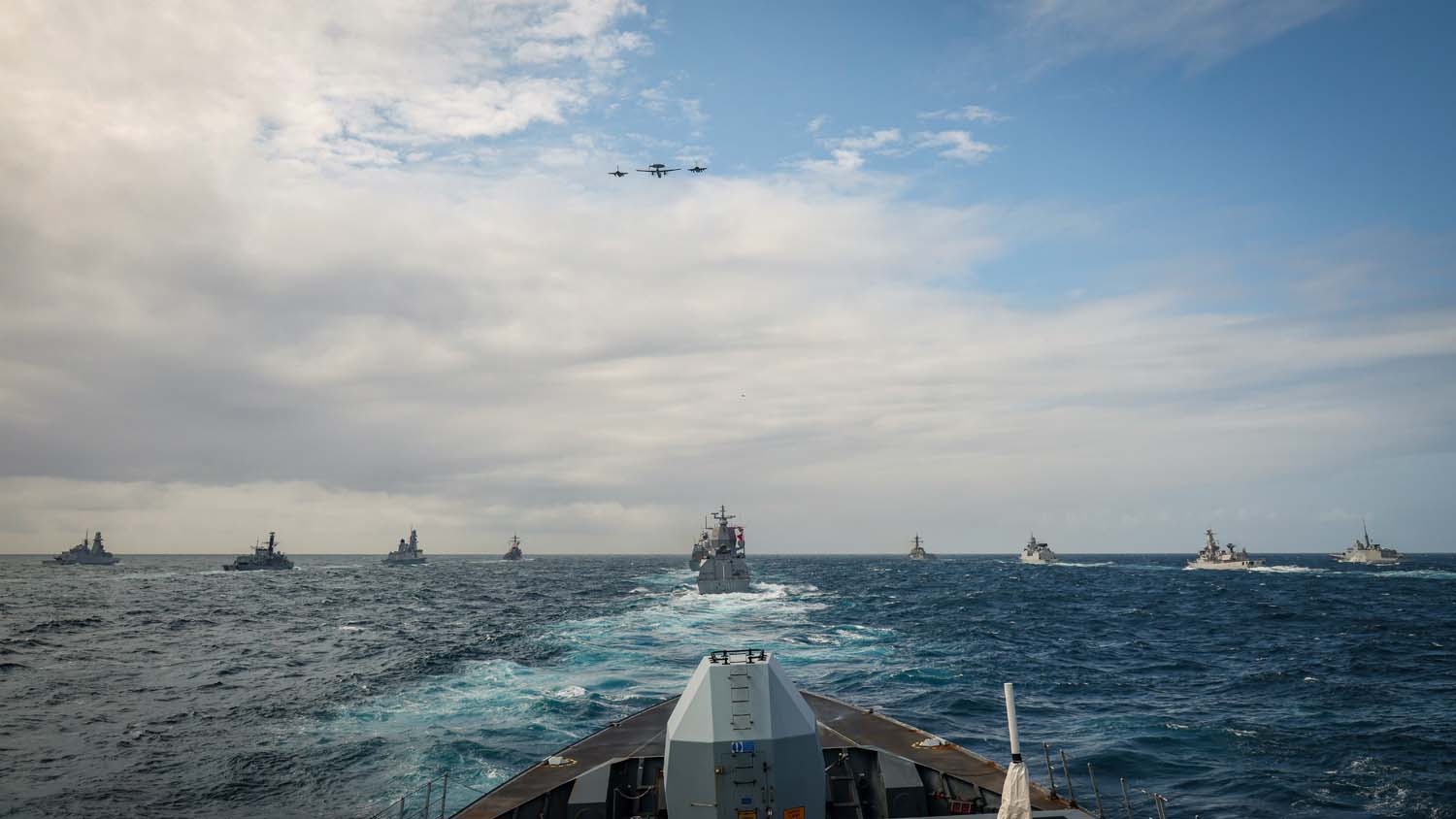
The Ministry of Defence has pointed to the UK-led Joint Expeditionary Force as a central element of its approach to deterring Russian activity in the High North, highlighting recent ministerial engagement, major exercises and operational responses to hybrid threats in the region.
In written responses to Labour MP Graeme Downie, Defence Minister Al Carns said the Defence Secretary last met his counterparts from Joint Expeditionary Force nations at a JEF Defence Ministers’ meeting held in Bodø, Norway, from 4 to 5 November 2025. The meeting marked the first time JEF defence ministers had convened in the High North, a move the government says underlines the growing strategic focus on the region.
According to the Ministry of Defence, addressing Russian threats in the High North will remain a priority, with the issue set to feature prominently at the next Joint Expeditionary Force Leaders’ Summit, scheduled to take place in Finland in the first quarter of 2026. Officials are also considering dates for a further meeting of defence ministers.
While stressing that NATO remains the “ultimate guarantor” of European security, Carns set out a distinct role for the Joint Expeditionary Force, describing it as a mechanism that enhances security and stability across Northern Europe, the High North and the Baltic region. He said the JEF provides a rapid, adaptable and high-readiness military capability designed for crisis response, collective defence and security operations, including responses to hybrid threats across multiple domains.
The minister pointed to Nordic Warden in December 2024 as an example of the force’s operational utility, citing the JEF’s rapid response following damage to the Estlink-2 power cable in the Baltic Sea. That incident has been widely viewed as part of a broader pattern of vulnerability affecting undersea infrastructure in northern European waters.
As Framework Nation for the Joint Expeditionary Force, the UK is continuing to drive efforts to improve readiness and coordination among member states. Carns highlighted Exercise TARASSIS as a key part of that effort, describing it as the JEF’s principal activity in 2025 and the largest exercise conducted by the force in its 11-year history.
Exercise TARASSIS was held across the High North and Baltic regions during September and October 2025, involving multiple JEF nations and focusing on interoperability, high-readiness operations and collective responses to regional security challenges.
The Ministry of Defence said JEF activity in the High North and Baltic will continue to expand over the coming year, with an “ambitious series of exercises” planned to build on TARASSIS and further strengthen the force’s effectiveness and cohesion.






“ Officials are also considering dates for a further meeting of defence ministers.”
Personally I think the army should be very much focused in this role for our land based NATO contribution. Germany and Poland, supported by France and Italy are perfectly able to manage the Polish and southern NATO boarders.. it’s the Baltics that need some fucused support and this is where the deployable part of the British army should be designed around fighting.
What if Germany elects a pro Putin government as it very well might? Poland would be surrounded by pro Russian nations?
I am all for Britain taking an isolationist view of the world if practically possible but realistically it probably isn’t. We would then have to surrender our permanent seat on the UN Security Council and give up our various senior military command posts within NATO.
Our utility as an ally to the U.S. would then be so reduced as to call into question their support for our nuclear deterrent and much else.
A British government might pursue that course but it looks, at least to me, like one fraught with geopolitical peril….and it might very well not fly with the electorate.
However the Green Party or Your Party might be advocating something along those lines and they are polling quite well.
Hi monro it’s not an isolationist view to decide where you will focus.. to be honest if Germany becomes pro Putin there is very little the UK could do in that regard.. but the future we have at present is one in which 2 large European powers can focus on the polish border and we can support the northern flank.. it’s a logical split of responsibilities.
We are committed to providing a Corps of two divisions to the NATO Strategic Reserve.
To renege on that commitment, particularly since we, and not Europe, were one of the key signatories to the Budapest Memorandum security assurances to Ukraine of 1994, would look a great deal worse than isolationist.
Nevertheless, whisper it softly, that appears to be exactly our government’s current implicit position.
I don’t think the British army should be focused in the Baltics. In a previous post you suggested that a primary role for British Armed forces would be the elimination of Russia’s Northern Fleet, which I agree with. For a multi service approach to that end, I think the North is where the land forces should be employed; holding the line in Finland and Norway to allow their territory to be used to counter the activities of the Russian Navy and enhance those of our own while conducting air, drone and missile strikes from as forward as possible, to degrade the Northern Fleet and its facilities.
Hi a land role in Finland and Norway would be really implied in a focus on the Baltics… because all of those nations together essentially create a Baltic bastion… but the very high north of Europe has a very different land forces need than anything else.. and heavy brigades will have less use.. the environment becomes the issue.. Russia is very very unlikely to be so foolish as to kill its army fighting the Norwegian and finish environment.. more special light forces are needed in Norway especially ( it’s why it was always the marines job to strengthen the northern flank.
Hello Jonathan, I agree that Russia is unlikely to want to fight in the Norwegian and Finnish environments but is that not a factor of deterrence? We suspect that Russia has designs on the Baltic States so we put forces into the area we think Russia wants to fight in. Should we not also make it clear to Russia that it will have to fight in areas that it does not want to as well? Wouldn’t that be an effective deterrent?
With regards to the utility of British forces in the north, the Finns, Norwegians and Swedes all employ their own comparable heavy forces of MBTs and armoured vehicles so I do think they could be employed usefully. I understand that the very high north is challenging and requires highly specific types of troops and equipment but, if that is where the marines are operating, does it not make sense to deploy other elements of the small British army in the same geographic area, to provide security for their efforts?
Cheers
It may very well be that, in view of the negotiating ‘difficulties’ that Britain has with the eu (France) regarding access to the continental defence and other markets, and various other ‘difficulties’ with the eu (France), the leadership of this country has decided against re-arming in order to meet the major commitments to NATO land forces that it has signed up to, perhaps as a negotiating position; who can say? It cannot be a lack of resource for we spend the required uplift to defence spending and more every year on the quixotic pursuit of unevidenced environmental goals.
If that really is the case, then a squadron of tanks here and a platoon of infantry there up north represents pretty much the entire sustainable deployed effort of today’s British Army.
When Putin’s Russia takes Odessa and then Moldova, threatens the Suwalki corridor, the remaining land route connecting the Baltic States to the rest of the civilised world, that platoon/squadron group may look like a rather perilous hostage to fortune rather than any kind of deterrent.
Deterrence relies on evident resolve. To the entire world, it must seem as though such resolve is in short supply in Western Europe today.
That is extremely dangerous.
‘Quixotic.’
Thanks for broadening my vocabulary today. 😀
Great stuff! We do seem to be in a bit of a pickle, don’t we? And that is before even considering the cricket!