

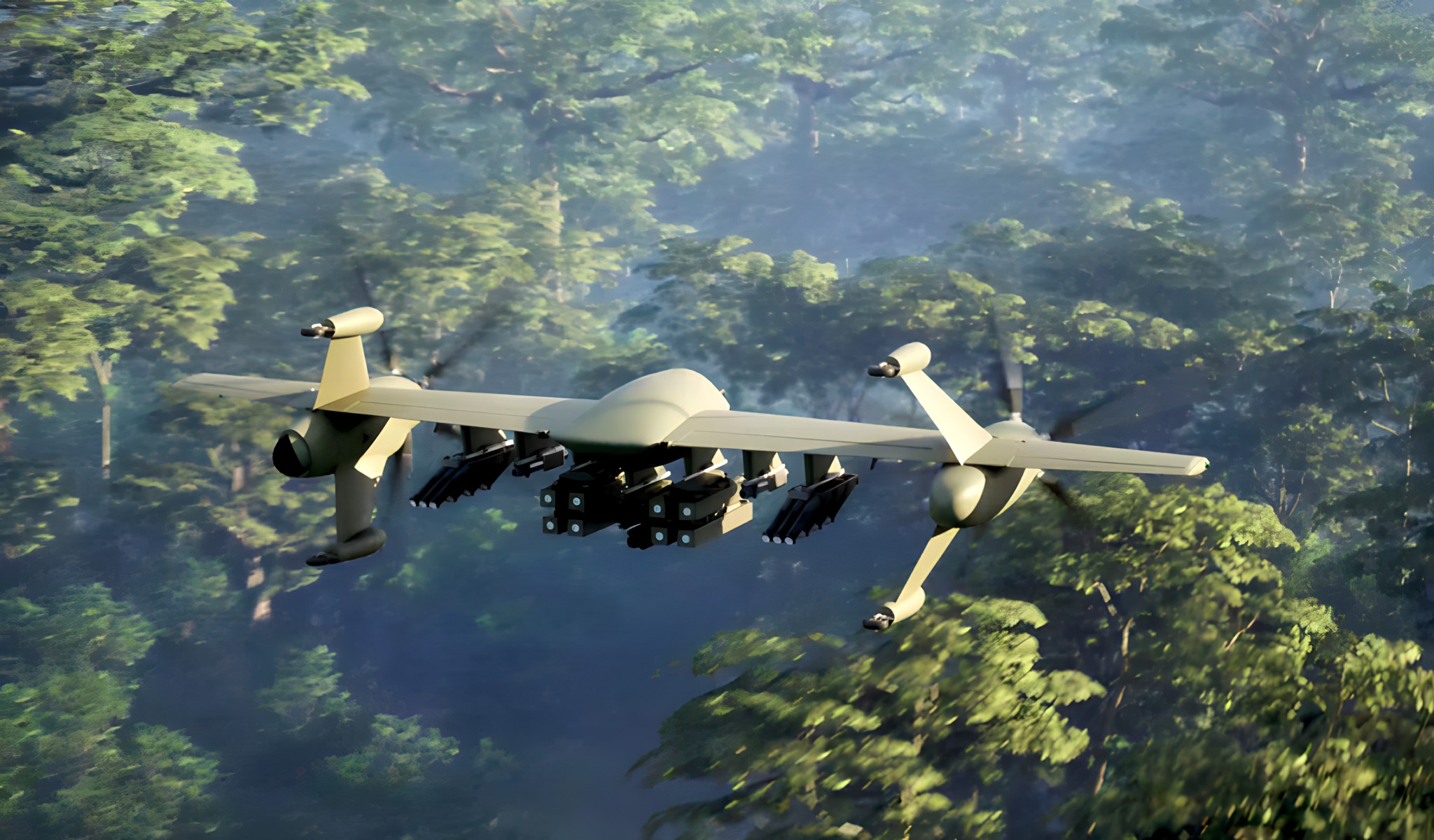
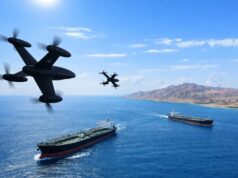
Sikorsky, a Lockheed Martin company, has introduced its Nomad family of vertical take-off and landing (VTOL) uncrewed aerial systems designed for long-endurance, runway-independent missions across land and sea, according to the company.
The Nomad family builds on Sikorsky’s successful 2025 flight test of the Nomad 50 prototype, which demonstrated the efficiency and reliability of its rotor-blown wing design.
The twin proprotor configuration combines the vertical lift of a helicopter with the range and speed of a fixed-wing aircraft. Operated through Sikorsky’s MATRIX autonomy technology, the aircraft will primarily use hybrid-electric propulsion, with larger variants featuring a conventional drivetrain.
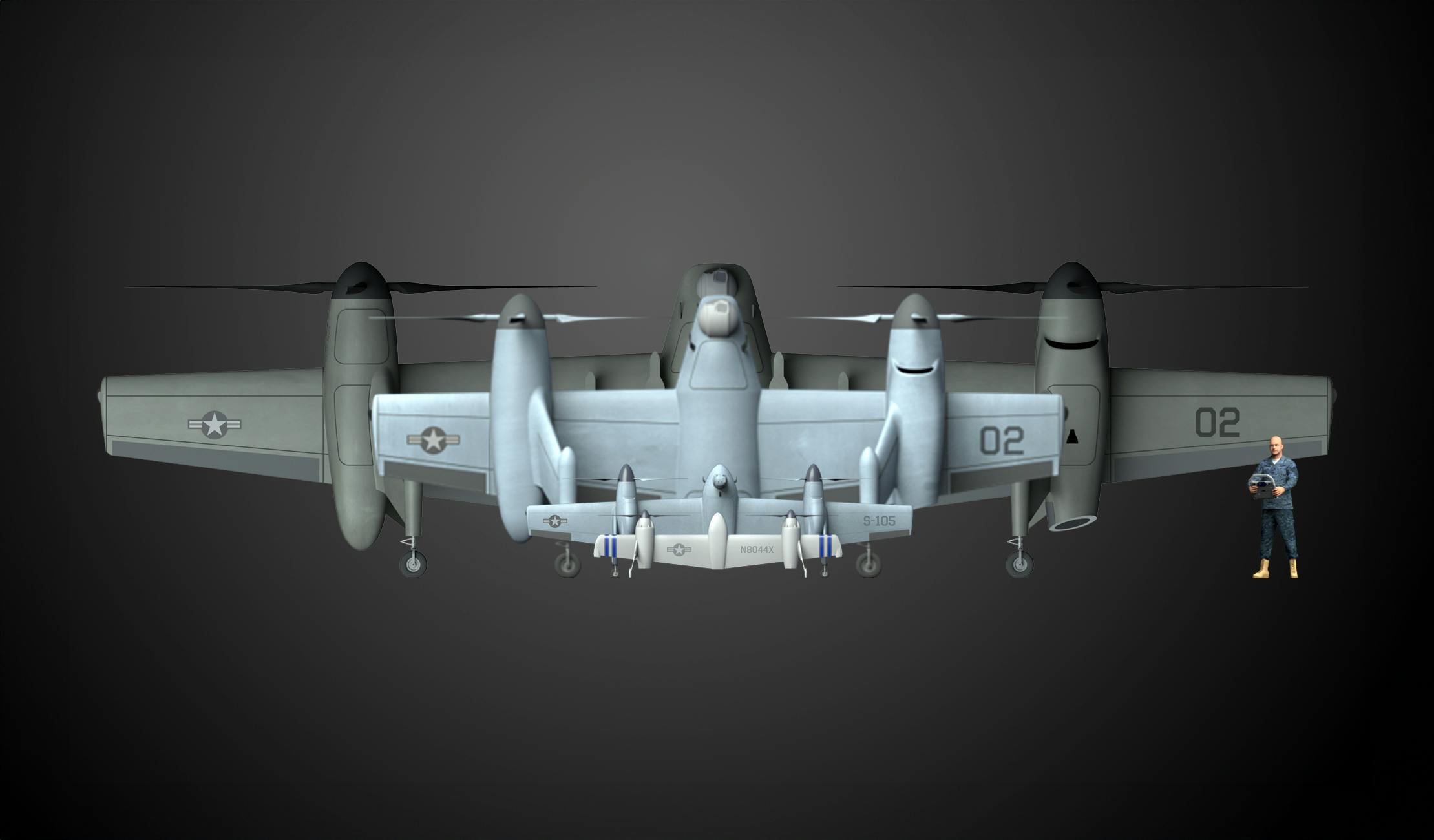
“We use the term ‘family’ to point to a key attribute of the design; its ability to be scaled in size from a small Group 3 UAS to the footprint equivalent of a Black Hawk helicopter,” said Rich Benton, Sikorsky Vice President and General Manager. “The resulting Nomad family of drones will be adaptable, go-anywhere, runway independent aircraft capable of land and sea-based missions across defence, national security, forestry and civilian organisations.”
Sikorsky confirmed that work is underway on the Nomad 100, a Group 3 aircraft with an 18-foot wingspan and a first flight expected in the coming months. The company said the scalable Nomad line will serve missions including reconnaissance, light attack, and contested logistics.
According to Sikorsky, MATRIX autonomy allows Nomad drones to integrate seamlessly with rotary and fixed-wing platforms and has already been demonstrated in firefighting, logistics resupply and advanced mobility roles.
“Nomad represents new breakthroughs for Sikorsky and the next generation of autonomous, long-endurance drones,” said Dan Shidler, Director of Advanced Programs.
“We are acting on feedback from the Pentagon, adopting a rapid approach and creating a family of drones that can take off and land virtually anywhere and execute the mission – all autonomously and in the hands of Soldiers, Marines, Sailors and Airmen.”




We were discussing that whatever we needed for carrier mass would have to be blown flaps or blown wing, which this is. However, it won’t be able to reach high subsonic speeds, and there’s a question as to how the family will be scaled over 600kg MTOW. Sikorsky say that larger drones will have “conventional propulsion”, without saying what that means. I’m hoping it just means a shift from hybrid-electric to hydrocarbons, and not something fundamental, like it won’t do VTOL.
The detail target stats aren’t published as far as I can tell, and only the smallest of the drones is currently flying in prototype, but this looks like an interesting initiative. One of several where companies have raced to create autonomy software then asked: what are we going to put it in? (As we heard with Proteus.) Perhaps one to keep an eye on over the coming years. Let’s see what they do with it.
There have now been a number of publications of the NOMAD family of tail sitters. But Sikorsky’s Chief Program Engineer, has also said that they are looking at manned variants. However, these wouldn’t be tail sitters, as you’d have the orientation problem when coming into land. So what they are looking at is a tilt-wing. Again not a new concept, as the LTV XC-142 did 10 years worth of trials from 1960 to 1970. However, it also had a horizontal propellor mounted at the far end of the tail, which was used during helicopter mode for pitch control.
Sikorsky developed the SB-1 Defiant in collaboration with Boeing, for the US Army ‘s Blackhawk replacement. This was a coaxial helicopter with a massive pusher propellor, to help it go past 200 knots. However, it struggled to reach 250knots, which was the Army’s cruise requirement, it reached 247 knots. Its competitor in the competition was the Bell V-280 Valor. Which was a clean sheet tilt-rotor design. The Valor reached a top speed of 305 knots. It also had significantly more range than the Defiant. The US Army choose the Valor as its Blackhawk replacement.
The problem the Defiant had was that it didn’t incorporate a fixed wing into the design. The wing would generate proportionally more lift as the aircraft went faster. Which would allow the torque powering the coaxial rotors to be either significantly reduced or completely removed, i.e. they don’t need to generate as much lift , as the fixed wing is supplementing the lift. However, it meant the rotor blades still had the issue that standard helicopters face. Which is, the advancing blades tip speed reaches supersonic speeds and retreating blade stall, both significant barriers to going any faster. In tests, the Defiant’s rotor speed was reduced to 85%, but this still wasn’t enough to get round the two traditional problems. The Tilt-rotor Valor always had the advantage.
From the loss of the US army’s competition, and the eventual drying up of Blackhawks being built. Sikorsky had to come up with a plan B. Knowing that helicopters are limited to around 200 knots, they looked at other means to compete with Bell. The obvious answer is to resurrect the tilt-wing concept. In principle, a tilt-wing should preform better than a tilt-rotor in the hover. As you are removing the upper flat surface of the wing, from blocking the downwards flow of air being pushed by the prop-rotors/propellors. Which means the disc loading is reduced. The LTV XC-142 reached speeds of 375 knots. A more modern version should have no issues reaching 400 knots, plus should be a lot more controllable in the hover using digital flight controls.
For a tilt-rotor or tilt-wing, pitch control is difficult without the use of a swash plate on the prop-rotor dive, as it means you will need a tail mounted horizontal propellor or jet to push the nose of the aircraft up or down. A swash plate does make things a lot more mechanically complex. But does mean when in the hover, there is a lot more control in pitch, roll and yaw.
In other news Boeing has just released images of a tilt-rotor drone, which looks remarkably similar to Bell’s V-247 Valiant. I’m not sure if this is a separate aircraft from Bell’s Valiant or is the same one, but branded as a Boeing product?