From the cargo ships carrying global trade to the undersea cables anchoring the internet, national security is now inseparable from what happens on, above, and below the ocean’s surface. Persistent and reliable intelligence about this activity, dubbed “Maritime Domain Awareness” by the US Navy, is no longer a secondary support function. It is a central pillar of a state’s national security.
However, modern navies and coast guards face a math problem: while maritime threats are dispersed and persistent, crewed hulls are scarce and expensive. Traditional fleets are not resourced for the constant gray zone surveillance required to monitor expansive seas, seabeds, and coastlines. To close this gap, militaries must embrace unmanned systems that, when deployed at scale, make the oceans transparent, detecting a wide array of threats and offloading monotonous patrol work from human crews.
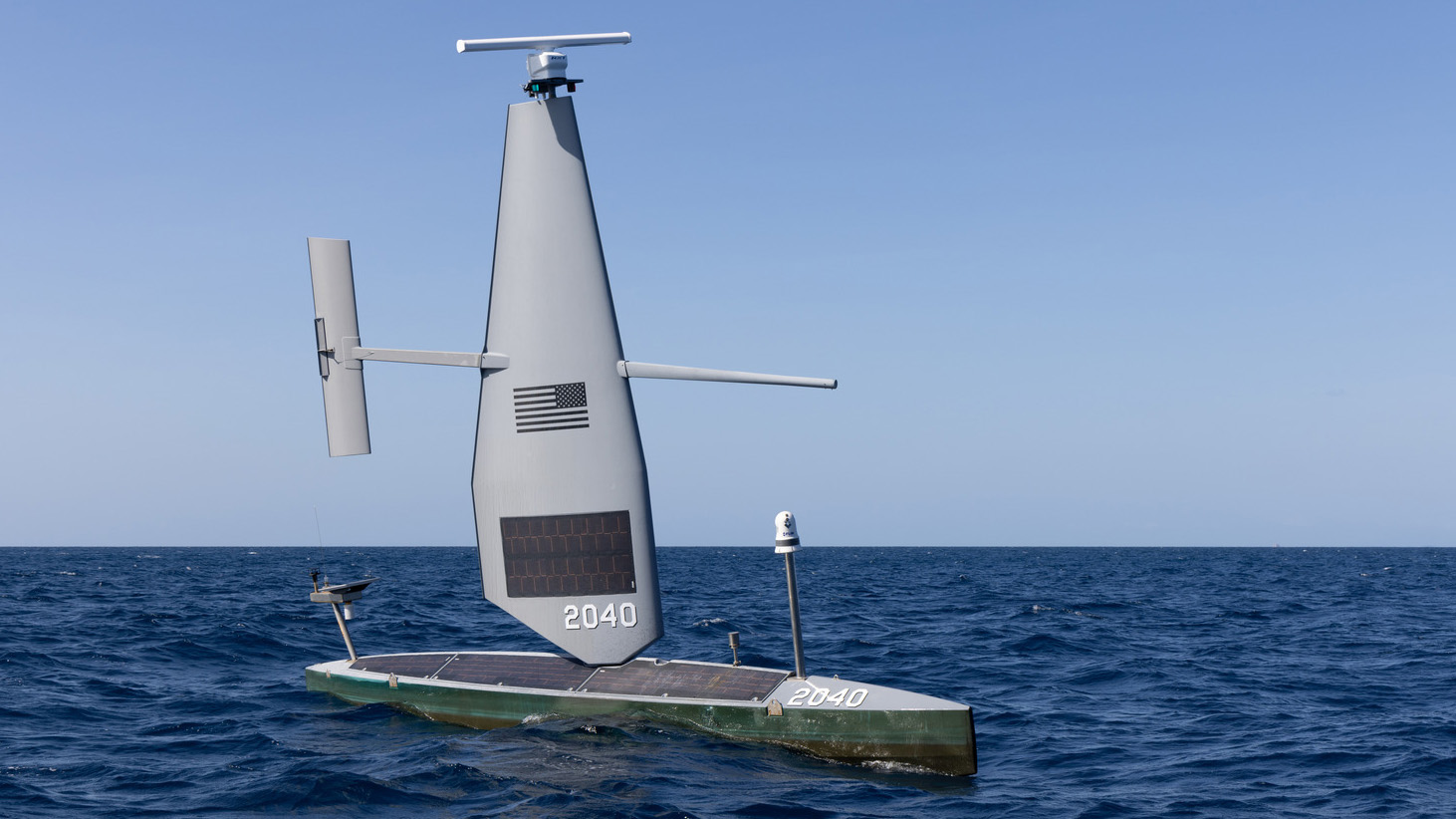
Now in its fifth continuous year supporting 24/7 operations, Saildrone has spearheaded this shift, providing high-endurance unmanned surface vehicles (USVs) to the US Navy, Coast Guard, and NATO and Middle East allies to secure some of the world’s most strategic, and most congested, waters.
Proven Persistence at Sea
Two classes of Saildrone USVs, the 10-meter (33-foot) Voyager and 20-meter (65-foot) Surveyor, enable this shift through two distinct advantages. First, a hybrid design utilizes a proprietary wing that harnesses wind to supplement primary propulsion. Integrated solar panels then provide the power for onboard sensors. Together, these systems allow Saildrone USVs to operate for up to 100 days without maintenance or refueling, extending their reach into remote regions where traditional logistics are nonexistent or high-risk. By handling these monotonous, long-duration patrols, unmanned systems allow commanders to redirect limited crewed assets toward higher-end, more complex combat or deterrence missions.
Second, these USVs provide a hedge against scarcity by carrying a sophisticated suite of payloads, including surface search radars, infrared cameras, and automated identification systems. By collecting and processing this data at the edge, and transmitting it in near real time to shore-based command centers, Saildrone USVs provide decision-makers with MDA at a fraction of the cost and manpower requirements of manned ships. This approach moves beyond reactive patrolling and toward a strategy of “deterrence by denial,” eliminating the predictable gaps that adversaries have long exploited to move undetected across the oceans.
One of the most significant advantages of unmanned systems is their ability to operate in conditions that would otherwise sideline a human crew. Saildrone USVs currently operate across vastly different environments, from the tropical waters of the Central Caribbean to the freezing conditions of the Baltic winter. In the Middle East, Saildrone Voyagers have consistently identified ghost fleets and dark targets, providing critical intelligence to the Combined Maritime Forces. In the Baltic Sea, during a six-month deployment for the Royal Danish Navy, Saildrone USVs maintained a 92% uptime despite the region’s challenging conditions.
In total, Saildrone USVs have amassed over 2,000,000 nautical miles and more than 60,000 days at sea, the equivalent of circumnavigating the Earth 92 times, while sailing for 164 years.
Complementing the Fleet
The value of unmanned systems lies in their ability to complement, not replace, manned ships. This theory is central to the US Navy’s “Fighting Instructions” document, released in February, which posits that unmanned systems will be a central pillar of the future fleet. That document also states unmanned systems must be prepared to deliver mission-oriented effects dependent on the situation and the commander’s need.
Whether tasked with intelligence, surveillance, and reconnaissance (ISR), electronic warfare, acoustic monitoring, or strike missions, the ability to rapidly integrate new payloads is critical for unmanned systems because it allows navies to adapt their fleets based on the evolving threat. Furthermore, by delivering this capability “as a service,” Saildrone USVs fulfill the demand for intelligence and action without adding to the maintenance burden of crews at sea or ashore.
Unmanned systems have transitioned from innovation projects to foundational tools of a credible maritime defense. Saildrone’s operational record proves that this technology is ready for high-volume deployment today. By providing persistent presence where crewed assets cannot stay for extended durations, USV networks exponentially increase the sensor footprint of naval forces.
The distributed nature of USV fleets, coupled with their minimal logistical footprint, ensures commanders can maintain a warfighting advantage even in contested environments. In a landscape defined by scarcity and dispersed threats, the integration of unmanned systems is a critical path to achieving true maritime superiority.