

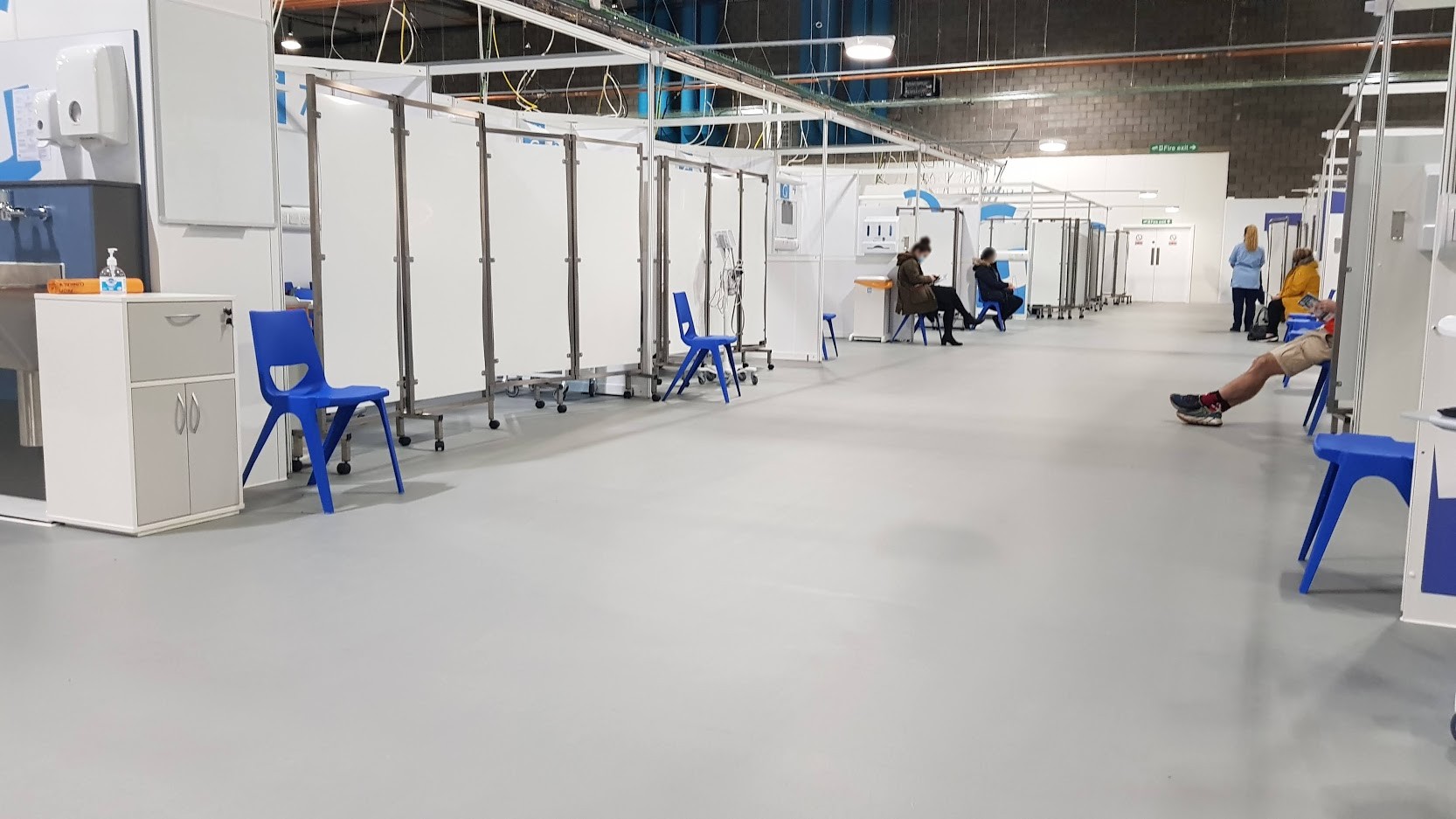
The Ministry of Defence is working with the Department of Health and Social Care and the NHS to review the UK’s health system capacity to respond to the demands of large-scale conflict, according to a written parliamentary response.
Responding to a question from Conservative MP James Cartlidge about Recommendation 57 of the Strategic Defence Review, Defence Minister Louise Sandher-Jones said work examining the UK’s ability to respond collectively as health services to wartime pressures is already underway.
She said the effort involves multiple government departments and health bodies. “There is ongoing work between Ministry of Defence (MOD), Department of Health and Social Care (DHSC) and the NHS to review system-wide capacity and shape and plan the UK’s approach to respond collectively as health services to meet the demands of warfighting.”
As part of that process, officials and health service representatives have been holding workshops to examine the potential impact of modern conflict on the healthcare system. According to the minister, the most recent session was hosted by NHS England in February 2026 and focused on the role of the NHS during major conflict scenarios.
Sandher-Jones said the workshop considered the clinical challenges modern warfare could place on health services and how organisations across the UK could respond collectively to large-scale crises. She added that the Strategic Defence Review recommendations and the creation of integrated crisis plans will continue to be developed through ongoing engagement between the MOD, DHSC and the NHS.
The Government is also working with international partners on related issues through NATO. The minister said: “Further, the work with allies through the NATO Medical Action Plan is addressing priority challenges in workforce; mass casualty planning; patient evacuation; and medical logistics.”
She added that efforts are also examining potential legislative and regulatory barriers that could affect the delivery of medical care during major crises.









And they’re only doing this now?
Has it got a fancy project name? like most paper work exercise that lead to nothing in the MOD have.
The establishment of Covid hospitals was very impressive, even though they weren’t required thankfully. Drone attacks are now a reality and could become the weapon of choice for terrorists, and we need widespread medical support and widespread anti-drone systems across the country.
I was thinking along the same lines. It’s less than 5 years since the Nightingale hospitals were established. We have a pretty good idea of what’s needed, so just get the “After Action” reports out and do a quick lessons learned.
The covid hospitals were essentially shite, great idea did not work.. for one simple reason PEOPLE.. you can build a lovely looking building in very quick time.. but it will take you 3 years to train a basic grade nurse and 6 years a basic grade Dr… and essentially we ended up with some lovely buildings that never got used..
Also guess who were instrumental in building them… yep the army…and they will not be around building stuff in a peer war.
But the fundamental issue is staff and efficiently.. the modern health system is build to see as many patients as possible with as few qualified staff as possible. It has no emergency capacity.
A bit negative for you, Jonathan, mate! Remember there are a lot of retired medical staff and volunteers in the Red Cross and St John’s, so the bucket is not so empty as you suggest. The TA would step in at the commencement of hostilities in the initial phases of conflict along with RN and RAF reservists to erect the necessary infrastructure. So, I applaud this initiative.
I spent a lot of hours of my life on Covid.. spent that first 6 months working 70 hour weeks.. I have a bit of a negative view of our covid response..
Stand corrected and thank you for your endless duty.
He’s largely right though. The AR will be called up and be rapidly backfilling the Army, the most useful units for civil resilience, RE, REME, RLC etc are already all earmarked for operational formations. But also a lot of AR medical staff have NHS or other civilian Medical Roles as their day job, so in the event of war, and with the RAMS reserves being mobilised, the cupboard at home will be even barer.
My mother was in the WVS for what seemed like most of the 1950s, and we appeared to be more prepared in those days, obviously due to the Second World War.
Two World Wars in living memory, Great Power Competition actively ongoing since the 1850’s, the British Empire still existing and funding the UK, and Britain hadn’t yet been forced into line by the US. Yes we where more prepared then.
‘the creation of integrated crisis plans will continue to be developed through ongoing engagement between the MOD, DHSC and the NHS.’
What could possibly go wrong?
‘I’m from the government and I’m here to help…’
Lads and lasses….realize one thing. Government ie politicians, yap, and do nothing. If there is, gods forbid, a large scale attack on the UK? You are on your own. I suggest respectfully, if you have not already, prepare for that eventuality.
First aid kits for every household.
Basic first aid training for responsible adults.
The pressure on the NHS is already enough.
We need them for specialist care.
But decentralising adds to network resilience, I think.
And a general culture of health promotion, will limit pressure and help manage resources efficiently.
Then blankets, water, and long shelf life no need for cooking food. Power banks, et cetera.
Also contingency plans for emergency travel.
Requirements for id.
How can this information be transmitted in a non-scary fashion? So the public can be prepared. Without feeling jittery.
I would say set up an open “front” organisation/charity. Not an official one.
Something that seems like grassroots.
But then give it coverage on Sky News on Bbc.
There could be a campaign for “be prepared day”
Which becomes an annual reminder. (Maybe around armistice??)
Let’s be utter and completely clear our healthcare system designed purely as a utilitarian system.. the greatest amount of good for the least effort.. what this means is our system is entirely designed to treat the most people with the least staff and in healthcare staff are all that matter.. buildings all the other stuff are meaningless and it takes an age to create the staff you need..
What most people forget is that healthcare is the single most complex endeavour ever undertaken by humanity and our healthcare systems are by far the most complex systems ever created.. we forget that average human life expectancy without a healthcare system was 30-40 years ( with a good diet, no processed food, exercise every day) a modern healthcare system in a population that actually have health lifestyles ( not eating tons of processed crap, smoking, drinking and actually getting off their arses every day) can move that to 85 years… we bitch and whinge about how crap our society is but just take that for a moment.. the natural order of things would see half of us dead by 30.. infact many of us would never get to adulthood.. those childhood diseases we sort out.. dead, get a appendicitis.. dead, get a compound fracture…dead, even a cut finger could kill you… we can even make you not dead anymore of you heart decides to give up.. or keep you alive if you have a bleed on your brain. We can even give people a life who simply did not have bodies that could live.. if you have cystic fibrosis you can now have a life into your 40s in 1900 you died in infancy….. there are 18,000 documented different diseases.. and people can have any number of them and they all interact with each other in different ways.. about 5000 different drugs that can be used in different combinations, it’s not even possible to categorise all the different surgical techniques but there are 1000s, then there are the diagnostics and other treatments.. the US system which has to monetise everything about healthcare has 155,000 codes for diseases, injury and disability and 70,000 codes for treatment and diagnosis..
What this essentially means is that healthcare is soooo complicated.. that even the most expert of clinicians now really only focus on specific areas.. we no longer really have general surgeons who do a bit of everything.. and it moves so fast that within a short space of time you are out of date. This focus is both to support efficiency and also the level of complexity.. you cannot know everything.. there are cross over skills yes, but you haematologist, GP or radiologist is going to be sod all use whipping out a spleen in a resus room…and your Gastro surgeon is going to be sod all use taking over care of all your haematology patients.. in the same way you don’t want an ED nurse sorting out and administering your complex chemo regimes ( they will cock it up and kill you) and your chemo nurse would not have the first notion how to diagnose and plaster a fracture or suture and manage a head wound..
So staffing is the core issue.. to manage a major trauma case ( someone who is a bit blown up ) you will need the following:
1) 2 emergency responders, this is the person that essentially stabilises the casualties to allow them to survive to the ED.. let’s say 3 years to get to a basic competency and 5 years on the job to be really effective and know everything.
2) ED team. ED consultant leading the trauma.. fives years medical school and 10 years on the job through the grades.. so 15 years to make one. Lead nurse, the person that actually makes sure everything works and is inplace, three years training, 5 years as a staff nurse then another five years as a senior nurses.. so 13 years .. a pair of staff nurses.. 3 years basic and a couple of years maturity on the job so five years. An anaesthetist consultant to manage the airway and keep the person alive while the trauma team work.. it’s 15 years to make one. The assistant to the anaesthesia.. that’s 3 years on the job.
A surgeon.. consultant level.. as general as possible with some cardio thoracic and vascular expertise again 15 years, a neuro surgeon on call, again 15 years, a radiographer to do diagnostics.. 4 years, a radiologist to interpret the diagnostics, 15 years… a biomedical scientist to do the blood work.. 5 years.
3)Definitive care: surgery of the required type.. so for a major trauma.. your looking at a full theatre team.. technicians and nurses with between 3 and 13 years experience about 5 of them.. add to the original surgeon another consultant probably an Orthopaedics surgeon.. 15 years and a more junior surgeon. Then you have further specialist surgery.. neuro, further ortho, etc etc which can go on for days.
4) recovery and rehabilitation.. nursing team on a ward.. lead by a senior nurse 13 years.. each 6 patients will need one staff nurse and one care assistant per 8 hours ( essentially 6 so 1 staff nurse per bed ) they are 4-5 years.. a couple can be new at 3 years..care assistants are on the Job training roles. Therapy team so 2 therapists at 3-5 years and junior dr cover you would need 6 to cover all the shifts 6-8 years. A pharmacist to supply the ongoing drug therapy, lab team for ongoing blood work, radiology for ongoing diagnosis..
With all of the people listed you could probably manage 1-2 major trauma cases a day. But they all need time off… ( a major trauma from call to popping them on a ward post definitive surgery is probably a 12 hour job).
As you can see a trauma call takes a lot of people from about 12+ disciplines that take 5-15 years to train..20 for the trauma call and definitive care and 30+ for the recovery… your average DGH ( each county of .5-1 million people will have 2 DGHs) with all resources pulled in could manage 3 major trauma cases at the same time.. during the day when all staff are in and available.. at night 1.. but essentially if you had 3 major trauma cases at the same time you would be cancelling a lot of elective surgery that day… so per million population we can manage about 6 major trauma cases concurrently but that will impact a bit on elective care..
Simply put the NHS has zero extra capacity.. the way it manages major events 3+ major traumas or other mix of mass casualties is to cancel elective care and distribution the load across a number of hospitals.. any surge is always managed by not doing elective care/surgery… essentially the NHS is still managing the elective debt incurred from covid and its plan is to actually get through the covid backlog by 2029..
What makes it worse is that:
1) the armed forces have no role four, they only do role 1-3 of the operational care pathway.. that’s intial stabilisation and surgery to stabilise, role four of the operational care pathway… definitive care and recovery is undertaken by NHS hospitals.
2) all of the military reserves related to the healthcare professions have an NHS day job that if there was a peer war and the UK was attacked they would not be able to easily leave.
So if we look at reserve capacities the best comparison is Germany.. so for context Germany spends about 420 billion pounds a year on its healthcare system vs the UKs department of heath budget of 188 billion and the total UK healthcare spend is 220 billion.essentially that has been the difference every year.. so what does an extra 200 billion a year get Germany in resources… Germany has 638,000 hospital beds or 77 per 10,000 people vs the UKs 166,000 or or 24 per people. Germany has about 5 doctors per 1000 people the UK has 3.1 Germany has 14.4 nurses per 1000 people the Uk has 9.. Germany has 37 CT scanners per 1 million people the UK has 10..
I am afraid the UK cannot ever have a healthcare system that is resilient enough to manage a major shock because we simply refuse to believe healthcare actually costs a huge amount of money, we run around in a delusion state in which we firmly believe we can run a system for 25% -40% less cost per person a year for healthcare than France and Germany and yet have the same quality of service and resilience.. and then you get the market led private healthcare lobbyists.. the only true market led modem system is the US and they pay 4.5ish trillion dollars a year for healthcare… that’s 25% more than the entire UK GDP on the healthcare for 340 million people.. they spend around 400% more per person on healthcare that the UK..
The simple fact is the UK has underpaid for its healthcare for the last 80 years by probably 1000s of billions of pounds.. if we all spent 70 years going into Tesco and underpaying by 25-40% against other supermarkets at cost rates how well do you think Tesco would be doing.
The question you must ask.. is a healthcare system a luxury or is it a fundamental requirement for the survival of the state and its security.. hint on this one ( from a person who has studies and is an expert on healthcare systems) the UK healthcare system at its core was fundamentally created from the learning and requirements from three wars and you can essentially trace the birth of our modern system from three wars.. public health came from the boer war proved health visitors, school medical inspections, school meals act, national insurance act,WW1 provided the ministry of health, 1919 housing act, the college of nursing, 1929 local government act which saw the organisation of local community hospitals. WW2 essentially created the NHS as a unified national health system due to requirement for a centralised healthcare system and the learning that only a unified system could essentially manage the military and civilian casualties from a modern total war… essentially the NHS was simply formalising the work that had already happened as a war responce.
So it’s worth remembering the NHS was created by war for war… it would not and could not have existed without WW2 and was a direct national response to the needs of WW2… one of the reasons the US never managed to create a working health care system was because it was never put through the test of existential war.. as we come to a pre war world we neglected the NHS at our nations peril.. because if we truely get into it it will be one of the cornerstones of the nations ability to keep fighting and having a will to keep fighting..
That is the most comprehensive lesson I’ve ever seen on the NHS thank you for taking the time to explain it.
One of your longest!
Did that just flow or did you plan what to say?
I guess the former.
Bit of a flow state with this one.. it’s my favourite subject.. I almost went back to the Crimea war, but thought the concept of war as a the formative force behind modern concepts of nursing is a story for another day..🤣😂
This is a joke presumably? The NHS cannot cope with a Saturday night in Salford let alone WW3.