

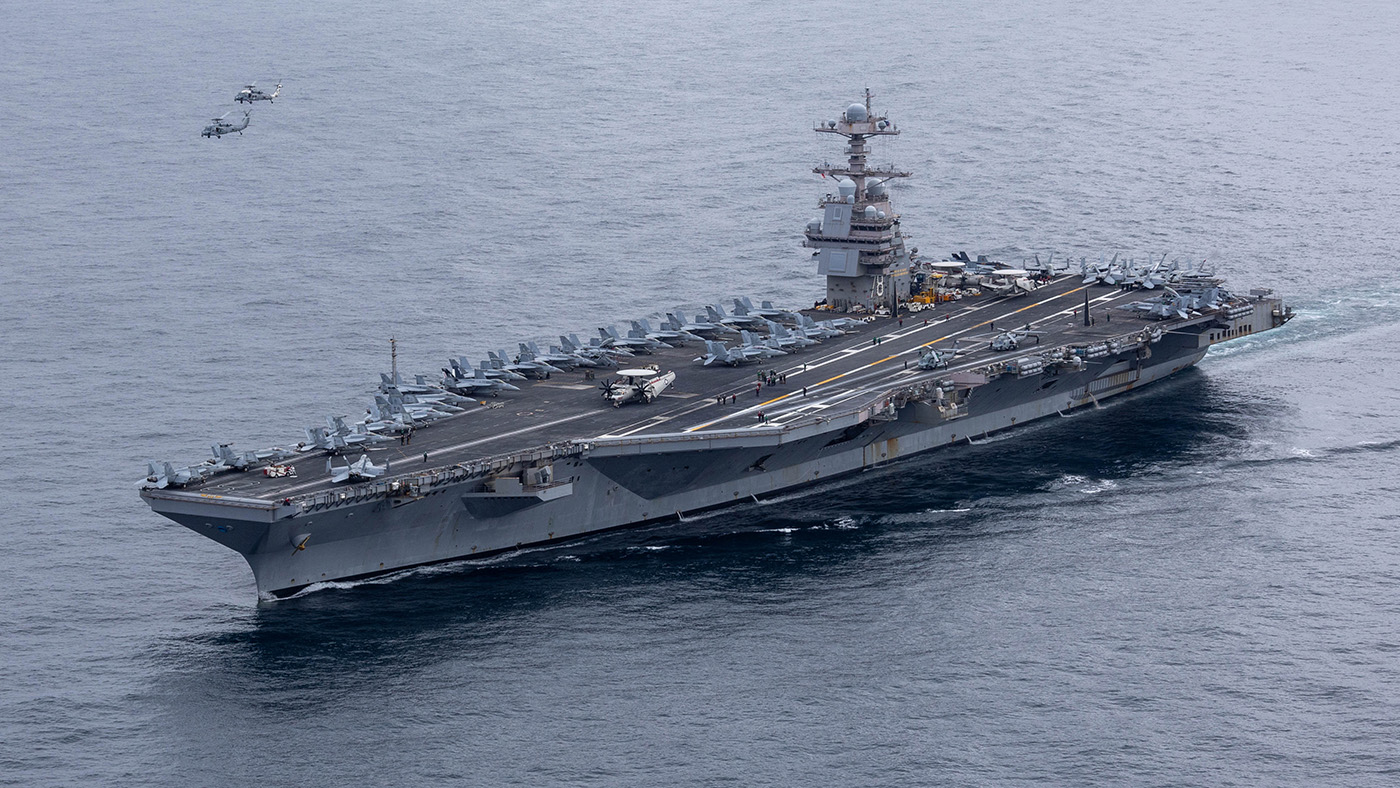
The U.S. Navy’s newest aircraft carrier, USS Gerald R. Ford, has transited the Strait of Gibraltar and is heading east after recently operating in the Caribbean, positioning the world’s largest and most advanced warship closer to the Middle East amid rising tensions with Iran.
The 100,000-ton nuclear-powered carrier had been conducting operations in the Caribbean in recent weeks before shifting course across the Atlantic. Her passage through Gibraltar signals a clear repositioning toward the Mediterranean and, potentially, the U.S. Central Command theatre.
USS Gerald R. Ford is the lead ship of the Ford-class and represents the most technologically advanced carrier ever built. At 337 metres long with a flight deck spanning more than four acres, she is powered by two A1B nuclear reactors that provide virtually unlimited range and significantly greater electrical output than previous Nimitz-class ships. That additional power supports advanced systems across the ship and future upgrades.
The carrier is designed to embark an air wing of more than 75 aircraft, including F-35C Lightning II stealth fighters, F/A-18E/F Super Hornets, EA-18G Growlers, E-2D Advanced Hawkeyes and MH-60 helicopters. Her Electromagnetic Aircraft Launch System replaces traditional steam catapults, enabling smoother launches and reduced stress on airframes, while Advanced Arresting Gear improves aircraft recovery. Together, these systems are intended to generate higher sortie rates than earlier carriers.
Defensively, the ship is equipped with the AN/SPY-3 radar as part of the Dual Band Radar suite, along with Close-In Weapon Systems and Rolling Airframe Missiles to counter incoming threats. She operates at speeds exceeding 30 knots and sails as the centrepiece of a carrier strike group that typically includes guided missile destroyers and cruisers, along with a fast attack submarine.
The Ford-class was designed to reduce crew size compared with previous carriers, relying on greater automation and redesigned internal systems to lower lifecycle costs. Despite this, the ship still carries a complement of roughly 4,500 sailors and air wing personnel when fully embarked. Her movement eastwards places a significant concentration of U.S. naval air power within reach of the Middle East.




Considering there are probably millions of iranians that want to see the “supreme leaders” head on spike for all their dead friends and relatives, I’d wager they want this carrier to do something spectacular once it reaches the area
Not if it means Trump becomes effective Supreme Court Leader. Frying pan and fire comes to mind.
It’s possible they want Iran to cave and come to the table before it reaches the area. Although given the Iranian viewpoint, I suppose that would be spectacular too in a different way.
This is the problem.. yes they hate their government.. but when an outside threat attacks that suddenly gives the government more legitimacy..they will not sea the US as liberators they will see them as invaders and the enemy..
Sometimes it’s why it’s better to use gray warfare and political warfare to develop the overthrow of these governments.. delivering 100,000 rifles to those’d that want to overthrow their government will be seen as support.. bombing the infrastructure of the nation will not.
Look at Iraq and Afghanistan..did they see the US as liberators.. yes for about a week… then they were the invaders.
You are assuming they going to invade, which they are clearly not preparing for.
This is likely to be a missile and air attack just like last time
‘No-one likes armed missionaries’ Robespierre
I wonder if all the glitches such as EMALS reliability and aircraft elevator faults been properly sorted?
Not on the latest reports to congress.. it’s still out of action 1 day in every 5.
yes despite initial teething problems, EMALS is fixed and has been operational for a few years now
in 2023, in its first major deployment that lasted about 6 months the Ford did over 8,700 successful sorties (launches and recoveries). that is a huge amount of sorties in such a short time.
since its commissioning, the Ford has achieved over 22,900 successful sorties.
Have they tried Tariffs ?
USS Gerald R. Ford definitely brings plenty of options:
Carrier Air Wing 8
▪ The “Tomcatters” of Strike Fighter Squadron (VFA) 31 – F/A-18E – from Naval Air Station Oceana, Va.
▪ The “Ragin Bulls” of VFA 37 – F/A-18E – from Naval Air Station Oceana.
▪ The “Golden Warriors” of VFA 87 – F/A-18E – from Naval Air Station Oceana.
▪ The “Black Lions” of VFA 213 – F/A-18F – from Naval Air Station Oceana.
▪ The “Gray Wolves” of Electronic Attack Squadron (VAQ) 142 – EA-18G – from Naval Air Station Whidbey Island, Wash.
▪ The “Bear Aces” of Airborne Command and Control Squadron (VAW) 124 – E-2D – from Naval Air Station Norfolk, Va.
▪ The “Rawhides” of Fleet Logistics Squadron (VRC) 40 Det. – C-2A – from Naval Air Station Norfolk.
▪ The “Spartans” of Helicopter Maritime Strike Squadron (HSM) 70 – MH-60R – from Naval Air Station Jacksonville, Fla.
▪ The “Tridents” of Helicopter Sea Combat Squadron (HSC) 9 – MH-60S – from Naval Air Station Norfolk.
Is that their Rounders Teams ?
USS Abraham Lincoln (the one currently operating in the Arabian Sea) has even ‘better’ nicknames:
Carrier Air Wing 9
▪ The “Tophatters” of Strike Fighter Squadron (VFA) 14 – F/A-18E – from Naval Air Station Lemoore, Calif.
▪ The “Black Aces” of VFA 41 – F/A-18F – from Naval Air Station Lemoore.
▪ The “Vigilantes” of VFA 151 – F/A-18E – from Naval Air Station Lemoore.
▪ The “Black Knights” of Marine Fighter Attack Squadron (VMFA) 314 – F-35C – from Marine Corps Air Station, Miramar, Calif.
▪ The “Wizards” of Electronic Attack Squadron (VAQ) 133 – EA-18G – from Naval Air Station Whidbey Island, Wash.
▪ The “Wallbangers” of Carrier Airborne Early Warning Squadron (VAW) 117 – E-2D – from Naval Air Station Point Mugu, Calif.
▪ The “Titans” of Fleet Logistics Multi-Mission Squadron 30 (VRM-30) – CMV-22B – from Naval Air Station North Island, Calif.
▪ The “Raptors” of Helicopter Maritime Strike Squadron (HSM) 71 – MH-60R – from Naval Air Station North Island.
▪ The “Chargers” of Helicopter Sea Combat Squadron (HSC) 14 – MH-60S – from Naval Air Station North Island.
I have the final as – 🐺 vs 🎩
I still find it surprising that the Ford was not built with the capability to operate F-35C aircraft. The most modern, supposedly most powerful ship in the USN. And it cannot operate the Navy’s most advanced multi-role fighter. That is beyond odd.
What is also odd that given the F-35C IOC occurred more than 7 years ago (barely), it is odd that the Navy had just 4 active F-35C squadrons (56 aircraft?) deployed or assigned with a CSG, and one of those F-35C squadrons deployed on carriers is flown by Marines. Only the Vinson, the Lincoln and the Washington are fully on board with the C and I believe the Roosevelt is too, but I am not sure that. I think the Navy has 90+ C’s and the USMC has 30+ of them, so almost half of the C’s are deployed to the carriers, whether at sea or in training.
My understanding is that it was deliberate to get her in the water ASAP so as much data as possible could be sent back as lessons learned. Being first in class, Ford introduced a lot of new technologies, including EMALS, Advanced Arresting Gear, weapons elevators, and new radar and power systems. The Navy deferred full F‑35C integration so they could test and mature these systems in real operational conditions first, rather than risk trying to add the most complex aircraft support straight away. Ford hass effectively been a live testbed, letting the Navy work out the kinks before fully committing the F‑35C air wing. Some of the new systems are still refining reliability, which proves why the Navy staged the integration this way.
Lessons learned are being fed into the second in class USS John F. Kennedy, which has just completed its builder’s sea trials and is back in the shipyard for further testing and outfitting, with full F‑35C capability integrated from the start.
AFAIK the Ford carrier group is 3 to 4 days away from being in position tons strike.
No strikes until after the Olympics closing ceremony.
Sunday 22nd February
I would say that it’s arguable as to whether the Ford can be described as the most powerful carrier in the world or indeed in the US fleet presently, as it still cannot fly the F-35 C, the article is incorrect there as it won’t be capable until it receives modification during its first refit. The carrier itself might be the most ‘powerful’ on paper but it’s only as effective as its air wing and the Carl Vinson and three others in reality are more powerful in terms of their air capability currently. One of those is the Abraham Lincoln presently on station in the Arabian Sea and thus will be more effective as things stand than the Ford when it arrives which will however provide the added mass. That’s unless we just write off the F-35 with its unique capabilities as an important factor in which case someone had better tell the RN.
Yup, It’s my Pet Hate !!!
Labels and headlines just don’t seem to be that accurate anymore.
I would agree it’s my understanding that it still cannot match the sortie rate of a Nimitz as its cats will be out of action after 5 days flying opps and as you say it’s still functionally a 4th generation carrier at present.
Also arguably the carrier with the most potential power in the world is the the Charles de Gaulle.. because if they wanted to load if for bear it could launch 40+ ASMPs with 300KT warheads.. that makes the de Gaulle a strategic nuclear platform than has the firepower to destroy a nation..
The super hornets could deliver hundreds of nuclear strikes.
Ahh but against who ?
With the Trump ego bruised and unstable, who knows what he’ll do next.
“you got no friends” 😂
Are US carriers carting around hundreds of warheads? Seems a little preposterous.
except the F18 Super Hornet does not carry a nuclear payload. originally Germany selected F18 to replace Tornado for nuclear mission with B61, but US said certifying F18 for B61 never going to happen,whichis why Germany ended upbuying F35A.
it’s not a technical issue, just not part of US Navy doctrine
ie US Navy does sub launched nukes, and USAF gets bombers and ICBM.
get the feeling its more about inter departmental turf wars / rivalry
Umm first off NOPE.. The F18 is not able the carry nuclear weapons.. never been cleared or had any integration work done..
And the ford is not equipped to carry the F35….
The last big issue is no US carriers have the capability to manage nuclear weapons.. the last was the USS Kennedy and that capability was removed in 1993…
And even if all that was overcome I’m not sure how you can compare a fighter dropping a free fall nuclear bomb with a fighter launching a Mach 3 600km range nuclear missile… but you do you… 👍 because America must always be better, even if it does not have the thing, “If I had ever learnt, I should have been a great proficient,”…😂🤣
Here we go again….Murika, pew, pew, pew.
Yet according to Hegseth, Trump and Vance, Iran’s military nuclear capability was completely destroyed beyond any repair last June.
Strange that.
I’m interested in how protection is afforded going through the Suez canal bottleneck.
How good is the security?