

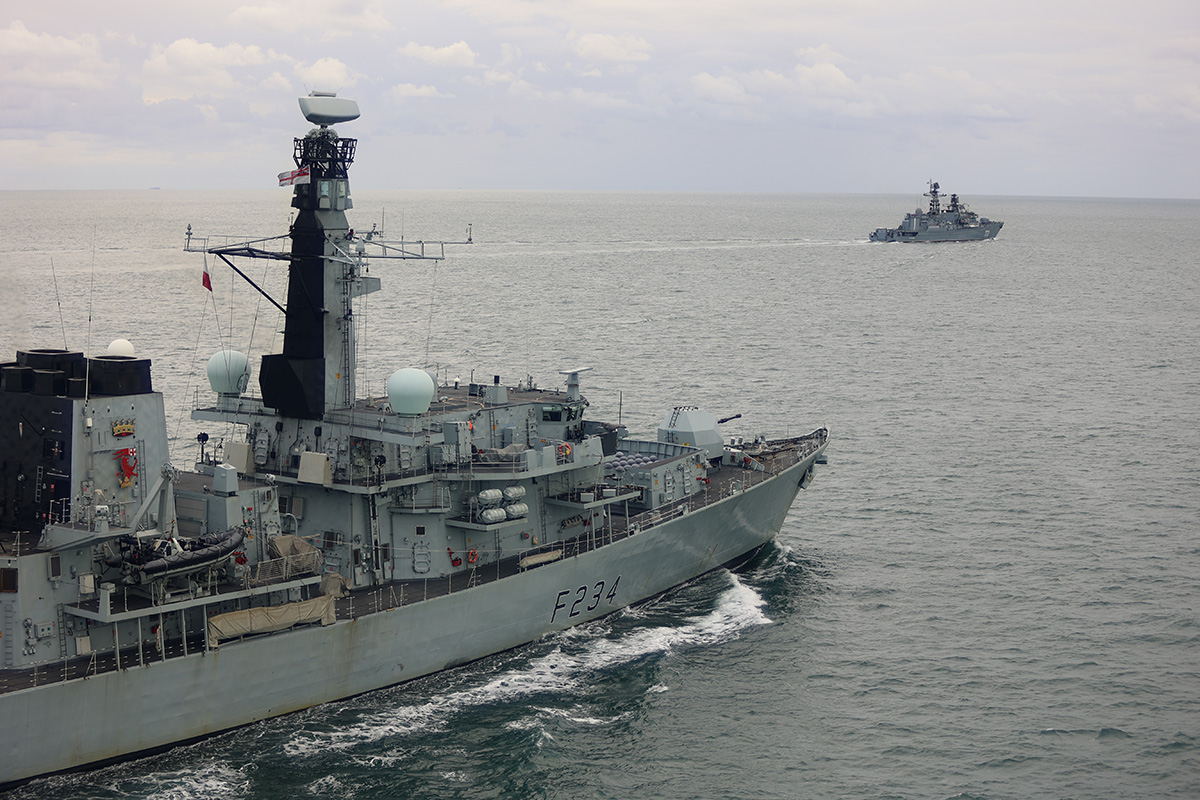
An MP has questioned whether the Royal Navy has enough ships available to sustain operations in the North Atlantic while responding to crises elsewhere, warning that capability must match growing strategic demands.
Speaking during a Westminster Hall debate on NATO and the High Arctic, Labour MP Alex Ballinger raised concerns about naval capacity as the UK faces simultaneous pressures across multiple theatres, including recent deployments connected to tensions in the Middle East.
Ballinger said the issue was not simply whether deployments could be planned on paper, but whether the UK could maintain them without weakening commitments in other regions. “There is a practical, day-to-day test. We are facing concurrent pressures in other theatres, including recent deployments to the Middle East,” he said.
He argued that credibility depends on whether the UK can deploy forces while maintaining other obligations. “The question is not whether we can deploy ships to other regions on paper; it is whether we can do it without hollowing out our commitments to other parts of the world.”
Ballinger linked the issue to wider delays around the Government’s forthcoming Defence Investment Plan, which is expected to outline long-term capability priorities and funding. He said that without a clear and costed plan, strategic messaging risks being undermined.
“We can announce deployments, launch missions and make speeches about the High North, but if we do not publish a clear investment plan that is costed and credible, our adversaries will conclude that the UK strategy is stronger in rhetoric than in reality,” he told MPs.
He noted that the chairs of both the Defence Committee and the Public Accounts Committee had warned that delays to the plan could send negative signals about the UK’s ability to deliver its defence ambitions.
Ballinger also asked the Government whether the Royal Navy has sufficient ships available to operate credibly in the North Atlantic while responding to other security challenges, and what steps were being taken with NATO allies to reassure Denmark and strengthen stability around Greenland.
He told the debate that climate change, Russian military activity and increased competition over undersea infrastructure were raising the strategic importance of the High Arctic. In that context, he argued that deterrence ultimately depends on credible capability.
“Deterrence is built on credibility, credibility is built on capability, and capability requires investment,” he said, adding that ship availability and the Defence Investment Plan would be key tests of the UK’s approach.









He’ll not get far in this government if he keeps displaying so much clarity of thought.
Two things. Firstly, the US build up of forces should have been a pretty good hint. Of course, the US should have informed countries such as the UK anyway – especially if they wanted to use European bases – but that’s a separate issue. Knowing what was going to happen why wasn’t at least one RN ship already on the way to Cyprus when the attack happened? A competent government would have prepared for this. Secondly, we now have absolute proof that we need more surface vessels… yet nothing in the way of attempts to sort this.
The UK surface fleet is half the size it needs to be. Defence is the first and main priority of any government. Excuses will not be good enough when the first drone actually hits London – and eventually it will happen.
The US asked Starmer for the use of two UK bases and was turned down flat. The US was under no obligation to notify the UK about anything after that. Besides, no one in the US trusts a British Prime Minister whose tenure in office depends on the approval of Islamic fanatics who hate the United States.
They did. However, if the US wanted to use British bases then they should have told the British government exactly why or when. I don;’t know if they did. As for obligation – yes, they do have an obligation to inforn allies when they are about to do something that affects those allies, and they should ask, not demand. As for ‘Islamic fanatics who hate the United States’ – sorry, not interested in deranged raving of ignorant MAGA fanatics.
I think that No one In the World will now trust the US.
So much damage being done.
Half?
Way less than half.
SDR 1998 specified a 32 combatant navy.
Currently we have, at best, a 13 ship navy with RFA, possibly, in an even worse position.
I would say half is a minimum – I agree that I would prefer a lot more, but doubling the size of the surface fleet should be achieveable, and the increased use of drones should also mitigate the need for assets above half to a degree.
The idea that drone frigates will take over from full fat frigates is pure Power Point ATM.
Yes, drone sonar tugs are a thing and could well be used to increase the search area by augmenting the mother ship. But then you need to prosecute and that isn’t in drone territory yet.
Didn’t say that. However, a network of drones – both surface and underwater – would mitigate the shortfall. They have the potential to be a force multiplier.
We lost a third of the surface fleet >100t in the last five years alone, and shrinking has been going on for decades.
We are at least a year or two away until we see the first uptick in frigate numbers. ( assuming no more T23s go to scrap during that time)
6-8 years away from full recovery to 13 escorts.
The questions should be about how the MOD /Treasury can help speed up procurement.
More Type 23s will be lost before their replacements enter service that’s an absolute certainty and the earliest date for the entry into service of all 13 new frigates is stated as 2035 but with Norway likely to take 1 or possibly 2 from those currently in build you can expect that to move out until at least 2040 if and it’s a big if we order replacement vessels.
So in summary more pain and gaps to come over an extended period that might be marginally alleviated with an improvement with Type 45 availability.
Hopefully the current humiliation of our politicians (and lives are not lost because of it) does the trick and some further Type 31s are ordered to close the gap in capability and numbers as quickly as possible.
To be clear 19 escorts is nowhere near enough for the commitments the U.K. has and will have into the future.
Never mind the threat uptick that is clear to everyone.
In many ways, this is a question asked solely to name what everyone knows. I would imagine everyone in that room knows the navy is paper thin and that it will stay that way for years yet. They also know it is a result of decisions made over many years previously. It doesn’t need to be said in public for them to know it. Doing so gets the MP’s name in the media but beyond that, nothing changes
Well it is better to keep the issue in the public eye as it makes defence spending upticks easier to sell to the electorate.
Surely the last 72 hrs should have answered his question and made the situation quite clear!
We need the new frigates yesterday. A lot hanging on the skill and efforts of BAE and Babcock now. No pressure! 🙏
If we’re serious about addressing immediate vessel shortfall we’d be buying back the t23s given to Chile (and still operating). Lend lease plugged a gap when needed – we have a similar issue now? Bring back Spey/ Tamar and their crews to be prioritised onto remaining T23/45s.