

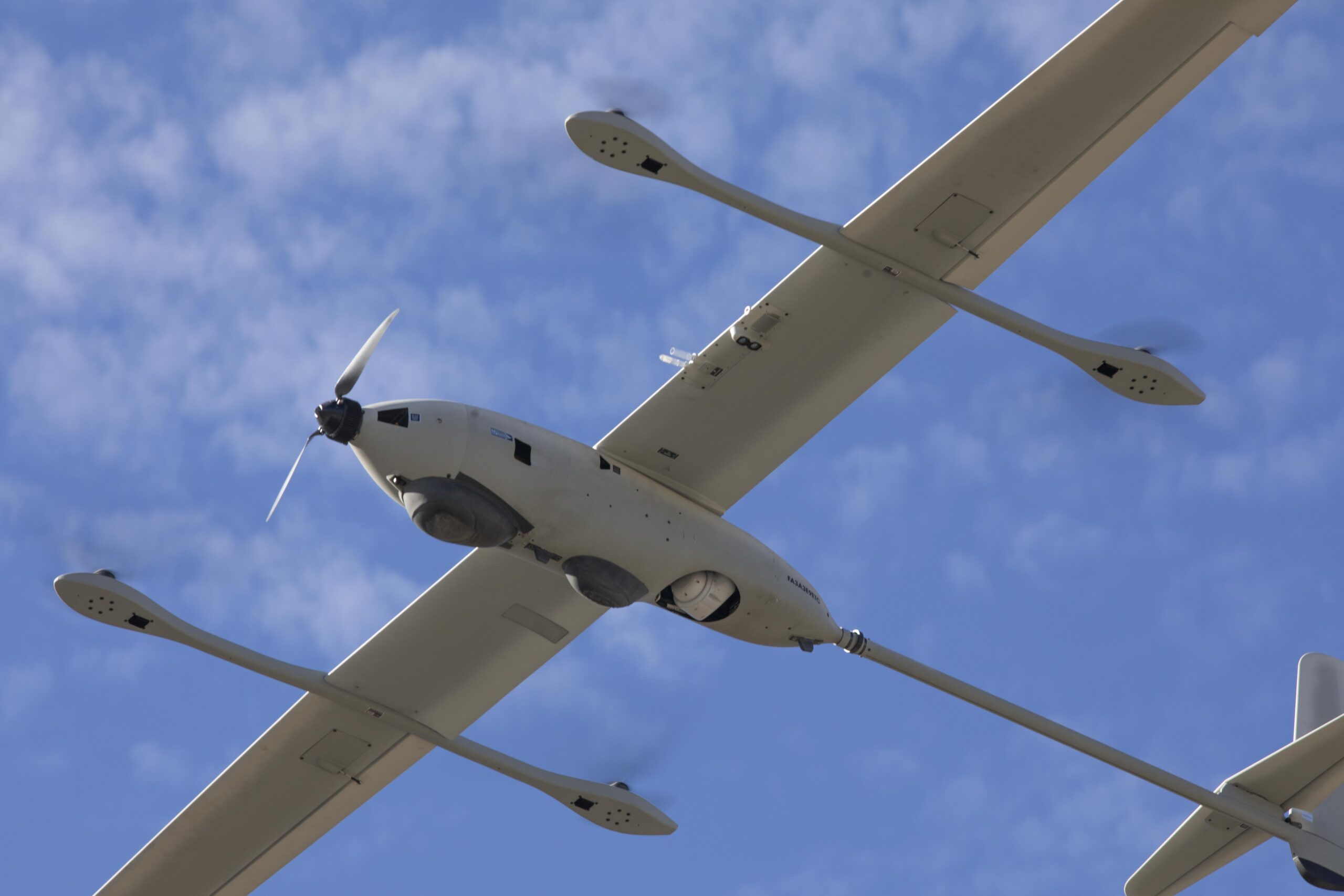
Senior Ministry of Defence officials have faced blunt criticism from MPs over the pace at which the UK is fielding drones and one-way effectors, amid warnings that British forces lag behind key European allies in deployed capability.
During an evidence session of the Defence Committee, Labour MP Fred Thomas argued that the UK was falling well short of Germany in translating rhetoric on drones into equipment on the ground, particularly in NATO’s eastern flank. Thomas pointed to Germany’s decision to deploy significant numbers of one-way effectors alongside troops in Lithuania, contrasting it with the British deployment in Estonia.
“In hard terms Germany will be sending troops out to Lithuania with €350 million-worth of one-way effectors; we will not be doing that with our troops in Estonia any time soon,” he said. “Our troops in Estonia do not have that capability.” He warned that official assurances about progress risked obscuring the reality on the ground. “To continue this line, which we continually get from the MoD… that we are doing these things and we have these capabilities does not help anyone. We don’t. We are not doing them anywhere near quick enough. That is the reality.”
The criticism came as Rupert Pearce, the newly appointed National Armaments Director, set out plans for a restructured UK approach to defence innovation, amid questions over whether the MoD’s internal structures were capable of matching the speed seen in the United States. Thomas challenged Pearce on whether the UK’s procurement system was fundamentally at odds with the spiral development model used by the US Department of Defense, where frontline users and commercial technology firms work directly on rapid solutions.
Pearce acknowledged concerns but said the US itself was reassessing how innovation bodies operate within defence structures. He told MPs that Washington was moving to bring the Defence Innovation Unit back under tighter Pentagon control.
“I met the chief scientist of the DoD last week in Washington… and he is bringing the DIU back into the Pentagon, integrating it under his group with DARPA,” Pearce said. “I think they want to drive greater consistency in their procurement and in their efforts around innovation.”
In the UK, Pearce said a new organisation, UK Defence Innovation, had been established to take a more systematic approach to identifying and developing emerging technologies.
“We have set up a new body called UK Defence Innovation, which will sit along DSTL doing the horizon scanning on novel technologies in the UK and supporting those novel technologies,” he said.
He described a model intended to capture ideas at every stage of maturity, from academic research to early-stage commercial ventures. “The early-stage technologies might be in an academic arena… later-stage technologies might be something in someone’s garage or something that has got early funding from VCs.” Pearce said frontline units would still play a role in identifying urgent needs, but responsibility for sourcing and scaling solutions would sit centrally. “They will throw it over the transom at us. It is the job of UK Defence Innovation and DSTL to go and find these technologies.”
He added that the organisation would have significant resources to accelerate development. “UKDI has £400 million this year to splash on fostering those rapid iteration cycles,” he said, alongside a parallel effort to attract private capital into defence technology firms. Further questioning highlighted the tension between sustaining today’s readiness and funding long-term transformation, particularly in light of commitments made in the Strategic Defence Review.
Responding to Conservative MP Lincoln Jopp, Pearce acknowledged that this balance was unavoidable. “We have to deal with the issues of today while we build the Armed Forces of tomorrow,” he said. “There absolutely is a tension… We have to sustain and enhance our readiness today with what we have and what is available in the next couple of years, and we have to transform over the top to create the Armed Forces of tomorrow.”










Fred Thomas could be a contributor on here with that insight. The answer was hardly encouraging mind going on about redistributing the deck chairs rather than getting new lifeboats.
Is it just me but couldn’t “We have to deal with the issues of today while we build the Armed Forces of tomorrow,” be equally, arguably more important the other way around ie building the armed forces of today while dealing with the potential issues of tomorrow which are far less predictable are more nuanced and changeable in terms of actual answers than many of the immediate needs? If you try to do the best with what you have while waiting for that perfect answer for tomorrow you have probably already lost, you need to add to your present capabilities that you know you need and others are doing while trying to anticipate longer term trends and developments. The Minister seems to think this is mutually exclusive and everything needs to be exact throughout before making centralised decisions. That never actually happens but does explain why we have endless committees and deferred decisions while waiting for horses to turn into perfect unicorns before committing. Cop out on steroids.
It always seems me the reason for all the meetings is that with collective waffle and all the lack of decisions keeps civil servants in a job. Perhaps committees should be a maximum of two people so that we know who is delaying the outcomes. The other thought is to send the Royal Cops of Civil Servants into the front line supported by the Royal Corps of Members of Parliament, I predict that things would change swiftly.
Well said Spy. Tackle the “right now right now” so you can play/fight tomorrow. Are they stocking up on the fundamentals and how about some more substantial GBAD/Shorad to protect the whole country and all the toys in the shed!?
We are amidst a veritable “Swarm” of drone articles. 🪇🪇
We might be behind on drones but we are making leaps and bounds on one way effectors 😀
We have the tech, and we are buying them for Ukraine. We just won’t buy them in number for the UK.
” ….horizon scanning…” another one for the bingo card Daniele!!
They’ll be reinventing ‘helicopter views’ and ‘360s) soon.
🙄
Also re announcing old news.
We KNOW the UKDI org has been set up and yes we know it’s got a ringfenced 400 million budget.
Still, these people have to say something…
These interceptor drones look very interesting. Ukraine would be the ideal place to test them in the real world. Small autonomous drones could be very effective for countering FPV drones.
• Interceptor‑MR (Medium Range) — a larger interceptor capable of engaging targets at ranges of around 5 km or more, using onboard AI and imaging to autonomously pursue and defeat drone threats.
• Interceptor‑SR (Short Range) — a smaller, lighter version (~1.5 kg) with about 1 km engagement range, suitable for vehicle mounting or even man‑portable use, tracking hostile UAS autonomously through onboard sensors.
marss,com/products/interceptor‑mr
UK laging behind? Surely not.
As are 🏴 in the 3rd 🏏 test… still need 194 runs…
Tell me about it. My brother in law, a “converted” Aussie is full of it!
It is not difficult to say we need to build a million drones. 80% this specification. 2% that specification. 0.02% this specification and so on.
The MOD need to risk some seed funding to help small and medium companies build some prototypes. Many of which will be useless. However some will form the backbone of our drone fleets of the future. This is not hard it is just not the way that the MOD usually do business. The politicians need to sweep away the old rules in this instance and severely adjust the rules in other areas.
By way of comparison… HMG spent £277million on the Ventilator Challenge during the pandemic. Now that money was partly spent on setting up new production lines and buying the ventilators produced.
But it also funded four U.K. engineering companies to design, build, and certify new ventilators that utilised off-the-shelf parts so that assembly lines could be rapidly established.
(Normally the design of a new ventilator is a multiyear project. All 4 companies did it in 3 months.)
In the end production of these didn’t proceed, but it shows the U.K. has the capability to develop complex engineering products in a rapid timescale, if the finance is provided.
It also illustrates the problem often encountered as a consequence of top down directed schemes, very relevant to drone development:
‘The recent JAMA study, in addition to other studies of patients in Italy and Seattle, Washington, contributes to a growing understanding that outcomes are generally not very good for COVID-19 patients treated using mechanical ventilators. These formal studies support emerging reports from emergency room and intensive care physicians that ventilators are being overused and encourage the continued exploration of alternative treatment strategies.’
Well in back in 2020 as the NHS gained more experience of Corvid-19 it was realised that CPAPs were a better solution than ventilators. Which is why the ones developed here weren’t put into production. But based on the data from the far-east and then Italy, ventilators originally seemed the best call.
That’s the tricky thing with science. Conclusions can change as you acquire more data and experience.
So far better, then, to receive and evaluate all expert representations rather than proceed on the basis of bigotry, incompetent models and venal influence?
Drone development in Britain requires a specialised test and evaluation centre. Cranfield University airfield just got dumped by Marshall. Plenty of availability in airspace and diaries there….
Not in time critical situations that are also life or death situations. Then the precautionary principle comes into play. Because if you wait until you have all the data, it’s too late. Not a difficult concept to grasp.
It was well known by Coronavirus experts in China at the time of the outbreak that SARS CoV 2 was simply a novel common cold coronavirus by 06 February 2020. There was no excuse for Britain’s government health advisers not to be aware of that. It was in the public domain:
‘….this is actually not as severe a disease as is being suggested. The fatality rate is probably only 0.8%-1%. There’s a vast underreporting of cases in China. Compared to Sars and Mers we are talking about a coronavirus that has a mortality rate of 8 to 10 times less deadly to Sars to Mers. So a correct comparison is not Sars or Mers but a severe cold. Basically this is a severe form of the cold.’
Prof. John Nicholls, University of Hong Kong 06 Feb 2020
‘In 1997, following the first outbreak of H5N1 influenza in humans, he commenced collaboration with the Department of Microbiology to study the pathological effects of avian influenza viruses in the respiratory tract. In 2003 he was a key member of the research team at the University of Hong Kong which isolated and characterized the novel SARS coronavirus which was associated with the global outbreak of 2003. His work on SARS and avian influenza has been published in prestigious journals such as Lancet, PLOS Medicine and Nature Medicine’
All the rest was simply panic or, in some cases, quite possibly venality by overpromoted incompetents.
That you don’t know the difference between a rhinovirus (common colds) and coronavirus (Corvid-19) just shied both your ignorance on this topic. You’re just quoting verbatim waffle posted by tin-foil hat conspiracy theories. Most of which originated from Russia as part of a disinformation campaign. Congratulations on qualifying as one of Putin’s “useful idiots”. 🤦🏻♂️
A ‘corvid’ is a crow.
SARS-CoV-2 (Severe Acute Respiratory Syndrome Coronavirus 2) is the specific coronavirus that emerged in late 2019, known as COVID-19.
Britain’s common cold unit discovered the very first common cold coronavirus in 1965, using the original B814 nasal swab from a “boy with a typical common cold in 1960,”
‘The common cold is caused by over 200 different viruses…..rhinoviruses……Other viruses that can cause colds include coronaviruses, adenoviruses, parainfluenza, enteroviruses, and human metapneumovirus’
So no congratulations to you.
The idea that Professor John Nicholls, part of the team that isolated the novel and deadly SARS coronavirus in 2003, is a conspiracist repeating Russian propaganda really is very silly indeed.
And his findings regarding covid in Feb 2020 were backed up by various serial prevalence studies conducted by the now Head of the National Institutes of Health (NIH) and others.
‘…when I saw the World Health Organization in 2020 say that we have a 3% mortality rate. They were very cagey about what they meant, but I knew what they meant. They meant that three out of 100 people that had been identified with COVID died from it. And they were looking at Chinese data, they were looking at Italian data. And the first thought I had was, well, maybe this is like H1… It’s a respiratory disease, respiratory virus. It spreads very, very easily, obviously. It seems likely that many more people have had it than had been identified.
..you have a situation in mid April, 2020, where 3, 4% of large Metro centers had evidence of the disease already, you know the disease is very, very infectious, that’s a (lockdown) strategy that cannot work……
there’s now a whole bunch of these seroprevalence studies have been done that replicate from around the world what we found. The typical finding in these seroprevalence studies is that for people that are under the age of 70, there’s a 0.05% mortality risk. So 99.95% survival after infection for people under 70. For people over 70 it’s 5% mortality.’
Common cold rhinoviruses can be more deadly that that amongst certain groups of patients:
‘Hospitalized Rhinovirus Cases: A 5-year cohort study found that 12.5% of rhinovirus-infected patients admitted to a medical teaching unit died within 90 days of presentation.’
You should now recalibrate a number of things, particularly your view of the events of March 2020 but also your conduct on this site. It does you no favours.
As per usual with conspiracy theorists, quotes vast swathes if text because he doesn’t understand it and so cannot paraphrase.
Can’t distinguish between a crow and a virus. Says it all. 🤣
Read up the Hoover Institution interviews with Jay Bhattacharya, now Head of the U.S. National Institutes of Health and come back if and when you know what you are talking about.
I feel everyone seems to have got a little side tracked lol.
I’m not too sure that a panic created by a common cold coronavirus which cost the country £500bn, vapourising the investment that national security, war on Continental Europe, now so desperately needs, can really be described as a ‘sidetrack’.
We are where we are, in breach of our security assurances to Ukraine, our commitments to NATO and our responsibilities as a permanent UN Security Council, as a direct consequence of an abdication of leadership.
A reforming government is required, while we still have time.
Even eu guidance regarding the precautionary principle states that it must be used in conjunction with a cost/benefit analysis of the likely effects of measures proposed.
‘But when it came to more in-depth economic analysis – for example, predicting the potential economic impacts of different policy options or projecting how economic behaviour might respond to a renewed spread of the disease – the Treasury shared information much less effectively with the rest of government, particularly in 2020.
Senior Treasury officials also vetoed proposals from other departments to establish a cross-departmental group to discuss economic impacts and the proposal for a socio-economic version of the Scientific Advisory Group for Emergencies (SAGE), which could have fed external expertise into government in a more systematic way.’
‘The Treasury during Covid’, Institute for Government, April 2023
That is what the expensive and entirely nugatory ‘covid inquiry’ is not telling us.
Agreed. Covid put the UK onto a war footing (although I’m not sure the public ever understood that the enemy was a virus rather than the Government of the day) however currently the UK seems to be on a peace-time footing and not even a cold war footing. Russia for example are gaining benefit from having to use new tech such as drones. Some might suggest that a little more urgency is needed by HMG.
I doubt it’s that big of a lag, a lot of these programs feed into others and the overall R&D. The biggest issue is probably more of what you want, and then sticking with whatever industry provides, vice the actual tech.
MoD five years ago: we may be behind on conventional equipment but we’re well ahead on drones
MoD now: we may be behind on drones but we’re well ahead on looking for the next thing
UK lags behind allies on? almost every thing apart from open going no where projects and meets,
Even Leonardo are threatening to walk away from Yeovil in an article in the DT today.
Doesn’t sound very soveriegn to me?
That’ll get HMG and local MPs rattled.
Hi folks, Daniele, hope all is well i read the same article. Overall, I find the whole issue over defence quite worrying at the moment in the hands of the current government and the previous one was just as bad. We see publicly head of MI6 and head of military stating the clear threat to this country and yet a slow progress reluctant to urgently finance our military, instead fund welfare keeping people at home.
Cheers
George
Hi George.
The penny has finally dropped for many I think.
Not in time critical situations that are also life or death situations. Then the precautionary principle comes into play. Because if you wait until you have all the data, it’s too late. Not a difficult concept to grasp.
Even eu guidance regarding the precautionary principle states that it must be used in conjunction with a cost/benefit analysis of the likely effects of measures proposed.
‘But when it came to more in-depth economic analysis – for example, predicting the potential economic impacts of different policy options or projecting how economic behaviour might respond to a renewed spread of the disease – the Treasury shared information much less effectively with the rest of government, particularly in 2020.
Senior Treasury officials also vetoed proposals from other departments to establish a cross-departmental group to discuss economic impacts and the proposal for a socio-economic version of the Scientific Advisory Group for Emergencies (SAGE), which could have fed external expertise into government in a more systematic way.’
‘The Treasury during Covid’, Institute for Government, April 2023
That is what the expensive and entirely nugatory ‘covid inquiry’ is should be telling us but is not….
And the parrot continues, because that’s all the tin-foil hat brigade can do, parrot out other peoples words because they’re aren’t capable of independent thought.
🥱
Arguments from reference seek to establish substantive conclusions.
And, as such, the concepts deployed in such arguments should be appropriate for theoretical inquiry.
To this end, however, our common-sense concepts are often sub-optimal.
To overcome the limitations of common-sense, theorists engineer new concepts that are better suited to the task.
The semantics of these new concepts is not subject to empirical confirmation or disconfirmation through ordinary linguistic inquiry; we do not examine the intuitions of competent speakers to establish the extension of such concepts. Rather, theorists stipulate a theory of reference for the new concepts. And thus, when theorists deploy those concepts for theoretical purposes, it is legitimate for them to assume that the theory of reference is correct.
Given a good explication of the relevant concepts, the assumption in an argument from reference that a theory of reference is correct is justified.