

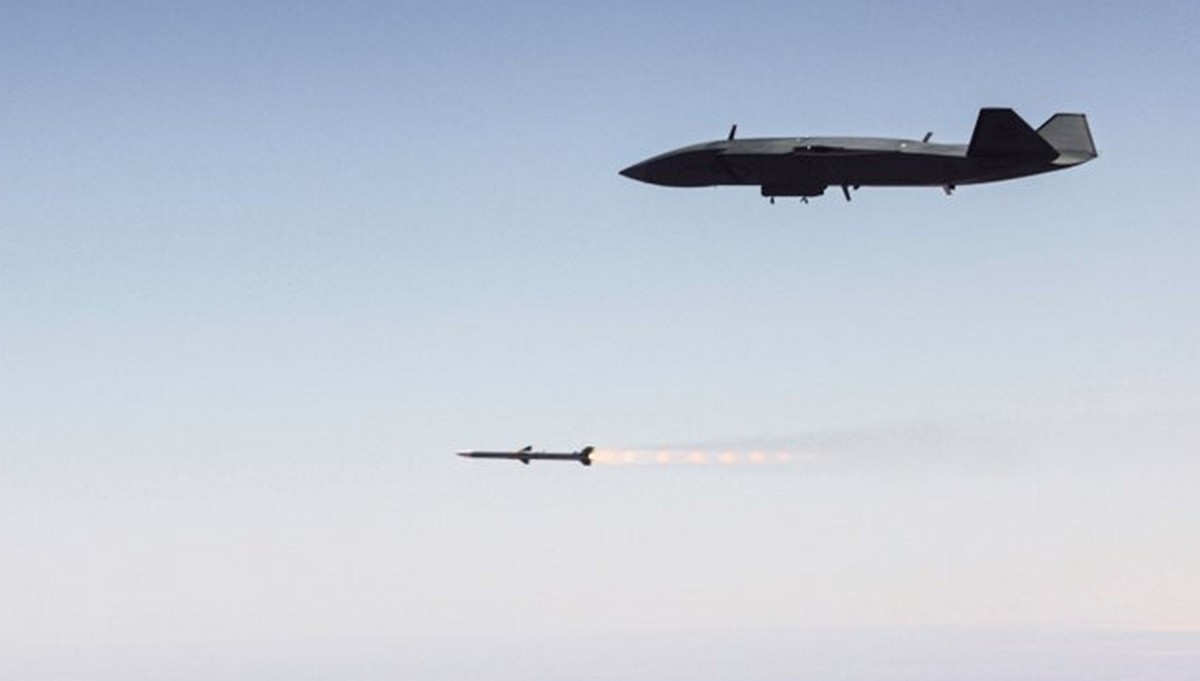
Boeing and the Royal Australian Air Force have completed an air-to-air missile firing using an MQ-28 Ghost Bat uncrewed aircraft during a live exercise in Australia, marking what the company describes as a first-of-its-kind autonomous engagement.
The trial took place at Woomera and involved the MQ-28 operating alongside a crewed E-7A Wedgetail airborne early warning aircraft and an F/A-18F Super Hornet. According to Boeing, the MQ-28 successfully engaged and destroyed a fighter-sized target drone using a Raytheon AIM-120 AMRAAM missile as part of a coordinated mission linking crewed and uncrewed platforms.
Boeing said the aircraft launched from separate locations before being brought together in a single mission. An E-7A operator assumed control oversight of the MQ-28 during the sortie, while the F/A-18F provided sensor data to identify and track the target. That targeting information was then shared across the network, allowing the MQ-28 to reposition and conduct the missile engagement after receiving authorisation from the Wedgetail, according to the company.
Amy List, managing director of Boeing Defence Australia, described the event as a milestone for autonomous combat aviation. “This is the first time an autonomous aircraft has completed an air-to-air weapon engagement with an AIM-120 missile, establishing the MQ-28 as a mature combat capable CCA,” she said in the press release.
List added that the demonstration highlighted the role collaborative combat aircraft could play alongside crewed platforms, saying the mission showed how such systems can increase operational mass and reduce risk to pilots, according to Boeing.
Boeing also highlighted the autonomy architecture underpinning the exercise. Colin Miller, vice president and general manager of Phantom Works at Boeing Defense, Space and Security, said the engagement reflected progress in integrating autonomous systems with existing aircraft fleets. “This exercise demonstrates the maturity and sophistication of Boeing’s mission autonomy solution which is built on open standards and government architectures,” he said, adding that it was designed to integrate across multiple generations of aircraft.
The exercise was conducted with participation from the RAAF, Boeing, the US Air Force and other industry partners. Boeing characterised the event as part of ongoing efforts to develop collaborative combat aircraft concepts intended to operate as force multipliers alongside crewed airpower.





So for the UK, there are plans to have combat drones flying off carriers very soon. Does this offer a workaround the weapons integration delays with the F35? So whilst an F35 can’t use Meteor for example, can it be carried and launched by a drone under the control of the F35?
If so, this isnt a perfect solution to the delays, but it would be a workaround that might get those weapons deployed a lot quicker than waiting for Lockheed Martin to do it
Well there are no jet fighter comparable drones that can be launched without a catapualt.
And even if jet drones/CCAs could launch via the QE class ramp, they would need traps to land.
The Bayraktar Kizilelma is a better option, jet powered & designed to fly from the TCG Anadolu which has a shorter runway than the QE class
How is it a better option, it cannot keep up with an F35
It depends on how much of a priority supersonic flight is to you. Drones like that are attritable, so if shit hits the fan the F-35s can speed up and leave the drones behind.
is it me or from the side does that present a remarkable resemblance to the YF-23?
With NZ talking about greater interoperability with Aus wonder if they’ll consider the Ghost Bat to compliment their P8s and aerial patrols?