

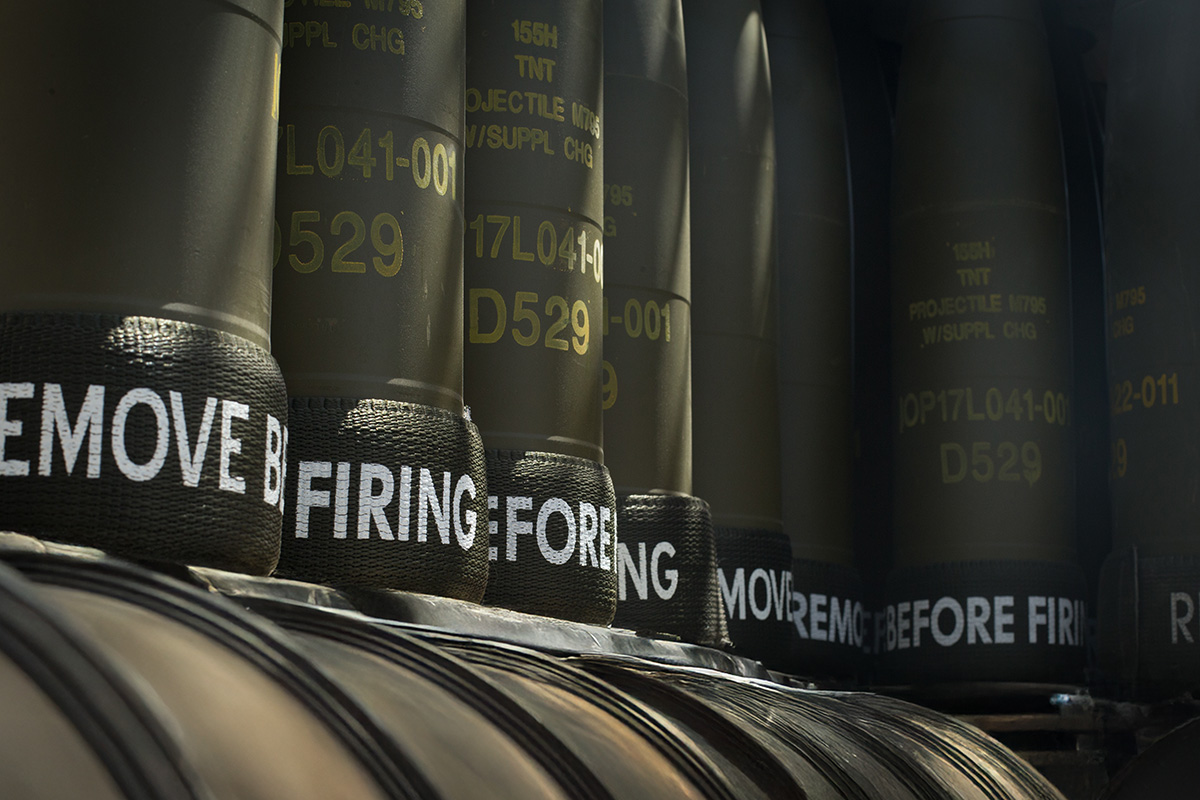
Jobs supported by defence spending on weapons and ammunition manufacturing rose by 51 per cent across the United Kingdom in 2024/25, according to figures published by the Ministry of Defence on Friday.
The increase amounts to 2,000 additional posts, taking the total to 5,900 across the manufacture of weapons, ammunition and military fighting vehicles.
According to the department, the rise reflects a drive to rebuild what it calls a sovereign, always on pipeline of munitions supply, so that artillery and missiles can be produced at greater scale domestically. It describes that capability as central to warfighting readiness and deterrence while creating skilled manufacturing jobs.
Luke Pollard, Minister for Defence Readiness and Industry, said: “These figures show that a rising defence budget is creating more good jobs across the UK. Defence is an engine for growth and our investments are driving reindustrialisation. As we increase our military readiness and capabilities we are generating good well-paid jobs nationwide.”
The 51 per cent figure is the sharpest movement in the statistics, which otherwise record MOD expenditure with industry of £31.9 billion in 2024/25 supporting 274,000 jobs across the country.
Munitions production has been among the most exposed weaknesses in Western defence since 2022. Artillery consumption in Ukraine has run at rates no European producer was sized for, and states discovered that output could not be raised quickly because plants had been closed, tooling scrapped and specialist suppliers lost across three decades of low demand. Explosive fill and propellant, rather than shell bodies, proved the tightest constraint.
The Strategic Defence Review of 2025 identified magazine depth as a weakness across the British armed forces, and the government has committed to a series of new energetics and munitions facilities.











All munitions are important and supplies of battlefield weapons for the realistic 1 division the UK could deploy is important.. but the fundamentally important things the UK needs to be able to manufacture and keep firing in numbers that matter are..( list by the numbers needed)..offensively:
1) 2500km range one way strategic drones
2) long range cruise missiles for typhoons (500km +)
3) long range strike weapons for F35 (100km+)
4) long range cruise missiles for SSNs and surface vessels..( 500km+)
5) some form of 2500km+) advanced ground launched weapons.. either cruise and or Ballistic..
In the end the UK needs to be able to hit Russia with conventional strategic weapons at the same or greater rate than Russia can hit the UK.. because our and NATO’s armies are only deterrents as long as NATO does what it says on the Tin.. because if NATO fractures for the UK only strategic weapons will matter so we need to be able to build and deploy a lot of those, not just battlefield weapons…
We will also need a vast supply of anti air weapons of all capabilities.. because in any war and if NATO stands or not Russia is going to spend a lot of time throwing conventional strategic weapons at the hated Anglo Saxons.
And not just Russia.
Umfortunately we have tiny quantities of the weapons you mention above. We aren’t in any way provisioned for realistic combat
Yes that is what needs to change..
And if you increase your stocks with all this you’ve got to expect a corresponding increase and advantage seeking from our adversaries which might already exist? The UK will need an increased GBAD network to be able to repel what might be coming our way and maximise shared missile inventories. Drone ships at sea are great for whenever but GBAD is needed sooner than later.
‘always on pipeline of munitions supply’- when we have built up a sufficient uk stockpile how do we maintain the capability?
Sufficient stockpile? Has that ever happened? When the generals come back saying we have enough to sustain our forces, including reserves for six months rather than six days, we can worry about it then.
Talking of bolstering ammo stocks, they want to stick paired 40mm on T91s, why can’t they do the same on the two carriers to compliment the three Phalanx’s and beef up the depth of defence? One forward port, the other rear starboard or, as others have suggested replace the lot with 3-4 40mm? Cheap as [s]hips!
As always Jonathan “hits the nail on the head”
I think we need to take a step back. The idea that the UK could stand alone toe to toe with Russia, with the necessary military equipment that some on here have suggested we would need, is not realistic. Russia has vastly more natural resources, manufacturing capability, people (meat fodder), everything. Individually, no European country could. That’s the whole point for NATO.
Militarily and economically, the NATO (even just ENATO) countries acting together can stand up to Russia and probably beat it. But it is as much a political partnership as it is a military/economic alliance, and that is probably its weak point. Putin knows this. The UK must do all it can to ensure our allies realise that, if Russia attacks just the UK, our partners need to honour their commitments and come to our aid, because if they don’t NATO/ENATO is no more and they will be next. I don’t see another way.
So, yes build up our defences as best we can, including stockpiles and manufacturing resilience, but that’s perhaps the ‘easy’ bit. Over to Burnham and Streeting 😧😧
If we are unable to meet our commitments to NATO, it seems unlikely that NATO will meet its commitments to us, particularly, as we have seen, if stocks of anti ballistic missiles run low.
Within a fifty year timescale, Russia’s intent is to seize Moldova and the Suwalki corridor to re-establish an iron curtain from Kaliningrad to Odessa. Another intended phase might very well be an invasion of Norway to control the Baltic and sevure ballistic missile launch sites. That would be accompanied by mass mixed drone and missile strikes on this country, a soft target and one that might very well split the alliance.
The timescale may be fifty years but the clock started in 2014. Britain is, if anything, less prepared than we were then. Meanwhile our government spends scarce tax money on societal change based on a confected aim of ‘net zero’
The level of complacency, delusion, with continuing war on Continental Europe, hundreds of thousands dead, millions displaced, really should be of immense concern to all.
Especially the Russians. Because they can’t even defeat one nation bordering them that didn’t even have a proper Navy.
Russia has been pressing on with its project of imperialist demographic expansionism since 2014. They haven’t stopped, will not stop and nothing short of revolution will make them stop. There is absolutely no sign of any serious internal dissent within Russia and they are in no hurry. If they think an attack on Britain will assist them in their aim, then they will attack Britain, having already deployed CBRN materials capable of killing thousands in this country with complete impunity.
And you think we couldn’t do the same to them? We could. And much more. Putin won’t attack a NATO nation because he knows it would be suicide.
He already has, several times, with very little reaction. He has killed a British citizen within the United Kingdom and badly injured a police officer, dumped enough Novichok to kill thousands. He has completely disregarded U.S. (and British) ‘red lines’ regarding use of chemical weapons, invading Crimea the year following a British parliamentary debacle organised by our now Foreign Secretary in 2013. He has ignored British and U.S. security assurances given to Ukraine, invading in 2022, the year after the U.S. shambles of a withdrawal from Afghanistan.
He has attacked any number of NATO nations, using cyber and paid third parties.
We are in another Cold War which may very well go hot…because, having unilaterally disarmed, we no longer have a credible conventional deterrent.
Meanwhile we spend stupid money in pursuit of a net zero agenda for societal change.
This is not going away and will not end well.
And you don’t know what we have done to them. The sanctions have hit hard..But of course the Russians sell the image all is well. It certainly is not.
Completely agree…but the Russian (and Ukrainian) people are phenomenally resilient, most of them inured to physical hardship. They queue for petrol etc pretty much without complaint because that is situation pretty much normal. There is very little sign of internal dissent. Most dissenters have left or are dead. The country had a chance to move against the regime when Prighozin made his move. But nothing happened. This does not end any time soon…and Britain must contingency plan for the worst case…
Loool a mixed energy strategy is part of our security strategy – Net zero or not. How can we have industry with plans that span multiple generations if we can be easily derailed by fossil fuels? Rose tinted glasses do not get around that reality.
Even now although we are definitely impacted because energy currently is priced on the global market, the fact we have more of a mixed energy mix mitigates impact to us as normal people and our military projects that are industrial by nature
The things you want require not just money but re industrialisation because of the level of atrophy.
The point for me should be how we ensure or make the case against atrophy once deindustrialisation is claimed – to avoid the loop of ‘wasted’ resources due to being reactionary in nature
‘…an independent study…models a power system that prioritises firm generation capacity, responding to demand, rather than forcing consumers to react to the vagaries of the British weather. This plan includes a diversified mix of nuclear, renewables and gas generation, which builds a much cheaper power system…
The savings are substantial. The alternative policy pathway saves £320 billion between 2030 and 2050, and reduces system costs by 20% in 2040 versus “business as usual”. Savings are made across four major areas:
£137 billion in network spending, thanks to a higher utilisation firm power system with supply located closer to demand
£94 billion from lower wholesale prices, thanks to the removal of carbon taxes
£67 billion in lower spend on balancing and ancillary services
£22 billion across generation subsidies and the Capacity Market
Realising savings of this scale requires a shift away from the current central planning model, to a system that allocates the costs of intermittent generation to the causative generators, rather than sending a bill to the end consumer.’
Firm Foundations: The case for cheap and reliable power 18 August 2026
‘Re-industrialisation’ requires deregulation. It cannot be achieved (unless ruinously expensive) by government diktat.
It is expensive power, over-regulation (including the frankly mad search for the holy grail: net zero), that has caused atrophy.
Net zero has caused atrophy? 😂
Some other great points that somewhat align though. And one or two for me to think about
I’ll question the claim that green energy is more expensive though. Most types are on par or trending cheaper now – along with the use of batteries which is a key element that makes it work
For example, the world factory, China with huge energy needs have now been able to add the grid of Germany per year driven by green energy – perhaps they benefit from reduced standards/red tape etc like you say in order to build those facilities out
In fairness even Labour have talked about curbing nimbyism, the other end of what I think you speak to. But the point is… the advantage isn’t purely morally good (I’m defaulting to that instead on woke nowadays lol) – it’s proving for security economic reasons to be a no brainer. Agree on more localised projects too!
Although from what I can tell I know you aren’t arguing against it, I thought those were relevant points
It is the pursuit of net zero that has caused sky high electricity prices. Logically, if fossil fuel prices are international, then Britain’s electricity prices should be the same as the rest of Europe. They are not. They are higher and our high electricity prices, as a consequence of the dotty pursuit of ‘net zero’, are a major contributory factor to our industrial atrophy.
The answers are all in the referenced report.
‘The UK has expensive electricity, higher than its developed nation peers. In 2024, Britain had the highest industrial electricity prices of International Energy Agency member countries, and the second highest domestic prices, just behind Germany.[1] Having made electricity some of the most expensive in the world, policy now tries to push consumers to use more of the UK’s expensive power – as electrification is the main lever to drive the decarbonisation of heating and transport.
Two logical flaws have driven the country into this position.
Firstly, the wider system costs that come with building a power system centred on intermittent generation have been overlooked. Building new transmission lines, balancing the grid and retaining a backup power system to deal with still, dark winter days all add to system costs. Those costs are charged to consumer bills, rather than being properly internalised by the generators that cause them.
Secondly, 95% decarbonisation of the power sector has been prioritised ahead of electrification. This has driven up electricity costs, making electrification more costly and less attractive than it should be.
The UK can get out of this mess by building the electricity system around a core of reliable generation capacity. The opportunity is material, with the potential for £320 billion of system cost savings from 2030 to 2050.
This approach is not compatible with a dash for Net Zero by 2050, as it retains a 23% role for gas in the electricity system of 2050. But it would reduce emissions in a way that the British public could actually get behind, rather than have forced upon them. An electric vehicle or heat pump powered by such a generation mix will reduce emissions by over 80% relative to a combustion engine or gas boiler.[2] Cut electricity prices, and those technologies will become the rational choices for consumers.
The proposition is simple. Fix the electrical foundations first. Build a diverse generation mix around nuclear, renewables and gas that allows consumers to access affordable electricity when they need it. Cut systems costs and let consumers adopt electrification technologies on their own terms.’
Firm Foundations: The case for cheap and reliable power 18 August 2026
That, in its turn, will free up capital investment for defence spending, re-industrialisation, but ‘net zero’ by 2050 must go and a bonfire of regulations must take place for economic growth to resume. We left the EU to give ourselves that opportunity. We must now seize it.
Sorry James but Ukraine says you are wrong.
In what way?
Russia has not managed to win a land war on its borders against one of the poorest nations in Europe with only a 40 Million population.. what do you think would happen if it actually clashed with a prepared Germany.. or UK.. who were not half arsing their defences..
I think you are making some incorrect assumptions..
NATO was not formed to defend against Russia it was formed to defend against the Soviet Union and its massive empire.. the Soviet Union had just under 300 million population and was 11% of the worlds GDP, being the second biggest economy in the world and it ruled with an iron fist and could use a wider empire totalling 400 million people and 15% of the worlds GDP and economic power.. no single European nation could defend against that, that is why NATO was formed..
Russia is not the Soviet Union, it a nation with a population of 133 million and one of least healthy in Europe German has a very fit and healthy population with 85 million people… Russia has already lost 500,000 prime fighting aged men.
Russia now has about 2% of the worlds GDP, it is no longer a global powerhouse..
In reality is has been unable to defeat a nation of 40 million right on a doorsteps, a nation with only 1/10th of its wealth and resources.
But let’s look at how unbeatable Russia is against the UK in a strategic war..
Russia has lost the ability to build large surface warships above 5000-6000 tons.. infact in 36 years it’s only managed to build 7 frigates and destroyers.. and 2 of those were started in the Cold War in the 1980s.. in the same time period the UK built 21 frigates and destoyers and 2 70,000 ton carriers.. and that was utterly half arsing it. Russia is building 7 frigates the UK is building 13..
Russia has for the med, North Sea and pacific fleets 17 active large escorts.. of those 10 are around the 40 year old age bracket.. of those it has exactly 5 major surface combatants in the northern fleet.. 5 are bottled up in the Black Sea and cannot be used in a wider war.. five are in the Pacific..to far to matter and 3 in the Baltic ( bottled in)
The RN has 6 frigates and 6 AAW major surface combatants as well as 2 70,000 carriers..
Let’s look at SSNs the UK has 6 soon to be 7 modern SSNs Russia has 5 modern SSNs with only 3 of those in the northern fleet.. 3 of the SSGNs and SSNs ( Oscar’s, victors ) in the northern fleet are about 36 years old and even when they were built were a generation began the UK SSNs of the time ( about up to a Churchill class) on top of that the northern fleet has about 3 30 year old Akula class… so yes it has Russia has 9 SSN/SSGNs in the northern fleet compared to 6 UK SSNs but only 3 of those Russian SSNs are modern.. the rest are 30-40 year old…
Strategic strike aircraft wise that could reach the UK from Russia.. you are taking 60 strategic strike aircraft, but most of those are older bears.. that will die to any fighter that even smells them.. the UK can put 2 squadrons of F35bs 1000km from Russia.
Conventional strategic strike.. which all the matters in a Uk Russia spat is not as far apart as you think.. as long as the UK commits to building long range strike weapons.. millions of semi educated masses are completely irrelevant in a UK Russia conflict unless they can somehow walk 2000kms over open sea.
As for land combat..Im not sure Russia would be ready for what a fully committed Germany could or would do if pushed and they got over their war guilt.
In reality NATO was about three things
1) making it easy.. essentially NATO was so overwhelming nations could essentially take there foot of the gas a bit..even the U.S. did this
2) make it so overwhelming that it was a natural deterrent.. it would be impossible to comprehend attacking a power block with 60% of the worlds wealth and power..
3) protecting the smaller nations and preventing nibbling.. Russia taking smaller nations and slowly growing it powers…
It does not mean a larger European nation could not defend itself.. just as Ukraine has managed to do..
How many of those T23, T45, SSN, etc are available to fight tomorrow?
The same sort of numbers of Russian platforms… I’ve just explained how few platforms Russia also has and how old the are.. but they will have more availability than the RNs will they ?
Of course we can’t (or won’t) defend ourselves. Blindingly obvious to all, we cannot even police our own borders, bad guys able to come and go as they please. Putin has authorised several attacks on mainland Britain already, the perpetrators home free, enough CBRN material dumped in this country to kill thousands. Within a fifty year timescale, an attack on NATO at some stage is almost certain. Putin attacked Ukraine based on flawed intelligence. He believes his war is going well…flawed intelligence. His aim is to recreate the USSR, a 250 million strong superpower encamped on the borders of the EU. And he, his successors, will not, cannot stop because they believe, for reasons of demography, that if Russia does not expand, it will cease to exist.
That is the crisis at hand, not some flaky science fictional net zero agenda for societal change.
There is a difference between cannot and will not.. I’m very much of the veiw that we can.. but the “will” is the question.. we have spent 20 years running down below what we need.
Spot on…except, perhaps, for timelines?
36 years since the ‘Options for Change’ defence review:
‘…we have sought to devise a structure for our regular forces appropriate to the new security situation and meeting our essential peacetime operational needs. The framework … would be reinforced in a period of tension by drawing on volunteer reserves and reservists, who will have an important role to play. We have also allowed for the possible need to build back up our forces over a longer period should international circumstances ever require us to do so … We shall … continue to need a robust defence capability as our insurance against the unexpected … Our proposals will bring savings and a reduction in the share of GDP taken by defence … We need force levels which we can afford and which can realistically be manned, given demographic pressures in the 1990s. The aim is smaller forces, better equipped, properly trained and housed, and well motivated. They will need to be flexible and mobile and able to contribute both in NATO and, if necessary, elsewhere…’
Or not really…
Looked at within the correct (long term) timeframe, the ‘new security situation’ was exactly the same as the last one…and the one before that etc. etc.
Only this time, as you indicate, through stupidity, incompetence, self interest, we have unilaterally disarmed…
Dangerous times.
Don’t believe a single word of it.
Labour are liars – incompetent liars.
So what have we ordered as did not see any orders for 155mm shells etc or is just more government half truths and spin while not really ordering much as we are skint,
5,900 up 51% is still not that many. For what is needed we should be talking triple that number if we are to make up the shortfall in munitions for our armed forces at todays levels and maintain a steady supply line to Ukraine.
To give some scale, in the Cold War of the early 1980s, the Royal Ordnance munitions factories alone had about 20,000 employees, and there were probably at least as many again doing munitions-related work in a variety of private and state-owned companies (British Aerospace, Shorts, Thorn EMI etc).
A lot of job role have been automated as well
And what are we hearing from John Healey on DIP and spending………the sound of silence…….wait for the budget. I would suggest supporters of Healey bare themselves ready for disappointment come budget time. There is nothing being uttered by Burnham that suggests he wont look at the 2035 target and say yes of course we will achieve it but for now let’s talk buses. It is simply NOT a priority of this government anymore than the previous half dozen. Until popular opinion polls start showing the public thinks WW3 is coming then nothing will change. Burnham’s defence posture is the same as the last five, fingers crossed and hope the Yanks are really our friends which now they clearly are not.
Now lets double it. And add in a substantial increase in weapon systems, small arms, manpower, medical facilities and air defence.