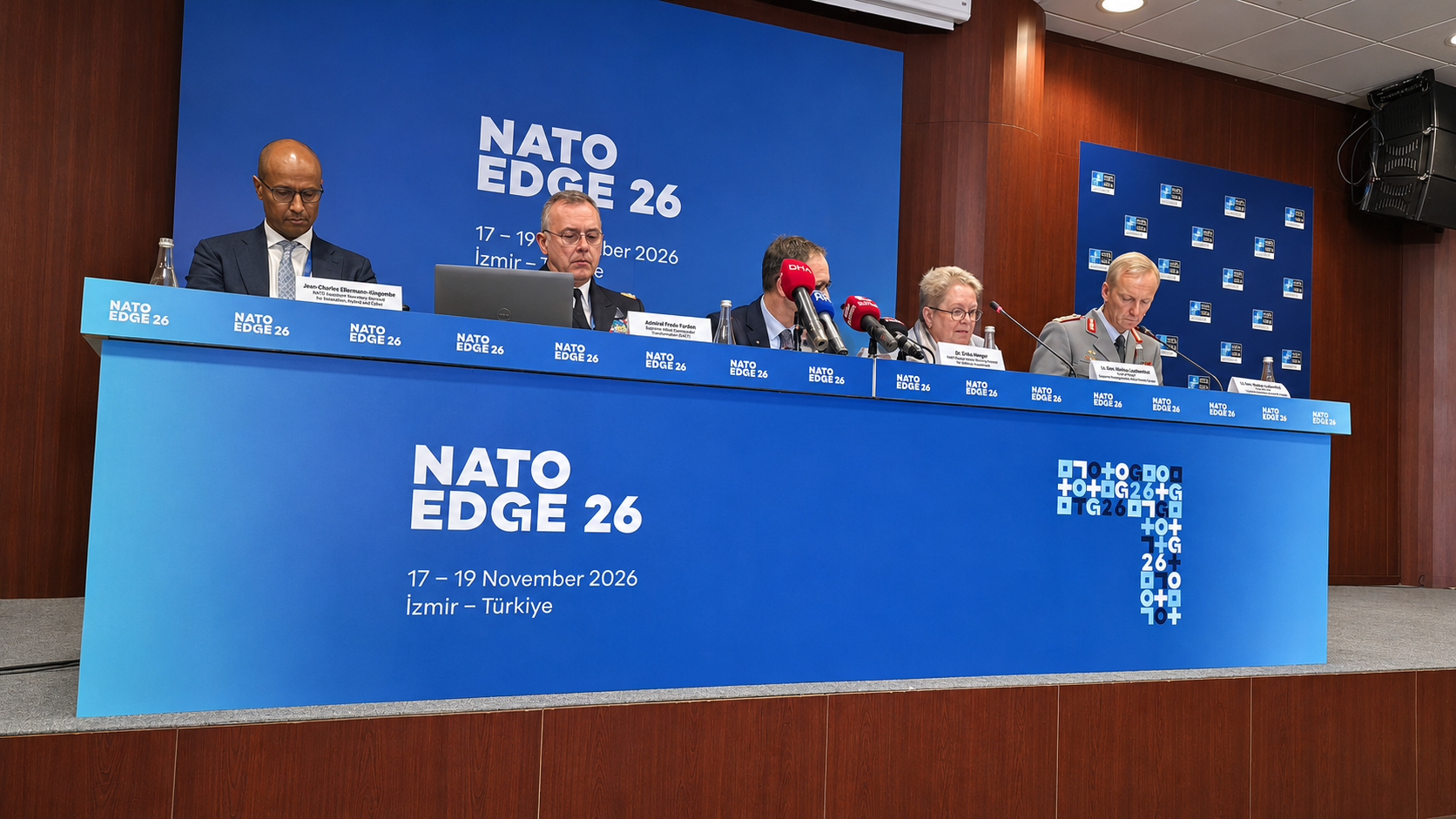
NATO is facing what its Supreme Allied Commander Transformation called “a Darwin moment”, with five of the Alliance’s most senior civilian and military leaders using a joint press engagement at the end of the first day of NATO Edge 26 in İzmir to argue that NATO must turn its rising budgets, its data and the technology on show from industry into usable capability far faster than it has in the past.
Admiral Pierre Vandier, who leads Allied Command Transformation, said the question for a 32-nation alliance was whether it was “on the side of the dinosaurs”, given the pace of change on the Ukrainian front line, where Russia is adapting quickly, and in technology itself, which he described as producing “a revolution each trimester” in artificial intelligence.
He said recent trials gave him cause for optimism, explaining that at the Fuse experimentation event in Latvia, AI agents and large language models had been used on top of different companies’ systems to make them work together, solving in around two hours problems of integration that had previously taken around six weeks, which he said showed NATO to be “an adaptable species” rather than a dinosaur.
Major General Rainer Beeck, Deputy Chief of Staff Cyberspace at Allied Command Operations, gave the operational view, saying NATO remained a defensive alliance ready to fight tonight under a theory of victory he summed up as “block, blunt, break”, but that Russia’s war against Ukraine had shown how rapidly warfare was evolving.
“We must transform at the speed of the threat, not at the speed of our bureaucracy,” he said, adding that data alone does not win battles and that the greatest risk was moving too slowly in operational delivery, because “the warfighter needs capabilities, not promises”.
Money, industry and adoption
Tarja Jaakkola, NATO’s Assistant Secretary General for Defence Industry, Innovation and Armaments, said the Alliance’s message was that commitments must now translate into tangible capabilities, pointing to more than $50 billion in procurement deals and initiatives announced at the Ankara summit in July and to allies’ plans to invest more than $40 billion in counter-drone capabilities over the next five years, supported by a new counter-drone marketplace that already offers 16 tested systems for quick purchase.
Asked later for her single most pressing priority for next year, she said it was ramping up industrial capacity, because while ammunition output had risen, “we are not still there”, and allies now needed to work out what they would need industry to deliver if they entered a crisis or war.
Jean-Charles Ellermann-Kingombe, NATO’s Assistant Secretary General for Cyber and Digital Transformation, said the biggest obstacle to the Alliance’s digital priorities, including the warfighting cloud, data sharing and AI, and cyber defence, was the speed of adoption, because technology was advancing faster than the organisation, and he urged companies to engage early, collaborate continuously and be ready to act as strategic partners during crisis and conflict as well as in peacetime.
Dr Dylan Browne, General Manager of the NATO Communications and Information Agency, said NCIA expected to bring around €2.7 billion of business to market over the next two years across cloud, AI, cyber, command and control, space and networks, and that NATO’s answer to the speed problem was commercial adoption, which he described as “an adopt, not a buy mindset” in which the Alliance takes proven off-the-shelf technology rather than building bespoke systems through lengthy procurement, without allowing speed to come at the expense of security or interoperability, which he called “fundamental requirements, not optional extras”.
What NATO needs most
Asked by the UK Defence Journal what capabilities NATO most urgently needed from events like NATO Edge, referring to Browne’s remark the day before that the conference would help deliver the future capabilities the Alliance needs, Browne said he would not describe anything as missing, because NATO had the communications and information capabilities it needed and the challenge was one of scale, with NCIA running more than 200 exercises a year and recent global events showing the value of cloud-based intelligence and AI-driven insights that let NATO draw on “our 32 allied nations’ brightest brains and smartest intel analysts”.
Vandier, invited by Browne to answer the same question, said NATO was at “the beginning of the new age”, placing the change in historical terms by describing the First World War as a war of farmers with bayonets, rifles and tractors and the Second World War as a contest between industrial systems, before adding that “today we see that we are turning to a digital competition”, in which ammunition, missiles and tanks still matter but digital technology and AI have become the enabler at the centre of warfare.
Asked by another journalist for their top priority for next year, Vandier said the absolute priority was delivering the warfighting cloud, but that the real roadblock was persuading nations to share the data needed to fuel it, because “when you say share data, people think that you are giving the key of your own personal library, and no nation wants that”. He said tools now existed to let nations choose which books, pages and paragraphs to share and which to keep back, but that NATO’s data standards still reflected “a paper legacy approach”.
Ellermann-Kingombe said he had “exactly the same priorities”, while Beeck summed up the goal as making 32 allies’ data on a 32-nation warfighting cloud “count more together”, and Browne added a call for talent, saying NCIA had more than 400 technology roles to fill and wanted applicants who were patriots keen to serve.
Hybrid threats and the cloud
On Russian hybrid attacks, Ellermann-Kingombe said allies had seen an uptick in sabotage and cyber attacks on infrastructure, much of it linked to Russian efforts to discourage support for Ukraine, and pointed to the real-time maritime surveillance developed through Allied Command Transformation’s Task Force X after damage to Baltic undersea cables as one way NATO was improving its understanding and raising the cost for adversaries. Vandier added that in NATO, multi-domain operations meant orchestrating military and non-military instruments of power together, which was where digital technology gave the Alliance the speed and scale to move “not as dinosaur” but as something much more agile.
Ellermann-Kingombe said the transatlantic warfighting cloud would be a federation of interoperable national and commercial systems rather than a single system, combining technology from US hyperscalers with European integrators while respecting national sovereignty through common NATO standards, and Beeck, recalling how commercial cloud providers helped move Ukraine’s data out of the country within days of the full-scale invasion, said NATO needed every option to hand and even floated the idea of data centres in space, saying he was “just somebody who has a desire, a desire to have data everywhere”.
Asked at the end of the session whether he expected a significant conflict with Russia by 2030, Vandier declined to make a forecast, saying “I’m not Madame Irma, as we say in France. I’m not the weatherman of the conflicts. I just say we need to be ready tonight and tomorrow”, and adding that the tension between being ready for tonight and ready for the next fight was exactly what NATO Edge was about.