

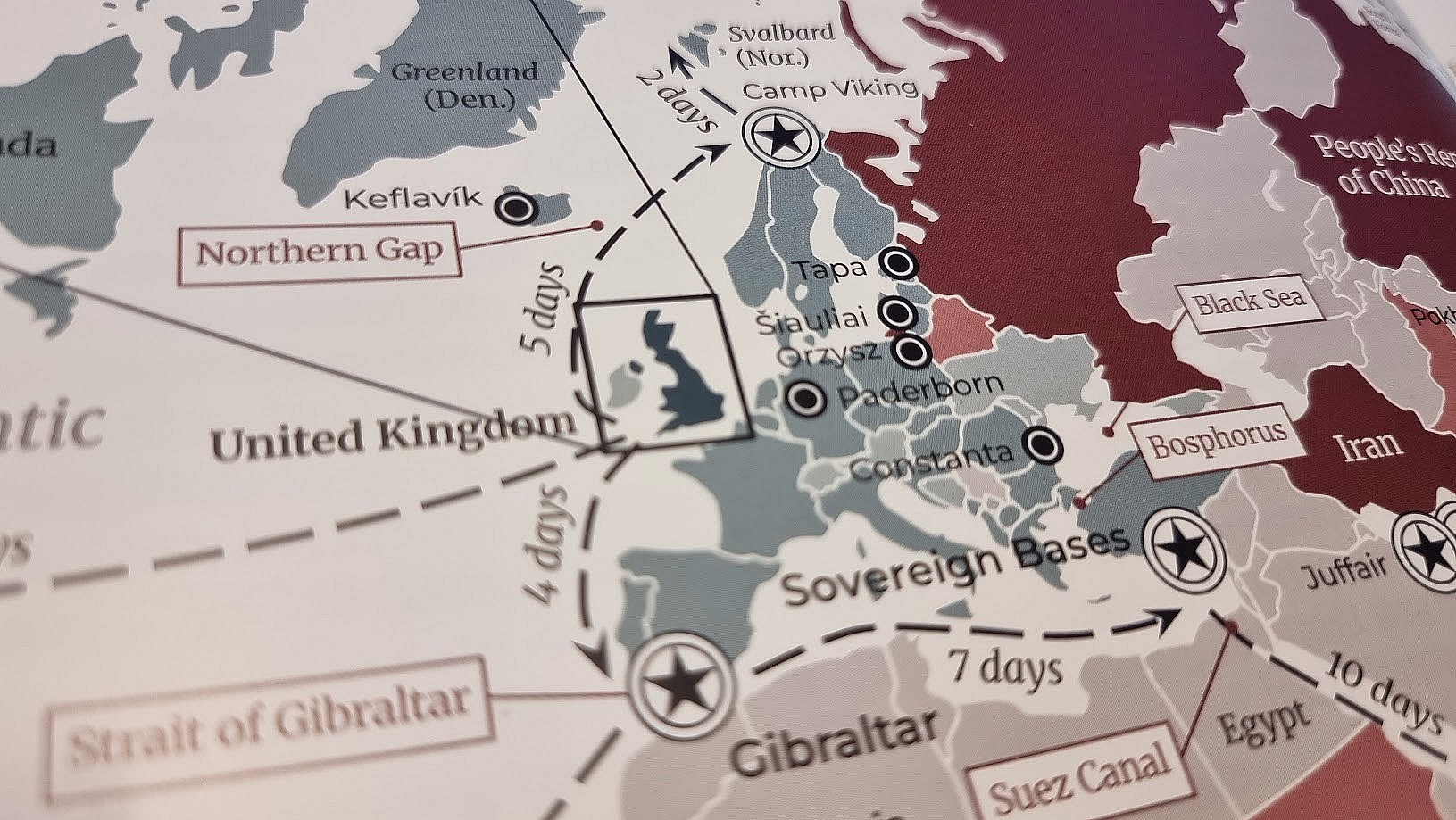
A new geopolitical atlas argues that the UK could emerge as a central global power by the middle of the century if it concentrates defence resources on maritime capability, particularly the Royal Navy, according to the authors.
Published by the Council on Geostrategy in partnership with the Royal Navy Strategic Studies Centre, the atlas presents 12 strategic maps examining Britain’s security, economic interests and exposure to global threats.
The study makes clear that the current international environment is as dangerous as the period preceding the First World War and calls for a renewed emphasis on seapower to protect national resilience.
The publication, titled Britain’s world: The strategy of security in twelve geopolitical maps, concludes that with increased defence investment and a more integrated maritime strategy, the UK could become the “pivotal power of the mid-21st century”, particularly within alliances such as NATO and AUKUS. Several of the maps focus on critical vulnerabilities. One highlights that 99 percent of the UK’s data traffic depends on around 60 subsea cables supporting an estimated £1.15 trillion in global financial transactions each day. The atlas warns that growing Russian activity targeting undersea infrastructure via its so-called shadow fleet could cause disruption “akin to a major military attack”.
Another visualisation examines cooperation between China, Russia, Iran and North Korea, described as the “CRINK” coalition. According to the publication, this grouping represents a coordinated challenge to the existing international order, noting for example that North Korea is assessed to supply “50–60 percent of Russia’s artillery expenditure in Ukraine”, with China acting as “a decisive enabler”. The atlas also places strong emphasis on the Arctic and North Atlantic, urging the UK to prepare for conflict in what it terms the “Wider North”. It notes that Russia’s Northern Fleet retains the ability to project significant firepower across the region, posing challenges to NATO’s northern approaches.
Beyond defence, the authors argue that maritime power underpins economic strength. The atlas states that maritime industries contribute more than £116 billion in turnover to the UK economy, exceeding rail and aviation combined, despite remaining “politically peripheral”. It also points to forecasts showing the UK could become the world’s fifth-largest economy by 2030, while stressing that private-sector actors such as technology firms and utilities should be integrated into national maritime security planning.
James Rogers, co-founder for research at the Council on Geostrategy, and Andrew Young, fellowships officer at the Royal Navy Strategic Studies Centre, said: “Britain has a natural asymmetry; while most nations are land-focused, the UK looks out across the sea.” They added: “If it manages to resource, integrate, and especially focus its armed forces on the Royal Navy, it has the potential to emerge in a truly enviable position by the mid-21st century – pivotal to the geopolitics of the world.”
They also warned against disengagement, stating: “If the UK attempted to retreat from geopolitical competition, history and current threat assessments suggest that the repercussions of such disengagement would soon be felt on British soil.”
In a foreword to the atlas, First Sea Lord and Chief of the Naval Staff Gen Sir Gwyn Jenkins said the risks to subsea networks were strategic in nature. He wrote: “The vulnerability of our undersea infrastructure demands that we confront malign state tactics in the depths; much like the pirates of old, attacks on these networks are assaults on civilisation itself.” He added: “These maps are crucial. They turn doctrine into terrain, and policy into place.”


We are an island and we had Brexit. Re-establishing a reasonably-potent RN seems to be absolutely essential to me.
100 percent its a no-brainer.
RN-RAF-Army in that order, but we need a much bigger of each, no Cinderella service. The army alone needs doubling. RAF obviously needs rebuilding to a far more potent & viable position & we should be busting a gut to get back to a 30 escort fleet asap, before expanding further. GBAD essential too along with civil defence measures. (Inc air raid shelters/bunkers to protect as many of the populatioon as possible so we’re not just left to suck up missile/drone/bomb strikes.) Return several post-cold war closed airbases to serviceable condition. Make serious plans to decouple ourselves from the USA if Trump/MAGA prooves more than a tempory blip. We could end up with a hostile USA to the west, Russia to the east & China projecting globally.
If it costs money (which of course it does) it ain’t going to happen. Just pie in the sky.
True enough but that doesn’t make Frank’s words any less relevant or accurate. I would say that a 30 escort fleet is not enough if we do end up with a hostile USA to the west.
The fact is Europe has been under performing for decades economically, including the UK, and we all need to work out away to put that right. Treasure, in the broadest sense, is what warfare is ultimately about and Trump doesn’t try that hard to hide the fact. Russia wants to reestablish it’s empire because it has lost access to people and resource wealth that it desperately needs, China calls Siberia the northern resource area and Australia the southern resource area so it doesn’t take much thought to guess what they want influence over.
The UK’s geographic position gives whoever controls these islands considerable influence over what happens in Europe and Europe has considerable technological and economic wealth…
We are possibly entering a new age of empires and the big four this time around are the USA, China, Russia and possibly India… The rest of us will need our friends and allies to stay free and independent or get consumed by one of the empires.
So yeh, I think Frank is highlighting the minimum that we need and that assumes the rest of Europe stays on side post NATO and puts in the same level of defence investment. Big assumptions, but if we don’t what kind of future will we bequeath our children and grandchildren..?
Cheers CR
I would like to see a risk analysis of possible covert/state sponsored attacks on major telecommunications hubs As an ex BT manager I know there are less than 10 “critical” hubs supporting IPX routers. Without these hubs the UK internet infrastructure would be rendered inoperable.
May be it is about time to reconsider some dependancies.
The same can be said for our power grid and goodness only knows how vulnerable our water system is and water is the most important of all resources..?
Thing is most people think networks come with built in redundancy as an inherent characteristic. Wrong! Networks, like all systems need redundancy building into them. In fact, networks can significantly increase vulnerability as they are often very susceptible to cascade failures which are very difficult for recover from.
Cheers CR
We’re an island, focus has always been on power projection away from these shores; originally just sea-power but now including air-power too.
That said, the army can’t be neglected, as it is deployed to defend our allies’ lands, which ensures we never have to fight land-battles on ours.
The last time Britain’s army successfully repelled a serious threat of invasion once the enemy had landed was at Stamford Bridge in 1066.
Air power can be used on land to support allies as well as at sea, let’s focus on that rather than the Army.
Torpedo, are you forgetting that we are in NATO? We have a role in participating in deterrence, and if necessary, Defence across the Euro-Atlantic area. That involves the army too. The army, as you suggest, is not narrowly focussed on defending the homeland against a land invasion (I don’t think that has even been exercised at scale since the mid-80s); the army is primarily an expeditionary warfare service.
The army is also the service that has been used the most in post-WW2 kinetic operations and peacekeeping – being relegated to third place in importance would be a strategic and political mistake.
I think we need to also consider there is a very good chance nato is finished. Infact a senior leader in nato just the other day publicly came out and said that if the US continues down the road of aggression towards Greenland NATO is done and the day the US takes over Greenland is the day the EU closes every US base on the continent and tells the US to leave…
So I think we have to be cogent that the very first mission of our armed forces is the defence of UK interests and sovereignty and that may or many not be as part of NATO… there is now a real possibility we will exist as an independent power in which the US and EU are at best uncomfortable neutrals with Russia as another independent nation eying us as fair game.. and the UK with only an alliance it can pull together from the likes of Norway and Iceland.
So yes we don’t don’t want to bin the army.. but we should be aiming for a strong fully deployable heavy division that can deliver a max effort deployment of 3 heavy brigades and a warfighting divisional HQ and a light division that can deliver a deployable Mec brigade, light infantry battalions and an air mobility brigade for wider stability work.
Anything beyond that would mean a lack of focus on naval and long range air power and the only thing that will keep our sovereignty if the geostrategic situation in the west completely melts down ( as it looks like it is) will be naval, maritime and strategic air power.
In summary if NATO was a strong force that was going to survive doubling down on the army would be the wisest action, if we were an EU member state I would say they same… as is we are now faced with the collapse of the Western alliance into EU and US power blocks with the UK stuck in the middle with to be blunt its arse hanging out and Russia wanting to kick it.
I agree, we should very much prepare for a world where NATO doesn’t exist. I want to see the UK create the kind of sea denial China has built in the western pacific in the North Atlantic. If we have sufficient air, space and naval assets to deny this part of the world to anyone then we are secure.
The army is important but more for contributing to European powers defence.
We’re not secure because we need a continuous supply of imported goods that largely come from outside the North Atlantic. We basically need to keep the sea lanes open globally.
Who is the ‘we’ in your equation Ian? I ask because almost every ally we have likewise needs a continuous supply of imported goods. In short, any control of sea lanes is only going to be possible if democratic allies around the globe all play their part.
We in the UK, particularly the RN, have a habit of presenting the global threat as justifying the need for a large Royal Navy patrolling the world’s sealanes, as two centuries ago. The reality is we will be lucky to get more than 19 escorts over the next decade. That means 6 maybe 7 at sea at any one time. Half of these should be in the East Atlantic, matching the Russian submarine and cable-cutting threat and a couple will be needed in the Gulf and Pacific.
That leaves one or two escorts at most to patrol the world’s sealanes. We all know where the threats are without the atlas.
The timing of this atlas looks to be a pitch for the RN to get an even bigger slice of the defence procurement budget. Alas, that won’t be happening, too many other big calls on the budget.
The UK food primarily comes from Europe (58% UK and 24% EU)
The majority of its fossil fuels are still extracted from Europe (UK Norway)
Any major resource that is not from Europe tends to come from North America (inside North Atlantic)
Most of what comes from Asia is consumer manufactured goods that are pretty easy to live without.
Except chips.
The Army has been used lots for peacekeeping because we’ve been fighting -outside- NATO, I would argue.
If we are doing NATO first (or EU allies first, or Europe first, or whatever) then all of those allies should be able to play to their strengths and contribute in the best way they can. Given our apparent inability to new-build AFVs and our geographic position as outlined above there is no particular reason why our role should be deploying troops to Estonia and Ukraine short of that the formations already exist. If we were starting from scratch now I see no reason why we would need to retain land forces in Eastern Europe. Air power is more flexible for us (once we have AShMs) and sea power is our direct defence.
The Dutch landed at Landguard, Felixtstowe in the late C17th. Then there was the Scots ravaging the North under the Bruce, the French under Pprince Louis toward the end of King john’s reign, the Jacobite invasions. But today the seas aren’t the barrier they once were. Massed airbourne assault, sabotage teams, missile & drone attacks could easily cause much damage.
I think you missed the last part of my comment.
The point of the army is to ensure that it never has to repel an army landing on these shores in the first place. It does that by fighting in allied countries across the Channel and North Sea. This ensures that an enemy is never in a position to launch an invasion in the first place.
An example where it failed was WW2, and the Germans reached the coast. Thankfully the RAF were able to save the day, denying the Luftwaffe air-superiority and saving the RN from a near suicidal action with the Home Fleet.
My position too. I have always called for a RN, RAF, Intelligence Community stance first.
That said, the Army is in such a state and simply too small already for what HMG want it to do. And with reports that they are now expected to go to UKR as well, alongside Cabrit, alongside the SACEUR Reserve, alongside Norway, and all the rest, just how much more before the system fails.
Well if the army went to Ukraine, it would be part of a peace keeping mission, ie a deterrence force. In other words, not expected to fight.
But that’s not going to happen. Putin isn’t interested in a peace deal, let alone one that sees NATO troops in Ukraine.
Unrealistic. Even if the UK’s entire military budget was spent on the Royal Navy, massively increasing risks on air and land, it would still be 1/5th of the US Navy’s budget, while the US still spends substantially on air force, army, marines and space. That’s what makes a military power “global”. China spends far more than the UK and increasingly so, as does in PPP terms. In a world of giants, the UK and France can only be middle powers with a level of global reach, regardless of how sliced or concentrated their military budget is.
(meant to write “as Russia does in PPP terms”)
The article states the UK being the Pivotal naval power not the largest.
By virtue of geography alone the UK will always likely be the pivotal naval power in any age of great power competition.
Like if we teamed up with China and they could station a fleet in Bermuda, that would be pivotal.
Well, also depends or other euro nations: what they gonna expect from uk/france once the us has completely the turned rogue.
completely turned rogue.*
True but in the context of Germany being there too now that they started spending massively on defence, and Italy with their navy and airforce, and Poland with their army. The world has suddenly changed and Europe, slowly, is changing with it and it’ll have to work increasingly together.
I agree. In terms of naval power, Europe need more capital ships like aircraft carriers. 1 or 2 from France, Italy looks for 1 and Spain 1 or 2.
In terms of submarines, UK targets are far higher than all other nations.
For frigates, with 100 in service, we are good. May be we need to rely more on European equipments on ships.
(“as does in PPP terms”, I meant “as does Russia in PPP terms”)
Your assuming there is a USA by the middle of the century and its spending alot of money in a navy, both assertions are not guaranteed. Peace time naval spending by the USA has only existed since 1949.
November other major European nation had a full on civil war in the 19th century.
The UK controls sovereign bases in the north be south Atlantic, Indian oceans, Caribbean and Mediterranean.
Even without any ships it would still be a major maritime player.
The idea that the US will still be around by the middle of the century is far less of an assumption than assuming a country’s (say, UK’s) GDP ranking by the middle and end of the century.
As for being a major maritime player without enough ships to protect overseas territories from local or global aggressive powers, I disagree. France is in the same position (actually, much more so given that they have a far larger national maritime zone and overseas lands to protect).
How many airbases does France have in the South Atlantic and Eastern Mediterranean. How can French territory control access to the Atlantic Ocean at all four access points?
What French bases are in range of the Suez Canal and Straits of Gibraltar?
You might remember the UK grabbing an Iranian tanker in the Mediterranean with no naval vessels involved recently.
Helicopters and marines can quite effectively launch naval blockades if you have an airbase near by.
Facilities in Gabon, bases in Guyana, Jordan, la réunion, Polynésie, UAE, Jordan, Djibouti.
Solenzara is definitely in range of range of the Suez Canal and Straits of Gibraltar.
Nb: I did not incluse non air bases or facilities that can be turned into air base such lamentin in la martinique
Your confusing military facilities with sovereign territory. Military facilities in other peoples countries are of little use unless you’re defending them.
The UK has 100% UK sovereign territories doted across the Indian Ocean and Euro Atlantic with major air abases located on each of them.
France doesn’t have that, the USA doesn’t have that, Russia doesn’t have that and China doesn’t have that and none have a viable way to ever get it.
La Martinique, Polynésie or la réunion are French. Contrary to cyprus for instance which is not british. Corsica is in France too.
May be consider la Réunion, new Caledonia, Mayotte and other Islands in the Indian Ocean.
In South Atlantic, it is true, we don’t have location. Though, France longest land border is with Brazil. Then la Martinique, la Gouadeloupe and other Islands in the Carrabean sea, Saint Pierre et Miquelon, next to Canada, la Polynésie française and la nouvelle Caledonie in Pacific Ocean. We also have a place next to Mexico. Well, we need a fleet as well, with various missions to cover.
Overseas airbases without ships to resupply and defend them are essentially moot.
It’s not about being the largest it’s about providing the balance of power in a world dominated by huge power blocks.. we only need to be able to tip the balance of power to remain sovereign.. that is how smaller powers have managed larger powers thought history.. even if you going to get beaten and have no chance of winning if you can create a pyrrhic victory condition for your enemy they will probably leave you alone.
Yes, the UK has always been a smaller power on the world stage,its just had such a pivotal naval role.
For most of its history France had ten times the population of the UK/England and significantly more wealth.
If the US wants to through out the rules based order (which we started) then the UK should look back on its historic Geo strategy which is normally find someone else with a large army to team up with while we take care of the sea and do a bit of raiding.
That worked every time since the war of Spanish succession.
France has also significantly more land borders… That’s why the armée de terre et armée de l’air comes first.
That is fine, we have been a middle ranked power for decades.
Middle powers can still be major powers, nobody expects to match China, USA, India, it is impossible.
But we’re not fighting alone. Most of ENATO & Canada likely acting together should hold their own collectively even if USA continue as a Trumpian reich.
The Uk has never fought a major war on its own since 1776 which is the major reason it hasn’t lost one in so long.
We need to compare more than budgets.
Looking at data, the USN is startlingly inefficient at both procurement and manning.
Why does a Legend Class coastguard cutter have a crew as large as a Type 31 frigate, for example? Or an Arleigh-Burke a crew double that of a Type 26 Destroyer?
Yes. It’s warships are hugely expensive and do not include weapons, which the UK does. This goes back to the start of the twentieth century. One example. KGV to North Carolinas. North Carolina cost just under 77 million dollars to build from order in 1937 at a 4.61 exchange rate and KGV only 7.5 million pounds. Same with the Burkes cost are the ship without weapons and the Type 45 is with everything, but calculated as the Burkes, they were around 600 million pounds. Far cheaper.
WOW.. Who would have thought it? An island nation trading all over the world that has been defended by it’s navy for four hundred years. Screamingly obvious to most of us .
“If the UK attempted to retreat from geopolitical competition, history and current threat assessments suggest that the repercussions of such disengagement would soon be felt on British soil.”
Attempted to? That has been the reality for at least the past three decades
Levi, certainly our forces are much smaller in manpower and platform count terms over these past three decades….but where and what have we retreated from? We are still in NATO, created JEF, have many bases around the world and have the remit to go to the aid of the BOTs. We have still contributed strongly to US-led and NATO-led alliance operations.
I don’t see that we have disengaed from much, if anything. [Unlike most Remainers, I don’t consider leaving the EU has had great defence significance; we continue to trade with EU countries]
Thanks Graham. I don’t disagree, and certainly I am not saying we have wholly disengaged, but would you not agree there has been a very noticeable deterioration in the country’s authoritativeness? I doubt we’d ever do a Sierra Leone now for example, there simply isn’t the political will to make our voice heard in the world. Seems to me if you are not actively engaged, you are actively disengaging
Of course, the best way to achieve balance and cooperation between all three services is to have one service similar to the U.S. Marine Corps which, as it happens, has almost exactly the same number of servicemen as the entire British Armed Forces.
Placing all three service chiefs under the command of the Chief of the Defence Staff is a useful first step down that road.
Monro,
I am very opposed to restructuring our forces (the three services) along the lines of a single integrated service such as USMC. Canada tried this a few years ago and it was a disaster – they have largely unpicked it all now.
Having the three service chiefs reporting to CDS is however long overdue.
Streamlining is required, not restructuring.
Esprit is required at ship/regiment/squadron level. The USMC has that. So do we. We certainly do not need to emulate poor decisions on uniform standardisation, nomenclature, that Canada went for.
Nevertheless, to have two services operating tiny numbers of the same aircraft is crazy.
To have two services engaged in the land/air battle, particularly given the diminutive size of both, acts against operational effectiveness.
To have three services operating tiny numbers of helicopters is hopelessly inefficient.
The armed forces are already moving in the right direction. A Royal Marine commands the Royal Navy. If the Armed Forces seek more resources, they must now offer up proposals as to how to maximise the utility of those resources.
I wonder what the study would have concluded if they’d partnered with the RAF instead?
In a sea power focus the RAF is just as if not more important than the Navy.
Something which the RAF don’t seem to have cottoned on to. If I was a devious air marshal looking to fight for extra budget I’d be making hay over how useful more Poseidon, Wedgetail or Maritime Protector would be for Atlantic Bastion instead of USVs to try and steal some of the funding from the Navy’s own project, but the RAF has been strangely quiet on the (at least public) stall-setting front.
Even from a national interest perspective air power is key for us as it means the same investment can be used across land and sea.
The same can be said when focusing on the Army: the Army and RAF are inseparable because modern land warfare is designed as a joint air–land system. The Army can’t manoeuvre effectively or survive against a peer enemy without air superiority, ISR, precision strike, and mobility. Likewise, air power only becomes decisive when it directly supports ground manoeuvre and holding terrain, shaping the battlefield to enable the Army’s actions.
At the end of the day, that’s why we have the three services — each plays a vital part in making operations work.
In other news, Volume 2 of the Atlas will be out next month: The RAF have sponsored it and it shows how if the UK were just to concentrate all of its defence budget on air power, the UK could be a globally significant power by 2035… it cites the absolute criticality of the air to power status, global trade and the environment.
Volume 3 publishes in March. The Army think-tank CHACR as the sponsor and it will show the absolute criticality of land to global power status… “If we were to concentrate just 100% of the Defence Budget on the Army, just think where we could be in 2035…. after all. People live on land.”
To be very fair the British empire was created by essentially utter focus on maritime power.. in modern history pretty much every major land power has when time to challenge the major maritime power lost.. in the end you control the seas you win..
That was because air power didn’t exist. In the immediate post-war era control of the skies was deemed to be the most important consideration- not least because the channel provides no defence against air attack, and we’d just been thoroughly ‘blitzed’.
Air power is still at heart more transient than maritime power.. boats are still king.. own the ocean’s control the world.
IMO there are a lot of parallels to be drawn between the Napoleonic wars and the current situation. We have a squabbling alliance, most of whom are quite weak, fighting a unitary military behemoth that is mostly a land power but also has significant naval forces. This time I think the UK should reprise its role as the primary land power (while also supplying the Spanish/Ukrainian guerrillas with gold and guns) while Poland as the dominant allied land power takes Prussia’s job.
Jonathan, they used to say a very long time ago that ‘the army was a weapon that was launched by the Navy’. Not sure whose quote it is. It still has a ring to it, although now the army (well, at least the soldiers) can also fly to conduct expeditionary warfare, but its heavy equipment, less so.
Indeed being an island gives us both advantages and disadvantages in regards to our army. The advantage is without a land border to defend we don’t need a behemoth of an army to combat an existential threat as the Eastern land powers really need.
2) Any army we do send will only ever be to support an ally.. but we can only really size it to what we can deploy, support via long range logistics and recover via the Navy, RFA and Airforce.
one bit of learning I hope the Baltic states, Poland, Germany and the South eastern nato nations have taken to heart is you need serious numbers of troops to stabilise against an attack as well as the highly mobile tip of the spear heavy Mec brigades to keep the enemy guessing and fight the deep battle.. but without massed infantry your not going to be able to pin the enemy spear formations you don’t want them flying through your nation and then digging into towns.
One bit of learning we need to take forward is a modern peer war is probably going to be very long and it’s going to burn through equipment and munitions very quickly so we should aim for logistic ease in regards to a brigade or division we send to an ally.
Despite the CRINK nation sponsored narrative about the UK being shit at everything it’s worth noting that from a Geo strategic point of view since the 70’s we have risen in terms of GDP ranking 7th to 5th.
Our economy is almost bigger than Japan’s and not far behind Germany (now fare bigger than France)
By the middle of the century we will have the largest economy and population in Western Europe and by the end of the century we will have the largest population in Europe (exceeding Russia)
We will remain the 5th/6th largest economy in the world through this century and move to 2nd in the G7 from 6th back in the 80’s
And we will still have the world’s best spread of sovereign bases and territories able to dominate maritime trade almost anywhere on the planet outside of the pacific.
“By the middle of the century we will have the largest economy and population in Western Europe and by the end of the century we will have the largest population in Europe (exceeding Russia)”
Not all humans are interchangeable economic units. I see our population growth as a weakness not a boon, given where the increase is drawn from. Foreign populations loyal to other causes and nations make us weaker if we need to act decisively against those causes or nations
I don’t think migration is the issue itself or even numbers.. after all the US was created by en entire migrant population.. it how you manage and integrate that migration population. So for me it’s more about a failure of the concept and implementation of multiculturalism that is the issue.. and we should have know it would fail because the moment a multicultural empire fails the constituent nations that are made up of multicultural groups always fall into bloody violence.. the only know and secure way to support mass migration is via integration.. the US worked because every immigrant whatsoever their culture was a flag waving US patriot who had allegiance to the constitution.
If we are going to save our own nation from political violence we do need to find a way to integration and an understand of what it is to be a flag waving British patriot who has allegiance to our nation.. no mater your religion or racial background.
Strongly agree. Seems easier said than done however
The actual reason for going up in the rankings is due to demographic decline elsewhere, more than growth on our part.
Yes but it’s all relative which is how power is measured.
If we measured it in horsepower it would be a massive increase. 😀
And where are your from Mr Goldsteinberg?
😀
With all due respect, I see a lot of approximation and assumptions there.
Britain has not gone gloriously from 7th in the 1970’s to 5th now, it has gone up and down like other economies, 4th in 1960, 5th in 1965, then 6th, 5th, 4th, 6th, and 5th again, overtaking and being overtaken by France. And “almost bigger than Japan” means still smaller…
As for all those forecasts about where the UK (or any other country) will be by mid and end of century, they are just wild assumptions. Who could have ever imagined even a fraction of what happened and the impact on world economies, with things like the fall of the USSR, dot com bubble, internet, credit crunch, Covid, a war in Europe and Trump to list just a few.
In 1980 China’s nominal GDP was half of that of the UK, now it’s 5 times bigger…
Those projections are from the OECD?
Do you have any better models than the OECD?
I never said going from 7th to 5th was glorious. The UK has been holding a similar spot for three hundred years it’s everyone else that keeps dropping and this trend will continue in the 21st century.
By 2100 Nigeria will be twice the size of China and we will be the only European nation in the top ten economies in the world.
Better yet almost everyone on the planet will speak English.
That’s what winning looks like in the race for civilisation dominance.
First Greece, Rome then the UK.
Such a concentration of self-congratulatory illusions is a perfect explanation for Brexit: first, the world does not speak English, but American, and advances in instant translation systems mean that its role as a lingua franca will eventually fade away. I will skip over the economic prophecies and remind you that Greece never imposed its culture on the world; Rome did that. A slight “oversight” in the universal role of the Spanish empire, from which, incidentally, you borrowed the motto.
China and Japan speak American English, a mixture for Japan. Europe, India, Africa all learnt British English- the UK held cultural influence over more of the world and for longer than the US has.
Greek influence was found in their entire known world- Marseilles used to be a Greek colony, all of the way out to modern-day Afghanistan. Rome then took much of their culture and really did conquer much of the known world.
American 😂
Reality:
Germany Gdp: 5.01 trillions
Japon Gdp: 4,3 trillions
Uk Gdp: 3,96 trillion
France Gdp: 3,5 trillion
So no, not « almost bigger than Japan’s », « not far behind Germany » or « far bigger than France.
Your figures are wrong uk is over 4 trillion
No, it was 4.08 in 2023 and imf estimates at 3.96 in 2025. Overtaking Japan could happen around 2040 if no crisis happens and harm our economies which is highly unlikely.
Most estimates for 2030 put japan at about 4.8-51 trillion dollars and the Uk at about 6.8 trillion dollars.. Japan has some massive in build issues.
Uk Gdp won’t increase by 70% in the next 4 years, let’s be realistic.
I’m
Just quoting what the assessment is.. in reality at present UK growth each year is 1.5-3% and Japan is 0-0.5% so it’s very likely we will overtake Japan with a couple of years.. Japan has a collapsing population, very low GDP per capita compared to the UK and has a national dept that is at insane levels.. it also has a cultural inability to change direction, I love Japan but it’s in profound economic decline.
Jim, interesting
“Despite the CRINK nation sponsored narrative about the UK being shit at everything it’s worth noting that from a Geo strategic point of view since the 70’s we have risen in terms of GDP ranking 7th to 5th.
Our economy is almost bigger than Japan’s and not far behind Germany (now fare bigger than France)…”
…..and all thanks to Brexit?!
It’s the Premier League that makes us a pivotal world power 🙂
No, it’s Wallace & Gromit!
What I find really interesting especially around economic power is the predictions around GPP..
1) the predictions around the drop of the eastern pacific democracies in the GDP lists going into the 2030s.. Japan dropping like a stone and South Korean even more so.
2) the rise of India to the third spot..
3) the resilience of the European democracies