

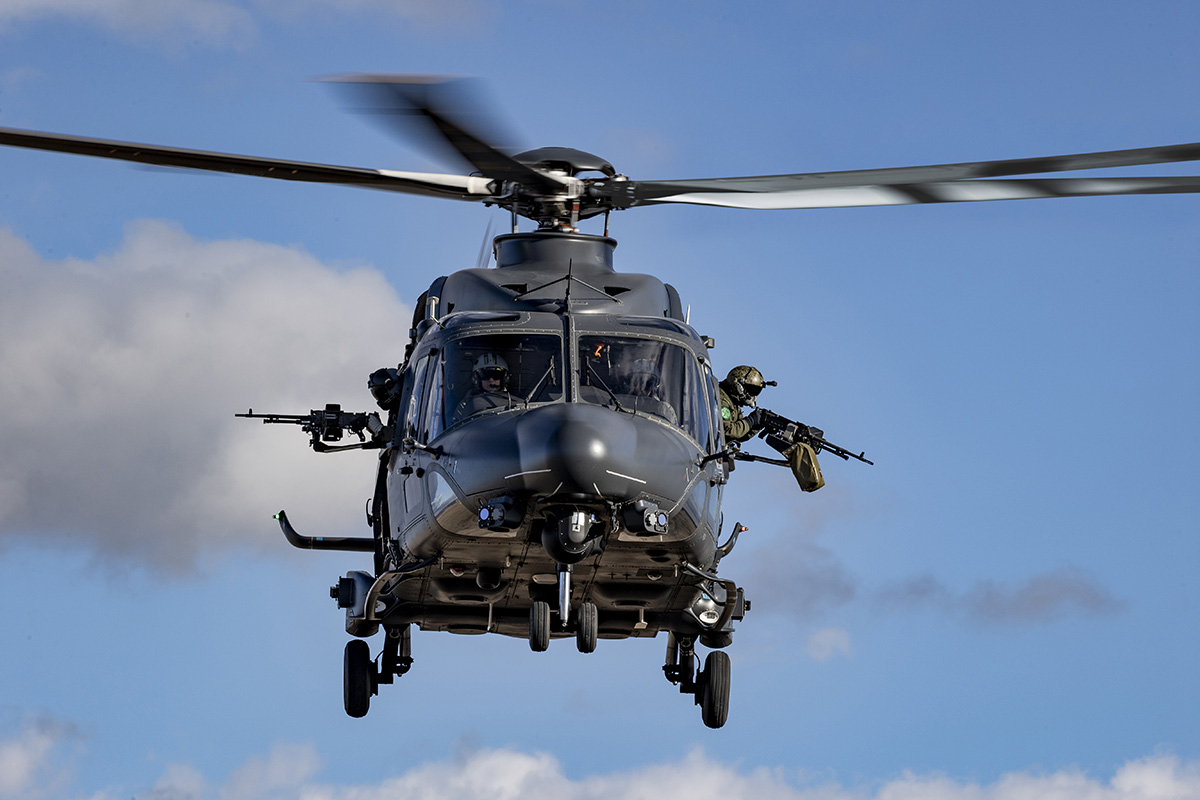
The full contract notice for the Ministry of Defence’s New Medium Helicopter programme has been published, revealing further details of the GBP 989 million deal signed with Leonardo UK in March.
The contract, which was formally concluded on 23 March 2026 and published on the Find a Tender service on 10 April, covers the procurement of 23 helicopters to replace existing rotorcraft for Army and Strategic Commands over a 91-month period.
Beyond the aircraft themselves, the notice sets out the full scope of what Leonardo will deliver under the deal. The contract includes design organisation integration services for government-furnished assets and mission role equipment, two flight simulation training devices for aircrew and rear crew at the UK Main Operating Base at RAF Benson in Oxfordshire, and training courses for qualified helicopter instructors, aircrew, and groundcrew maintainers. Courseware material for ongoing aircrew and maintainer training is also included.
The contract further covers an initial in-service support package, the details of which give a sense of the programme’s scale. This comprises initial provisioning spares, deployed support packages, ground support equipment and specialist tooling, technical publications and aircrew publications, logistics and spares management, forward and depth maintenance, and design organisation modifications and technical support.
The notice describes the NMH as a “common medium lift multi-role helicopter, fitted for, but not with, specialist Mission Role Equipment” that will be “able to operate in all environments in support of defence tasks.” The “fitted for but not with” designation means the aircraft will be designed and wired to accept mission-specific equipment but will not carry it as standard, allowing different configurations to be fitted depending on the operational requirement.
The procurement was conducted through a competitive procedure with negotiation, though only one tender was received, from Leonardo UK based at its Yeovil facility on Lysander Road. The evaluation process used a combination of pass/fail criteria and weighted scoring. Mandatory pass/fail gates included compliance with air system requirements, simulator system requirements, quality management systems, and cyber security and resilience assurance for what was classified as a high cyber risk profile.
Beyond those mandatory thresholds, bids were scored against weighted criteria. Technical merit carried the heaviest weighting at 40%, followed by support at 17%, UK industrial contribution at 15%, social value at 10%, commercial considerations at 10%, and time and delivery confidence at 8%.










One of the MoDs favourite phrases “fitted for, but not with”
Fuck sakes… It’s because they haven’t got the kit to fit to is anyway.
Read it properly
In this circumstance for a general utility helicopter fitted for but not with makes lots of sense.
but if this is a utility helicopter, what platform gets used in war zones? Do we have a fleet of armoured units?
Didnt we have to retro fit all the helicopters in Afghanistan because none of them had armour and were taking fire?
These will be doing exactly the same role as the Puma before it. So doing both Green and Black tasking and roled to the specific requirement, which if in a high threat area from small arms will include additional armour. Though I’ve not seen anything yet on what defensive aid systems (DAS) will be fitted to the aircraft.
Because as the article says they will be fitted for but not with.
Preparing for war (Starmer’s claim) doesn’t scream fitted for but not with. It screams penny pinching – trading soldiers lives for Treasury cash.
I thought the requirement was for about double that number?
The requirement turned out to be whatever number could fit under a billion pounds.
Yep cut by about half
This the problem by manufacturing a short run in the UK the prices are forced right up so the numbers bought…..
No mention of the Treasury “profiling” of funding to spread the cost of the program for as long as possible while a) pushing up the final bill and b) denying the capability to the UK’s troops.