

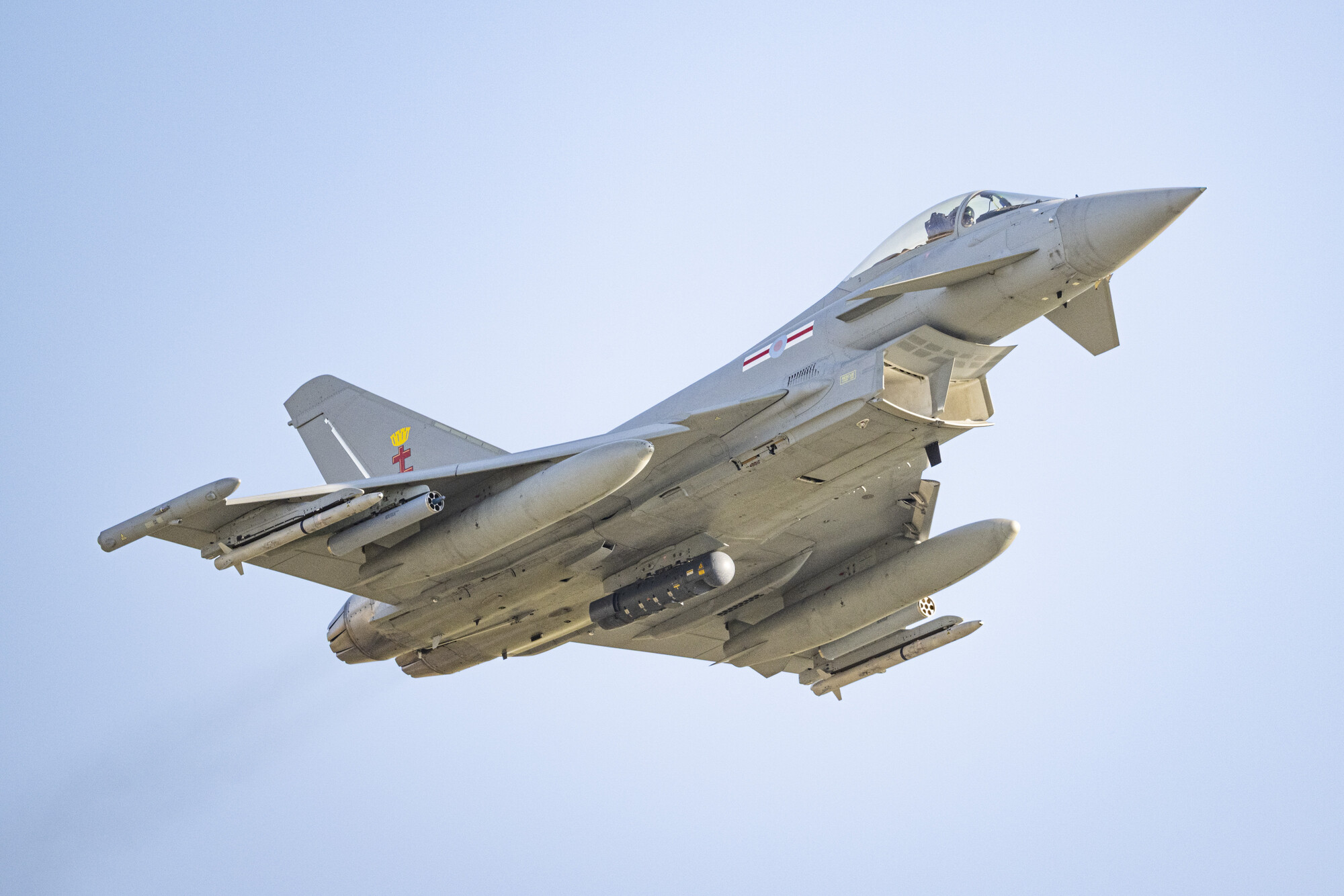
A Eurofighter Typhoon has test-fired a low-cost precision weapon designed to counter uncrewed aerial systems, according to BAE Systems.
The trial, conducted from the company’s flight test facility in Warton, Lancashire, saw a Royal Air Force Typhoon test aircraft launch an APKWS laser-guided munition against a ground target at a UK range, the company said.
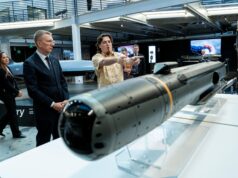
The APKWS guidance kit, manufactured by BAE Systems in the United States, converts unguided rockets into precision weapons and is already in service on a range of platforms including F-16s, A-10s and rotary-wing aircraft, according to the company.
BAE Systems said the trial is intended to explore how lower-cost weapons could be integrated onto Typhoon, particularly for countering drone threats where more expensive missiles may be disproportionate.
“This trial with the APKWS laser-guidance kit on Typhoon demonstrates a game-changing capability and a cost-effective solution that would enhance Typhoon’s already impressive range of weapons capabilities,” said Richard Hamilton, Managing Director of Air Operations at BAE Systems’ Air sector.
The company said the activity, carried out with support from the RAF, will inform future integration work and forms part of a broader package of upgrades planned for the aircraft.
Typhoon already carries a range of air-to-air and air-to-surface weapons including Meteor, Storm Shadow and Brimstone, and is undergoing further enhancements including the ECRS Mk2 radar and additional weapons integration.
According to the company, the APKWS system is capable of both air-to-surface and air-to-air engagements and has been used operationally for several years. The recent trial is expected to be followed by further testing, including against aerial targets.







Seems like a good idea BUT a £100 million aircraft to bring down a drone?.
Would you rather the drone gets closer before being engaged? This allows them to down the drone before they’re anywhere near their targets
Or you could upgrade the beechcrafts or cheaper airframe instead of burning off airframe life on a front line jet.
I meant a Beechcraft Texan II, or just buy some Beechcraft Wolverines that can be as a training aircraft inbetween
Those aircraft don’t have the speed or sensors to cover a large area of airspace, we would be better off with jet trainers/light fighters like the M-346 or T-50. They have the speed an sensors necessary without the costs of a Typhoon or F-35.
The goverment will not invest in another jet, unless shows commonality with an existing platform, granted, if m-346 does get picked for new trainer. I’m looking at areas that have need low cost per hour airframes for drone interception. This isn’t meant to be going into heavy contested airspace, but for place like drone interception. The reason I bring this is that the AT6 Wolverine has a 85% compatibility with the Beechcraft T-6. I guess, the only place that benefit would be Cyprus.
However, I think the way things are going they will just use a drones which are on trials, such as Malloy T-150. Also, Apache is also getting the kit, and with recent footage, have done an ok job.
Also those aircraft are vulnerable themselves to other threats.
There’s hardly any risk to the jet, that doesn’t seem like a fair comparison. You might as well complain about the £200M Sky Sabre fire group, or £500M Fylingdales.
And to think we are retiring the perfect aircraft for this role in the Hawk…hope it’s replacement is looked at for this role.
You could fit APKWS to M346, I would have thought.
No radar on Hawk so would be pilots eyeballs only
Could do a podded IRST though, from the scope video the MoD occasionally publish they seem to do a lot of the targeting using the t-pods.
Would hope a cheaper option, drone related and more appropriate would become operational.
Indeed a drone that is armed with these would be the best option. Protector perhaps?
Or a billion pound destroyer.
Sorry, most alongside and the one deployed has plumbing issues lol!
They don’t usually kamikaze the plane into the drone, mate.
Hmmm…
Design a UCAV from the ground up for mid-air impacts, encase sensors in cages and thick covers, have FOD gratings over the engine intakes. Do we have an idea for the cheapest ever cost per intercept?
I’d argue a maxim gun on the back of a 4×4 still is the cheapest.
Yeh, and the Ukrainians were using at least one Maxim early on in the current war. Apparently left over from WW1 if I remember rightly!They were proudly showing it off to the BBC in a dugout..!
Cheers CR
Ukraine has actually quite a lot of Maxim derivatives in inventory, it’s not a rare one off. The Soviets kept producing them into the 1930’s and kept using them in a frontline role into the 1940’s (we kept Maxims in use until the 1960’s as well). Then like most Soviet equipment they packed thousands of them into storage and Ukraine inherited them.
They do use them in stationary defence roles with the Territorial Defence Forces, but yeah, the most notable use is for hunting Shahed’s. Between 1 and 3 Maxim guns on a Toyota provides a fair amount of lead to throw at relatively low flying, slow, drones and saves expensive interceptors for Cruise missiles and the like.
Of course… the Soviets never threw anything did they.
I know the RM used their Vickers Maxim guns well into the 60’s. They were reliable weapons by all accounts, so why not?
Thanks CR
I have seen news articles on WW2 era Multiple Maxim AA mounts being manned by old ladies in Ukraine, that seem to have been remarkably effective against drones.
About 1000€ for a FPV in Ukraine and about 10k€ for AI drones (ÉGIDE) in France, that is what I was able to gather. Could be challenged though. But keep in mind that these systems work in a much more compact kill zone than what you may achieve from a plane or a radar equiped jet. Interceptor drone work for point defense or « route » interception.
Introducing a new aircraft type into service is going to cost a hell of a lot more than 100M. Even a Tucano type aircraft or a jet trainer
Tucano maybe good for drone shooting.
Not really. No radar, no datalink, and nothing like the speed and endurance and all weather capability needed. People make the mistake of thinking that because some drones are small and cheap, they should be easy to shoot down. But they aren’t. Easy to shoot down when you have found them. But the difficult part is finding them and engaging.
There is a market for say a light turbo propeller plane with data link all weather reasonable speed, a cheap drone killer. thinking light planes can be directed to target by bigger ground radar or other assets on data link.
You allready have plenty of helicopters…
Also the running costs, the people who support the aircraft, and its vulnerability on the ground as a £100 million target. It feels like we are moving ever-closer to drones like the Airbus ‘Bird of Prey’ interceptor… missile armed drones designed to intercept enemy drones.
Maybe someone will adapt the windracer. I know they are testing the Malloy drone with the APKWS rocket.
So you want to buy another aircraft at many more billions just to deal with drones. If you have money to burn you buy lots of specialist fleets. we don’t have money to burn. The additional cost of equipping Typhoon to do the job is tiny compared to the cost of another fleet of aircraft, pilots, etc.
Did I say any of that? No, of course I didn’t, nor did I imply another aircraft. I only wrote one sentence for heavens sake.
It’s not the cost of the intercept you look at … it’s the cost of the non-intercept.
How much damage has been prevented by shooting down the drone? What impact will the damage caused by the drone have on the war effort? Was that an important arms factory that was put out of action?
Suddenly using a Typhoon with high quality radar is a good idea.
The idiocy of not doing this sooner is unbelievable.
No urgency in UK Defence – so we’ve wasted a huge costly munitions pile in the Med and now ‘looking’ at this.
Stable
Door
Horse
Bolted
This kind of idiocy makes us more vulnerable as it has been obvious for three years that low cost mid spec is the way fowards.
Indeed this has been available for years, seems like testing should have been done long before now.
Definitely. The MOD/RAF should have been using this in the current Gulf Conflict. These innovations are introduced far too slowly 🤷🤦♂️
I believe that it’s BAE that’s funding the testing. There’s no MOD commitment here
Indeed. Ukraine war is going on for years.
Bae’s paying for it all. Rachel is not contributing one penny.
Who’s paying for the RAF typhoon,.pilot and air crew that did the test?
That’s sunk cost
Not entirely true, it’s resource that could have been used elsewhere and so it’s money put into the project. Not a whole load but it’s not nothing.
It’s exactly nothing. If the test hadn’t happened not a penny less would have been spent by the RAF..
Not sure it was an RAF Typhoon anyway.
The post states it was an raf. Of course there is a cost, the wear on the airframe from the test costs money. The crew and maintance staff would have been used elsewhere, and so oppertunity cost. Nothing is free in life.
I do find it amusing that reeves is the first chancellor anyone directly names rather than blaming the generic treasury and it’s all because she is a woman and the media seem to hate powerful women.
You’re correct it was a RAF test and evaluation aircraft. But wrong that it cost extra money. It didn’t.
And don’t be so fucking stupid. Everyone called Gordon Brown and George Osborne by their names when they were Chancellors. As were every other Chancellor.
Look back at older posts here, they all talked about the treasury holding the money or the PM and never mentioned the chancellor by name.
Ahhh …Labour Diddums!!!
It’s useful but in the end the all up cost of putting a typhoon in the air for 1 hour is about 45,000 pounds. You need a cheaper platform that can deliver the cheap effector.
Its an interesting Paradigm because it shows that in the end the driver away from the cheap plentiful attrition platform was human costs… when you can only train a few hundred pilots you need them to have the most effective aircraft imaginable, quality wins when the human cost limits both sides…but it never really answered the question asked by quantity ( when you omnipresent you win…. Sherman and T34 vs panther and tiger, the Royal Navy vs every other navy for 100 years) as soon as an effective way was developed to remove the human cost from quantity we start to see that quantity win over quantity.. the west really needs to relearn quantity matters.. turning up matters.
Why the heck do you think the west is taking the lead on unmanned combat aircraft?? Jeesh.
Yes because an unmanned aircraft can replace a ship… in your head maybe.
That makes zero sense, are you sober?
No just answering the wrong question, but then your responses are aggressive and rude, so I don’t think I will bother responding anymore, cheers.
Bottoms up.
Whatever replaces Hawk needs one or two of the squadrons to act as specialist combat trainers/light combat air. We use the Typhoons for practically all of the initial ACM training at the moment and training new pilots eats up a lot of the frontline air time. We just need a few of the aircraft upgraded with an IRST and targeting and the hardpoints to take APKWS and ASRAAM and that would sort a lot of the issues with defending UK territory against the high volume, low difficulty drone attacks we have at the moment.
Or a beast mode for the UCAVs, that would work too.
Agree.
In the Cold War a large number ( 88? ) of Hawk T1 were wired to have Sidewinder, working with F3s.
All the military needs lower tiers of assets to increase mass.
This rocket, should have been acquired before, but we know HMG, no interest and reaction rather than proactive.
I appreciate it would be some way off but, a role for one of the many configurations of Aeralis ….. though, I dare say Aeralis is a dead-duck, given the lack of motivation (DIP) from the UK Gov?
Hawks with Sidewinders turned out to be useless in exercises so the experiment was not repeated.
Wasn’t aware of that, only that they existed as a last ditch.
I also recall a version of Hawk was sold as a light fighter type to someone.
Even further back, the BAC Strikemaster!
BAE Hawk 200, light multirole aircraft with 11 (!) hardpoints. Aeralis subtly market an armed variant but they aren’t very popular, I think M346 can be armed too. They’d spend most of the time doing lead in fighter training anyway, would very much be a reserve fleet.
M346 have a radar version recently sold to Austria.
There is also the
hawk 127 still in service with Australia.. essentially any version of the hawk trainer could be armed, with sidewinder, gun and gravity bombs..
The Finland hawk 66 armed with the AA-8 “Aphid, sidewinder, rocket pods, gravity bombs and cannons
The malaysian hawk 208 go further and can carry 6600ibs of stores.. including sidewinder, AGM 65, rocket pods and cannon.
There are some hawks even ordered with a fit for 4 sidewinders.. many have and are armed and many have been used in hot conflicts.
So buy a fourth type for RAFcombat air? Don’t be daft.
No, just a variant. M-346, T-7 and Aeralis all have options of being armed and given the necessary sensors. Would be a much more minor type difference than F35A to B.
The raf as we know have often operated many different types of combat aircraft, as the threat develops it may or may not be an effective option in the future.. who knows ?
The threat will remain as long Time s the capability gap isn’t closed. Then another gap will be exploited.
Aeralis do not even have a static prototype. T-7 don’t have radar variants available. It is only M346 vs T50
It doesn’t cost 45k for an additional flying hour. Again, most of those costs are fixed and already sunk. Expanding the utility of an in service aircraft can be cost effective Vs how quickly you could spend the weapons integration budget on a handful of conventional ata missiles. Of course cheaper counter drone solutions are required but it doesn’t prevent this investment making sense
Hi Andy.. no but those hours are purchased for a a specific set of threats.. so yes have a solution for that set of fast jet hours you have invested in.. but more fast jet hours are not the solution essentially.
Once again your comment makes zero sense. RAF aircraft have always been used in ways their designers hadn’t thought of. Well, the successful ones anyway.
Whatever.
Bottoms up.
I think the Hydra 70 with kit Akws kit is being installed on the Apache.
And add it to the F35Bs and Apaches too? I think there are already more basic versions of this that are fired from the back of ute like vehicle?
If I remember they integrating APKWS on the British Apache.
And the French Naval Group have the Multi Purpose Launch System (MPLS) that can that can Martlet/Mistral and 68/70mm for ships. Would the RN look at something like this for a CIWS/counter drone mount? Its been mentioned previously that a SEA-Thales jv could potentially adapt the Ancilia decoy launcher to have Martlet and Starstreak on the same or similar mount for CIWS. And maybe add in rockets? France has the Sandural mount that does this with Mistral.
*that can fire
**sorry, i meant Safran (NGDS) Next Generation Dagaie System combining Decoy and Mistral.
We are also looking for the Camm in the French navy.
Anyone competent would have added this system to the arsenal years ago. It has so many uses that saves on expensive overkill.
Must be a slow UKDJ day guys. 😊 The system involved has a range of about three miles. I was just questioning the concern of having a Typhoon etal that close to a potential threat. For those who jumped to say I was complaining I refer you to my first phrase. “seems like a good idea”.
You mentioned the cost, not the range of the weapon.
Thanks Robert. I can always rely on you to find something to argue about anything I say. Interestingly you’re the only one.
I know you mean well Geoff. But the technical solution isn’t always so straightforward. It’s more the very complex air environment these aircraft are operating in, then the how easy it is to shoot a low cost drone down. They are small and have very low radar cross sections. To find engage and destroy one requires a very capable fast jet.
Hi mate.
Good point on acquisition.
But also, aren’t the Ukrainians using some very old types to shoot at Drones?
Hi mate. They are, but I’d bet they would kill for Typhoon and it’s capability to make it more efficient. Ukraine is in a very different place compared to a operation like we are seeing in the middle east. We have the ISTAR capabilities the Ukraine lack and also technically complex assets already in service
Depends if you have very good AEW and C, then you can use a simple capability to deliver an effector.
Could the Typhoon use its 27mm cannon against drones? Would it have enough range to be safe and effective? Silly question, but what do aircraft use their cannons for these days then? Unless you’re an A10 Warthog which has a 30mm that has been useful in the Iran conflict.
I guess as you say, it’s about range and how many you are engaging in one go. In Afghanistan, the 27mm was used manly for shows of force.
Real issue seems to be debris ingestion. They lost 2 Mig 29 in these canon attacks. The range is simply to short and speed différence remain very high.
A couple of things to bear in mind. The terminal velocity of the APKWS is determined by the launch platform’s speed. The height and platform’s track and bearing to the target will also be a factor. This will also help determine the effective range of the APKWS.
The USAF using F16s and F15s against Houthis drones, when intercepting were not directly behind the drone for that very reason. They were above and off to the sides. Not forgetting that 95% of these drones don’t have a turreted electro-optical sensor (due to cost), but rely on a fixed forward facing sensor. Meaning most of the time the drone operator wont know they are being targeted, so don’t do evasive manoeuvres. Thereby making life much easier for the intercepting pilot.
I mentioned this exact system several weeks back. The Yanks have been using it operationally for a while.
I get the point about using a big expensive jet, but in a combat zone we won’t have the luxury of having a bunch of planes sitting around waiting for drones to turn up. We will have a bunch of planes. i.e. Typhoon or F35 that will get tooled up according to the incoming threat. It’s one thing to have a bunch of bombs hanging around doing nothing but a completely different thing having a bunch of planes that are still not cheap, even if they are cheaper sitting around doing nothing.
What is there about this combination that makes it suitable for a fighter, where Marlet isn’t used? Does it have its own hardpoint or is there a multi missile launcher?
typically podded, 7 to a pod with 3 pods hanting off a single pylon
Thank you.
Its qualified for firing off a fast jet. Martlet/LMM is not.
Its qualified for firing off a fast jet. Martlet/LMM is not qualified.
I was wondering why it wasn’t, and the more I delve, the less good the option looks. There are lots of possible reasons, and at first glance they’d all end up with UK buying more American. However, I read that Belgium is testing FZ275 on F-16s and there’s already a low cost version made for Ukraine that might be even cheaper than APKWS/Hydra; however they don’t have the push that the US does, nor the install base that Hydra already boasts. Whether Ukrainian numbers offset that advantage I don’t know. I understand Thales is involved with it, so Martlet was always a long shot for C-UAS (no pun intended). There’s a nice photo in the Aviationist showing the arrangements of 42 rockets on two pylons (search: Belgian F-16s Are Testing FZ275 Laser-Guided Rockets for C-UAS Role).
It’s hard to beat the cost of APKWS.
For FZ275 headlines read “Thales Develops $10K Laser-Guided C-UAS Rocket for Ukraine”, and when you add the APKWS kit to the cost of Hydra it’s more than double that, $25K-$30K. Headline numbers never compare like with like though, do they? So who knows? Both on a par or cheaper than a Shahed.
True dat
Apache will have a big anti drone role going forward using weapons like these.
Drones to take out drones, we have some very fast and cheap drones being used in Ukraine, taking out Shaheds etc as we speak
Maxim guns, or modern types, single or paired on tripods \ vehicles
But to use a typhoon and “low-cost precision weapon,” We all know, this will not be low-cost at all
Close range to take out FPV drones… the best weapon of choice happens to be a shotgun!
That if the jammers don’t do the job first
When are we going to learn 😒Let’s take notes and apply them to the UK military
It’s not too late to put the Hawk back into production with slatted wings and an engine fix (the only real issue with the Hawk which should be easily fixable minus the French ‘collaboration’) plus FBW (why not) with an order for at least fifty units, for training and for light attack with this semi active rocket and a Aden cannon modified to fire 25 mm ammuniition (or just the standard 30 mm Adan cannon). The Hawk is not obsolete. It went from being a candidate for the USAF to being obsolete in one hard to believe corporate betrayal go once the USAF managed to get all the synthetic trainer expertise off the ‘collaboration’ with the British. The Hawk is still very viable and a government with courage should face down the transatlantic brown envelope brigade and keep it in production another forty years. The T7 is already a dogs breakfast by all accounts.
Are you serious??? The USN bought Hawks for carrier training. And the US didn’t need UK knowhow to develop synthetic trainers. Synthetic trainers were invented in the US. Jeesh.
It would seem that an A10 type airframe would be useful.
Lot of negativity here, but the earliest press I can find for rocket pods on Typhoon is photos from March this year: https://theaviationist.com/2026/03/06/typhoon-spotted-rocket-pods-first-time/
Getting through the clearance process to fly a totally new wing stores system and do an actual weapon release in flight is HUGE news, and the result of a massive amount of effort. It might only be a test, but its a big step towards it being a viable option for Typhoon.
Excellent comment.