

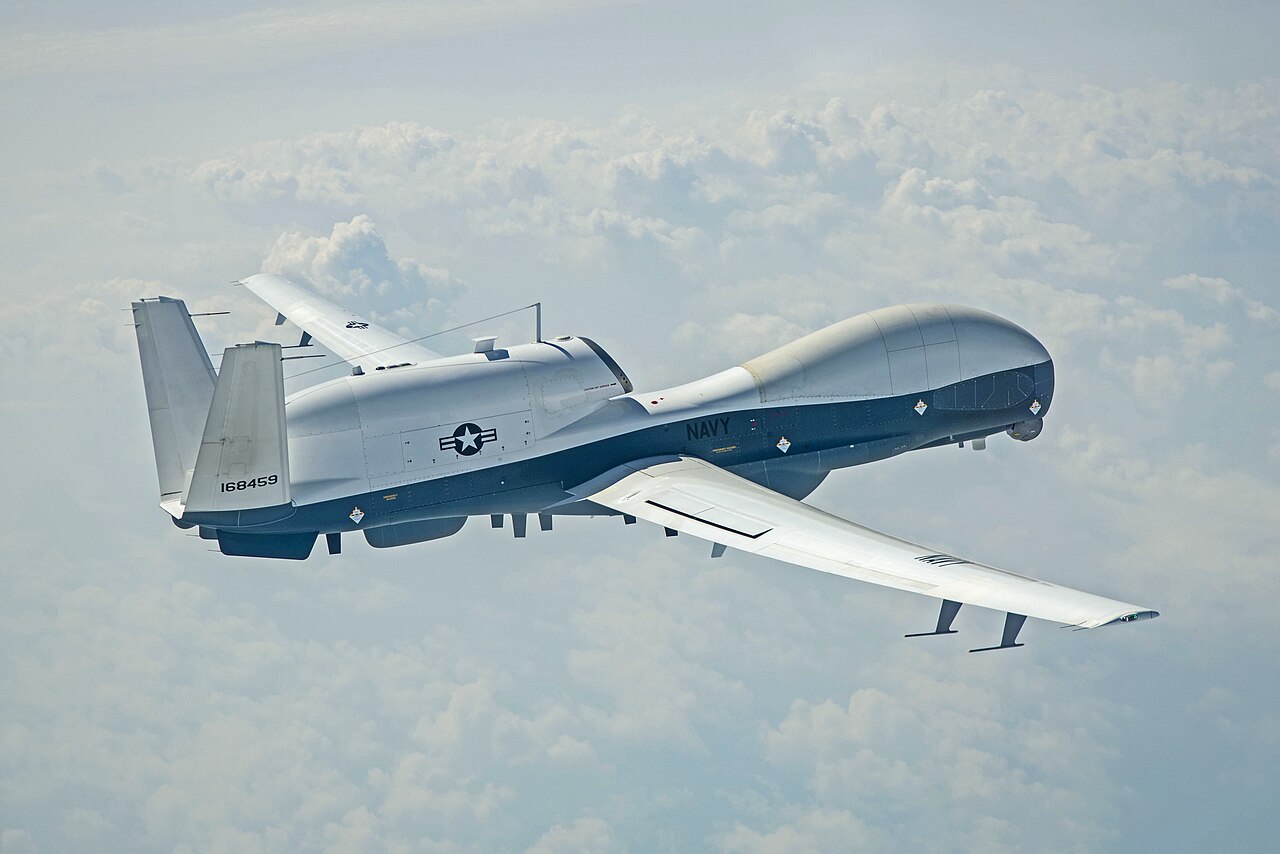
A US Navy MQ-4C Triton unmanned aircraft appears to have declared an in-flight emergency over the Persian Gulf before rapidly losing altitude, according to open-source flight tracking data.
The aircraft, serial 169804, was tracked on platforms including Flightradar24 emitting a 7700 squawk, the standard code for a general emergency. Data indicates the drone dropped from around 52,000 feet to roughly 12,750 feet within minutes while operating north of Bahrain.
Tracking suggests the aircraft was flying a typical high-altitude surveillance profile before the sudden descent. Its track then ended over the Gulf, though it remains unclear whether this reflects a loss of the aircraft or simply a loss of tracking data.
The incident was first highlighted by UK Defence Journal senior editor Jon, who monitors military aviation activity using open-source tracking tools. There has been no official confirmation from the US military at the time of writing.
The MQ-4C Triton is a high-altitude, long-endurance maritime surveillance drone derived from the RQ-4 Global Hawk family. It is designed to provide persistent intelligence, surveillance and reconnaissance over wide maritime areas and routinely operates alongside P-8A Poseidon aircraft.
The type has been deployed extensively across the US Central Command area of responsibility, including the Gulf region. According to open-source reporting, some Triton airframes previously based in the UAE were repositioned to Naval Air Station Sigonella in Italy earlier this year.
UK Defence Journal has contacted US forces for comment.
It remains unclear what caused the emergency or whether the aircraft was recovered.









Located in Italy, wow another capability the US can’t deploy without NATO.
Wrong. Again. My but you Brits are ignorant.
So the Triton does in-flight refuelling now does it? (hint: no, it doesn’t) Given that the range of the Triton is around 8400 miles and the distance from NAS Jacksonville or NAS Patuxent River to the Persian Gulf is 7700miles and 7100miles respectively, sure, you don’t need you NATO allies, you can send the MQ4Cs to the Gulf, on a one-way trip. They’d have about two hours on station before they fall out of the sky. Given the fact that the USN has about 56 of them at the moment, you’ll run out of them very quickly.
Honestly, if it wasn’t for all the shootings, we’d think America didn’t have schools.
Good point Chris
Ouch! Spot on but fuck me this hits hard “Honestly, if it wasn’t for all the shootings, we’d think America didn’t have schools.”
Wow, I am gobsmacked laughing at this.
Chris, you’re not supposed to murder them like that….
I laughed out loud at work at that last line. Brilliant stuff!
The past couple of years have demonstrated the endemic ignorance, stupidity and corruption of MAGA Americans. Go back to your crayons and milkshakes.
Don’t make the Yanks’ brains hurt, they might have a problem deciding which to drink and which to colour with.
In other news Healy just gave an update on Russian submarine operation over our pipelines north of the UK. Seems the entire operation was monitored from start to finish without the Russians knowledge. They apparently used an Akula SSN to try and divert from the actions being carried out by two smaller submarines but it didn’t work.
Apparently they didn’t actually do anything to any pipelines they were testing to see if they could do something covertly and they failed.
Even the Russian navy are a bunch of donkeys now. Floating around in 40 year old SSN’s that were pretty loud in the 80’s much less now and thinking this was some form of diversion.
An old and bold Chief Ops Sonar, once described them as sounding like a bag of bolts in a washing machine. I was on my part 3 and up till that point assumed these legendary Russian boats were holes in the water.
I did read somewhere that the US has lost 11 Reapers too from their unmanned fleet. Given the losses to the manned aircraft which seems to be a high count too, maybe the operational use of all needs looking at. Seems they have learned nothing from the Ukraine eh?
I think they’re up to 15 Reapers lost now.
Not surprised Chris tbh the gung-ho approach that they take is asking for it.
That’s Grim.
Ha ha! I see what you did there! 😂😂
Latest info on MQ9-Bs is that Iran shot down 16. This is on top of the 7 to 9 shot down by the Houthis in 2025. The majority of the US MQ-9Bs will not have any radar warning, unless they’ve been fitted with a electronic surveillance (ESM) package. Even then it will need to be capable of receiving the right frequencies, as most ESM targets mobile phone networks and data-links. Without the radar warning, the MQ-9s are sitting ducks for surface to air systems. However as soon as you start adding radar warning that can then automate countermeasures, the cost ramps up dramatically.
In this respect manned aircraft do have an advantage. medium altitude long endurance (MALE) type drones like the MQ-9B, will be controlled by the operator via a satellite data-link. Because the signal bounces off a satellite to the operator, who then sends an action to the drone, the signal does have quite a bit of latency. Whereas a crewed aircraft its more or less instantaneous between the pilot’s reaction and action.
So whilst the “Florida Orange”has sent two fleets into the Indian Ocean to get a couple of dozen more votes in November, the UK and other NATO ships are doing the real work by scaring the crap out of the boats of his bosum budy; Putin. Must be nice being ruled from the kindergarten?🤗🤗
Lost votes more like
Oh,another child like name,Florida orange? Grow up you silly little lunt.
Infants.
Spot the Trump groupie.
Hue Janus !