

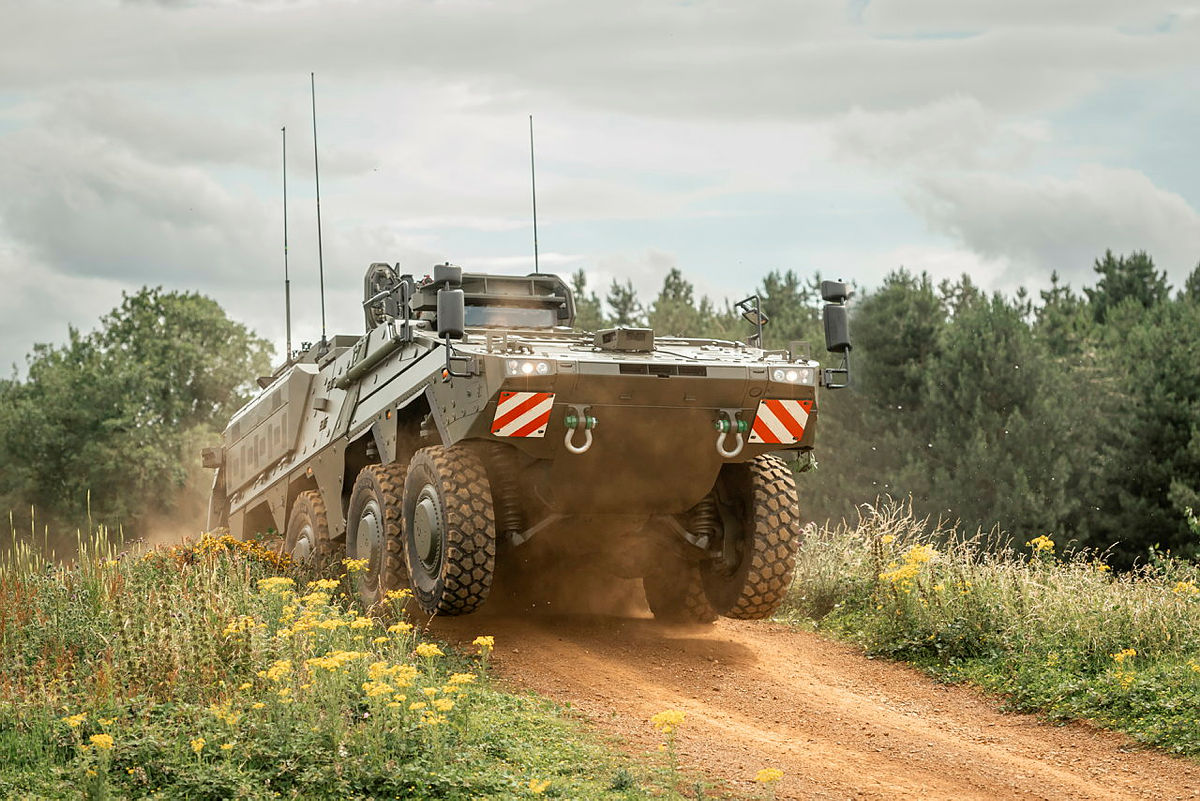
The Ministry of Defence has taken no decision on including a hard-kill counter-drone active protection system within the Mechanised Infantry Programme, though such opportunities are being explored, according to a written answer published on Monday.
Luke Pollard, Minister of State for Defence Readiness and Industry, was responding to Ben Obese-Jecty, the Conservative MP for Huntingdon, who had asked what assessment had been made of the potential benefits of including such a system in the programme.
Pollard said: “Hard-Kill Counter-UAS opportunities are being explored, but no decision has been taken to include a hard-kill Counter-UAS active protection system within the current scope of the Mechanised Infantry Programme. However, the Department continues to evaluate emerging technologies and capability options to ensure Army platforms remain effective against current and future threats.”
Soft-kill systems work by interfering with the threat, jamming its guidance, decoying its seeker or obscuring the target behind smoke, and they consume nothing physical when they operate. Hard-kill systems physically destroy the incoming round, typically by firing an interceptor or a projectile pattern into its path.
The Mechanised Infantry Programme
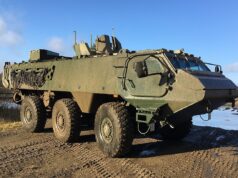
The programme is delivering the Boxer to the British Army, a wheeled armoured vehicle built around a drive module and interchangeable mission modules, produced in Britain by WFEL at Stockport and Rheinmetall BAE Systems Land at Telford under a contract for more than 600 vehicles.
The Boxer is intended to carry the Army’s mechanised infantry battalions, and the vehicles began arriving with units over the past two years. The question of what protective equipment they carry has been raised repeatedly since the invasion of Ukraine, where losses among armoured vehicles to small drones have run at a rate nobody planning armoured forces in the 2010s anticipated.
The department’s broader general position on counter-drone work has been set out through a series of related efforts, including the Request for Information issued in July for electronic warfare systems for the Armed Forces of Ukraine, which sought equipment able to disrupt drone control links from soldier-portable, vehicle-mounted, uncrewed and emplaced configurations, and which the department noted was the only category where a combat-proven answer to fibre-optic drones was being sought.






No surprise there then.
Can not afford it there will be some warm worded statment about being may be fitted for but not carrying and limited numbers held back in case of deplyment a bit like the crap way C3 gets fitted for Hard kill but not all of them, save a few pounds, look like the Government is doing some thing and then kick it in the long grass and hope there is no war or we will take casuilties because we are skint and Labour talks a good defence but will not stump up the money.
O/T but it looks like Ukraine has actually got its hands on RCH 155 according to the DefenceBlog
Colour me shocked.
Given that they’ve just seriously upset Israel, we can assume Trophy is off the cards!
(BTW I’m not in support of Israel’s policies)
Lets hope it doesn’t bite us.
Have any of those imbeciles actually looked, or even care, at a list of WHAT Israel sell to us compared to what they buy?
On Hard Kill, how many could be bought for every combat vehicle in the Army with the money Burnham still wants to give to Mauritius?
I don’t think the issue would be Israel, at least not yet, I fear the Labour government is the one reluctant fearing of it’s potential voters retaliation upon publicly signing new contracts with Israeli defence contractors, I haven’t seen such announcements in the lat two years
You mean Muslim voters. And the illegals they are fast tracking to citizenship so that they won’t ever lose an election again.
The thing is that the 2nd best option, if not going for Trophy, is the Iron Fist from Elbit Systems so Israel again… this option would be more compelling since it might be produced locally by Elbit Systems UK if the deal was big enough, Iron Fist comes with Latest versions of Bradley and CV 90, who knows…
We already have a solution for Boxer in the form of CTA-40 that were purchased for Warrior. AEI Venom also looks like a good bet, it can go on pretty much any vehicle and the ammo is common with Apache. Stormer replacement should come with an anti-drone gun, to save the rockets for bigger threats. But it’s notable also that unlike Soviet rubbish, Western amour seems to be largely survivable to small drone hits.
It is impossible to have ONE solution that works in most situations and any without ammunition self destruction it is a risk for own troops.
These vehicles NEED protection to survive on the modern battlefield. It is now a pre-requirement for deployment. If they do not fit something they will be unforgivably negligent and it WILL cost lices.
If they end up with nothing, who will join me in a petition that those responsible spend a few months on the front line in such vehicles?
Just to get a “better understanding” and to “inform future decisions” of course.
Yes definitely… it is all very well sitting at a desk and cutting the bill, but if they had to sit in the vehicle they would pay the extra. Other nations protect their fleets as a matter of cause – they see an APS as part of the vehicles intrinsic cost – I am thinking Israel, Germany and examples in the US.
I’m not sure 5 RIFLES deserve that to be honest.
Luke Pollard’s statement is mostly true. The MOD through DE&S have been “exploring” counter-uncrewed air system (C-UAS) defence for at least two years now. As it was initiated as part of the lessons learned from Ukraine’s war with Russia. This requirement falls under the 10 year program for Land Ground Based Air Defence (Land GBAD) Project 6. The first delivery for this program has been the Sharpshooter SMASH sight, that can be mounted to an individual weapon or GPMG. Another part of the program is looking at how to defend vehicles by exploiting the in-service remote weapon system (RWS).
Maria Eagle for Labour answered a similar question in April 2025: “The programme has begun to deliver Counter-Uncrewed Aerial Systems (C-UAS) capability for dismounted close combat forces, albeit in relatively low numbers. The focus is now switching to higher level UAS detect and non-kinetic systems, and upgrades to vehicle mounted weapon systems to enable them to engage UAS.”
The biggest problem that needs solving is finding a cost effective (cheap and robust) method of detecting drones in all weathers. That would then enable the RWS to slew onto the threat and engage it. The FPV quadcopter drones being used to target vehicles in Ukraine, have a very small thermal signature. Where depending on how long the drone has been flying (heat build up in motors, battery and controller) can sometimes only be detected less than 50m away. Which doesn’t give much time to react to the threat. Not only that IR and thermal based sensor suffer from environmental affects such as rain, snow and dust, which can significantly degrade the detection range. Which means radar is the best and most reliable tool for the job. As depending on the transmitted frequency, can be agnostic towards environmental conditions.
There is a solution available, but it will need developing, which is based on the active protection systems, such as Iron Fist and Trophy. However, both systems effectors aren’t really suited to taking out drones. But both systems use an active electronically scanned array (AESA) based radar, utilising four fixed panel arrays, arranged around a vehicle to give 360 degrees field of view. The Trophy system in particular allows the vehicle to not only detect and track a threat. But also to fix the shooters location. Meaning something like the Merkava MBT, can use Trophy to align the turret and gun towards the shooter’s location automatically. This capability could be easily exploited to direct a RWS at an airborne threat, such as a FPV drone. Thereby allowing the vehicle to engage the threat at much longer stand-off distances. With a fifth panel array fitted to the top of a vehicle looking straight up, the vehicle will have full hemispherical coverage as well.
The downside is the unit cost of APS, plus the radar will have to be active to search for and find threats. Meaning with the right kit you could find a vehicle by triangulating on its emissions. Though if the AESA can operate over a wide bandwidth, there are techniques that can seriously degrade this ability. There’s no getting away from the cost of APS, if the sensors and mission system can be purchased for a reasonable cost, that will go a long way in protecting a vehicle from drones when interfaced with a RWS. Adding the hard kill turrets and effectors later in a FFBNW could be an option.
Of course not. Why would we want to make a decision?