

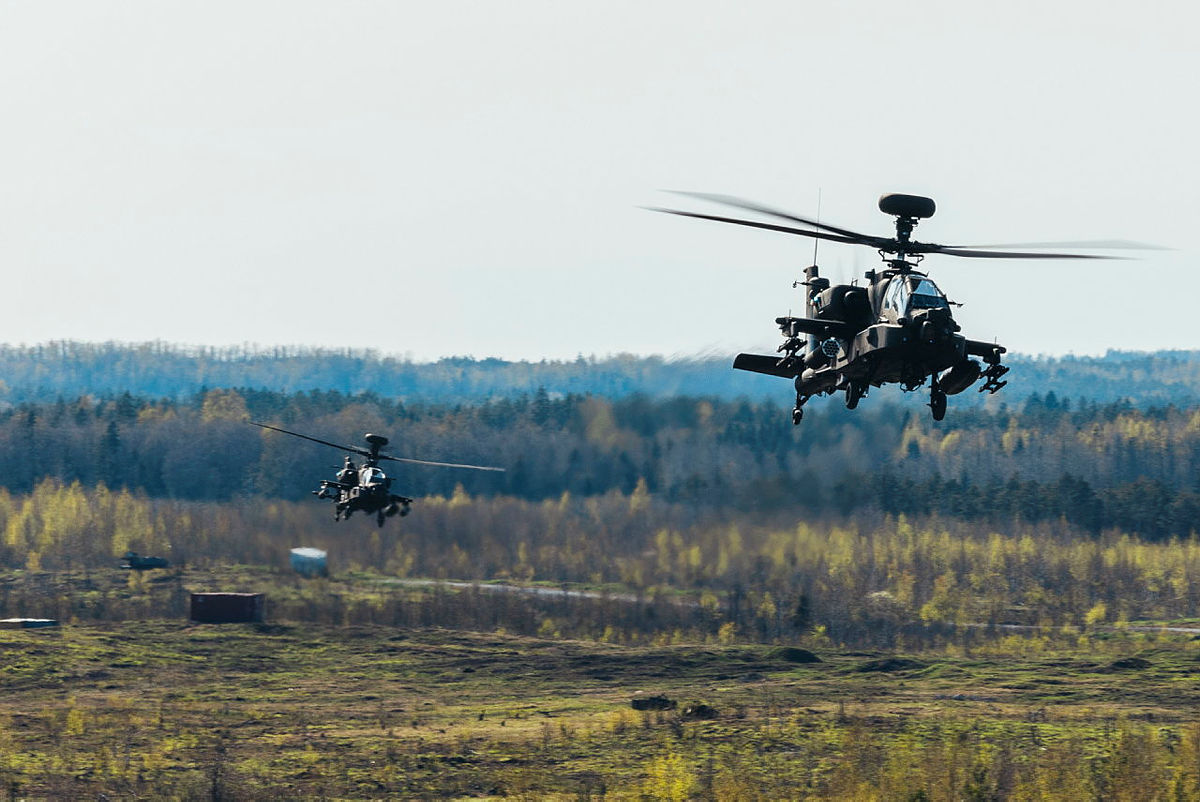
Two Polish state-owned firms have signed offset agreements with Boeing covering maintenance and ground support for Poland’s incoming fleet of 96 AH-64E Apache attack helicopters, work that will make the country the world’s second-largest Apache operator after the United States, the company stated.
The agreements were signed at the Wojskowe Zakłady Lotnicze Nr 1 facility in Łódź, with representatives of the Polish Ministry of National Defence, the Polish government and the armed forces present.
Under the arrangement, WZL-1 will provide maintenance, repair and overhaul services for the aircraft, covering organisational and intermediate level inspections and repairs along with selected depot-level component work. Boeing and the Military Central Bureau of Design and Technology, known as WCBKT, will separately assess whether Polish-designed ground support equipment can be used with the Apache, work intended to establish where domestic engineering solutions fit into the sustainment programme.
Jacek A. Goszczyński, chief executive of WZL-1, said: “For WZL-1, establishing the largest Apache support infrastructure in Europe is both a responsibility and a natural extension of our core business activities. This agreement will enable us to provide support to the Polish Armed Forces, significantly enhancing their operational capabilities.”
Marc-Olivier Sabourin, vice president for EICLA and training solutions at Boeing Global Services, said: “Signing these agreements marks a significant milestone in Boeing’s partnership with Poland and demonstrates our enduring commitment to supporting the Polish Armed Forces through robust, in-country sustainment and maintenance capabilities. Together with WZL-1 and WCBKT, we are building the industrial framework, technical expertise and workforce needed to support Poland’s Apache fleet for decades, while strengthening Poland’s sovereign defense capabilities.”
Roman Fiszer, chief executive of WCBKT, said: “Signing the implementation agreement with Boeing marks a significant step toward increasing the Polish defense industry’s participation in the AH-64E Apache support program. For WCBKT S.A., this represents an opportunity to further develop capabilities and strengthen the company’s position as a national center of expertise in the design, manufacture, and servicing of ground support equipment for modern military platforms.
“We believe that utilizing equipment developed and manufactured by WCBKT S.A., alongside the potential of the Polish industry, will enhance logistical support efficiency and strengthen the operational independence of the Polish Armed Forces.”
Offset agreements of this kind are a standard feature of large foreign arms purchases, requiring the seller to place work with local industry in return for the order, and they are usually where the argument over sovereign capability is actually settled. A fleet supported entirely from abroad depends on someone else’s supply chain and someone else’s political consent; one supported at home does not.
Poland’s Apache order is the largest export sale of the type. Warsaw signed for 96 aircraft in 2024 as part of a broader rearmament programme that has also brought in Abrams tanks, K2 tanks and K9 howitzers from South Korea, HIMARS rocket artillery and Patriot air defence, funded by defence spending that has run above 4 per cent of GDP, the highest share in NATO.
The country is the 19th nation to operate the Apache, of which around 1,300 are in service worldwide. Boeing says the type continues to take on new roles including counter-drone work.
WZL-1 is part of the Polish Armaments Group and operates facilities at Łódź and Dęblin, with more than 80 years of aircraft maintenance and overhaul work behind it. The company has also signed agreements tied to Poland’s Abrams tank purchase, produces launch canisters for PAC-3 MSE missiles and supports the Polish M-346 trainer fleet. WCBKT, also part of the Polish Armaments Group, has been the country’s only domestic manufacturer of ground support equipment since the early 1990s.






In stark contrast to calls here to do away with Apache as it is vulnerable to Drones.
Poland are either even greater idiots than we are, or sensible enough to think that all battlefield assets have their place, rather than knee jerking them away and then regretting it down the line as even less assets then present themselves for use.
I support the latter option, and think that counters will be found and that Apache still has great value.
France used Tigers with laser guided rockets effectively vs iranian drones in UAE.
just tosay attack heli still have their uses and their role continues to evolve
Like Wildcats deployed to Cyprus.
Ah yes. The Wildcats we are getting rid of, either cut or replaced as in the case of the FAA.
yes i have trouble understanding the wisdom behind that decision esp. with no replacements in sight.
The drone wars are a product of combatants either not having regular kit (ukraine & iran) or not being prepared to commit any more regular kit (russia). If a lovely NTO eastern flank war kicked off, we would be using everything from F-35s & Leopards down to cardboard drones. Drones are an addition not a replacement.
Absolutely. And yet the senior command and the MoD/Ministers talk of nothing else and kit is being cut with no replacement, Wildcat in the Army as an example. And Wildcat is going in the FAA as well replaced by Drones, which I doubt can conduct all the tasks currently carried out.
It is financial salami slicing to fit a budget, and it never ends despite what comes out of HMG mouth.
Your “regular” kit will be lost trough attrition unless you have a significative quality/quantity edge over the enemy.
Drone(which are a missile) and long range missile are much easier to produce, train for and upgrade/update plus are not dependent on know physical structures like your airbase and naval base.
Note that i am not talking about supposed 2000-3000t naval drones like the supposed RN T9x
Lets imagine a war with Russia-UK. As all UK military industries are indefensible, for example GCAP-Tempest would have to be developed in Japan. (assuming Italy as NATO also in the fray). A couple of cruise missiles at shipyards and T26 T31 programes stopped, worse the SSBN/SSN builds.
They are vulnerable but if you have an enough large army you can make a small bet on them.
In my opinion they can still be useful in kaos phases, for example stopping a breakthrough, also missiles like SPIKE NLOS makes possible to fire behind a hill, besides firing at 50km range is different than at 8km.
That said, starting developing an new Apache would not make sense. Technology did not evolved enough.