

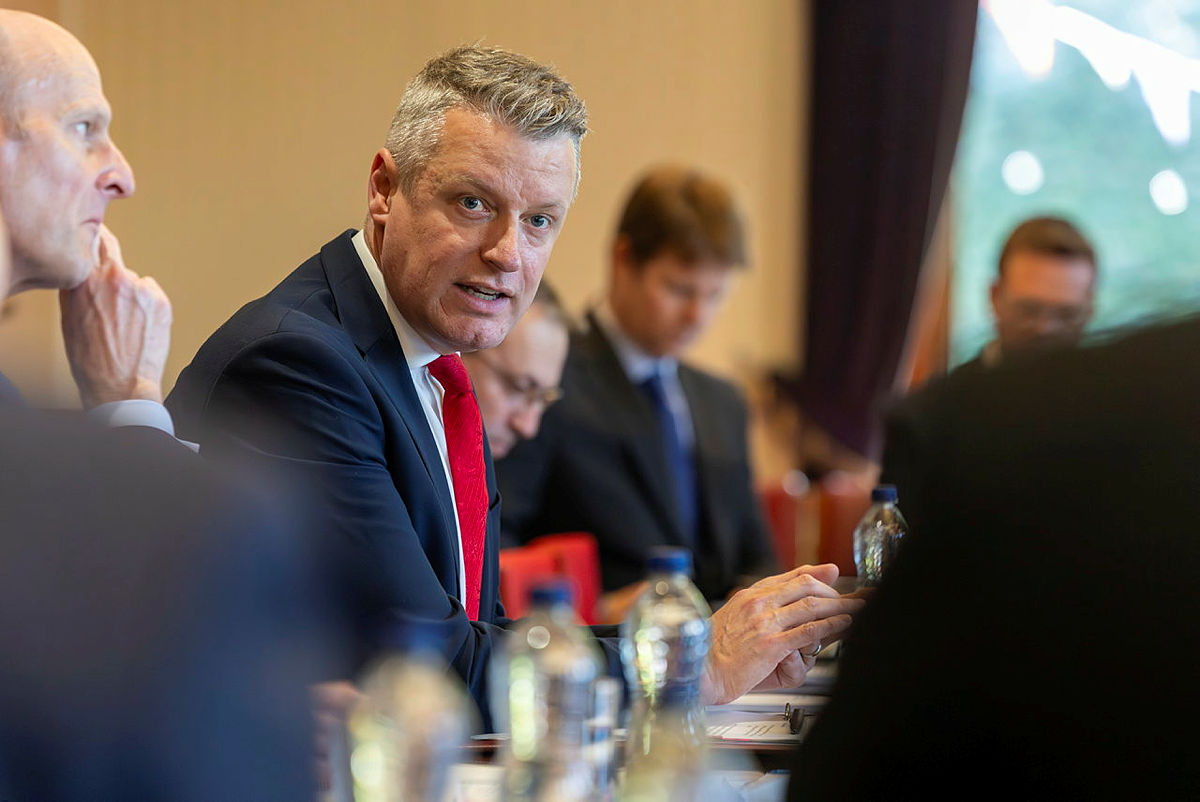
The UK is reforming procurement and expanding industrial partnerships to support faster capability delivery, Minister for Defence Readiness and Industry Luke Pollard MP has said.
Speaking at DPRTE 2026 in Farnborough, Pollard said the government’s “stated ambition” is to move the armed forces towards “warfighting readiness… able to deter, and, if necessary, defeat a peer adversary.”
He argued that a more dangerous and unpredictable security environment is driving the need for faster action, stating that “the world is getting more dangerous… the threats that we are facing are becoming more severe and more apparent to us all.”
Pollard confirmed that defence spending is increasing, with an additional five billion pounds allocated this year, but added that reforming how that money is spent is central to delivering capability at pace.
He said efforts are underway to accelerate procurement, including “cutting the time of contracting” and “removing… rules that get in the way of delivering the capabilities that our Forces need at a faster pace.” The minister also highlighted a greater focus on UK industry, noting that “as we’re spending more of an increasing defence budget with UK-based firms, we’re also spending more of that with SMEs as well,” with a target to increase direct SME spend by 50% by May 2028.
Pollard also pointed to recent contract activity, stating that more than 1,200 defence contracts have been signed since the general election, with 86% awarded to British companies. Since October, £4.9 billion in contracts have been signed, with 94% going to UK firms. Among the programmes referenced were £650 million for Typhoon upgrades and £1 billion for the New Medium Helicopter programme, alongside ongoing investment in uncrewed systems and maritime autonomy. He also announced in-service support contracts worth more than £280 million over seven years for military vessels, awarded to Babcock and Serco, with a significant portion directed to smaller UK suppliers.
Looking ahead, Pollard said the forthcoming Defence Investment Plan will provide greater clarity on long-term priorities, adding that “there’s very few people that want it out more than I do… and that will come out soon.”
He stressed that industry will play a central role in delivering capability, describing defence as “a team sport” involving government, armed forces and suppliers.
Pollard added that strengthening the defence sector’s visibility as a career path is also important, arguing that “if we can make the case that defence is an engine for growth… then we attract more investment, more bright young people.” He concluded by emphasising the need for continued collaboration between government and industry to deliver capability at speed in response to a deteriorating security environment.











Ok sounds good, another MOD press realease that avoids the big issue. You have order kit for it to be delivered, at the moment there seems to a 2 year hold on buying any thing apart from service contracts. So how are these reforms going help?. Of course any thing that helps address the total mess procurment is very welcome but it kind of still missesthe point, no procurment going on out side spares etc.
All we have is what we have had for 30 plus years, run down, clapped out or simply retired and gapped, fix that and then that might help fix other massive problems. Rather than talk about it, releasing long winded statemets and sound bits try being up front about the real crap state of things.
Not expecting it fixed over night and some things are getting better and seem on the right track, its just the not ordering the fighting kit seems as if we got all day no rush, just hold on a bit longer. And by 2031 every thing will be rosey.
Complete Public-Relations BS.
The whole Procurement chain mess was a deliberate invention to drag out the spending on defence projects. I never really got it, because delaying things just makes them more expensive due to inflation. Now they system has gained a life of its own and is actually preventing anything being delivered in a timely manner.
I suspect a bit of fat-trimming will take place, but the purpose of the Procurement chain – to prevent defence spending – still remains.
The extra 5 Billion this year, how much of that is going into core conventional defence, so paying for people to operate kit, and buying that kit for the RN, Army, and RAF?
And how much was diverted into a long list of other “Defence” items that eat at the Defence table but have no relation to equipping the forces?
Good question – I’d like to see a comparison of our actual conventional forces spend (excluding Civil Service £3bn, Pensions (9% of defence), Nuclear (20% according to this forum), Afghan resettling – v’s other NATO allies and v’s similar island nation (Japan).
Spend benchmarks should be based on this?
So I had it on good authority that the increase in the Army budget almost entirely covers the salary and NI increases….
I am pleased that it covers it TBH.
The usual trick would be for it to slightly not cover it!
That is at least a positive to try to help with retention.
Hi M8, Believe it or not that’s more than I was expecting, I was reckoning on a 3.5% increase pa if they carried out Starmers intent to get to 3% by end of this Parliament (FYI that’s 08/29)and I’ll explain why. I used to have to work to a Budget which was always fun trying to work out the CAPEX and OPEX and what annual increase we needed. So last month I did a little exercise on a spreadsheet to see what they would need to do to get to 3% of GDP by end of this Parliament (08/29).
Given GDP growth is History I worked it out using last years 25/26 budget of £62.2Billion (2.4% GDP) as a baseline. It worked out at 3.5% increase pa for 26/27, 27/28, 28/29 gets us to 3% or £77.75 Billion, which is an extra £15.75 Billion over 4 years.
If they then continued that annual increase at the same rate we would be at 3.5% of GDP or £89.41 Billion by 32/33.
Given what’s going on right now this is nothing short of a bloody miracle, but they do need to announce to someone how they will fund it.
Hi mate.
Thanks for that. The 5 Billion, has it been seen on any official document?
Considering Healey either did not know how many Escorts the RN had earlier, or just plain lied, I don’t particularly trust a word that Pollard says as gospel.
Talking of finances, just read a report on X that Rutte, so NATO, has downgraded our % spent on “Defence” from 2.4% to 2.31% for 2025. Less than 2024.
And that’s with all sorts thrown in.
This government are not a serious government, something Just Me likes to say.
This is the real problem.
Government have been hiding the true nature of the defence calamity for a while by releasing less and less data.
There used to be a published breakdown of how funds were top level split between, salary, pension, capital expenditure, maintenance contracts etc but this has disappeared in the last couple of years.
I take it you refer to the remarkably well named report titled “UK Defence Spending in Numbers”, which has been MIA or AWOL since 2024 (for 2023 spending). There is an IFS report that’s a bit more up to date and is pretty interesting.
Yes, that is what I was referring to.
It should be renamed, Peter & Jane Examine the Defence Budget….
Or Janet and John 😂
Seriously £5 billion looks like they are pre loading a hockey stick increase to 3% GDP. and I think they actually had to announce it now due to new FY and Purdah starting. And better done away from Westminster it’s pretty sneaky really .
I wouldn’t say it was clever enough to be sneaky….just really blatant really.
Hi Danielle, the extra £5bn was specifically assigned:
‘The additional £5 billion allocated to the UK defence budget is aimed at enhancing national security and addressing various military needs. The funding is specifically designated for several key initiatives:
Key Allocations
Allocation Amount Purpose
Ammunition Stock Replenishment £1.9 billion To replace munitions that have been sent to Ukraine and to improve the UK’s munitions infrastructure.
Nuclear Enterprise Modernization £3 billion To support the construction of new industrial infrastructure and enhance support for in-service submarines.
AUKUS Submarine Programme sp Incl. in above To facilitate the next phase of the AUKUS pact, which involves collaboration with the US and Australia on nuclear-powered submarines’.
Thanks, Graham. So no surprise, not a single extra plane, helicopter, ship, gun, vehicle.
Pretty standard.
Though, another way to look at it is 5 billion saved for those things elsewhere? Unless that pot now goes to Chagos, Afghan resettlement, the SIA, SSN decommissioning, and who knows what else they’ll find to add as defence spending.
On nuke infrastructure, the warhead assembly building at Burghfield is billions over budget I recall.
I don’t trust anything these charlatans do.
Hi M8, I am by nature a pragmatist, so I look at this announcement in various ways.
1. We absolutely need to spend extra money on new equipment and more of it, but even if you magically threw £20 Billion into the pot you would see zero increase in the high value kit such as ships, submarines, fighter Aircraft, AFV / Artillery or GBAD for at least 5 years.
The simple political truth is that regardless of what we think about Starmer and Co the previous lot did precisely zilch even after 2022, they should have ordered replacements for everything they gave to support Ukraine, but nope !
2. Everyone on this site pretty well agrees that UK Defence procurement is a joke, so before we go and spend even more money for very little gain it needs fixing. Otherwise well “throwing good money after bad” comes to mind. But in the meantime they do seem to be taking a pragmatic approach to “must have” spends.
3. I sometimes wonder what is the use of buying any equipment when we either don’t maintain it so it can be used and don’t buy sufficient stocks of missiles, bombs, ammunition or even spares.
So IMHO the most sensible way to spend £5 Billion right now to boost U.K Defence capability in the short term is to ensure that what we do have is actually available and fit for purpose. On a personal note I’m actually embarrassed that out of 6 Astute SSNs we only have 1 operational due to lack of previous investment in support / maintenance / spares.
What this lump of extra money effectively does is enable the necessary work to be properly funded without having to penny pinch it from elsewhere in the existing budget.
So yes I think what Pollard said was very sensible (it’s effectively a very large “must have”) but we need the DIP and the spending plan ASAP, unfortunately that now has to wait till after the May Elections. My guess is an uplift in Defence will be announced either on 11th May (Defence Oral Questions day) or as it will be a Political Big event on 13th May in the Kings Speech during the State Opening of Parliament.
PS Re AWE Burghfield being over budget, I’m not at all surprised 🤔 and as for Chagos well I think it’s been Trumped.
Morning mate.
Thanks for another voice of reason.
Kings speech sounds like a fine way to do it, if at all till the autumn with summer recess.
Good news. Now, can we see new kit before the default date of 2030?
Mr Pollard is talking a lot about abolishing the “silly rules” that are stopping procurement. He means inside the MOD. And he’s right, but it all feels like a diversion from discussing getting ready for war and paying for it. It’s a good conversation, it just feels like the wrong one.
I was listening to Deborah Heynes who did the War Game podcast for Sky and she was likening the “we are spending money” talki now to that in 2010/11 when we were seeing it cut to the bone. Nobody in the MOD is fooled by that, she said.
So in your world there’s no such thing as risk and all projects will always run on time and budget.
The level of procurement risk hasn’t suddenly leapt to swallow £5bn without a sign. That would be a new Ajax-sized write off annually. You tell me where the money is going then. In my world the money isn’t getting though to capability. I’m waiting on the DIP, like everyone else, to see where the money is going, and if it ever existed.
Jon, MoD stated where the £5bn was going eons ago:
‘Ammunition Stock Replenishment – £1.9 billion – To replace munitions that have been sent to Ukraine and to improve the UK’s munitions infrastructure.
Nuclear Enterprise Modernization – £3 billion – To support the construction of new industrial infrastructure and enhance support for in-service submarines.
AUKUS Submarine Programme sp – Incl. in above’
Hi Graham, In the absence of the DIP I actually think this is one of the most sensible MOD announcements in decades. It’s fine to order lots of new equipment but when you have 66% of our SSNS and T45s OOS due to maintenance being underfunded for decades what’s the point of adding to the backlog. In the short term it’s the best way to boost capability by maximising what we already have.
But being a Cynic (realist) I do wonder if this sudden largesse has little to do with common sense and more to do with HMG / HMT having been shamed into this due to our “Emperors New Clothes” fiasco re Cyprus, Trumps comments et all.
As a matter of interest what do you think of Lt Gen Reilly and her answers re Ajax ? Is she right or is it an Army impression of the Monty Pythons “no women here” scene from The Life of Brian ?. I know zilch about how tracked AFVS work but surely someone must make a self tensioner rather than a bloke with a spanner ?
All been said before and will last right up until there’s a failure and it will snap back. The project management triangle doesn’t disappear. If you want to speed up procurement you will expose the taxpayers to more risk. The greater the risk on a project, the more it will run over budget.
That depends if the spending is for more 5″ shells, A30 missiles, NSM etc as those lines can be bought at fixed cost as they are all knowns. So there should be little risk in increasing stockpiles which a good % of money in needed for.
So it is quite important to differentiate that sort of low risk spending with the higher risks of developing new cutting edge products.
Then there is the mid risk which is ordering more of large platforms such as T31 which could be low risk is fiddling with the spec was excluded or could be very high risk if the Good Idea Committee is allowed full reign.
Unfortunately, I would not be surprised if the type 32 frigates and type 82 destroyers are totally eliminated, and replaced by a few drone missile barges. The Royal Marines may totally disappear. The RAF may benefit with F35A, which the fleet air arm can’t fly.
Unfortunately, I would not be surprised if the type 32 frigates and type 82 destroyers are totally eliminated, and replaced by a few drone missile barges. The Royal Marines may totally disappear. The RAF may benefit with F35A, which the fleet air arm can’t fly.
Those that harp on about something being a “team effort” are usually the ones putting in the least effort.