

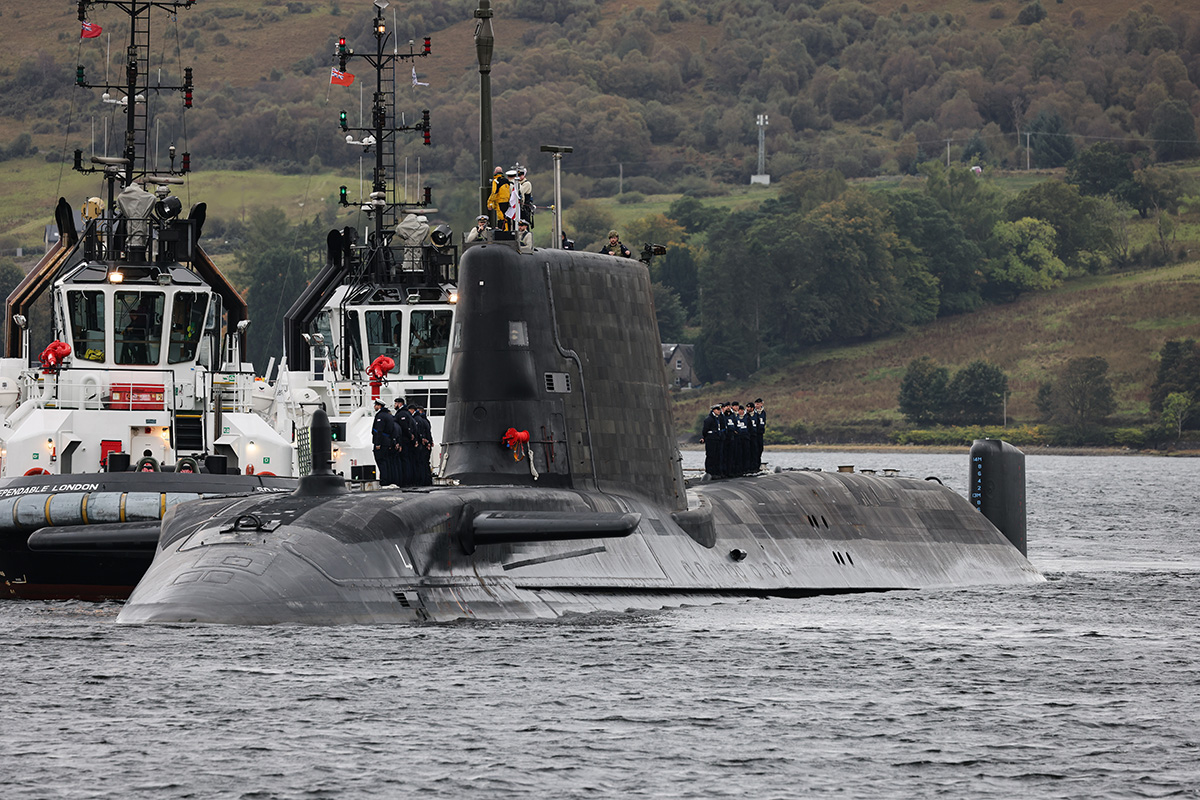
HMS Agamemnon, the sixth of the Royal Navy’s Astute-class hunter-killer submarines, has arrived at her home port of HM Naval Base Clyde for the first time, a week after sailing from the Barrow yard where she was built, according to the Royal Navy.
Members of the Submarine Flotilla lined up to greet her, alongside the Director Submarines, Rear Admiral Andy Perks, the Naval Base Commander Clyde, Commodore Andy Bray, and the Commander of the Submarine Flotilla, Commodore Ben Haskins.
Rear Admiral Perks said: “The arrival of HMS Agamemnon at HM Naval Base Clyde is a significant milestone for the Royal Navy. Her delivery reflects the dedication, skill and collaboration of thousands of people across our Defence Nuclear Enterprise, who have worked together to build one of the world’s most capable attack submarines and deliver a formidable warfighting capability for the United Kingdom.
“As she begins a demanding programme of sea trials and operational preparation, I am delighted to welcome the Submarine and her Ship’s Company to their new home on the Clyde, and I look forward to seeing them join the operational fleet in due course.”
The timing carried a certain weight for the Submarine Service, since the boat came alongside exactly 125 years to the day after the launch of Holland 1, the Royal Navy’s first submarine. Agamemnon left BAE Systems at Barrow on 25 September with around 100 submariners aboard, and the trials that began on passage will run on for weeks and months yet, testing her performance, manoeuvrability, speed and general seaworthiness.
Her commanding officer, Commander John Gabb, said: “It is an enormous privilege to be the first person to command this vessel at sea.
“We will get to know Agamemnon well over the coming months, but this submarine is incredibly quiet, has a world-class Sonar and will be home to us all as we generate for operations.”
The passage north included the boat’s first dive at sea, carried out in the Inner Hebrides Exercise Areas under the watchful eye of a Royal Navy Merlin helicopter. She had been submerged once before, in a trim dive at Devonshire Dock Hall in October 2025, when she went down some 15 metres without leaving the building.
Commander Gabb said of the dive: “The first dive for any submarine is a significant achievement in its generation. While this time we were being supported by a Merlin helicopter, it will not be long before we are conducting realistic pre-operational training using the same aircraft to simulate the enemy.
“Next time we will be pushing the crew and the submarine to its maximum potential to operate undetected.”
Agamemnon’s keel was laid in July 2013 and she was commissioned by the King on 22 September last year, which gives some sense of how long a modern nuclear boat takes to get from the first steel to the open sea. Astute, Ambush, Artful, Audacious and Anson are already in service, and the seventh and final boat of the class, HMS Achilles, is still under construction at Barrow after being renamed from Agincourt in January 2025.
Commodore Haskins said: “Welcoming HMS Agamemnon, the newest submarine of the Flotilla into her new home at HM Naval Base Clyde is a special moment for our Service. To get here the crew have conducted themselves with the professionalism and dedication that is expected from every one of our submariners.
“Today’s milestone marks the first step on a journey which will soon see this outstanding boat delivering high-tempo operations across the globe.”
The Royal Navy describes the Astutes as the largest, most advanced and most powerful attack submarines it has ever operated. They are the first class built without optical periscopes, using high-specification video technology to scan the horizon instead, and the service calls them the quietest submarines ever constructed, able to circumnavigate the globe submerged while making their own oxygen and drinking water.
Their armament runs to the Tomahawk land attack missile, which lets them strike targets hundreds of miles inland, and the Spearfish heavyweight torpedo, which the Royal Navy says can engage at up to 30 miles at low speed.



Atleast we can stop the clock on the next Astute going to sea.
Great boats that have been completely let down by two decades of government underfunding support resources. Hopefully we can turn a corner and get them back to sea soon.
Forty five years from start to finish. The study for what became Astute class was in 1986. tender for the first in 1994, Astute laid down in 2001 and Achilles is due to be at sea in 2031. Five different governments and ten prime ministers so far. Is it any wonder that the fleet has shrunk.
More than 30 years to build them and still not finished. I really hope they are sorting themselves out in bot the government ans Barrow.
I give it 18 months before its laid up in port somewhere and a lack of engineers and mariners keep it there like the other 5 or so, doing jack for the British taxpayer so as nice as it is to see, Britain still has a woeful record and no missiles to put in the tubes!