

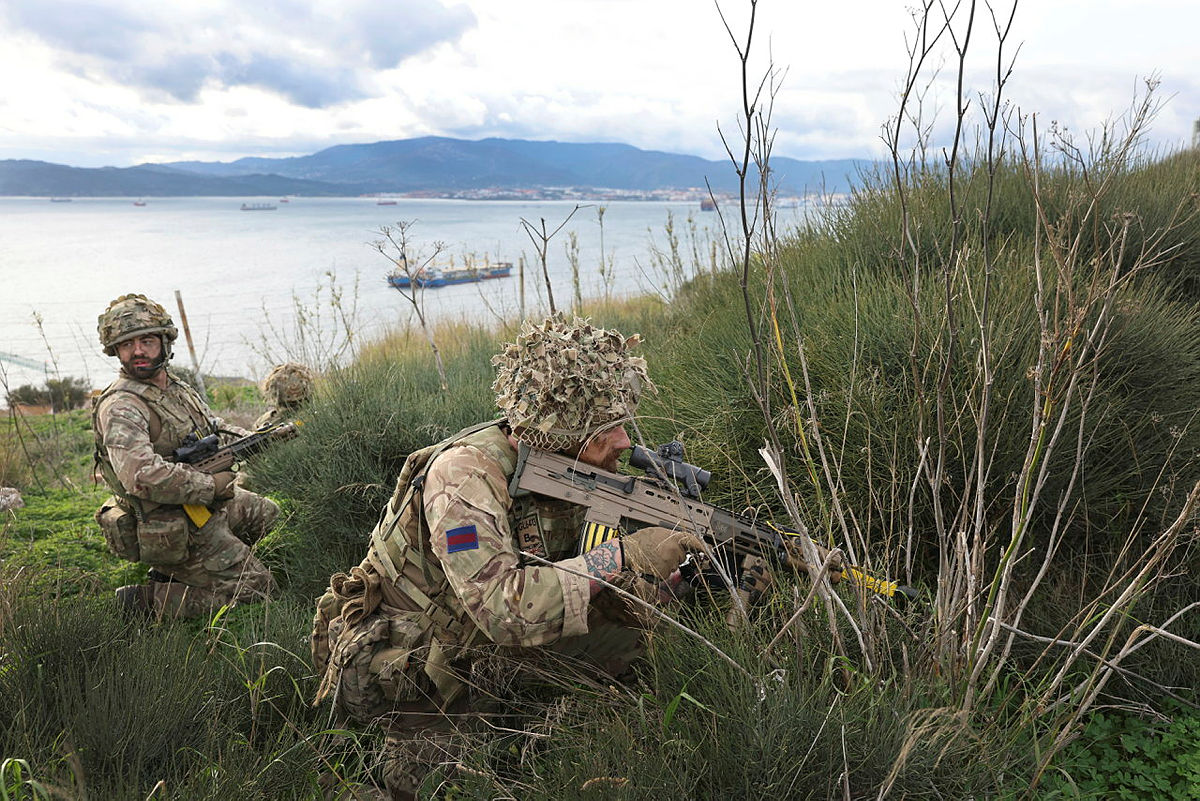
Applications to join the Army Reserve have reached their highest level in five years, but concerns remain over the number of candidates progressing into trained personnel.
In response to parliamentary questions, Defence Minister Louise Sandher-Jones said more than 5,000 applicants are currently in the recruitment pipeline.
However, she acknowledged that converting those applicants into fully trained reservists remains a challenge.
“Further work is required to strengthen the progression of applicants into trained Reservists,” she said, adding that improving this conversion rate is now a priority.
The recruitment process is managed by Capita, which continues to face scrutiny over its performance in delivering candidates through the pipeline.
The Ministry of Defence said it is in regular engagement with the company and the Army Reserve to identify improvements.
“All parties remain committed to identifying, agreeing, and implementing measures that will deliver sustained and measurable improvements across the Reserve recruiting pipeline,” Sandher-Jones said.
Additional changes are expected during the 2026–27 recruiting year, ahead of the planned introduction of the Armed Forces Recruiting Service in 2027–28, which is intended to overhaul the current system.







Thats odd, I thought Crapita had lost the contract.
Ayy due to how bad they had already done. So what’s happened?? Why have they regained the contract. I went through the process. And the capita process had no leeway one way or the other with common sense. It is a big reason why there is a lack of people getting through. Not that they are not suitable. I’d just left and had a military doctor put in my notes I was fit and ready for reserve service. They totally disregarded the military doctor. I had been a PTI so the sqn really wanted me. And instructor quals etc. but definitely not gonna go through that again while capita are involved. Absolutely horrendous.
I’m not surprised by this, I don’t think the British army will ever be disposed to train large numbers of reservists. It’s always seen it as an inconvenience.
We need something like the national guard.
British Army has never seen reserves as a being anything other than a diversion of resources or at best augmentation of the full timers.
This is something that they should be steamrollered on. Same with navy and RAF. Reserves can perfectly well crew ships like T31 on patrols with a core full time crew this should done in rotation.
Great idea in theory, in practice not so much. Unless there’s a national emergency you can’t compel reserves to deploy.
Things will have to change like they manage in Scandinavia.
They won’t and I wish people would stop citing Finland and Sweden, because they usually get them terribly wrong. They *also* can’t compel reserves to mobilize without a national emergency. Add to that the Swedes and Fins use their reserves in largely territorial defence roles, not expeditionary operational roles, and when it comes to their navies, their reserves do not man their combat ships, for example even the Visby’s with their small 43 crew complement, are manned by a combination of career sailors and conscripts doing their full time service, not reserves recalled to crew them.
That is not really true – I’ve lived in Sweden and my office had a nice view of Kockums Goliath!
Reserves have to do their periodic training call up – it is a part of their social contract. I’ve worked with several.
The system largely works as they get some very bright motivated types engaged.
We need to change the way reserves are viewed and have employers understand the enormous benefits of the training and leadership skills that service brings.
People can volunteer for a reserve service contract that means they have to do XYZ and the law has to be changed so that employers have to respect this and enable it. It is the employer obligations that need to be changed.
SB, with respect, you are confusing two very seperate things and seem unaware of the laws in the UK.
Training call ups are not the same thing as deploying mobilising or mobilising the reserves. In the UK we already have laws that require employers to give reservists time to complete their mandatory training. Training is not the issue (though funding to enable that training can be). The issue is *mobilisation*. It’s all well and good saying “Have a T31 with a reservist crew” but in practice that’s a T31 you can not use operationally unless a war breaks out. Because while you can do a week or two refresher training with a sub unit sized formation once a year, calling that sub unit, let alone unit, up for a six month deployment to Cyprus is a completely different thing.
Again, this is not something Finland or Sweden do. They maintain a trained reserve that can be activated in times of national emergency, chiefly for territorial defence missions. That reserve can not be activated on anything other than a volunteer basis to, for example, deploy to Cyprus in a quasi-not-really-war-but-national-interest-kind-of-thing.
And that’s the problem with the British Reserves, we have not been fighting wars (really since ww2 but Cold War planning does get an Asterisk) that have enabled the government to mobilise and deploy reserves, and so the individual volunteer augmentee is the system the army has fallen into.
Also re; “they get some very bright motivated types engaged.” So do the British Reserves, unit’s like the HAC 335 Medical Evacuation Regiment, the Staff Corps, 23 and 21 SAS have some incredilby motivated types in their ranks, with some pretty unique skills, and the wider reserves have a pretty big mix of society in them.
I think we are talking about the same thing but miscommunicating.
I am talking about having T31’s that are largely crewed by reservists and that can be fully activated in a time of war. I see nothing wrong with that concept.
The idea that we can ‘only’ have fully professional forces is for the birds. I would certainly have volunteered to crew a T31 type ship if that opportunity had been there – it wasn’t so I didn’t.
You think incorrectly, and I suggest re reading my post.
We don’t have “only” fully professional forces. We have reserves but the way they primarily function is by providing individual augmentee’s, because *AS I SAID*, and individual like yourself might be happy to volunteer to do a 9 month tour on a Type 31, you can’t compell an enitre ships crew to do so, outside of a national emergency like a peer on peer war. So a Type 31 that is crewed by reserves would effectively be useless in the kind of conflicts the UK finds itself in, and would be a lot of money put into an asset that never will be used. As it stands, if you where in the RNR *today* the only thing stopping you from volunteering to do a tour on a T-31 is the fact that a T-31 isn’t in service yet.
Instead the system of individual augmentee’s means that if a reservist *wants* to go on a deployment, they can put their hand up and fill a gap in the Orbat as needed. And as things stand, in the UK, the need for active ships and equipment for the Regular Army is so high that funding a ship for the RNR that will sit in port and cross it’s fingers that one day we’ll go to an all out war with Russia so it’s crew can be mobilised, is not something the RN needs (and the same broadly goes for the Army and the RAF).
I have to disagree and cite something that I do know about.
In ’82 lot of ships got crewed that didn’t have a full crew because all the people manning a desk and RNR put their hands up and said they wanted in.
I am not suggesting 9 months tours. Something like 3 months would be plenty to keep people up to standard. As crews are increasingly swapped with elements rotated this is perfectly possible for forward deployment as well as UK waters.
Okay so do you just want to admit to not bothering to read? Because both those points have already been covered multiple times SB.
“In ’82 lot of ships got crewed that didn’t have a full crew because all the people manning a desk and RNR put their hands up and said they wanted in.” Congratulations, you are describing individual augmentees. Nobody is saying this isn’t happening, it’s the system I am now describing for the thrid time. There is a difference between Reservist volunteers filling gaps in existing Orbats, and needing an entire Unit or Ships Crew to rock up. One is realistic and is the basis around which the armed forces currently employ reserves. The other isn’t unless you want an asset that is out of service outside of a Peer War where the government compels every reservist into service.
“Something like 3 months would be plenty to keep people up to standard.”
And again, you are now talking about training, which is protected by law for the Reserves in the UK, as I also explained several times, not Operational output. You don’t deploy people on Operations to “keep them up to standard” you keep people up to standard so that you can deploy them on operations.
Perhaps we need some culture change.
To quote from rhe book ‘London’s Navy.
“At Trafalgar about 22% of the crew of Nelson’s Victory were volunteers. In 1945, the R.N.V.R, boosted by the many wartime volunteers, was providing no less than 88% of all the commissioned officers then serving in the Royal Navy. At its peak, R.N.V.R. officers and men from ordinary seaman to Commodore, served in almost every ship and shore base, numbering 48,000 officers and 5,000 men.”
The armed forces have an obvious need for trained personnel, both regular and reserve, to carry out immediate tasking. But there’s also a need in time of conflict to rapidly increase those numbers with new trainees. The training of Ukrainian recruits shows how quickly and efficiently this can be achieved. Just a thought but would it be a bad thing if we had a large number of volunteers, untrained beyond an initial induction level, who had passed medicals and basic security checks and indicated a willingness to come forward at short notice?
In a world where the armed forces where swimming in cash, yes. That would be great.
But in the real world; there are other priorities. I’d say that revitalising the Regular/Strategic Reserve, which is several notches down the priority line already, would take precidence over such a system.
Remember that unlike Ukraine (and Finland, and Sweden, and Estonia, Latvia, Lithuania, and Poland) we don’t really have a need for Territorial Defence, so just mobilising basic light infantry without the equipment to motorise or mechanise them, isn’t that useful for us. Simo, Mikka and their mates can dig a trench across the road in Lappeenranta and provide value to the Finnish defence plan even though the Finnish Armed Forces haven’t given them any vehicles. John, Stew and their mates digging a trench in Milton Kenyes because the MoD doesn’t have the vehicles or logistics to move them to Poland provide a lot less value to the NATO defence plan.
I was thinking more that they would be useful as attrition replacements but I hear what you’re saying. If we stuck to the current sysytem, even if Vlad was marching across Europe, the bureacracy of enlistment would add months to the process of getting new recruits to the frontline. If that bureacracy could be sorted out in advance, even if the troops were barely trained beforehand, they could become available much sooner.
No I get that, and in a big war follow on forces will be needed eventually. But look at it like this: We currently can’t deploy all the Regular Army, because 4 Light Mech Brigade is lacking enablers and vehicles (lets assume 12 and 20 get their artillery back soon). So 4 Light Mech might just be attrition replacements to 12, 20, 7, and 16.
Then the Army Reserve gets called up. 12 and 20 already have 5 Reserve Battalions aligned to be attritional reserves, but 19 Light Brigade can’t deploy, so that entire force is attritional reserve, because it has no enablers and limited mobility (and really isn’t organised to be a fighting unit).
Then you have the Strategic and Regular Reserve, something that exists but has been starved of funding and not been exercised in years, but in theory still exists. It’s a pool of trained personnel, on the books, all with experience and would just need refresher training.
All three of those are pools of personel that exist, and require less training and time to get into fighting shape than the system you are proposing, but all of them are underfunded and, as stands, can’t be utilised to their fullest extend.
Adding a fourth echelon to the army and the abiliity to repalce looses only makes sense if there is enough money to fund the three existing ones to the point we are using them properly. Otherwise you are going to have the overhead of creating a new system, with a new admin branch and generating less combat power for the money you spend. (this is not even touching on equipping these people).
Hence the theory is good, but in practice the UK needs to be spending it’s money elsewhere and get what exists in order before running down it.
Not surprising, I joined but all we ever did was march and clean the guns, never fired one, never practiced any real type of manoeuvre just matched up and down and polished a gun we weren’t allowed to fire. I often joked that at least we could dazzle the invading Russians with our polished gun.