

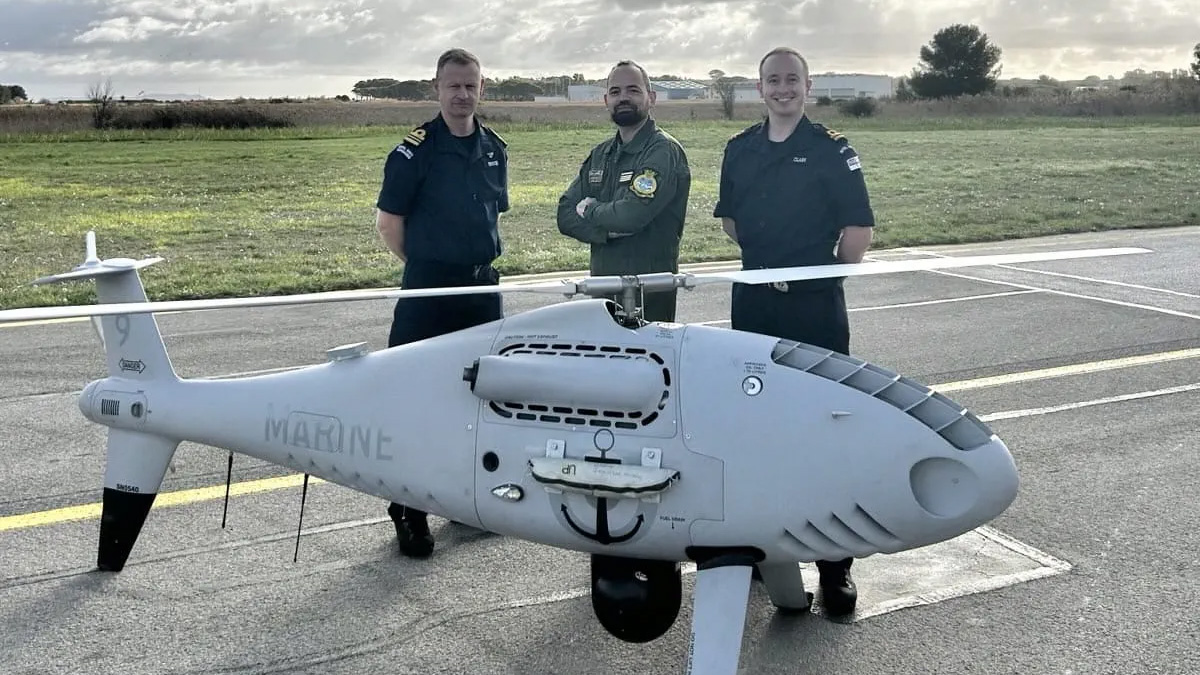
Royal Navy drone personnel have carried out joint training with their French counterparts in the Mediterranean, focused on sharing experience in the operation of uncrewed rotary-wing aircraft, the service stated.
The activity involved sailors from 700 Naval Air Squadron, who deployed with the Royal Navy’s Peregrine drone to the south of France for training at Base Aéronautique Navale d’Hyères. The location is the French Navy’s only air station on the Mediterranean coast and is shared with both Toulon’s international airport and specialist naval aviation units.
According to the Royal Navy, the training took place alongside personnel from the Marine Nationale and the Centre d’Expérimentations Pratiques de l’Aéronautique navale, the French Navy’s experimental test and evaluation squadron responsible for assessing new aviation systems and technologies. Peregrine is the Royal Navy’s variant of the civilian Schiebel S-100 Camcopter, adapted with additional equipment for frontline operations. The service said it is the first remotely piloted helicopter operated by the Royal Navy and is capable of sorties lasting up to five hours, operating beyond the visual horizon of its host ship or base.
The drone has been used operationally in the Gulf in recent years, where it has supported maritime security tasks by providing persistent surveillance of contacts of interest. The Royal Navy said this has reduced demands on crewed helicopters while lowering fuel use and operational costs. During the training period, the 700 Naval Air Squadron team exchanged operating practices with the French Navy, which also operates the S-100 system, primarily from its Mistral-class helicopter assault ships. According to the service, both navies employ the platform in broadly similar surveillance roles.
The Royal Navy said the favourable weather conditions at Hyères also enabled squadron personnel to renew their drone operator qualifications as part of the deployment.


Will a drone one day be able to do ASW duties? ie dipping sonar and carry a light wieght torpedo ?
yes the tech is available, but the platform will need to be substantially bigger than a S100, Proteus or VSR700
You are really mixing up the sizes there.
* S-100/Peregrine/AWHero/Skeldar V200 are MTOW class 200kg
* S-300/VSR700 are MTOW class 700kg
* Proteus/FireScoutC are MTOW class 3 tons.
I have no doubt that Proteus will have no issues carrying sonobuoys and the equipment to process the multistatic signals, dipping sonar or a couple of light torpedoes. It’s 15 times the weight class of the S-100, which couldn’t do ASW at all.
The question of whether the S-300 or VSR700 can undertake ASW work is more open. It looks like the Airbus machine is significantly underpowered compared to the newer Schiebel S-300.
I’d hazard that the S-300 could manage to drop a lightweight torpedo, but it would be marginal, so not just any lightweight torp. The same would be true of using dipping sonars; it would depend on which one. With care the S-300 could be useful in the ASW role, especially if used in multiples.
The VSR700 would only be able to use a marine radar and carry a few sonobuoys. However, that configuration has been proposed for ASW for the French Navy. It looks like a poor choice to me.
could be a good move, any ship could carry one, even small ships, be a big boast
Do we still have a single example?
Why are they not standard fit on every River B2, for example?
No money, no will..
Lancaster was carrying two around the Gulf, but I assume they will be reassigned. Like everything else, future orders will be held up by the DIP.
Good to see cooperation with France, lets hope this increases dramatically. Given the antics of the Orange Clown this past few months? The US is totally unpredictable and increasingly unreliable.