

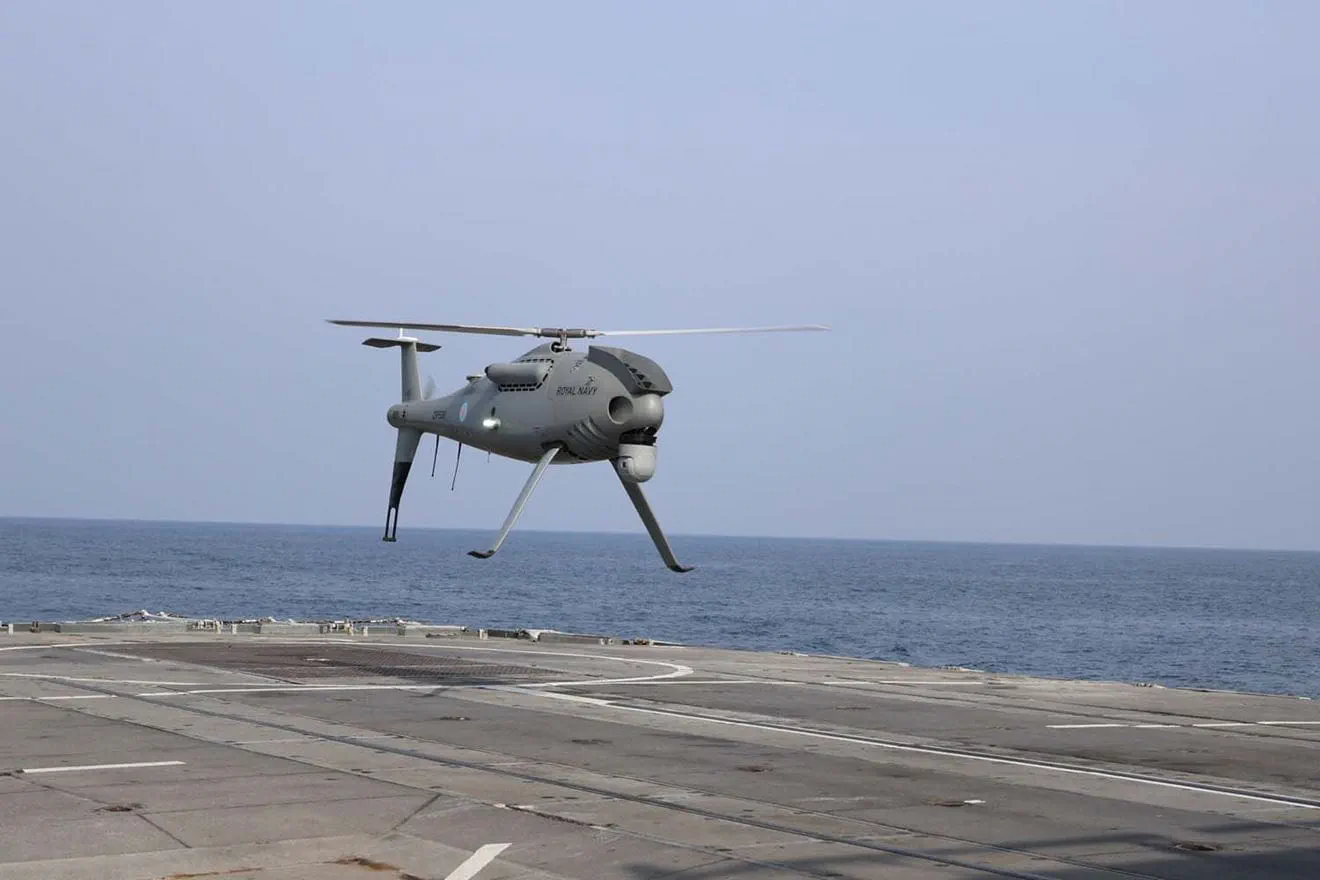
A Royal Navy drone operator has been recognised after rapid intervention prevented a £2.5 million unmanned helicopter from plunging into the sea during operations aboard HMS Lancaster, the Royal Navy stated.
Lieutenant Commander Adrian “AJ” Hill received an aircrew commendation, becoming the first drone pilot to be awarded a Fleet Air Arm “Green Endorsement”, described as the highest safety award within both the Fleet Air Arm and Royal Air Force.
The incident occurred at the end of a routine two-and-a-half-hour patrol in the Gulf of Oman, where HMS Lancaster was operating the Peregrine mini-helicopter surveillance drone to monitor for suspected drug trafficking activity.
According to the Royal Navy, the 10-foot unmanned aircraft was hovering in autonomous mode around 60 feet off the ship’s stern when it suffered a computer error and began descending rapidly toward the water. Lt Cdr Hill, a flight commander with 700X Naval Air Squadron, said the aircraft came close to impact. “It went very low. It was only about one to two feet from the sea. A quarter of a second later it would have touched – and if it’s in the sea then it’s ‘game over’,” he said.
Hill said he was able to take manual control quickly and recover the aircraft. “Almost out of the corner of my eye – I saw it suddenly descending,” he said. “It was only a few seconds from crashing into the sea. I had to take manual control – that’s pressing three buttons in the right order – and ‘full-up’ on the controls. After that I got it to a safe height, collected my thoughts, and manually put it on the deck. It was one of my best landings, as the adrenaline was pumping.”
The Navy said the only witnesses to the recovery were two engineers from the Culdrose-based drone squadron who were observing the landing. Hill said the incident was not entirely unexpected given the system’s development stage. “You can’t train for this type of emergency, but I knew what I needed to do. This was just reaction – and not panicking,” he said. “Peregrine was still in its testing phase while we were flying it from Lancaster so the fact we had some difficulties is not unusual.”
The citation stated that Hill demonstrated exceptional professional skill and that while the incident did not present a risk to life, it posed a significant risk to equipment and operational capability. The Peregrine is the Royal Navy designation for the 200-kilogram S-100 Camcopter developed by Schiebel, fitted with additional military sensors for operational use.




Oh deary me.
I’ll bet you avoid the self checkouts don’t you?
Ha, ha.
There will be these types of failures in the future but the only question is how much we can reduce the incidence of this happening with future technical developments.
That said, count me in as a skeptic on the viability of self-driving cars, at least in the UK with its already decent levels of road safety; other countries with poor safety records (e.g. China, USA) might well benefit from the adoption of autonomous vehicles.
Cheers.
I think I would actually feel safer on the roads if I knew other cars as well as the one I’m in were driven by robots and not ret*rds.
Well Waymo perhaps (we will see) but Tesla absolutely not, they are the most dangerous cars on US roads statistically mostly due to drivers over reliance on its compromised ‘self drive’ capabilities which are level 2 at best and has got it into serious trouble in California (with a ban threatened) with its shall we say “over ambitious” advertising. In Austin its initial low key robotaxi (years late as usual) ring fenced test debut there is still no evidence of operation without a safety driver present. One was spotted (a following Tesla was noted mind) but likely with remote safety driver (like Optimus interestingly) and Tesla subsequently announced driver free vehicles were on test, but even a prominent Tesla influencer has spent weeks hailing rides without as yet finding one. Perhaps unsurprisingly Tesla is now introducing subscription to use its present self drive capabilities and moving away from the long held promise that suddenly millions of his present road cars will suddenly have true self drive capabilities at the flick of an electronic Tesla switch. Fact is they are physically incapable of doing so safer than humans, lidar is presently vital to any semblance of safe operation as Waymo and others well understand.
So I wouldn’t be too confident anything remotely level 5 and provenly safer is going to be a common sight any time soon especially on complex road systems like London has. It will be modest testing for quite some time yet mostly with safety drivers of the sort already happening in London though little known, and as Waymo is proposing in some so far unspecified form.
Oh hello again.
Nice Cock Ring you have there. Does It make it purple ? you do like purple ? 🤦♂️
Keeping it original and laughing at your own jokes still I see.
Keeping up the Angry Purple Member act I see.
Cock Ring Suit’s you !
What is it now, 8 different names on here ?
Got to be at least 8 , that’s some serious trolling efforts I must say. 🥇
I honestly don’t think I have ever changed my name on here. Unless I mistyped but I don’t think so.
🤦♂️
RR, Considering the characters involved in the two most recent users of the ‘I don’t recollect….’ defence to direct accusations, it raises painful thoughts I would rather do without.. not that I am accusing you of anything other than unfortunate timing of course. 😂
Anyway, nothing I say is ever meant to be hostile. I just try to go against all the negativity. I’m really not trying to offend you.
Oh, lol, It’s such a shame you wrote that first comment in the way that you did then,
Never mind, carry on, It’s only Banter.
A Cock Ring ffs 😂😂😂🤦♂️
If that’s what you think it is then I’m not going to correct you. But yeah. if I have pissed you off then I apologise.
Ok a digital handshake it is then.. oh dear another unfortunate thought by association comes to mind. I need therapy. 🥸
I think the world needs therapy right now
I only charge £60 an hour and I’m very 👍
I charge £200 an hour and I subcontract to Jonathan (who is very 👍).
😆 I used to!
But my wife’s slowly training me up….
£2.5 million for a drone equipped with a camera.
How do I get me sum of that sweet sweet tax payer cash.
“you can’t train for this” and “The Adrenaline was pumping”. 😁
I will repeat what I said on another site, this is rather more concerning than the actual event might initially suggest where the focus is on the skill and awareness of the operator. This is a relatively small and mature and well understood drone that in terms of its physical operation is barely pushing real boundaries ignoring any payloads involved. I would have presumed certainly other than in very exceptional almost catastrophic circumstances a drone of this nature should revert to a stable hovering posture (if it’s physically capable of so doing as in this case) when something goes wrong, giving the operator time to take manual control in a controlled manner. It’s important to know why that did not happen surely, when we are told such vehicles and their control technologies are so sophisticated. In terms of its physical operation it’s not a prototype, it’s operational, or is there specific flight control technology peculiar to Peregrine that questions that assumption? If so that has larger direct implications for this platform obviously. It’s large enough to kill and injure personnel, indeed it has in its earlier manufacturer’s test days.
However, considering this, it’s beyond that that is the far greater concern. There are discussions about exploiting far more complex (in size, technological, performance and aerodynamic aspects) than the Peregrine represents, especially in terms of the carriers. Imagine such basic flight control problems occurring with these, fundamentally larger more complex platforms. Large prop and/or aerodynamically more complex tail sitters, especially with jet propulsion represent a whole new level of danger to ships and personnel if they go wrong and the pressures in a conflict environment add to the concerns. So at the very least raises questions about how quickly new greater performance platforms can be introduced I fear.
My little cheap “Temu Special” has all sorts of safety features built in, even this “Retard” can fly It without resorting to “Pilot shit” heroics 😅
I remember back in 2010 when I first encountered those tiny indoor quad copters at an RC company I worked for and I was mesmerised by them. Traditional Model helicopters had always been the most difficult scale models to fly safely. Things have come a long way since I have to say, though not necessarily the occasional electronic digital desire for no apparent reason to take a dump in the sea/ground. Can’t get the image of the Shield jet powered tail sitter chasing the crew around the flight deck of HMS Queen Elizabeth to the accompanyment of the Benny Hill music. But then there is the more serious connotations to consider.
Did check and there have been a few failures of loss of control over the years since an early one killed an engineer, but both similar loss of control I found were through engine fault or engine control problems, this sounds rather different. Would be interesting to know if such flight issues have indeed occurred before certainly now a mature platform (must have done over the years even if the UAV wasn’t lost) and what caused them. Difficult to assess much on one incident just that it has greater implications.
It would cost a bit more, but duplex or triplex flight control computers would be the way to go. I just assumed for this sort of craft they would have thought of that.
I mean, how hard can it be to fly these things… I’m not going to pretend I wouldn’t want a bit of instruction, but this guy didn’t recover a helicopter with an engine failure and was flying on minimal power, it was the UAV that decided, I’m not holding on anymore, you have to control me more…
NGL, if we’re treating this as a static camera holding a fixed altitude above the ship… Why don’t we get those blimps that stay in the air no matter what and all we have to do is keep the cable (Plus a backup and a backups backup cable) that can be sent up for very long endurances and able to scan the ocean from above?
Because youre now adding a massive radar target right above the ship, and telling everyone where said ship is.
I think the massive flat side of a hull not designed for Stealth is already screaming where you are… And if you want to address the threat, have a longer cable, tow it a couple hundred meters away from you.
Put a surface radar on it if you want to have a higher perch for scanning around you.
Clearly you don’t know about the radar reduction features of modern warships then.
And what about when the ship needs it sprint, the hell do they do with this ridiculous balloon.
My guy, for most operations at the moment, it’s a clear winner to a £2.5 million RC Copter that can’t even maintain a command to stay in the sky.
There’s a time and place for it and frankly, if you’re working counter drug trafficking ops, then unless those drug runners be packing a method to harm a Frigate, they’re unlikely to be seeing anything in the sky and rely more on not being visually detected as suspicious.
And yet no one is interested in your spectacular plan
Well, you are, commenting again and again.
Enjoy pointing out the blatantly ridiculous
Enjoy being whatever clown you are.
Radar horizon.. a ship is hidden from another ship at about 20 miles.. they cannot find each other.. you float a great big radar blimp 1000feet above it.. you have lost the cover of the radar horizon.. the ocean is not flat
This reads like the back cover of a Tom Clancy novel. Autonomous system glitches, human intervenes just in time, expensive kit doesn’t end up at the bottom of the ocean. The suspense was almost too much… Casting thoughts for the inevitable film, Peregrine Down, Three Buttons to Safety, Manual Override or Two Feet to Splash?
Or “Line of sight” and “Command and control ” ?
Drone Down (Under? for the Aussie version?)
We need “Airborne”,
No way, I open my mouth and the throbber squad pile in!!!!!! But……..
Aww c’mon, what’s the worst that could happen?
They bore me to sleep desperate to get the last sad word in!!!! 🤣👍
£2.5million for a drone??? That is totally outrageous, as well as totally unacceptable! More gold plated OTT hardware, that some complete lamebrain civil servant agreed to pay for.
No wonder the UK armed forces are desperately short on money!
You realise this isn’t some quad copter right? It’s got optics on it, it’s got a combustion engine compared to some dinky battery drone and can fire laser guided missiles,
So?